
Posted by:
Admin
Date:
July 2, 2026
Category:
blogs
How Management Reports Improve Business Decisions
What sets apart rapidly expanding firms from slow ones? It’s not ideas but rather it’s speed of making decisions.
In today’s busy market, relying on old Excel files is not enough anymore. Costs can go up quickly, clients can alter their minds and competitors can get ahead before a business becomes aware. This is the reason management reporting for businesses is so vital.
A business management report is a tool that collects, checks and shows a company’s financial picture. It also presents the firm’s operational performance in a clear and structured way. It helps managers see what is going on in daily business operations. For example, a report can show falling sales, growing costs or shifts in user attitudes before they become serious problems.
However, many firms still make key choices without all the data available. A 2026 UK study found that 71% of highly valued business decisions are made with limited or imperfect data.
Full reporting helps managers detect trends, avoid risks and keep staff working together. On the other hand, false reports can cause missed chances, slower actions and costly errors.
The importance of management reporting is far more than just figures. It gives business leaders clear facts so they can act faster and wiser.
In this blog, you will learn how management reports make better business decisions. You will know how these reports help with planning, tracking performance and promoting ongoing growth.
Key Takeaways
- Management reporting for businesses gives leaders clear and up-to-date data, helping them make better decisions based on facts rather than guesswork
- The importance of management reporting lies in its ability to track performance, spot risks early, and help businesses respond quickly to change
- A business management report should include key financial data, KPIs, cash flow information, and performance trends to support day-to-day and long-term decisions
- An effective business management report is clear, accurate, easy to read, and focused on the measures that matter most to business goals
- Business reporting and performance management work together to improve planning, strengthen accountability, align teams, and support steady business growth
What Is Management Reporting for Businesses?
Management reporting for businesses is the way of recording, analysing and showing business data to help managers make better choices. It gives leaders helpful data about money, sales, work, clients, staff, projects and how the entire business is doing.
It’s different from regular financial reports. Financial reports are usually made for people not linked with the business, like banks, investors or tax offices. They mostly focus on what took place in the past and follow strict rules.
On the other hand, management reports are for staff within the business. They are more flexible, practical and reveal what leaders need to know right now.
For example, a financial report might just state a yearly profit and loss. However, a management report can explain why profits changed, which prices are going up and which products are selling best.
These reports also show which clients are buying less and what steps should be taken next. This makes management reporting for businesses very helpful for routine decisions and future strategy.
Related: The impact of AI on financial reporting
To supply data is not enough. The data have to be integrated with strategy; they have to test a company’s assumptions, and they must challenge a company’s current outlook.
Peter Drucker, Management Consultant and Author
The Value of Management Reporting
The core mission of management reporting for businesses is to help managers make smarter decisions. It gives clear and organised data so decisions are based on facts, not opinions.
It also helps every person in the company see the complete picture. The managers can monitor how each branch is doing and sales teams can track all the money coming in.
Besides this, finance teams can watch cash flow and task teams can see how effective things are. Senior leaders also get the full view without waiting for updates from different people.
All this points out the importance of management reporting. When each person runs from the same trusted data, there’s less doubt, less repeated work and teams can work together better.
How Reports Make Things Clear
Management reporting for businesses makes complex data easy to grasp. It breaks down big sets of numbers into simple charts, dashboards and crucial messages.
Leaders usually don’t have time to look over hundreds of Excel rows. They need the main facts, trends and planned actions.
Clear reports assist in answering key questions rapidly:
- Are sales going up?
- Are prices under control?
- Is cash flow correct?
- Are clients coming back?
- Are projects on time?
- Are teams meeting their aims?
Proper reports remove the extra clutter and focus only on the data that matters. This helps leaders make quicker, more reliable decisions.
How Does Management Reporting for Businesses Improve Decisions?
Without reports, leaders might waste time guessing but with reports, they can fix the flaw quickly.
If sales go down suddenly, a report can show whether it’s a problem with an item, a region, a client group or pricing.
Management reporting for businesses also helps mostly by conducting trend analysis. One statistic alone does not tell the overall story. Monthly income is more valuable when compared to last month, last year, the financial plan or the forecast.
Learn more: Business strategies
1. Live Insights for Faster Decisions
Reports that are updated often let firms act quickly. If costs rise, stock runs low, sales slow or cash flow declines, leaders can respond before it becomes a big concern. This includes:
- A retail store can order extra popular products sooner
- A service company can check rising project costs before losing profit
- A marketing campaign can get cost changes before wasting money
This is one of the most helpful perks of management reporting for businesses. In a crowded market, it helps managers to work more quickly.
2. Trend Analysis for Better Planning
Trend analysis reveals how things alter over time. A single report shows what was done this month, while a trend shows if the company is moving in the right direction.
For example, revenue may go up but profit margins drop. That could mean larger discounts or rising delivery pricing. Without trend analysis, leaders might think all is fine but with trends, they can see unseen risks.
This points out how the importance of management reporting goes beyond daily audits. It helps leaders figure out norms, causes and future direction.
3. Improved Forecasting and Prediction
Management reporting for businesses also helps plan for the future. Leaders are able to predict future events by using data from the past and present. It includes:
- Reports can help forecast sales, cash flow, worker needs, stock, project costs and profit
- Leaders can prepare for issues instead of taking action too late
For example, seasonal based sales trends help organise stock and staff. Cash flow reports can show a shortfall next quarter, so leaders can delay expenses, gather payments or arrange funding early.
Quick Insight!
Businesses that review management reports regularly can spot problems earlier, react faster to market changes, and make decisions based on facts rather than assumptions.
What Makes Management Reporting for Businesses Effective?
Management reporting for businesses is only useful when reports are clear, correct and focused on what is most vital.
A long report with too many data points can make decisions difficult. On the other hand, a short report with the proper details can help managers make decisions quicker.
Effective reporting begins with business aims. Reports should keep track of the tasks that are most important to the company.
For example:
- If a company wants to develop, reports may track sales, new customers, repeat clients and market results
- If a business wants to lower costs, reports may track expenses, profits, productivity and waste
A business management report is also expected to be easy to read. Leaders should be able to pick up the main idea quickly. Also, they should not have to search through complex tables or tough words.
1. Importance of Key Performance Indicators (KPIs)
The importance of management reporting becomes obvious when firms use KPIs.
KPIs are values that show if a company is moving toward its goals. They help break down major goals into results that can be assessed.
Some common KPIs include the following:
- Sales increase
- Profit levels
- Client loyalty
- Staff performance
- Inventory movement
- Cash flow
- Project success
The best KPIs rely on the type of business and its targets. Management reporting for businesses works well when the right KPIs are selected.
Having too many KPIs can mislead people and too few can hide important issues. The aim is to monitor the numbers that have the highest effect on success.
2. Role of Visuals in Reporting
Images and charts make reports simpler to understand. Charts, diagrams, graphs and rating sheets help leaders view data quickly.
They also make it easier to compare:
- Various dept
- Different time periods
- Products
- Client groups
For example, a line chart can represent a sales trend much better than a table full of figures. A graph can utilise red, amber, and green markers to show which areas must grab focus.
Effective images are not just for visual appeal. They also help people grasp facts faster. This is very useful when leaders need to make quick decisions.
3. Data Accuracy and Consistency
Correct facts are essential. If the data is inaccurate, the decision may be wrong too.
Lack of reliable data can lead to concerns such as the following:
- Buying too much stock
- Missing key costs
- Producing unrealistic budgets
- Neglecting serious risks
Management reporting for businesses depends on reliable and uniform data. Firms should use reliable data providers and check their figures regularly.
Everyone should know how numbers are obtained and where the data comes from. For example, if the sales team and finance team determine revenue in different ways, their reports may not align.
This can create doubt and lower trust. When everyone uses the same rules and the same details, teams can make decisions with certainty.
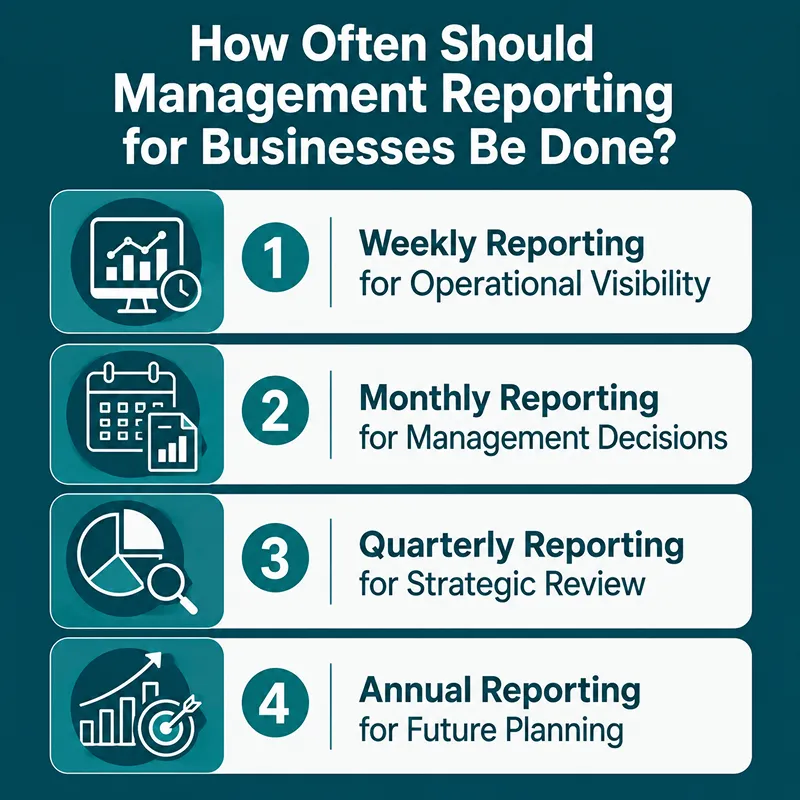
How Often Should Management Reporting for Businesses Be Done?
Management reporting for businesses performs best when it happens consistently. The schedule should align with how often leaders need data to make decisions.
Reports provide timely data so managers can see risks early, detect opportunities and act fast. There’s no standard plan but most firms use a blend of weekly, monthly, quarterly and annual reports.
1. Weekly Reporting for Operational Visibility
Weekly reports reveal temporary performance. They monitor sales, cash flow, project growth and client service. Weekly alerts help managers identify issues early and fix them before they progress.
2. Monthly Reporting for Management Decisions
Monthly reporting is widely used in management reporting for businesses. A monthly business management report offers a detailed view of finances and operations. For example, they show revenue, costs, profits, cash flow and KPIs.
Monthly reports help admins see trends and make accurate decisions. They also keep staff on track and assist with staff meetings.
3. Quarterly Reporting for Strategic Review
The aim of quarterly reports is short-term success. They look for updates on annual targets, plans, market trends and company goals.
These reports aid managers in detecting deeper trends that weekly or monthly reports might ignore.
4. Annual Reporting for Future Planning
Annual management reporting presents the big picture across the entire year. It helps assess tactics, resources and overall performance.
Annual reports lead to future budgets and plans and point out lessons learned and areas to upgrade.
Best Practice!
Focus on a small number of meaningful KPIs rather than tracking everything. Clear, consistent reports are usually more useful than large reports filled with data that does not support decisions.
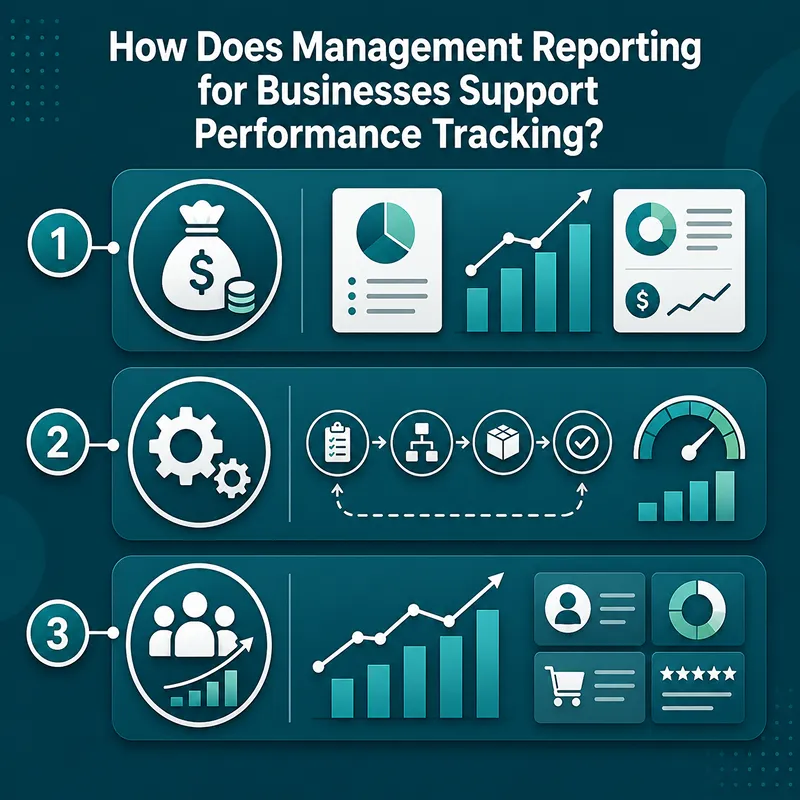
How Does Management Reporting for Businesses Support Performance Tracking?
Management reporting for businesses helps managers observe how well the company is doing. It tracks finance, operations, sales, customers and staff. Therefore, this gives a clear, ongoing view of growth.
Performance analysis matters because minor problems can develop. A little rise in costs, a slight delay in client payments, or a small drop in sales may look harmless. However, if these trends stay the same, they can damage profit and cash flow.
Regular updates work like an initial warning system. They help leaders detect problems early and fix them before they get more serious.
1. Monitoring Financial Health
Money is most important for any business. Reports keep track of revenue, costs, profit, cash flow, debt and available capital.
A company might show a profit on documents but still be having trouble with cash. It might have high sales but small profit margins. A business management report that focuses on finance shows these issues clearly.
This helps leaders control spending, maintain healthy cash flow and organise investments.
2. Tracking Operational Efficiency
Operational reports reveal how well assets are used. They track worker efficiency, project growth, delivery times, stock movement, service quality and staff performance.
This makes it possible to find waste and obstacles that slow down business operations. For example, if a report indicates that one process is slow, managers can check the reason for it. It could be staffing, lack of training, system issues or supplier lags.
More effective tasks lower costs and improve customer experience.
3. Reviewing Sales and Customer Performance
Sales and customer reports point out what brings in cash. They tell us which products sell most effectively and which channels work well. This also informs us which customers are most profitable and where leads are discarded.
This helps managers enhance marketing and sales. For example:
- If repeat clients make more profit than new customers, focus on keeping them
- If a product sells effectively but has low profit, check pricing or costs
Management reporting for businesses allows teams to focus on actions that really add value.
How Does Management Reporting for Businesses Improve Planning?
Management reporting for businesses helps firms make more viable tactics for the future. Without reporting, companies may create cost plans and forecasts based on assumptions.
With proper reporting, firms can prepare for growth and manage spending more effectively. This also keeps cash under control and helps them act faster when market conditions change.
1. Budget Planning and Control
Budgeting becomes much easier when a company often audits reports that compare planned results with real results. This contrast helps leaders decide whether the business is running as planned.
If costs are higher than planned, they can quickly find the reason and take action. If earnings are less than desired, they can adjust their method, improve sales efforts or review their goals.
If one department is spending less than its budget, then those assets may be used in other areas of the business.
This process helps firms stay profitable, organised and avoid unpredictable scenarios. Instead of waiting until the end of the year to find issues, leaders can deal with them as they arise.
2. Cash Flow Forecasting
Cash flow analysis helps firms know when money is expected to come in and when it will be required to go out. This is key because a company can be effective and still face issues.
Admin reports can show expected client bills, supplier receipts, staff salaries, loan due dates and tax payments. With this data, leaders can plan and make sure there is enough cash to cover crucial costs.
The importance of management reporting is especially obvious when dealing with cash flow. This is because minor issues are much easier to resolve when they are detected early.
3. Scenario Analysis for Future Readiness
Situation analysis helps firms prepare for different scenarios that may arise in the future. Instead of planning for only one goal, leaders can assess several options and know how each one could affect the business.
For example, they might be looking at what could develop if sales fall, costs go up or a major customer leaves. They might also analyse if demand is rising faster than expected.
Management reports give the data to be able to test these different instances. This gives leaders more confidence because they can prepare for change before it happens. This also makes decisions with a clearer view of the risks and chances ahead.
How Does Management Reporting for Businesses Improve Accountability?
Management reporting for businesses helps all parties know how well they are doing. When people can clearly view their aims, results and progress, it becomes easier to take charge for their work.
Quality reporting is not about judging people for errors. It is about helping team members learn, improve and make better choices.
Reports help make sure decisions are properly put through. When actions, duties and due dates are noted, people are more likely to finish the work that has been decided.
1. Department Level Duty
Department level reports help each team stay focused on its own goals. The finance team can keep track of budgets and costs. The sales team can monitor earnings and sales progress.
Service teams can assess efficiency, while customer service teams can track customer feedback and response times.
This gives teams a greater feeling of ownership. Instead of waiting for the top leaders to point out flaws, they can see their own results and take action more quickly.
The importance of management reporting becomes clear when teams can spot issues early. Also, when they make fixes before small errors become serious ones.
2. Shared Visibility Across Teams
Shared reports assist many teams in working together smoothly. When every person uses the same data, there is less error and fewer disputes about the business.
For example, sales, finance and operations teams may all need to figure out customer needs. If the sales team expects greater demand but the office team is not prepared, delays and issues can erupt. Shared reports help everyone stay updated and plan with one another.
This is why management reporting for businesses supports not only improved decisions but also deeper unity and regular interaction.
3. Action Tracking and Follow Up
Reports should perform better than simply show basic data. They should help people take the right steps.
Effective reporting keeps details of earlier decisions, accepted actions and progress towards targets. This enables leaders to figure out whether effective strategies are being carried out. This also allows them to know whether those actions are giving rise to the expected results.
If something is not working properly, changes can be made ASAP. This keeps the company moving in the correct path.
A business management report that consists of action analysis becomes much more than a record of past success. It becomes a useful tool that helps teams stay organised, reliable and loyal to meeting business goals.
Case Study: Lights4fun Using Data to Make Smarter Decisions
Lights4fun is a UK digital shop selling art deco lights for homes and gardens. It was set up in 2003 and now earns over £30 million annually. It serves clients all over the UK, Europe and the US.
As the business grew, it needed better ways to organise data, enhance reporting and support success goals.
The Challenge
Data was split across various systems and Excel sheets. Reports took several hours to develop and were usually outdated. Customer records were scattered, making it hard to get a full picture.
A 2026 UK study found that 71% of valuable business decisions are made with incomplete or partial data. This shows why better reporting was needed.
The Solution
With the data refinery, Lights4fun created a reliable basis. Data related to operations, sales and marketing was unified and routinely revised.
Perks included:
- Saving 10 hours a week on written reports
- A unified detail of every client
- A graph showing live performance for all teams
- Quicker decisions on predicting, marketing and product planning
The Results
After applying the strategies, the following result was achieved:
- Obtained insight goals 12–18 months ahead of plan
- One data scientist could deliver work similar to a full analytics team’s
- Teams accessed correct data 24/7, improving accountability
- Promptly reacted to market changes, defending both sales and margins
Key Takeaway
Lights4fun shows the importance of management reporting. A reliable business management report system can save time, reduce errors and help leaders make faster, smarter decisions.
Final Thoughts
Management reporting for businesses is not an option but rather its crucial for running a successful company. Clear and reliable reports help managers make better choices, track performance, forecast what might take place and stay accountable.
Sterling Cooper understands that organised, relevant and useful business management reports give teams the resources they need to work smarter.
Management reporting for businesses brings clarity, oversight and confidence. To boost your business decisions and grow with confidence, contact us today to learn how reliable reporting systems can help.
Struggling to turn business data into confident decisions?
Our team helps you create clear management reports that improve planning, performance, and profitability.
We have helped businesses gain better financial visibility and make data-driven decisions with reliable reporting.
Reach us today.
FAQs
An effective business management report provides clear, accurate, and relevant information that supports decision-making. It should focus on key performance indicators (KPIs), financial results, operational performance, and future risks rather than overwhelming readers with unnecessary data.
Business reporting and performance management help organisations track progress against goals, monitor performance trends, and identify areas that need improvement. By using timely and reliable data, businesses can make informed decisions, improve efficiency, manage resources more effectively, and support long-term growth.
GAAP reporting and management reporting are used for different purposes. GAAP (Generally Accepted Accounting Principles) reporting is a formal system used for external stakeholders like investors, banks, and regulators. It follows strict rules and is usually historical, meaning it shows what has already happened in the business.
Management reporting, on the other hand, is used inside the business. It is flexible and focuses on current performance and future planning. It helps managers and leaders make decisions by showing real-time data, trends, and forecasts rather than just past results.
To write a business management report, start by deciding its purpose and who will read it. Then choose the most important KPIs that match your business goals. Collect accurate and up-to-date data from reliable sources.
Next, organise the information in a clear structure with sections like performance summary, financial results, and key insights. Use simple language and visuals like charts where helpful. End the report with clear conclusions and actions that support decision-making.
Business management reports come in several types depending on what needs to be tracked. Common types include financial performance reports, which show profit, loss, and cash flow. Sales and revenue reports track income trends and customer performance.
Operational reports focus on efficiency, productivity, and processes. KPI dashboards give a quick overview of key metrics. There are also budget vs actual reports, which compare planned figures with real results to help control spending and improve planning.
Recent Posts

How to Build a Cash Reserve for Business Stability
August 11, 2026

How to Forecast Cash Flow During Economic Uncertainty
August 6, 2026