
Posted by:
Admin
Date:
May 19, 2026
Category:
blogs
The Impact of AI on Financial Reporting and Auditing
What if your financial reports could be faster, smarter and more accurate without putting extra pressure on your finance team?
Financial reporting and auditing are the basis of business growth because money decisions need your trust. Investors can face problems and may lose trust if your reports are late or inaccurate or even when they are hard to understand.
Today, efficient and smart businesses use AI tools. Their finance teams and audit firms use AI to perform daily tasks. It helps them plan better.
AI tools help companies to:
- Make reports faster
- Check data better
- Find risks early
- Understand numbers more clearly
Research shows that around 15% of UK businesses were planning to adopt AI within the next three months as per data collected in Dec, 2025. This suggests how quickly AI demand continues to grow.
AI is not just a technology. It has become a helping hand for your business and your financial decisions as well. AI is changing financial reporting and auditing in a way that leads you to a bright future. It is all about faster work, fewer mistakes and smarter decisions.
Artificial intelligence is not a substitute for human intelligence; it is a tool to amplify human creativity and ingenuity.
– Fei-Fei Li, Sequoia Capital Professor, Stanford University
Key Takeaways
- AI in financial reporting is improving financial reporting by reducing manual work, lowering errors and giving faster real-time insights for better decisions
- Financial audits are becoming stronger with AI in auditing through fraud detection, anomaly alerts and continuous monitoring of transactions
- Natural Language Processing supports AI in financial reporting by turning complex financial data into clear summaries, dashboards and investor-friendly reports
- Businesses using AI in financial reporting for forecasting, budgeting and risk checks can react faster to market changes and protect profits
- Human judgement still matters in AI and auditing as AI should support finance teams, while people handle ethics, strategy and final decisions
- Strong data quality, privacy controls and clear governance are essential for successful and trusted AI in auditing and finance adoption
- The best way to start with AI in financial reporting is one small use case, measure results, then scale gradually across finance operations
What Is Financial Reporting
Financial reporting means using reports to show how a business is doing with money. It helps people understand the business clearly, such as:
- Owners
- Investors
- Lenders
- Tax authorities
- Managers
Why Financial Reporting Matters
Financial reporting matters because it involves producing key reports, such as:
- The balance sheet
- Income statement
- Cash flow statement
Notes to accounts help explain the numbers in more detail. Some companies also add generative AI in financial reporting like MD&A (Management Discussion and Analysis) to explain results, risks and future plans.
If reports are not clear, people do guesswork. This leads to making wrong decisions and you may lose clients’ trust.
What Is Auditing
Auditing means checking if financial reports are fair, correct and properly prepared. It helps confirm that the numbers shown in the reports are reliable and can be trusted by business owners, investors, lenders and regulators.
Why It Matters
It matters because auditors make sure the numbers can be trusted with the help of auditing. They review:
- Records
- Systems
- Controls
- Evidence
Before AI in auditing, audits often needed manual checks, spreadsheets, sample testing
and long working hours. This took time and could still miss hidden mistakes. Now, AI and auditing work together.
Why AI Is Becoming Important In Finance
The following points explain why AI in financial reporting is becoming important:
Why Boards and Leaders Care About AI in Financial Reporting
Boards and leaders now see AI in financial reporting not just as an extra option but as an important business tool. Studies suggest that all surveyed boards had already taken the next step with AI.
AI in financial reporting becomes more successful when company boards support it because they can provide funding, clear rules and long term planning.
When leaders know how to use AI in financial reporting in the right way, AI projects are more likely to succeed.
1. Regional Adoption of AI in Financial Reporting
Each region is moving at its own speed but AI is clearly becoming important in finance everywhere.
The use of AI in financial reporting is growing around the world, such as:
- North America is moving the fastest because many businesses there have bigger technology budgets and adopt new tools early
- Europe is also moving forward, with more focus on rules, governance and data quality
- Asia Pacific is growing quickly too, as more businesses update their finance systems
2. Industry Trends in AI in Financial Reporting
AI in financial reporting is growing in many industries but not all sectors are moving at the same speed, such as:
Telecom and technology companies
Telecom and technology companies are leading because they already use a lot of AI data and digital systems.
Energy and natural resources companies
Energy and natural resources companies are also using AI to improve forecasts, control costs and check risks.
Manufacturing businesses
Manufacturing businesses use AI to connect finance with supply chain planning.
Retail and consumer businesses
Retail and consumer businesses are not efficient enough. They have older systems and tighter budgets due to which they are not as smart.
How AI Is Changing Financial Reporting
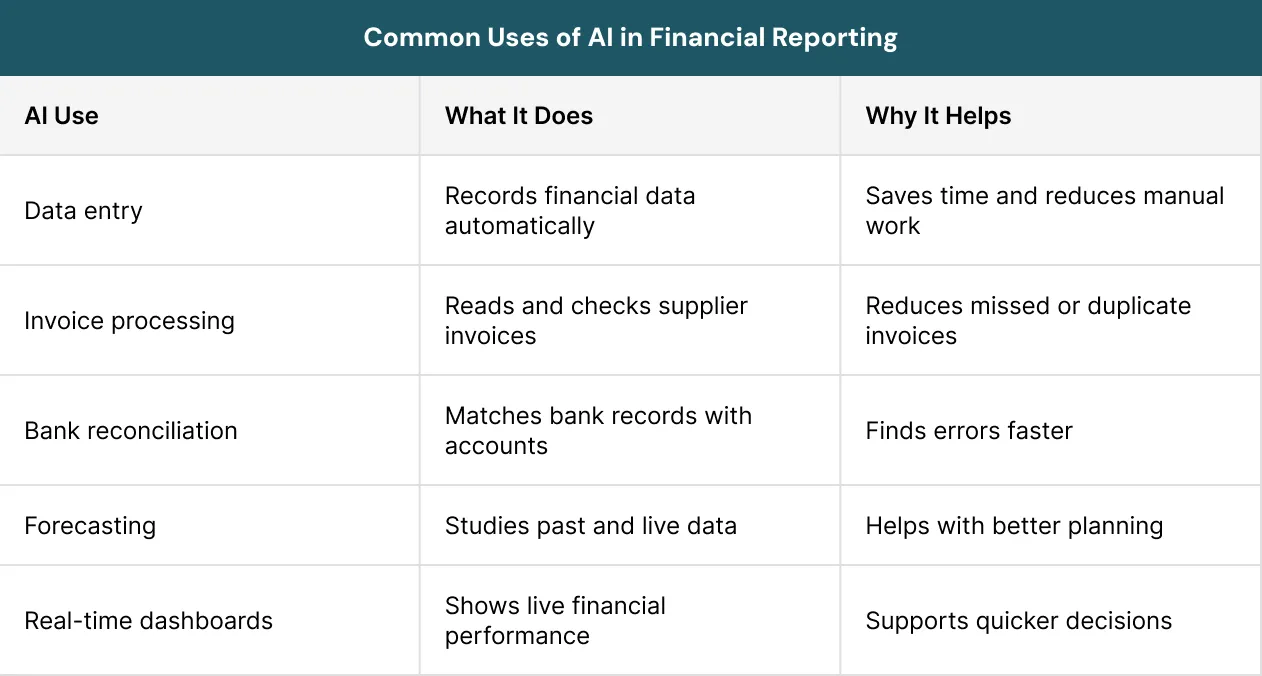
Finance teams take help from AI in daily tasks. One main use is automation, it can handle repeated work much faster like:
- Data entry
- Invoice processing
- Expense approvals
- Financial reconciliations
Workers can save around 45 to 60 minutes each day by using AI in financial reporting. It can process transactions as they happen. This is why finance teams do not need to wait until month end to understand business performance.
1. Better Accuracy and Fewer Errors
Manual work can lead to mistakes. These are typing errors, missed invoices, duplicate entries and wrong spreadsheet formulas.
Key Benefit:
AI helps businesses find mistakes early and make faster decisions.
AI tools can help reduce these mistakes. They can quickly check records, confirm data and flag unusual entries.
2. Real Time Reporting Gives Better Control
In old reporting numbers were usually checked after the month or period ended. A problem could be noticed too late if it happened early in the month.
AI helps to track different activities earlier, such as sales and profit trends, cash flow and costs.
AI in financial reporting changes finance from fixing problems late to managing them early. For example, leaders can control it quickly if spending rises. They can also respond sooner if sales drop.
3. Continuous Close Is Changing Reporting
Traditional reporting often finalises numbers at the end of the month or the quarter. This can delay important decisions and affects control over finances.
AI in financial reporting helps companies move towards a continuous close process. This means transactions are checked and updated during the period, not only at the end. It also helps to find errors earlier.
4. AI and Forecasting
Many finance teams find forecasting hard due to quick market change. Old methods may use limited data and take more time to update. AI can study past records, market trends, customer demand, costs and outside economic signals.
This helps create better forecasts that can support revenue planning, budgeting, staffing and stock decisions.
Many companies may move from slow forecasting methods to AI supported forecasting in the future.
5. NLP Is Changing Written Financial Reports
NLP is one of the most useful AI tools in financial reports. It helps AI read and write human language. In finance, it can write short summaries. It can also read invoices, contracts, receipts, bank statements and notes.
6. AI Makes Data Easier to Understand in Financial Reporting
Many readers find financial reports hard to understand because of long tables and difficult terms. AI helps them by changing raw data into dashboards, charts and short explanations.
AI makes reports easier for managers, investors and staff to read. This also helps them make better decisions.
AI Improves Investor Communication
Investors prefer the reports which are clear, quick and easy to understand. This makes the communication clear and easy and gains you customer trust and confidence.
AI helps by turning complex financial data into simple summaries, dashboards and charts.
Natural Language Processing (NLP) uses simple words to explain changes in revenue, costs and future risks.
NLP helps investors understand business performance without reading long technical reports.
How AI Is Changing Auditing
The following points explain how AI is changing auditing:
1. AI and Auditing
Auditing is changing quickly with the use of AI. In the past, auditors often checked only a sample of transactions. It was difficult to check everything.
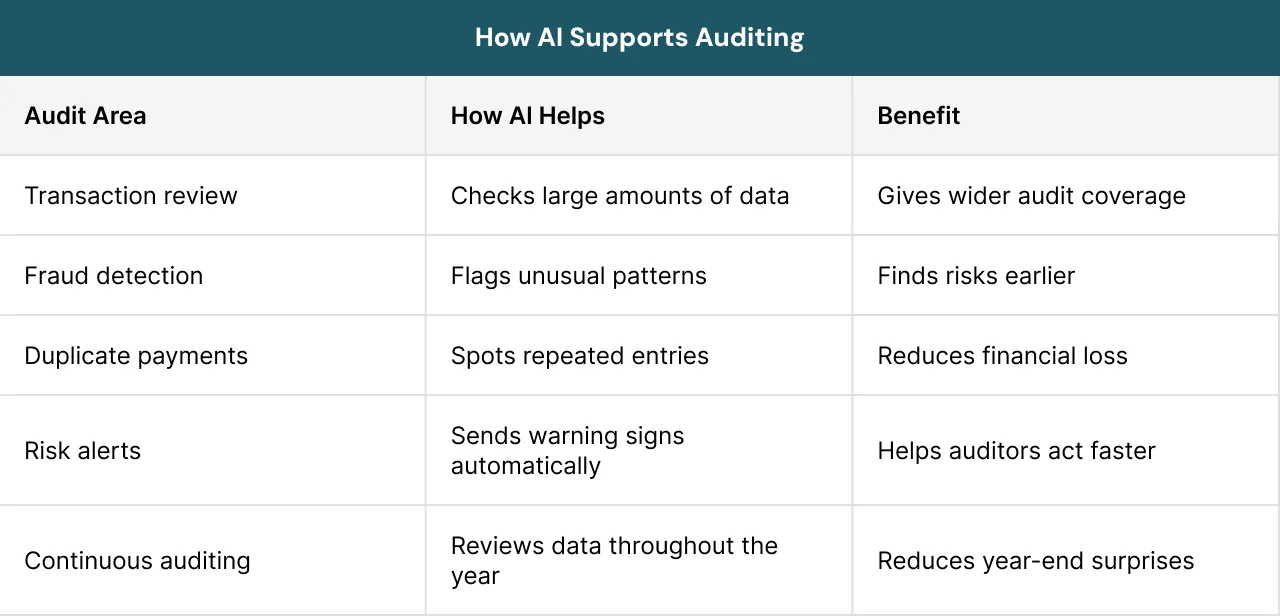
AI in auditing helps auditors review much larger amounts of data. It can even check almost all transactions. AI can also improve audit quality because it can:
- Compare patterns
- Find duplicate entries
- Flag suspicious payments
- Spot unusual transaction timings
2. Fraud Detection and Risk Alerts
Manual checks may not always find fraud that hides inside normal looking records. AI can study patterns and flag warning signs, such as:
- Repeated round number payments
- Unusual supplier activity
- Late night approvals
- Sudden changes in trends
AI in auditing can also watch credit risk, cash flow risk and market risk.
Some AI systems send automatic alerts that help businesses find problems early before they become bigger.
3. Continuous Auditing
Another big change is continuous auditing. Today, audits do not only happen at the end of the year. AI and auditing come forward to check transactions and controls throughout the year. This helps auditors find problems earlier, not after the year is over.
Continuous auditing helps build more trust with investors and regulators by saving time.
4. Why Managers Trust AI More in Some Cases
If both the auditor and the company used AI in auditing, the managers are more likely to accept audit changes. This happens because the audit advice looks more accurate and reliable with the use of AI. It also shows that trust in AI depends on how both sides use it.
AI Helps Compliance
AI helps finance teams stay organised and prepared. Financial reporting must follow rules like:
- GAAP
- IFRS
- Tax laws
- Industry rules
Compliance with rules and regulations is crucial otherwise businesses face penalties. It can also damage its reputation. AI can check transactions, documents and reports against these rules in real time. It can also flag missing data, unusual entries and possible policy issues.
1. AI and Stakeholder Trust
A stakeholder needs reliable numbers and trust only grows when AI is used properly. AI can help by making reports more consistent, reducing delays and finding problems early.
This shows businesses need clear controls, human review, data protection and honest communication.
2. Cost Savings and Efficiency
Costs can go down with faster routine work with the use of AI. This helps teams spend less time fixing mistakes and chasing documents. This also helps prepare reports sooner and easier audit preparation.
Now, there is less manual work which allows finance teams to spend more time on analysis. This happens when teams use AI. Some managers also expect AI to make audits more efficient. This may reduce audit costs in some cases.
3. AI Creates Better Decisions
The real value of AI is not only faster reports, it also helps with better decisions. Leaders can act with more confidence, when they can quickly see cash flow, risks, customer behaviour, market changes and budget gaps.
AI can help leaders with recruitment and HR, business Expansion, budgeting and Pricing, cost control and financial decisions.
Human Skills Still Matter
AI is powerful but it should not manage finance without human support. Human judgement is still needed for ethics, context, strategy and final approval.
Sometimes there may be a real reason behind a strange number. A business experience may help to understand forecasts properly. This is why human skills still matter.
Bias and Explainability
Bias data gives biased results because AI systems learn from data. That is why AI should be checked and tested often. This can affect lending decisions, fraud alerts, risk scores and financial forecasts.
People trust AI more when the system is clear and easy to understand. If AI says profit risk is increasing, finance teams need to know the reason why risk is increasing.
Challenges of Using AI in Finance
The following are the challenges that come with AI:
- One challenge is poor data quality. If old records are messy, missing or not consistent, AI may give weak results. Bad data often leads to bad insights
- Privacy is also a major concern. Businesses must protect their customer records because financial data is sensitive. The payroll details, business plans and pricing information demands confidentiality
- Security also matters. If AI systems are attacked, the damage can be serious
- Some staff may also worry that AI will replace their jobs. This concern is real but many roles may change instead of disappear
How to Start Using AI in Finance
Following are the ways to start using AI in finance:
1. Best Way to Start With AI
Businesses struggle when they try to use AI without proper research. You should not use AI in too many areas at the same time. The best approach is to test it on one single problem first. This could be invoice processing, expense coding, cash flow forecasting and bank reconciliation statements.
Note:
Start small with AI, then grow when it works well.
Test AI on that one task and check how much time it saves, how many errors it reduces and how the team feels about it. This simple approach reduces risk. If it works well, expand slowly.
2. A Simple 12 Months Roadmap
Following is a simple 12 months guide to start using AI in finance:
Month 1 to 3 should focus on getting ready by:
- Checking current systems
- Reviewing data quality
- Finding slow repeated tasks
- Getting support from leaders
Months 3 to 6 can focus on small tests like:
- Use OCR for invoices
- AI for simple forecasts
- Dashboards for live reporting
Months 6 to 12 can focus on growth by:
- Using AI tools in ERP and CRM systems
- Creating clear rules
- Training the team properly
3. Important AI Tools in Finance
There are many tools that can now help finance teams. No single tool works for every business. The right tool depends on the business size, goals, current systems and budget.
Some AI tools help with payments, supplier bills and bookkeeping. Other AI tools support planning, forecasting, closing accounts, fraud checks and excel work.
Following are the examples of some AI tools Tipalti, BlackLine, Planful, Workday Adaptive Planning, DataRails, Zeni, Botkeeper, Kensho and OneStream.
4. AI and Small Businesses
AI is not only for big companies. Small businesses can also take advantage. Cloud tools have made AI’s access easy and affordable. Smaller firms can now use AI for:
- Invoices
- Reporting dashboards
- Expense checks
- Budgeting support
The current data of 2026 suggests that 16% of UK businesses have embraced AI in their operations. This shows AI in financial reporting is growing very fast.
AI helps growing businesses improve control and report quality. Large companies may still lead AI adoption but smaller firms are catching up.
Real Life Example
Retail companies in the UK use AI in financial reporting. It makes monthly financial reporting easier. AI compares spending with the budget after:
- Collecting sales data from all stores
- Checking supplier invoices
- Tracking stock costs
Annual reports also matter for business growth. Managers do not wait many days for reports at the end of the month. They get:
- Real time dashboards showing profit
- Cash flow
- Store performance
Auditors also use AI in auditing to check transactions for risks and unusual patterns. This helps the company make reports faster, reduce mistakes and make better decisions.
What Finance Professionals Should Learn Now
Finance teams should learn the use of AI in financial reporting. The basics of AI include NLP, data quality, governance and how to give clear prompts.
In the future, the strongest finance professionals may be those who understand both finance and technology. They should know how to check AI answers and understand the logic. They should also know how to use human judgement with AI insights.
The Future of AI in Finance
AI in finance looks stronger with new trends, such as:
- NLP (Natural Language Processing) will get better at reading contracts, emails, reports and rules
- AI assistants may answer finance questions in simple words
- Predictive tools will also improve planning. For example, leaders can see what may happen if costs rise or sales drop
- Continuous close may become normal
- Audits may find problems earlier instead of after they happen
Conclusion
AI gives you a new direction to financial reporting and auditing. AI in financial reporting helps auditors check data efficiently and provide better assurance and accuracy. It also helps businesses save their time and control the errors.
AI is a powerful tool. It helps in forecasting and financial decision making but it cannot replace human judgement. AI in financial reporting still needs human guidance to work and serve businesses. The more skilled the people, the better the results.
AI in financial reporting helps businesses make wise decisions. It also helps a company grow and it’s helpful to use AI in financial reporting to get real time information efficiently. Yet it has some limitations. AI lacks ethics and real emotions, which are important factors to build trust with your clients.
Finance and auditing are changing with AI adoption but people still need to guide decisions and check the results carefully.
Sterling Cooper understands that the best way to use AI in your finance and reporting is to back it with human research and expertise. This is because businesses need faster, clearer and more reliable financial insights.
Contact us today to see how expert guidance on the best and most suitable AI tools can improve reporting and growth of your business within days.
Struggling with slow reports, manual errors or unclear financial data?
We help businesses use AI in financial reporting and auditing to improve accuracy, speed and decision-making. We have helped companies streamline finance processes and reporting systems.
Contact us today to discuss the right AI solution for your finance team.
FAQs
AI in financial reporting means using smart software to help prepare, review and improve financial reports. It can automate tasks like data entry, reconciliations and report creation. AI also helps spot errors, track trends and provide real-time insights. This allows finance teams to work faster and make better decisions while improving reporting accuracy.
The use of AI in financial reporting includes automating manual work, reducing reporting errors, improving forecasting, detecting unusual transactions and creating faster reports. AI can also turn complex numbers into simple summaries and charts. This helps management, investors and finance teams understand business performance more clearly.
Generative AI in financial reporting is AI that can create written content, summaries and draft reports from financial data. It can help produce management reports, investor updates, executive summaries and MD&A sections. Finance teams still need to review outputs but it saves time and improves communication.
Yes, AI can improve auditing by checking large volumes of transactions quickly and identifying unusual patterns. It helps with fraud detection, continuous auditing, risk alerts and data testing. This gives auditors better coverage than only checking small samples and can improve audit quality.
AI is more likely to change finance jobs than replace them fully. It can handle repetitive tasks such as data entry and reconciliations but human skills are still needed for judgement, ethics, communication, strategy and final approvals. Finance professionals who learn AI tools may become more valuable.
AI can be safe when used with strong controls. Businesses should focus on data privacy, secure systems, regular testing and human oversight. AI outputs should be reviewed before final use. Good governance helps ensure reports remain accurate, compliant and trustworthy.
Recent Posts

How to Build a Cash Reserve for Business Stability
August 11, 2026

How to Forecast Cash Flow During Economic Uncertainty
August 6, 2026