Posted by:
Admin
Date:
June 30, 2026
Category:
blogs
How to Prepare Your Business for an HMRC Compliance Check
Do you know that HMRC carries out around 316,000 compliance checks every year in the UK? This shows that tax reviews are a common part of running a business and can affect companies of all sizes.
As these checks happen regularly, it is important to understand what an HMRC compliance check is and how it works. HMRC carries out these checks to make sure tax returns are accurate and the correct amount of tax is paid.
Therefore, maintaining strong business HMRC compliance through clear records and accurate accounts is essential. Whether you have recently set up a business with HMRC or have been trading for years, keeping your records organised can help you stay prepared for a compliance check. Even small issues can trigger a review, so proper preparation can help you manage the process with confidence.
Key Takeaways
- An HMRC compliance check reviews your business tax records.
- Common triggers include late filing, random checks, and unusual transactions.
- Clear records help you respond faster and avoid issues.
- HMRC may request invoices, bank data, and tax returns.
- You can appoint a tax agent for support.
- Outcomes can include no action, penalties, or in rare cases, an investigation.
- You can challenge HMRC decisions if you disagree.
What Is an HMRC Compliance Check?
HMRC compliance check is a formal review that ensures people and firms are paying the right amount of tax based on UK tax laws. It is carried out by HM Revenue & Customs. It also checks if the tax returns and tax reliefs have been accurately filed.
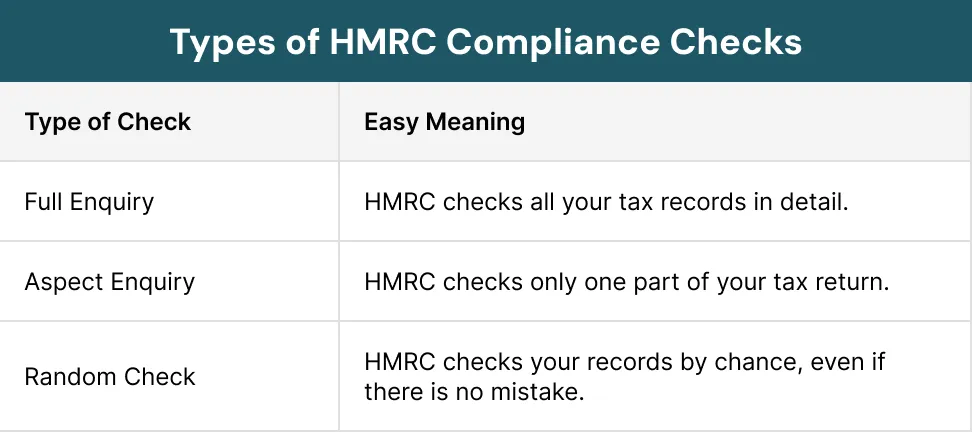
Before you prepare for a compliance check, it is useful to understand what may trigger HMRC to start one.
What Triggers an HMRC Compliance Check?
An HMRC compliance check may be triggered when HMRC notices unusual tax activity or an area that needs further review. Sometimes, these checks are done as part of routine monitoring.
The most common triggers of an HMRC compliance check include:
1. Late Filing and Late Payments
If tax filing or payments are not done in time, there is a high chance that HMRC will look into this matter. This means that if delays happen repeatedly, HMRC may evaluate the tax compliance of your business.
2. Random Selection
Sometimes, HMRC picks out companies on a random basis. This is done to make sure that HMRC is able to look into different situations and check whether companies are complying with their tax obligations.
3. Unusually High International Transactions
Larger or irregular foreign transactions can also trigger a review. HMRC may check these accounts to verify that foreign income, expenses and tax payments are reported correctly.
4. Discrepancies in Tax Returns
If HMRC finds incorrect or mismatched values in your tax return, it may start a compliance check. It usually happens when the income, expenses or records do not match properly.
Common Reasons for Checks
- Late tax filing
- Missing or wrong records
- Unusual financial activity
- Random selection
What Does HMRC Check During a Compliance Check?
During a compliance check, HMRC reviews your records to confirm that tax returns have been completed correctly and match your actual financial activity. This includes checking whether income, expenses and tax calculations have been reported accurately.
To verify this, HMRC compares your submitted returns with supporting documents such as invoices, payroll records and bank statements. This helps ensure consistency across all financial data and identifies any errors or missing information.
To break this down further, HMRC focuses on the following key areas of your business records:
1. Corporation Tax Records
HMRC reviews your business profits and expenses to ensure Corporation Tax has been correctly calculated and all taxable income is included.
2. VAT Returns
They check VAT return submissions to confirm that VAT has been reported accurately and submitted within required deadlines.
3. PAYE and Payroll Records
HMRC also examines employee pay, tax deductions and National Insurance contributions to ensure payroll compliance.
4. Business Expenses and Deductions
They verify that all claimed expenses are legitimate, properly recorded and supported by evidence such as receipts or invoices.
How to Prepare Your Business for an HMRC Compliance Check?
To prepare for an HMRC compliance check, firstly, you need to analyse the HMRC letter to understand the scope of review and the types of tax involved. Then, you should gather all necessary financial documents, which may include your bank statement and invoices. It will also be useful to notify your accountant early so they can support you throughout the process.
You can follow these steps to stay organised and compliant:
1. Carefully Review the HMRC Notice
Make sure you know the scope of review, particularly the specific taxes (such as VAT, Corporation Tax or PAYE) and the tax years being reviewed. Also, note down the deadlines and requests for extensions from HMRC if more time is needed.
2. Gather and Organise Records
Collect all documents that may be needed, such as sales and purchases receipts, expense records and bank statements. You should make sure that all of your documents meet legal requirements regarding how long documents must be kept, which is generally between 5 to 6 years. If you use digital accounting software, make sure all records are complete and easy to access.
3. Conduct a Pre-Audit ( Self-Review)
Make sure that your accounts match your tax filings and bank records. In case there is any mistake, it is advisable that you correct it as soon as possible. This will help you avoid penalties. Pay special attention to areas like dividends, director loans and IR35 arrangements when you are reviewing your records.
4. Appoint Representation and Communicate
Inform your accountant or tax adviser immediately so they can handle communication with HMRC if needed. You can authorise them to submit documents and respond to queries on your behalf. If required, you may also request reasonable adjustments from HMRC based on your circumstances.
How to Stay Prepared
- Keep clean financial records
- Match accounts with bank data
- Respond quickly to HMRC requests
- Use a tax agent if needed
How Does the HMRC Compliance Check Process Work?
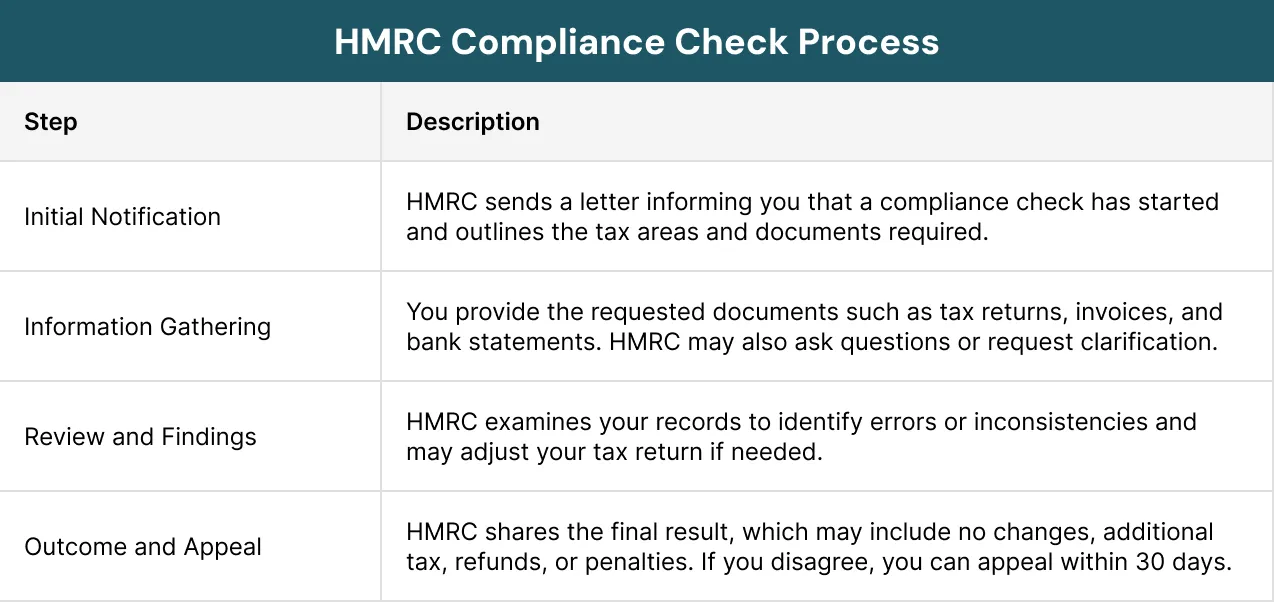
There are four common stages involved in the HMRC compliance check process. The stages start from the initial contact by HMRC and end with a final decision. In this process, you may be asked to provide documents, answer questions or provide tax details.
The main stages involved in this process are explained below:
1. Initial Notification
Firstly, HMRC will send a letter to inform you about the compliance check. They will also send a list of the documents and information that they need from you.
2. Information Gathering
You then need to send the required documents to HMRC. These include personal or business bank statements, invoices, receipts, payroll and VAT workings, management accounts and tax calculations. Keeping your records well organised can help avoid delays and make the process easier. HMRC may arrange an interview or even contact you to discuss your records.
3. Review and Findings
HMRC examines your records to identify any errors or inconsistencies. If your records are correct, they will close the check. If issues are found, they may amend your return or issue a formal assessment.
4. Penalties and Appeals
After the review, HMRC will give you the results of the review. If there are no issues, the check is closed with no changes. If you overpaid, HMRC will issue a refund with interest. If you underpaid, you must pay the difference, along with interest and potentially penalties (especially if errors were deliberate or due to a lack of reasonable care).
If you disagree with HMRC’s decision, you usually have the right to appeal within 30 days. You can request an appeal directly to an independent tax tribunal.
What Information Might HMRC Request For Compliance Check?
During an HMRC compliance check, HMRC may ask for different types of documents to verify that your tax returns and financial records are accurate. Keeping these documents organised and easily available can help you respond quickly and make the review process smoother.
Some of the most common records HMRC may request for compliance include:
1. Financial Records
HMRC may review your accounting records, including income, expenses and tax calculations, to confirm that your business information has been reported correctly.
2. Bank Statements
Bank statements may be checked to compare transactions with your accounting records and ensure all income and payments are properly recorded.
3. Invoices and Receipts
HMRC may ask for invoices and receipts as evidence to support your sales, purchases and claimed business expenses.
4. Payroll Records
Payroll documents may be reviewed to confirm that employee wages, tax deductions and National Insurance contributions have been reported correctly.
5. Contracts and Agreements
HMRC may examine contracts with customers, suppliers or employees to verify transactions, payments and the nature of business arrangements.
How Long Does an HMRC Compliance Check Take?
In the UK, a standard process carried out by HMRC takes 4 to 16 weeks in straightforward cases. But in complex and difficult cases, the review period can go up to 3 to 18 months.
The factors that influence the total period of the HMRC compliance check are:
1. Initial Response Time
HMRC usually gives 30 days to respond to the first information request. You can ask for an extension if you need extra time.
2. Type of Enquiry
An aspect enquiry can take between 3 and 6 months (covers one part of the tax return). While a general enquiry would take 9 to 16 months (covers the whole tax return).
3. Resolution Path
If there are no problems, the review process will be quick. If any problems are identified, you might be required to pay more taxes within 30 days. But if you have paid more than the amount due, HMRC will issue you a tax refund.
What If You Disagree with an HMRC Compliance Check Decision?
If you disagree with an HM Revenue & Customs (HMRC) compliance check decision, you can formally appeal in writing within 30 days of the date shown on your decision letter.
You have three main options to resolve the dispute:
1. Send New Information
If you have additional evidence or documents that were missed, you can send them to the HMRC officer handling your check. They may review the information and reconsider their decision.
2. Request an HMRC Statutory Review
You can ask HMRC to assign a different officer who was not involved in your case. This officer will independently review the original decision. You can request this review yourself or accept it if HMRC offers it. The review is usually completed within 45 days. You may also use Alternative Dispute Resolution (ADR) to help resolve disagreements.
3. Appeal to the Tax Tribunal
If you disagree with the review outcome, or skip the review stage, you can appeal directly. Appeals are made to the First-tier Tribunal (Tax Chamber) under HM Courts & Tribunals Service (HMCTS). You must submit your appeal within 30 days of the HMRC decision or review outcome.
Statutory records are the records needed to enable a person to make a complete and accurate return, declaration or claim and HMRC to check it.
HM Revenue & Customs (HMRC), UK Government
HMRC Compliance Check Case Study
The Ingenious and Icebreaker case shows how closely HMRC can review tax claims.
HMRC found that some investors had claimed tax relief that was much higher than the real money they had invested. The schemes used complex financial arrangements linked to film investments. HMRC successfully challenged the schemes. Investors later faced large tax bills and legal costs.
The key lesson is simple. HMRC does not only look at what is written in the accounts. It checks whether the transactions are real, whether the records are accurate and whether the tax claim matches the actual investment.
Conclusion
An HMRC compliance check can feel stressful, but it becomes easier when your records are clear and updated. Good planning helps you stay ready and avoid errors in tax reporting. Both HMRC compliance checks and business HMRC compliance cases are smoother when you keep simple, clean accounts.
At Sterling Cooper Consultants, we help businesses stay ready for tax checks, manage records and handle HMRC queries in a simple and stress-free way. Reach out to us today if you want support with compliance, bookkeeping guidance and tax preparation.
Staying ready for an HMRC compliance check is easier when your records are accurate and well organised.
Good bookkeeping helps you respond quickly and avoid penalties or delays. If you need support with tax compliance or HMRC queries, contact us today.
FAQs
An HMRC compliance check is a formal review conducted by HM Revenue & Customs to ensure individuals and businesses pay the correct amount of tax and adhere to UK tax laws. It covers various taxes including Income Tax, Corporation Tax, VAT, and PAYE.
HMRC initiates a business compliance check to ensure your business is paying the correct amount of tax and adhering to UK regulations. These checks are not always punitive. HMRC usually relies on risk-scoring software called "Connect" to identify inconsistencies that trigger an inquiry.
A HMRC compliance check can be triggered by several factors such as late filing, late tax payments, inconsistent accounting records or unusually high international transactions. These issues may indicate a need for further review to ensure tax accuracy.
The process begins with HMRC sending a formal notice explaining the check. The business is then asked to submit relevant documents and may be asked additional questions. HMRC can also hold meetings if needed. After reviewing everything, they provide a final outcome.
The time taken for a compliance check depends on the complexity of the case. Straightforward cases with clear records may be completed within weeks, while more complex cases involving missing or unclear information can take several months.
Recent Posts

How to Build a Cash Reserve for Business Stability
August 11, 2026

How to Forecast Cash Flow During Economic Uncertainty
August 6, 2026