
Posted by:
Admin
Date:
June 25, 2026
Category:
blogs
Corporation Tax Deadlines Every Director Should Know
Do you know when your next corporation tax deadline is? Missing even one key date could result in penalties from HMRC and create avoidable problems for your company.
HMRC shows that UK firms are required to comply with strict rules regarding payments and filings for Corporation Tax. This will result in penalties and interest charges automatically.
No company director can overlook the importance of corporation tax deadlines. You must meet your deadline for filing the corporation tax return even when there is no tax to pay. The penalties and interest may still be imposed by HMRC regardless of the size of the company and its profits.
Key Takeaways
- Corporation Tax deadlines apply to all UK limited companies.
- Payment and filing dates are different and must both be tracked.
- Corporation Tax is usually paid 9 months and 1 day after year-end.
- Company Tax Returns (CT600) are due 12 months after year-end.
- Missing deadlines can lead to automatic HMRC penalties and interest.
- Directors are responsible for compliance, even if an accountant is used.
- Good planning and bookkeeping help avoid last-minute issues.
What Are Corporation Tax Deadlines?
In the UK, corporation tax deadlines are based on your company’s accounting period. There are two distinct deadlines you must meet, which are the payment deadline (which comes first) and the filing deadline (which comes later).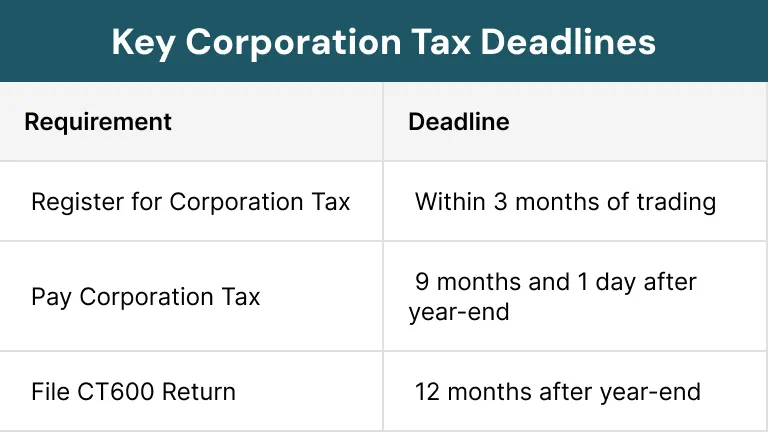
Why Should Directors Know Corporation Tax Deadlines?
Directors must understand corporation tax deadlines to be on the right side of the law. If you miss these tax deadlines, it can lead to high penalties as well as unnecessary stress. It can also affect the efficiency of your entire tax process.
Corporation Tax Payment Deadlines Every Director Should Know
One of the important corporation tax dates that every director should know is the payment deadline. This is dependent on the company’s financial year-end date, according to HMRC. Failure to make the payments will lead to interest and fines. Early planning helps avoid last-minute cash pressure. To understand these deadlines better, directors should know how the payment date works and how to prepare for it.
1. Corporation Tax Payment Dates
Corporation tax payment dates are typically calculated based on a company’s financial accounting period, which is usually 9 months and 1 day after the end of the accounting period. This applies to all UK limited firms. The HMRC considers the date of the year-end when determining the due date for tax payments. This timeframe gives businesses enough time to prepare for their tax payments.
2. Corporation Tax Payment Planning
Directors should plan for corporation tax by setting aside some money specifically for tax purposes. This will help them track all deadlines that HMRC sets throughout the year. The process will ensure they do not stress when deadlines are close. If payment becomes difficult, directors can contact HMRC to discuss time to pay corporation tax arrangements. In the UK, deadlines are determined by the end of the company year.
3. Simple Example of a Corporation Tax Payment Deadline
If the accounting period ends on 31st March, then the tax payment is due on 1st January. This shows how the time period between year-end and payment is calculated. Directors must plan ahead to deal with this issue.
Quick Reminder
Corporation Tax is usually payable before the Company Tax Return filing deadline.
Corporation Tax Deadlines For Filing Returns
Filing a return is a vital part of corporation tax deadlines that all directors should know. If you just pay the corporation tax, then it is not enough. You need to file a complete return with HMRC as well. If you fail to do this, it may lead to penalties even if taxes are paid.
Paying corporation tax is not the only requirement, as firms should also submit a return to HMRC. To avoid fines, directors should understand the filing deadline, the details required in the return, and the effects of filing late.
1. Corporation Tax Filing Deadline
The deadline to file a corporation tax return is within 12 months of the end of its accounting period. In this case, the form known as the CT600 should be delivered to HMRC. This happens regardless of whether any tax needs to be paid.
2. Information Included in a CT600 Return
A CT600 return includes the company’s income, expenses, allowable costs, and the final tax amount due. This will help HMRC to ensure that the correct amount of tax is paid. The details must match the accounts of the company.
3. Penalties for Late Filing
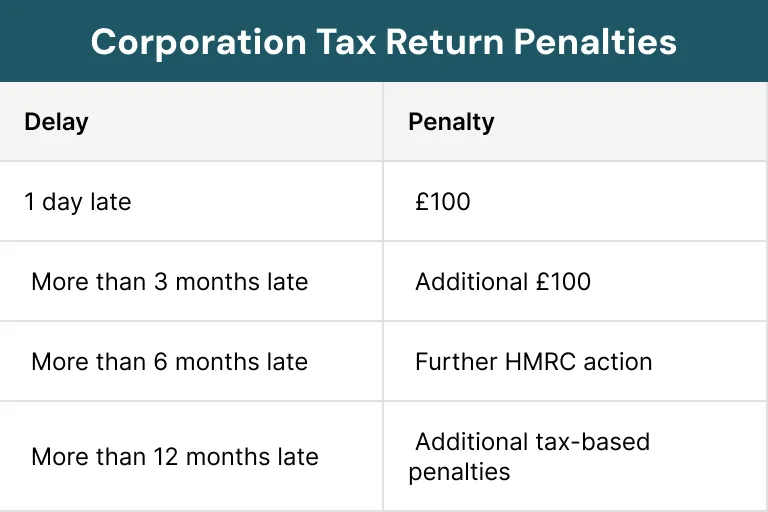
Filing late leads to a £100 fine. Further delays will cause additional fines. Delays that are extended can result in increased penalties from HMRC. It can increase the total cost too. Continued delay can lead to higher penalties and further HMRC action.
Corporation Tax Deadlines For Companies Paying By Instalments
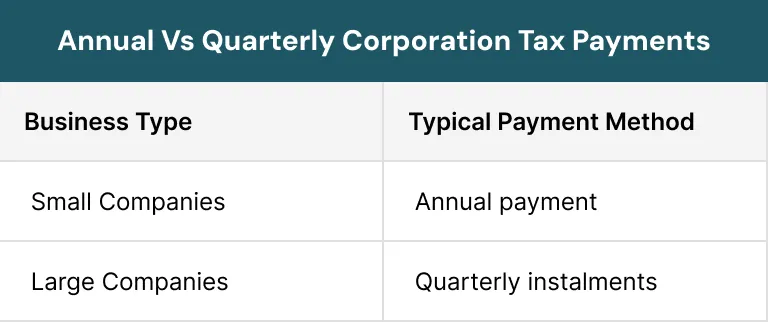
There is no annual deadline for corporation tax payments for all businesses. As for large companies, they can make the payments throughout the year. The size of their profits and other regulations will decide how often they do this. Most smaller businesses make one payment per year. But some businesses follow different rules. To understand how instalment payments work, it is important to know the deadlines and the companies that follow these rules.
1. Quarterly Corporation Tax Deadlines
Quarterly corporation tax deadlines are instalment payments made four times a year. The schedule is set by HMRC for big firms. Each payment represents a part of the total annual tax due. These quarterly tax deadlines help spread tax costs.
2. Companies That Pay Corporation Tax Quarterly
Large companies usually follow instalment rules. This applies when profits go above HMRC limits. Payments are split across the year instead of one lump sum. It helps manage high tax amounts.
3. Small Companies and Instalment Rules
Large firms normally operate under the instalment rule. This happens whenever profit exceeds the limits of HMRC. It is done by splitting the payments throughout the year rather than making a one-off payment. It keeps the tax process simple and fixed.
How Can Directors Stay Ahead Of Corporation Tax Deadlines?
Corporation tax deadlines do not need to be stressful if directors plan ahead. Directors can ensure that there is no issue with paying taxes because there are a number of simple things they can do. The following steps can help directors stay compliant:
1. Keep Accounting Records Up To Date
Updated records will increase accuracy and save time in doing tax work. It will help reduce errors in calculations and report generation. Updated records make it easy to file taxes at the end of the year.
2. Use Accounting Software And Tax Reminders
Software helps track all important dates and tasks. It reduces manual effort and missed steps. Directors can be reminded about all the deadlines coming up. The quarterly tax deadlines could also be tracked through alerts if needed.
3. Review Key Dates Before Your Year-End
Early review helps to properly plan cash flow. There is no unexpected strain on payments. Directors will have sufficient funds available before the payment deadline
4. Work Closely With Your Accountant
Accountants advise on rules and deadlines. They ensure that there is proper filing and payment. But it is a must for the directors to comply with the regulations. This ensures that tax duties are manageable.
“The responsibility for filing accurate returns and paying tax on time rests with the company,”
HMRC
Case Study: Apex Ltd
Apex Ltd is a software company operating in the UK. Its accounting period is from 1 April 2025 to 31 March 2026. This example shows how corporation tax deadlines work in practice.
The deadline for the corporation tax payment is 1 January 2027, i.e., 9 months and 1 day after the end of the financial year. The deadline for submitting the CT600 form is 31 March 2027.
The directors misunderstood both of those deadlines. They believed that both deadlines were the same, which resulted in the corporation paying taxes 3 months late.
HM Revenue and Customs charged interest for not paying taxes by their deadline. This shows how missing the deadline for filing corporate tax returns or the payment date can increase costs.
Conclusion
Every UK Limited Company is required to make corporation tax payments on time. It is vital that not only the dates by which payment should be made but also the deadline for filing are monitored and followed carefully. Non-compliance with such deadlines may bring fines from HMRC. Effective planning and record-keeping will ensure directors are able to comply without problems. Sterling Cooper Consultants helps helps businesses stay compliant through expert tax advice and compliance support.
Struggling with unclear financial data each month?
Many UK SMEs face the same challenge. Strong management reporting improves financial visibility, supports better decisions, and helps businesses stay in control of their finances. If you are facing these issues, get in touch today to see how the monthly management reporting can help grow your business.
FAQs
Monthly management reports are structured documents that summarize a company’s financial and operational performance over a specific 30-day period. They provide decision-makers with a consistent, timely overview of business health, allowing them to track Key Performance Indicators (KPIs), assess budget adherence, and make informed strategic adjustments.
Monthly management reports are vital for growing businesses because they provide a timely, data-driven snapshot of financial health. Rather than waiting for annual tax returns, these regular updates help owners monitor cash flow, track key performance indicators (KPIs), and adjust strategies before minor issues escalate.
A monthly management report is an internal tool that summarizes a company's financial and operational performance over the past 30 days. It typically includes an executive summary, core financial statements (P&L, cash flow, balance sheet), key performance indicators (KPIs), budget tracking, and actionable recommendations for the upcoming month.
Management reports should be reviewed on a tiered schedule depending on the data type: daily/weekly for operational metrics (like sales or cash flow), monthly for comprehensive financial and strategic reviews, and annually for high-level governance. This cadence ensures timely course corrections without overwhelming leadership.
Monthly management reports are generally better for day-to-day business operations and proactive decision-making than annual accounts. While annual accounts are essential for tax compliance and legal filings, they arrive too late to guide business strategy. Monthly reports provide timely financial visibility and control.
Recent Posts