Posted by:
Admin
Date:
June 23, 2026
Category:
blogs
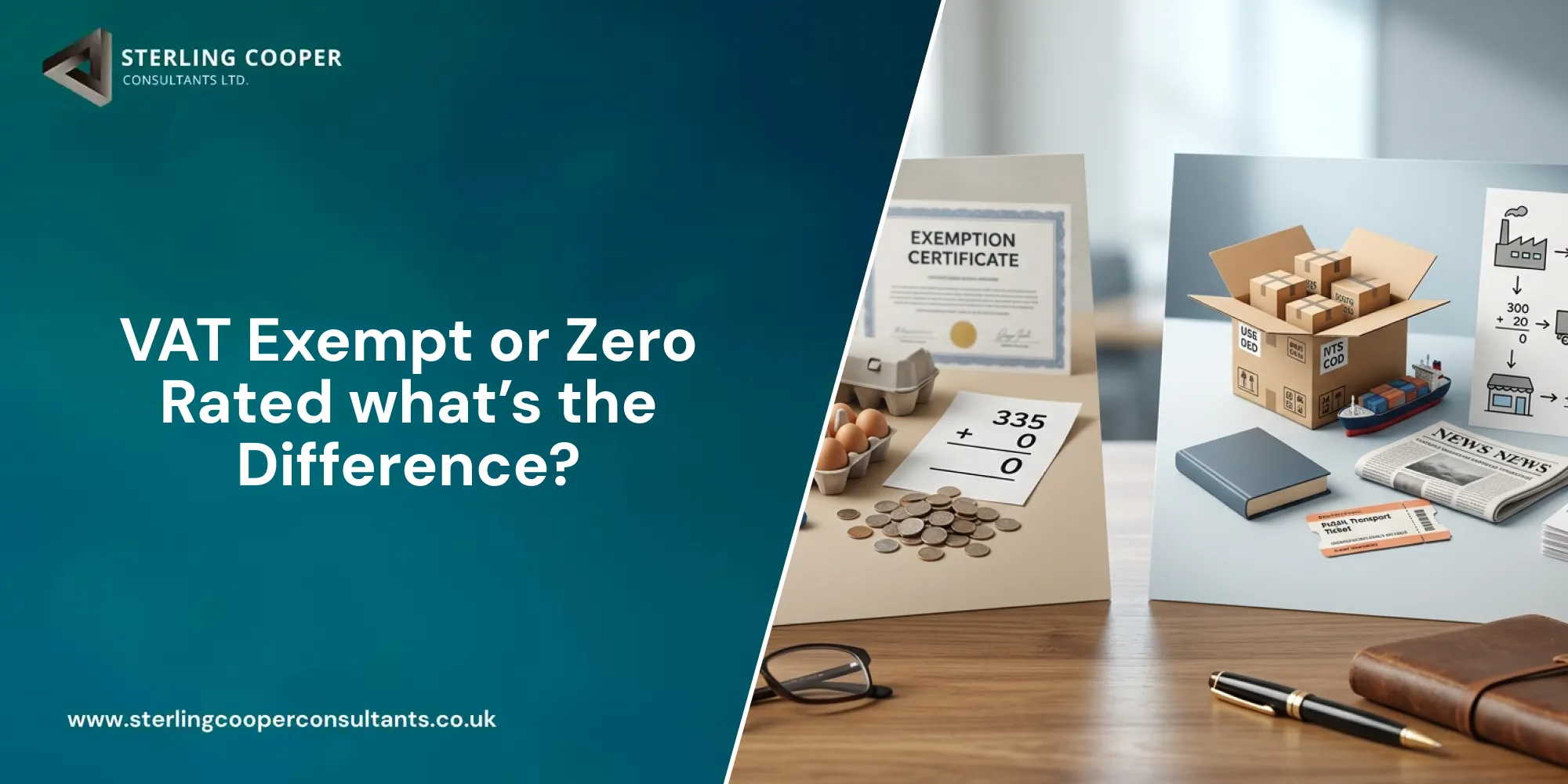
VAT Exempt or Zero Rated- What’s the Difference?
When a business deals with VAT, one of the most common questions is whether a product or service is VAT exempt or zero rated supplies.
At first, both seem the same because customers do not pay the VAT. However, there are important differences that affect the recovery of VAT, costs of business and also tax reporting.
Understanding whether a good or a service is a VAT exempt or zero rated helps you to stay compliant and avoid costly mistakes.
According to HMRC UK VAT receipts reached £171 billion in 2024/25. While more than 2.3 million businesses were registered for VAT.
These figures shows why understanding whether a supply is VAT exempt or zero rated is important for your business.
“Zero-rating lets you reclaim your input VAT; exemption turns it into a permanent business cost.
— Dr. Carl Shoup
Key Takeaways
- Understanding whether a supply is VAT exempt or zero rated is essential for accurate VAT reporting and compliance.
- Customers do not pay VAT on either zero-rated or VAT-exempt supplies, but the VAT treatment for businesses is very different.
- Zero-rated supplies are still taxable at a 0% VAT rate and usually allow businesses to reclaim VAT on related expenses.
- VAT exempt supplies are generally outside the VAT system, meaning businesses cannot normally reclaim VAT on associated costs.
- Common zero-rated items include most food products, children’s clothing, books, and certain exports.
- Common VAT exempt services include healthcare, education, insurance, and many financial services.
- Zero-rated sales usually count towards the VAT registration threshold, while VAT-exempt sales generally do not.
- Businesses that provide both taxable and exempt supplies may be subject to partial exemption rules.
- Applying the wrong VAT treatment can lead to reporting errors, missed VAT reclaims, and potential HMRC penalties.
- Keeping accurate records and understanding VAT classifications helps businesses manage costs and remain compliant.
- Professional VAT advice can be valuable when dealing with complex transactions or determining whether supplies are VAT exempt or zero rated.
What Is VAT?
VAT or “Value Added Tax”, is a consumption tax that is added to a product or service at every stage of the supply chain. It is ultimately paid by the final consumer and is widely used in over 170 countries, including the UK and Canada.
Businesses collect VAT from the customers and pay it to HMRC.
In the UK, the standard VAT rate is usually 20%, but some goods qualify for lower rates.
When you learn about VAT exempt or zero rated supplies, it is important to understand that how VAT works. Different VAT treatments affect how businesses charge VAT from customers and reclaim the VAT on expenses.
How VAT Works for Business?
Businesses that are VAT-registered must charge VAT on taxable sales. They also pay VAT on many purchases and expenses which are related to their business.
The difference between VAT exempt or zero rated VAT supplies affects whether businesses can reclaim the VAT or not. This can have a direct impact on profits and cash flow.
Understanding whether a supply is vat exempt or zero rated helps you to make good VAT decisions and to maintain accurate financial records.
Read also: VAT on Private School Fees
What Does VAT Exempt Means?
A good or service that is VAT exempt is outside the VAT system for charging purposes. Businesses do not charge VAT on these goods or services.
The key point about VAT exempt goods is that businesses normally cannot reclaim the VAT on costs which is directly linked to those supplies.
Why Are Some Goods and Services VAT Exempt?
Many services considered as important to society are classed as VAT exempt. This helps to keep essential services more affordable.
Governments often apply VAT exempt treatment to these sectors including healthcare, education and finance.
How VAT Exempt Supplies Work?
When a business provides a VAT exempt service, customers do not pay VAT. The invoice will show that the supply is exempt.
The business must keep their proper records of all VAT exempt transactions for VAT compliance and reporting purposes.
Pro Tip:
Even though VAT-exempt supplies do not include VAT on invoices, you must still keep detailed records of these transactions to meet VAT compliance and reporting requirements.
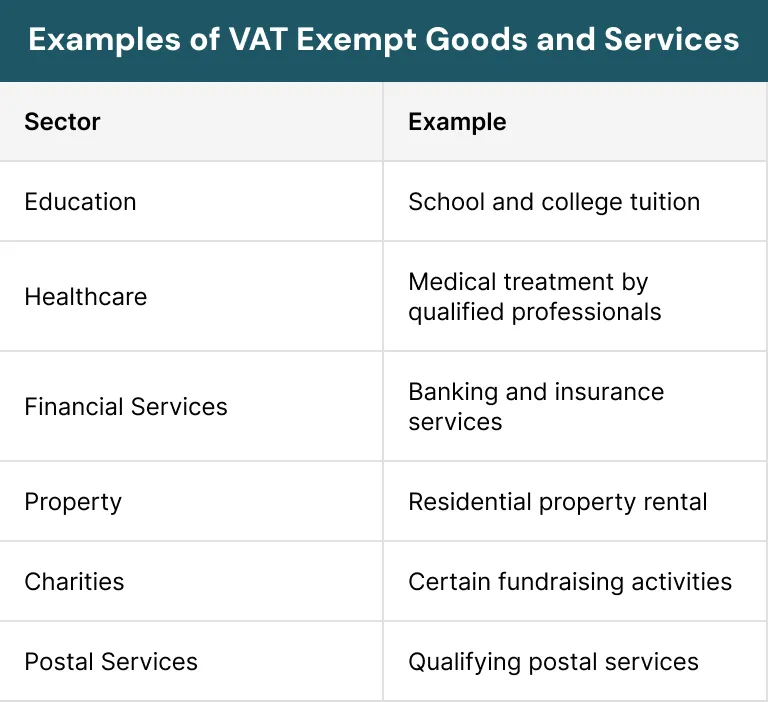
Examples of VAT Exempt Goods and Services
Many industries provide goods or services that are treated as VAT exempt under the rules of UK VAT.
Knowing these examples can help you to find whether they are dealing with VAT exempt or zero rated supplies.
- Education Services
- Healthcare and Medical Services
- Financial and Insurance Services
- Charitable Activities
- Rental of Residential Property
- Postal Services
Read more: What Disabilities Qualify for VAT Exemption?
1. Education Services
This helps to make education more affordable for students and families. They also support learning across the UK.
Examples may include school lessons, university courses and some vocational training programmes. The exact VAT treatment depends on the type of education being provided.
2. Healthcare Services
The VAT exempt for healthcare helps people to access the medical services at a lower cost. This is especially important for essential care.
Many healthcare providers rely on it when they offer services to patients.
3. Financial and Insurance Services
Financial services often involve complex transactions. VAT exempt helps you to simplify the tax treatment of many of these activities.
Examples include loans and insurance policies.
4. Charitable Activities
VAT rules for charities can vary depending on the type of activity or event. Some activities may be exempt, while others may be zero-rated or taxable.
Keeping accurate records can help charities to apply the correct VAT. This also helps to avoid mistakes during the reporting of VAT.
5. Rental of Residential Property
This VAT exempt helps to keep housing costs more affordable for tenants. It means that VAT is not added to normal residential rent.
Landlords should still keep clear records of rental income and related costs.
6. Postal Services
This supports the access to important postal services across the UK. It helps to keep standard mail services affordable for the public.
Some specialist or express delivery services may not qualify for the VAT exempt.
What Is Zero-Rated VAT?
Zero-rated VAT means a supply is taxable but charged at a VAT rate of 0%. Customers do not pay VAT, but the supply remains within the VAT system.
This is the biggest difference between VAT exempt or zero rated supplies. Zero-rated supplies still allow VAT recovery in many cases.
How Zero-Rated Supplies Work?
Businesses that sell zero-rated goods issue invoices showing VAT at 0%. The sale remains the part of taxable turnover.
This makes a major difference when comparing VAT exempt or zero rated supplies.
Why Governments Apply Zero-Rated VAT?
Zero-rating is often used for products that people need in daily life. This can help to reduce the cost of household items.
It also supports businesses because they can usually reclaim the VAT on related expenses. This makes the VAT system fairer for both consumers and suppliers.
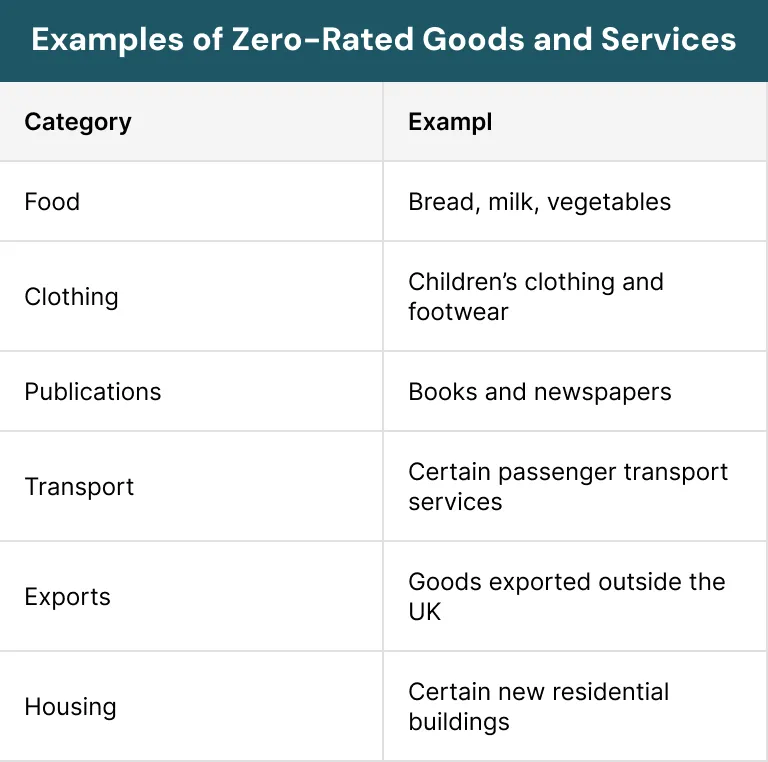
Common Examples of Zero-Rated Goods and Services
Many zero-rated products are linked to basic needs or public benefits. This helps to keep essential goods and services affordable.
Although these items have a VAT rate of 0%. They are still part of the VAT system. Businesses must record them correctly on VAT returns.
Here are some common examples of zero rated goods and services including:
- Food and Essential Grocery Items
- Children’s Clothing and Footwear
- Books, Newspapers, and Publications
- Public and Passenger Transport
- Exports and International Supplies
- Equipment for Disabled People
- New Residential Buildings
1. Food and Essential Grocery Items
Zero-rating helps families to spend less on everyday food items. This is one reason why many basic foods are not subject to VAT.
Items such as bread, milk, fruit and vegetables are commonly zero-rated. However, special rules may apply to some prepared foods.
2. Children’s Clothing and Footwear
This VAT relief helps parents to reduce the cost of buying clothes and shoes for children. It can make a difference for growing families.
Businesses should make sure that products meet the size and design rules that apply to children’s clothing.
3. Books, Newspapers and Publications
Zero-rating supports education and also access to information. It helps in the process of reading and learning for people of all ages.
Many printed publications qualify for this VAT. Businesses should still check the VAT status of different products.
4. Public and Passenger Transport
Transport helps people to travel for work and study. Zero-rating supports access to these important services.
Different transport services may have different VAT rules. Operators should understand the requirements that apply to their business.
5. Exports and International Supplies
Zero-rating helps UK businesses to sell goods in overseas markets without adding VAT costs.
Exporters must keep proof that goods have left the UK.
6. Equipment for Disabled People
This VAT relief helps disabled people to access products that support daily living. It can reduce the cost of important equipment.
The rules may depend on the type of product and who it is supplied to.
7. New Residential Buildings
Zero-rating can help to reduce some costs linked to new buildings. This may encourage the construction of new homes.
Property VAT rules can be complex. Developers should keep accurate records.
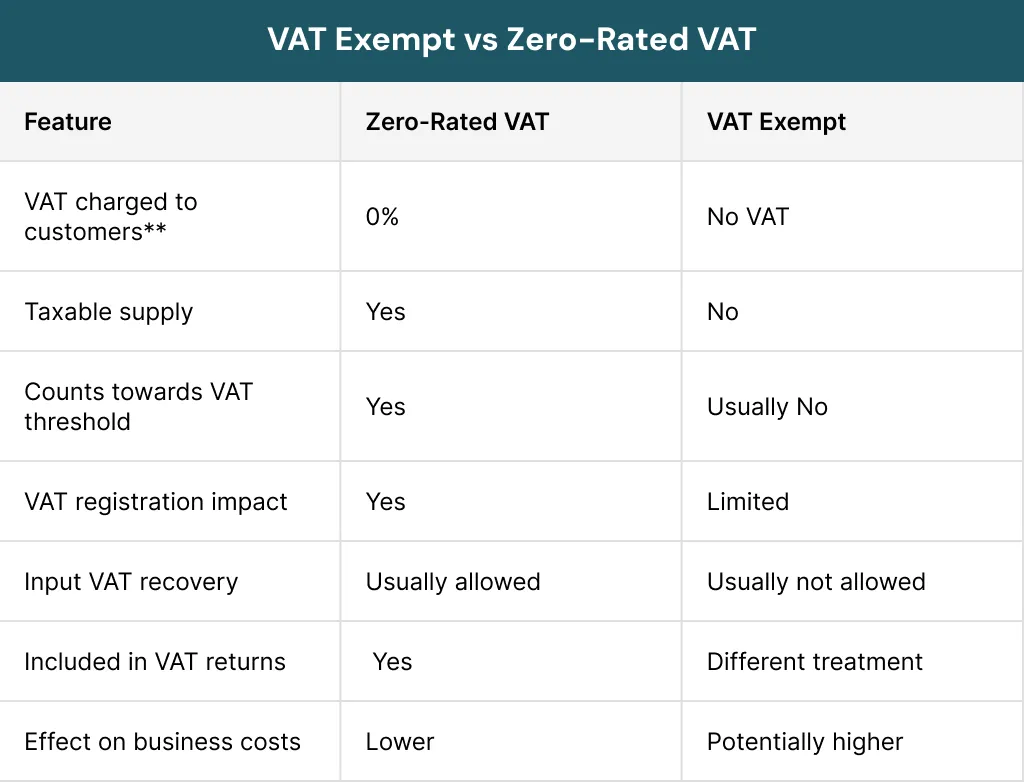
VAT Exempt vs Zero-Rated VAT: Key Differences
Understanding the difference between VAt exempt or zero rated supplies is important for every business.
The biggest difference is VAT recovery. Businesses that sell zero-rated goods can often reclaim VAT on expenses. While businesses that make VAT exempt supplies generally cannot reclaim the VAT.
1. Tax Treatment
Zero-rated supplies remain within the VAT system even though the VAT rate is 0%. Businesses must still include these sales in their VAT records.
By contrast, VAT exempt supplies are not treated as taxable supplies for VAT purposes. This changes how VAT is reported and recovered.
2. VAT Charged to Customers
Customers do not pay VAT on either zero-rated or VAt exempt supplies. This can make products and services more affordable.
Although the customer sees no difference, businesses must understand whether a supply is VAT exempt or zero rated to apply the correct VAT treatment.
3. Impact on Business Costs
The ability to reclaim VAT often reduces costs for businesses that sell zero-rated goods. This can help to improve profit margins.
With VAT exempt supplies, VAT paid on expenses often becomes an extra cost that the business must absorb.
4. Administrative Requirements
Both categories require accurate records and proper VAT treatment. You should keep clear records for HMRC.
5. Effects on Cash Flow
Businesses with zero-rated supplies may receive VAT refunds from HMRC. This supports healthy cash flow.
Businesses that deal mainly with VAT exempt activities may not enjoy the same benefit because VAT recovery is limited.
Why Does the Difference Matters for Businesses?
The distinction between VAT exempt or zero rated supplies can affect pricing and profits. A small error may lead to incorrect VAT returns and also lead to possible penalties.
1. Impact on Profitability
The ability to recover VAT can improve the overall profit. This is important for businesses with high operating costs.
Businesses that make VAT exempt supplies may face higher expenses.
2. Effect on Business Expenses
Everyday costs such as rent, equipment and supplies may include VAT. Recovering this VAT can help to reduce the financial burden.
3. Cash Flow Considerations
Regular VAT refunds can support the cash flow and help business operations. For businesses that provide VAT exempt supplies, benefits of cash flow may be more limited.
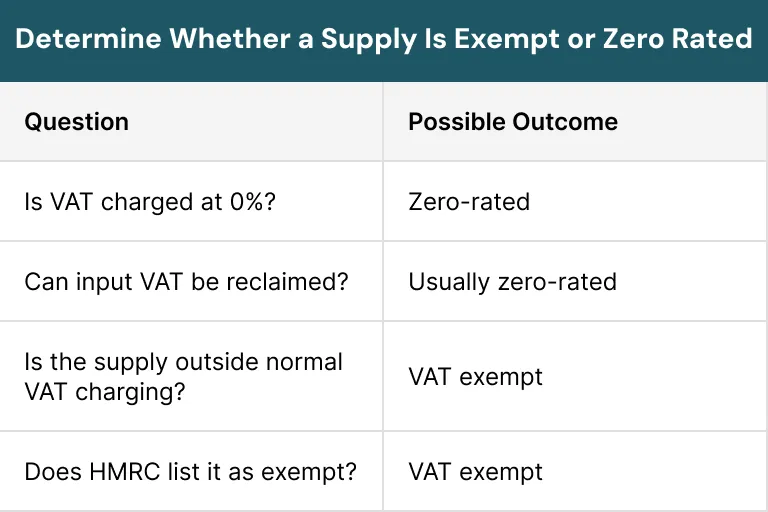
How to Determine Whether a Supply Is Exempt or Zero Rated?
Determining the correct category of VAT is essential for compliance. A mistake can affect the VAT recovery and reporting process.
You should carefully check whether a supply is VAT exempt or zero rated before applying VAT treatment.
1. Reviewing HMRC Guidance
HMRC publishes guidance covering many types of goods and services. These resources can help you to identify the correct VAT status.
Pro tip:
Reviewing official guidance can prevent costly VAT errors.
2. Understanding Product and Service
VAT treatment depends on the nature of the product or service being sold. Even similar products may have different VAT rules.
3. Common Grey Areas and Exceptions
Some supplies do not fit neatly into one category. Special rules may apply depending on the circumstances.
Businesses should be cautious when dealing with unusual products or services.
4. Seek Professional Advice
Professional advice can help you to understand the complex VAT rules.
Expert support is often valuable when determining whether supplies are VAT exempt or zero rated.
Case Study: VAT Exempt or Zero Rated Supplies
A small UK retailer sold children’s clothing and educational books. The business owner believed that these products were VAT exempt and therefore did not claim VAT on related business expenses.
After reviewing the business records, an accountant explained that these products were actually zero-rated, not VAT exempt. Because zero-rated supplies remain within the VAT system, the business was able to reclaim the VAT paid on certain costs.
As a result, the retailer recovered the previously missed VAT, improved cash flow and gained a better understanding of VAT rules. This helped the business to stay compliant and avoid future mistakes.
Conclusion
Understanding the difference between VAT exempt or zero rated supplies is essential for businesses of all sizes.
While customers often see no difference between them, the impact on VAT recovery, costs and compliance can be significant.
A VAT exempt supply generally does not allow the VAT recovery. While a zero-rated supply usually does allow the VAT recovery. This distinction can affect the profitability, pricing and cash flow.
At Sterling Cooper, we provide practical VAT support to help your business stay compliant, avoid costly mistakes and improve VAT efficiency.
Struggling with unclear financial data each month?
Many UK SMEs face the same challenge. Strong management reporting improves financial visibility, supports better decisions, and helps businesses stay in control of their finances. If you are facing these issues, get in touch today to see how the monthly management reporting can help grow your business.
FAQs
Monthly management reports are structured documents that summarize a company’s financial and operational performance over a specific 30-day period. They provide decision-makers with a consistent, timely overview of business health, allowing them to track Key Performance Indicators (KPIs), assess budget adherence, and make informed strategic adjustments.
Monthly management reports are vital for growing businesses because they provide a timely, data-driven snapshot of financial health. Rather than waiting for annual tax returns, these regular updates help owners monitor cash flow, track key performance indicators (KPIs), and adjust strategies before minor issues escalate.
A monthly management report is an internal tool that summarizes a company's financial and operational performance over the past 30 days. It typically includes an executive summary, core financial statements (P&L, cash flow, balance sheet), key performance indicators (KPIs), budget tracking, and actionable recommendations for the upcoming month.
Management reports should be reviewed on a tiered schedule depending on the data type: daily/weekly for operational metrics (like sales or cash flow), monthly for comprehensive financial and strategic reviews, and annually for high-level governance. This cadence ensures timely course corrections without overwhelming leadership.
Monthly management reports are generally better for day-to-day business operations and proactive decision-making than annual accounts. While annual accounts are essential for tax compliance and legal filings, they arrive too late to guide business strategy. Monthly reports provide timely financial visibility and control.
Recent Posts