
Posted by:
Admin
Date:
June 17, 2026
Category:
blogs
How Often Should a Small Business Update Its Bookkeeping in the UK?
Every business keeps its records but how often should it be updated? Just like bookkeeping for large scale businesses, small business bookkeeping is about documenting all cash flows that enter and leave your business. It allows you to know your actual standing in terms of finances anytime you want. Most of the small businesses in the UK have challenges in maintaining accurate records and up-to-date documentation. This results in cash flow problems and poor financial management.
Bookkeeping for small businesses is important to avoid cash flow issues and to keep the records aligned and updated. Timely updates will allow for reducing errors and making good decisions. Currently, there are 5.5 million businesses within the UK private sector in 2024. Among these, 5.45 million firms fall into the category of small businesses with no more than 49 employees. Small business bookkeeping becomes a major issue for UK firms.
Key Takeaways
- Small business bookkeeping should be updated regularly to stay accurate and useful.
- Most UK businesses benefit from daily, weekly, or monthly updates.
- Frequent updates help reduce errors and improve cash flow control.
- Using small business bookkeeping software can save time and improve accuracy.
- Good bookkeeping supports better decisions and long-term business stability.
Why Is Small Business Bookkeeping Important for UK Businesses?
Bookkeeping in the UK is an accounting technique used to document all money entering and leaving the company. Sales, expenses, invoices and salaries are some of the items that need to be recorded. It makes the accounting of the company easy and accurate. Bookkeeping simplifies the management of money.
Small business bookkeeping in the UK is important as it enables you to record all the finances that go in and out of your company. This will allow you to have an overview of the financial state of your business. It will also enable you to make informed decisions to outgrow the business.
What Happens If Bookkeeping Is Not Updated Regularly?
If bookkeeping is not updated regularly, then these cash flow issues will build up quite rapidly. It may cause you to miss payments or ignore invoices. Incorrect record-keeping could lead to HMRC penalties. It also makes it more difficult to see the real performance of your business. Updating regularly not only ensures that there will be no problems. It will also enable your business to expand with confidence.
Bookkeeping Support Business Growth
This allows you to plan with concrete figures. The profits and losses can be easily seen. It will also prepare you for the taxes that need to be filed at certain times. This way, no hassle will happen for you during busy times.
How Often Should Small Business Bookkeeping Be Updated?
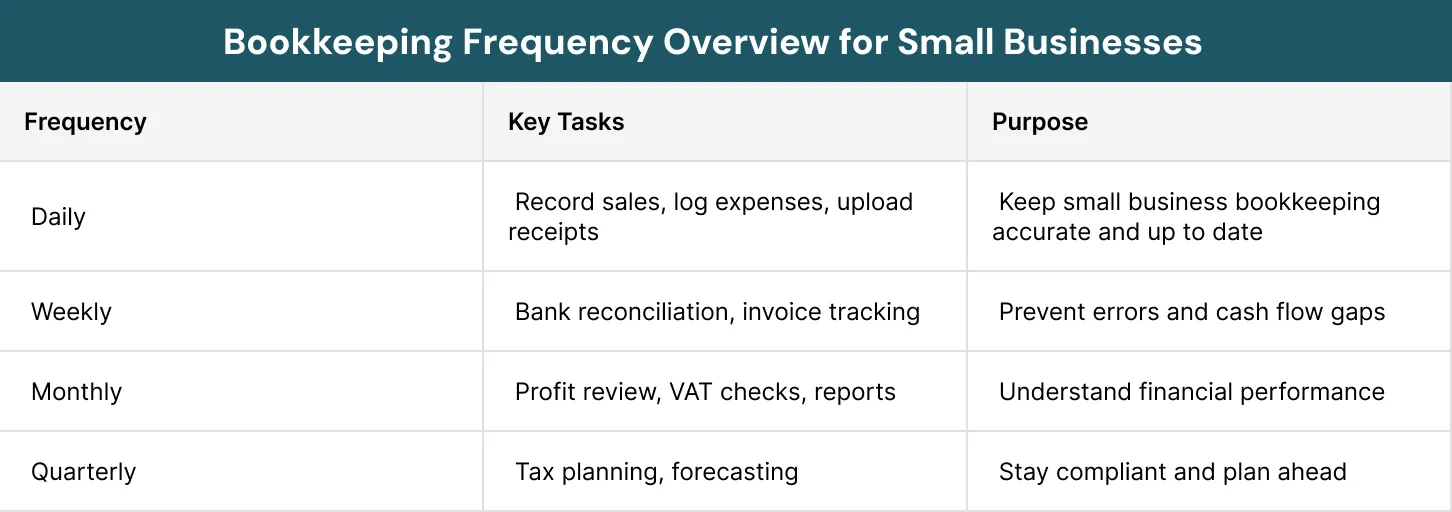
Small business bookkeeping must be done according to a fixed timetable. This will help you avoid errors and lost accounts. Your cash flows will also remain clear at all times. The majority of firms in the UK conduct their updates either daily, weekly, or monthly. A right schedule would depend on the nature of your business and the level of data involved.
1. Daily Bookkeeping Updates
The use of daily updates works best for businesses with lots of transactions. These daily updates will enable you to monitor your cash flow. You will be able to document your expenses and sales on a regular basis. This will also minimise the risk of lost receipts.
2. Weekly Bookkeeping Updates
The weekly updates suit most small businesses in the UK. It ensures that their records are neat and up-to-date. Bank reconciliations are easy with weekly updates. It helps avoid a backlog of work.
3. Monthly Bookkeeping Updates
Monthly Bookkeeping is best for full performance analysis. This will enable you to analyse the profit and loss in a very clear way. It allows you to analyse your VAT and other reports. It enables you to understand cash flow trends.
“What gets measured gets managed,”
by Peter Drucker
What Is the Best Bookkeeping Schedule for Small Business Bookkeeping in the UK?
A good schedule for small business bookkeeping should have tasks that occur on a daily, weekly and monthly basis. This makes accounting for your small business easier and more consistent. It also lowers the pressure you feel when tax season comes around. Breaking the activities down into daily, weekly and monthly actions will simplify bookkeeping.
1. Daily Bookkeeping Task
Make sure that all sales are recorded on the same day. Make sure you keep track of all your expenditures. You will make sure that there are no errors in your record-keeping.
2. Weekly Bookkeeping Task
Match bank statements every week. Look out for any unpaid accounts receivable. This will help keep your books reconciled. You will notice any mistakes early on.
3. Monthly Bookkeeping Task
Analyse profit and loss accounts. Check your status in terms of cash flow. This gives you an idea about the financial state of your business. You will be able to make plans for the following month.
What Factors Affect How Often You Update Small Business Bookkeeping?
The small business bookkeeping will be different from one business to another. This would depend on the size of the business and its growth. This would also be decided based on the number of daily transactions carried out by the business firm. Knowledge about these factors will help you choose the right bookkeeping schedule that is easier for you.
1. Business Size and Bookkeeping Frequency
Business size can affect how often record keeps updating. If a small company is involved, there may be updates done once a week or a month. But as the SME scales up, it will require frequent updates. Larger operations mean larger transactions to account for.
2. Transaction Volume and Bookkeeping Needs
The number of transactions matters a lot. Retail shops often need daily updates. Service businesses can update less often. More transactions mean more chances of mistakes. So, busy businesses need faster bookkeeping control.
3. Industry Type and Bookkeeping Frequency
The type of business also changes how often you do bookkeeping. Online shops need daily updates. Consultancy work can be updated less often. Trade businesses depend on cash flow timing. So, each business needs its own simple routine.
Read More: Essential Bookkeeping Tips Every Small Business Should Follow
What Are the Common Bookkeeping Mistakes Small Businesses Make?
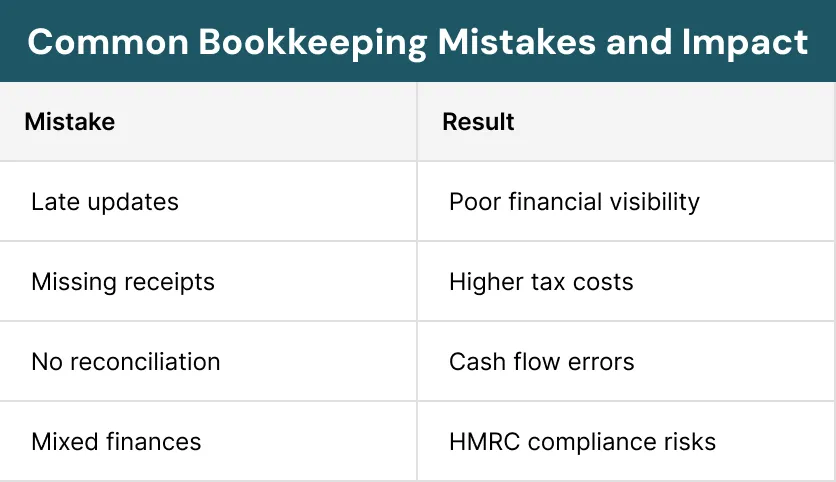
Many small businesses make bookkeeping mistakes when the records are not up-to-date. This results in inaccuracies and a lack of information. Small business bookkeeping can also impact cash flows and taxes. Errors are caused mostly by delays or bad procedures. Knowing about these common mistakes that small businesses make will help you ensure that your documents remain accurate and free from any major problems in the future. If these common mistakes can be avoided, small business bookkeeping will become much simpler and more reliable.
1. Delayed Bookkeeping Updates
Many businesses delay as they do not have enough time. Some even employ manual systems, which are more time-consuming. Owners who are busy tend to defer it until later. This results in delays in their record-keeping process.
2. Lack of Regular Reconciliation
Errors can go unnoticed for many years. The bank records do not match the books. There could be difficulties with cash flow. It could also cause problems with HMRC.
3. Mixing Personal and Business Finances
Using the same account for personal and business finances can confuse the record-keeping. You will not be able to capture the actual cost of running your business. It also means that the tax process becomes more difficult. Checking by HMRC becomes riskier.
How Can Small Business Bookkeeping Software Improve Update Frequency?
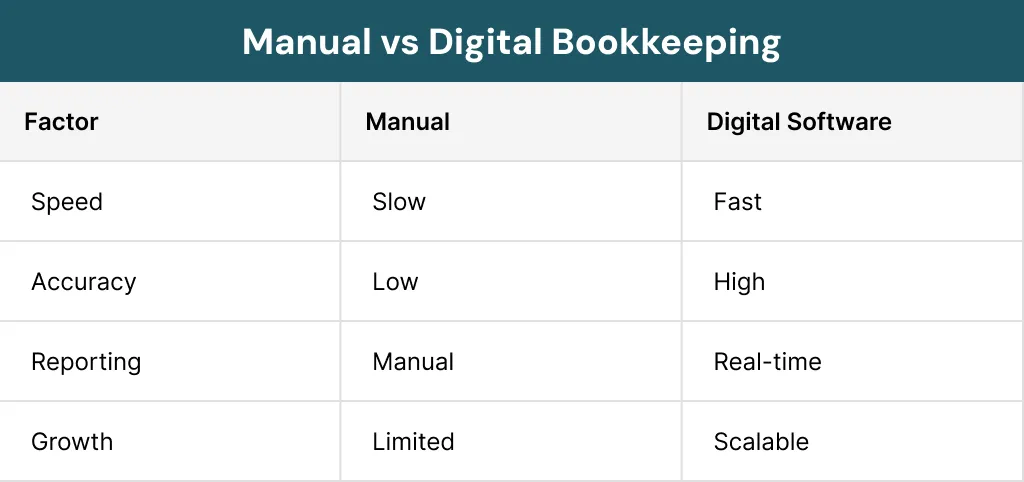
With small business bookkeeping software, keeping records becomes easier, faster and more accurate. They help cut down on manual labor and save time daily. Moreover, all your records can be stored in one system easily. Thus, you will have no trouble keeping your books up to date.
In order to have a better understanding of this concept, let us analyse the issue on the basis of update frequencies that can be achieved through bookkeeping software.
1. Faster Daily Bookkeeping Updates Through Software
The bookkeeping software enables companies to enter transactions as soon as they occur. Transactions for sales, purchases and receipts can all be added on the spot. This ensures that recording entries on a daily basis is easy and convenient.
2. Automated Weekly Updates With Reduced Manual Work
The process of automation will reduce the time spent on repetitive bookkeeping processes. Transaction information is updated through bank feeds. Expenses and invoices will be synced automatically into the system. As a result, weekly records are accurate and up to date.
3. Real-Time Continuous Updates Using Cloud Access
The cloud tools provide an option to access the information anytime and anywhere. Business owners can update their accounts on the go. This makes sure that there is no delay in accounting. As a result, there is an ongoing and instant monitoring of accounts.
Case Study
One of the mistakes that UK small firms make is updating their accounts at the end of every quarter to match HMRC VAT requirements. This implies that they use outdated information that may be several weeks or months old.
In an actual scenario, a London hospitality firm used quarterly bookkeeping. As such, they were unable to keep track of the rise in their cost of suppliers and the stock loss experienced. The effect was slow, but they were unaware of its impact on their cash flow.
Once they started using weekly bookkeeping, everything changed for the better. It became easier to monitor weekly expenses and payments from suppliers. Also, it helped them detect any stock loss and manage the purchasing procedure. In addition, they were able to follow up on outstanding debts.
What Are the Best Practices for Small Business Bookkeeping in the UK?
Simple and consistent practices are essential for effective small business bookkeeping services. It is necessary to maintain it according to a certain schedule. In this way, the books will stay clean and well-organised, and the process of tax payments will cause less anxiety. To apply these practices in real life, it helps to break bookkeeping into key routine tasks.
1. Weekly Bank Reconciliation for Accurate Records
Accountants need to verify bank accounts each week. This ensures that the records coincide with actual business dealings. It also makes sure there are no discrepancies at an earlier stage. This makes bookkeeping more efficient.
2. Easy Receipt and Expense Tracking Using Digital Tools
Use software programs to keep track of the receipts. Applications allow you to do it fast and easily. The bills can be uploaded anywhere. It will ensure that the receipts are not missed.
3. Monthly Financial Report Reviews for Better Control
Financial reports must be checked every month. In some cases, companies check financial statements quarterly. This is useful for knowing your profit and money flow. Also, this will help plan your future steps properly.
Read More: How Outsourced Bookkeeping Services Can Save You Time and Money
How Often Should Small Businesses Update Bookkeeping Before HMRC Deadlines?
Always update your bookkeeping before the tax deadline. It is best not to wait until the very end when panic sets in. This will make sure you have all the paperwork done in advance. To fully understand the impact of this, it is a must to know what role regular bookkeeping plays in HMRC compliance.
1. UK Tax Deadlines That Need Updated Bookkeeping
Quarterly VAT returns should be filed every quarter. The deadline for self-assessment is always set for January. PAYE has to be paid on time too. Failure to do this leads to penalty charges. Therefore, accurate record-keeping becomes very important.
2. Impact of Up-to-Date Records on HMRC Compliance
Updating the bookkeeping ensures that the data is always up to date. It prevents errors from occurring when filing taxes. In addition, deadlines are easily met through updating. This decreases the chances of HMRC penalties and fines.
Conclusion
Small business bookkeeping is much more than just a process. This is important for ensuring that your company remains stable in the UK. You can do this process at any frequency that you like, but the higher the frequency, the better it will be for your company. It can be done daily, weekly, or even monthly.
At Sterling Cooper, we help you avoid errors and improve cash flow management. Our bookkeeping services for small businesses help you organise everything and save a few minutes each day.
Struggling to keep your bookkeeping up to date?
It can feel messy when records pile up.
We help small businesses in the UK stay on top of their books with clear, simple support. No stress, no confusion, just steady and accurate records. Get in touch today and let’s make your bookkeeping easier to manage.
FAQs
It is a digital tool used to record and manage business finances. It helps track income, expenses, and invoices in one place. This makes bookkeeping faster and more accurate.
Popular choices include Xero, Sage and QuickBooks. They help manage accounts, cash flow, and reports easily. The best option depends on your business size and needs.
It brings all financial records into one system. It automates tasks like invoicing and expense tracking. This saves time and reduces manual errors.
Yes, most tools are designed for non-accountants. They offer simple dashboards and guided features. This makes daily bookkeeping much easier.
It helps keep finances organised and up to date. It improves accuracy and supports better decisions. It also makes tax filing and reporting simpler.
Recent Posts