
Posted by:
Admin
Date:
June 11, 2026
Category:
blogs
Best AI Tools for Accountants and Bookkeepers in 2026
The rise of AI tools for accountants is changing the accounting industry faster than ever.
Tasks that once took hours to complete can now be completed in minutes with the help of AI. From invoice processing to financial reporting, AI is now helping you to work faster and with less mistakes.
Many businesses depend on AI to improve their accuracy and to save time. AI tools help to reduce manual work and help firms to focus more on clients and growth of business.
According to KPMG’s 2025/2026 accounting study, 53% of companies already use AI in accounting.
Small bookkeeping firms and large finance teams are both using AI to improve their daily operations.
Therefore, the demand for AI tools for accounting is growing. Businesses now want faster reporting and better financial visibility.
Key Takeaways
- AI tools are now widely used in accounting, with many firms already integrating automation into daily bookkeeping and reporting workflows.
- A large portion of bookkeeping tasks such as data entry, invoice processing, and reconciliation can now be automated, saving significant time.
- Many accounting firms report faster month-end closing cycles due to AI-driven automation and real-time financial processing.
- AI adoption in accounting is growing quickly, with a rising number of professionals using AI tools for core financial tasks.
- Firms using AI tools can handle more clients without increasing staff, improving scalability and efficiency.
- Routine and repetitive tasks are being reduced, allowing accountants to focus more on advisory, analysis, and client strategy.
- AI improves accuracy by reducing human error in data entry, categorisation, and transaction matching.
- Despite automation, human oversight is still essential to review outputs and ensure financial accuracy and compliance.
- AI tools are especially valuable for managing high-volume tasks like accounts payable, accounts receivable, and bank reconciliation.
- Businesses adopting AI in accounting are gaining a competitive advantage through faster reporting and better decision-making insights.
- The role of accountants is shifting from manual processing to more strategic and value-added financial services.
- Early adopters of AI accounting tools are seeing better productivity, improved workflow efficiency, and reduced operational costs.
How Is AI Transforming Accounting in 2026?
AI is changing the way accounting firms manage work. Many repetitive tasks are now automated. This helps teams to complete their work more quickly.
The use of AI tools for accountants helps businesses to reduce pressure during busy periods like month-end closing.
Finance teams are now using AI tools to improve productivity. AI software can read invoices, categorise expenses and also match the bank transactions automatically. This allows accountants to spend more time to assist clients.
Another reason for AI growing fast is that clients now expect quicker services. This is why many firms are now investing more in AI tools for accounting to stay competitive in 2026.
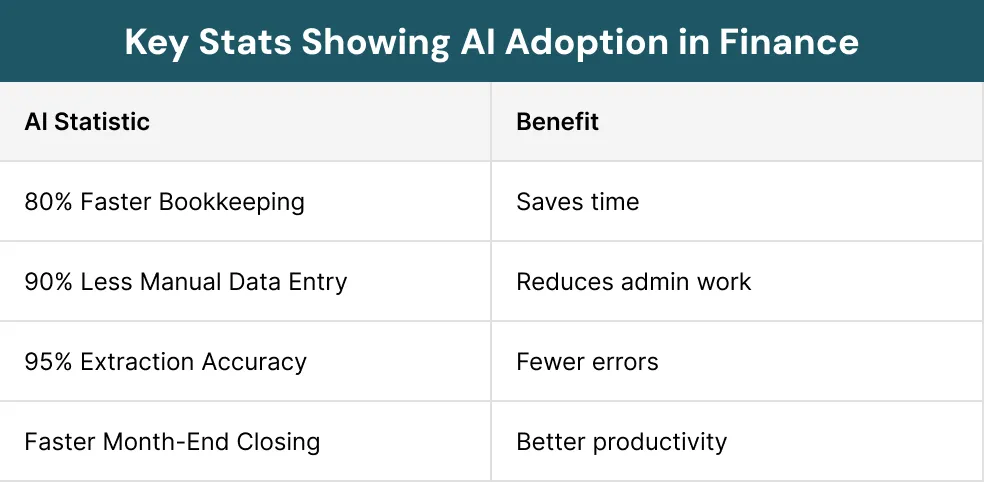
Key Stats Showing AI Adoption in Finance
The accounting industry is seeing huge growth in AI adoption. Many firms report that after using AI tools for accountants, they observed faster workflows and lower admin costs.
Here are some important statistics about AI in finance:
Did you know?
Many finance teams spend hours each week on tasks that AI can complete in minutes.
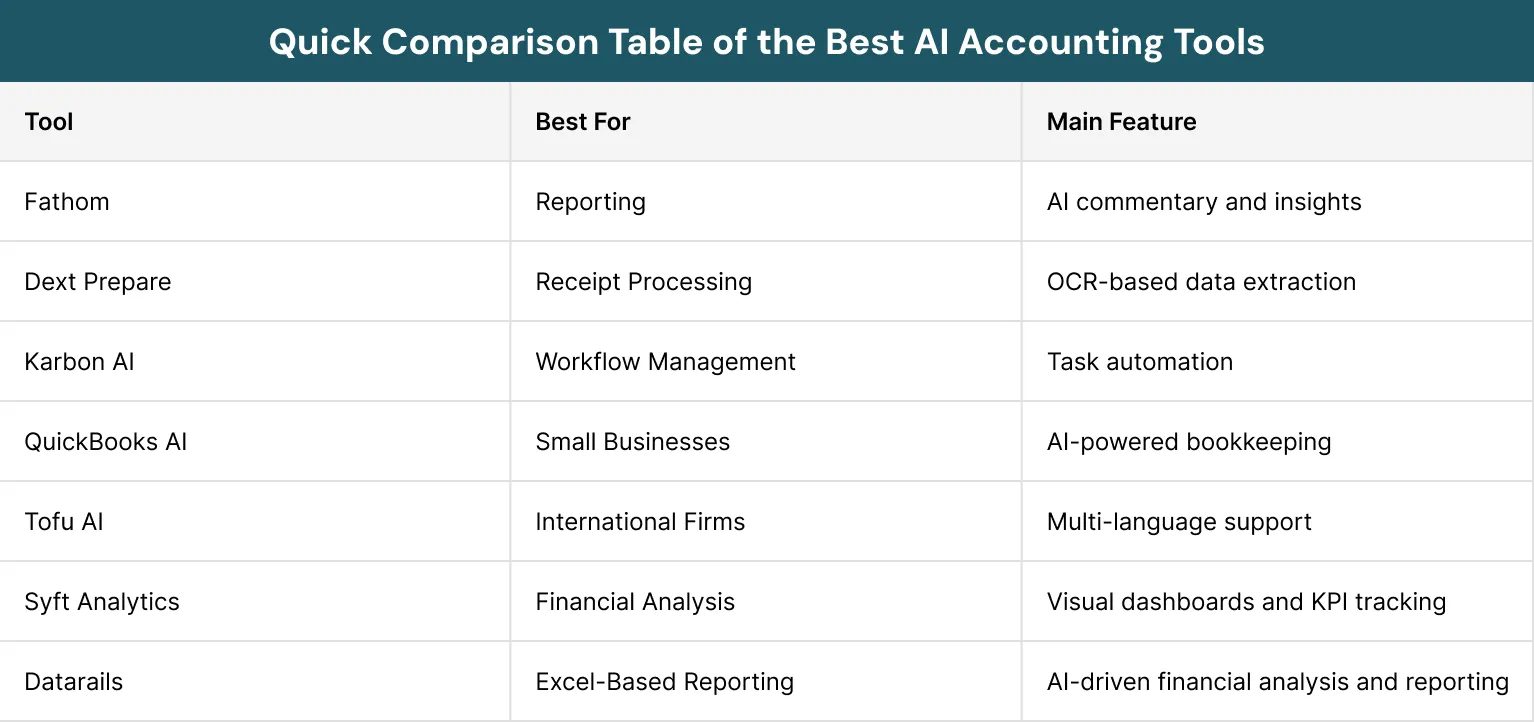
Best AI Tools for Accountants and Bookkeepers in 2026
The market for AI tools for accountants is growing day by day.
Many platforms now offer AI features that help to improve the bookkeeping and reporting. Choosing the right tool depends on your business needs.
Some firms need help with invoices and receipts, while others need advanced reporting. The best AI tools are designed to solve specific finance problems in the right way.
Below are some of the top AI accounting platforms businesses are using in 2026.
1. Fathom
Fathom is one of the most popular AI tools for accountants for reporting. It helps to create the management reports and KPI dashboards.
This tool connects with major accounting systems like Xero and QuickBooks. This makes reporting faster and easier for finance teams.
Which businesses does it help?
Fathom is ideal for accounting firms and finance managers. It is also best for businesses that need detailed financial reporting.
It is especially useful for organisations that regularly track KPIs and their business performance.
How does it help?
It uses AI to turn financial data into visual reports and insights. It reduces the time spent on manual reporting. Fathom helps accountants to explain the financial performance to clients and stakeholders.
2. Syft Analytics
Syft Analytics is focused on financial analysis and visual reporting. Many accountants use this tool to create easy-to-understand dashboards and business insights.
This platform also provides AI-generated ideas for financial changes. This helps firms to prepare their reports more quickly.
Which businesses does it help?
Syft Analytics is best for accounting practices, CFOs, financial consultants and businesses that need advanced financial analysis.
How does it help?
It helps to convert complex accounting data into simple visual reports. The AI-powered insights help accountants to identify the trends, risks and growth opportunities.
3. Karbon AI
Karbon AI is designed for accounting workflow. It helps firms to organise the tasks and client projects.
The platform uses AI to summarise the emails, assign tasks and also track the deadlines. This helps to reduce admin work for accounting teams.
Which businesses does it help?
Karbon AI is best for accounting firms, bookkeeping agencies and multi-client practices that manage the large workloads.
How does it help?
The tool reduces the admin work by automating communication and task management. This allows accountants to spend more time on client service and advisory work.
4. QuickBooks Accounting Agent
QuickBooks has introduced AI features to automate the bookkeeping tasks. The system can help to categorise the transactions and provide financial insights in a proper way.
Small businesses benefit greatly from these built-in AI features.
Which businesses does it help?
It is ideal for small businesses, freelancers, startups and companies that are already using QuickBooks for accounting.
How does it help?
The AI assistant helps to reduce manual bookkeeping by automatically generating useful financial summaries. This improves efficiency while maintaining accurate records.
5. Dext Prepare
Dext Prepare is one of the leading AI tools for accountants. This tool is helpful for processing receipts and invoices. It extracts the information automatically by using OCR technology.
The software integrates with the popular accounting systems. It also reduces the need for manual data entry. This saves time and improves accuracy too.
Which businesses does it help?
Dext Prepare is suitable for bookkeeping firms, accountants, retailers and organisations handling large volumes of receipts and invoices.
How does it help?
It captures and processes the financial documents automatically. This reduces human error, improves data accuracy and saves valuable time during the bookkeeping processes.
6. Datarails
This tool combines AI with Excel-based financial analysis. Finance teams can now ask questions about reports.
It is especially useful for businesses that still rely heavily on Excel sheets for reporting and planning.
Which businesses does it help?
Datarails is ideal for finance departments, CFOs, FP&A teams. It is helpful for organisations that use spreadsheets on a large scale.
How does it help?
The platform enhances Excel rather than replacing it. AI-powered reporting features help finance generate insights more quickly.
7. Tofu AI
Tofu AI is becoming popular because of its strong processing features. It can process invoices and receipts in more than 200 languages.
This makes it one of the best AI tools for firms with global clients.
Which businesses does it help?
Tofu AI is ideal for multinational businesses and global accounting firms. It is also helpful for companies that deal with suppliers and customers in multiple countries.
How does it help?
This tool automates multilingual document processing and data extraction. This reduces manual translation work and also improves efficiency when managing international financial records.
8. AutoEntry
AutoEntry helps smaller firms to automate their invoice and receipt processing. It uses flexible pricing.
This tool is useful for solo bookkeepers and smaller businesses who are looking for affordable AI tools.
Which businesses does it help?
AutoEntry is best suited for solo bookkeepers, small accounting firms and small businesses that are looking for cost-effective automation.
How does it help?
The tool automatically captures and uploads the data from invoices, receipts and bank statements. This reduces repetitive data entry tasks and saves time for small finance teams.
Pricing of AI Tools for Accountants and Bookkeepers
Pricing of each tool varies on plan. When you choose one, it is important to understand their price model as well.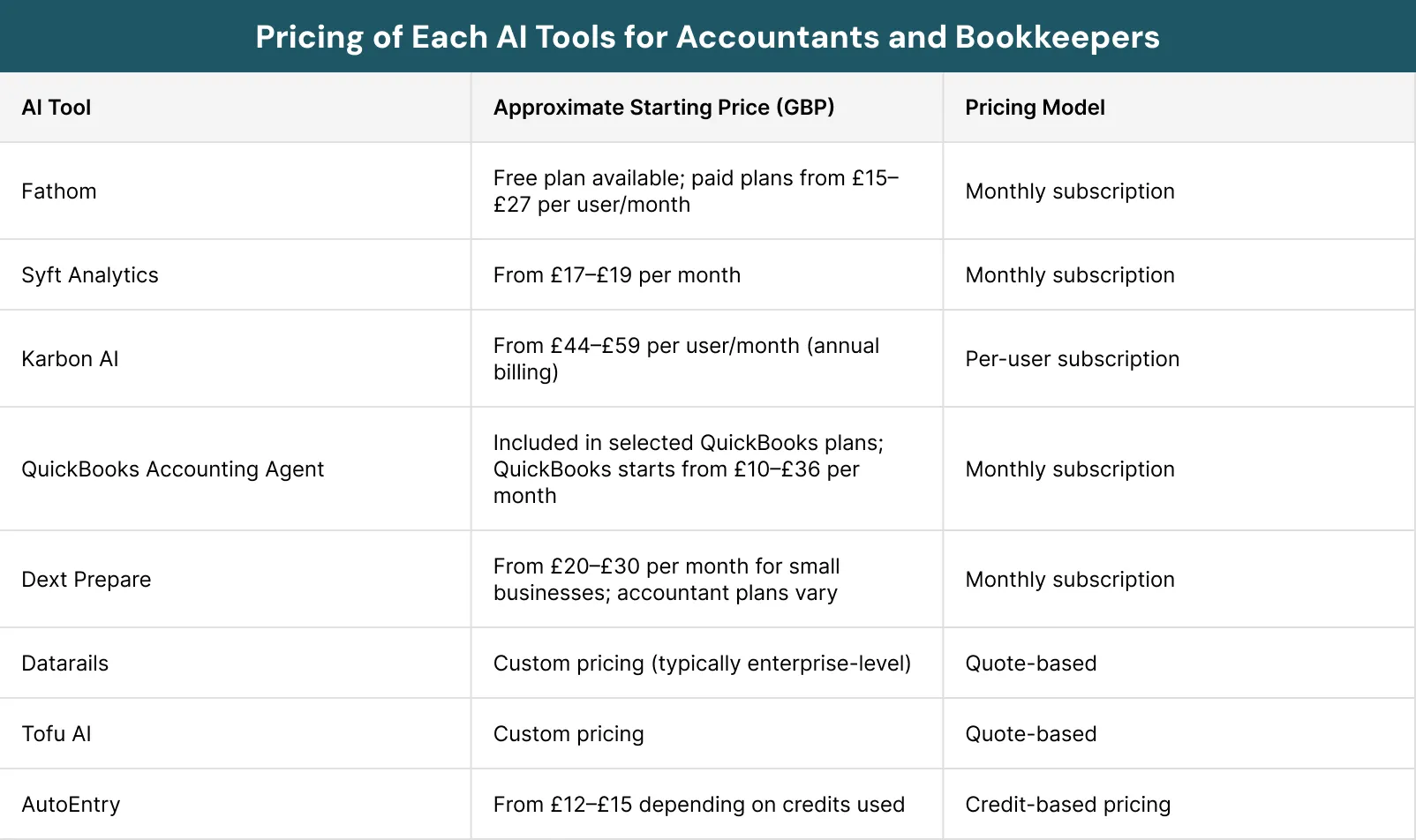
Pricing Disclaimer:
AI accounting software prices change regularly and may vary depending on the number of users, features, integrations and contract terms. Always check the vendor’s website for the latest pricing before making a purchasing decision.
What Do AI Tools for Accountants Do?
Modern AI tools for accountants help to automate the daily tasks. These tools can process the invoices and create financial reports.
The main goal of AI tools for accountants is to reduce manual effort. Instead of typing info into spreadsheets, accountants can now do this work with the help of AI in less time.
This helps firms to complete their work faster while keeping their records accurate.
Another advantage of AI tools for accounting is better visibility into business finances. AI can now spot unusual transactions and provide useful insights for better decision-making.
1. AI Bookkeeping Automation
Bookkeeping automation is one of the biggest uses of AI in finance. Many AI tools for accountants can now categorise the transactions automatically.
It helps to improve the consistency. During busy periods, human mistakes are common. AI applies the best logic at that time. This makes AI tools useful for reducing errors.
Read more: Essential Bookkeeping Tips Every Small Business Should Follow
2. AI Document and Receipt Extraction
Receipt and invoice processing can take a lot of time. But today, AI tools for accountants can scan the documents and pull out key info automatically. This includes supplier names, dates, totals and tax details.
OCR technology helps AI to read printed and hand written text from receipts and invoices. Many AI tools can even process the documents in different languages.
3. AI Reporting
Reporting is an area where AI tools for accountants are making a big impact. AI can now help to analyse the financial data in a proper way. It also generates insights about changes in revenue, profit and expenses.
These tools help you to create reports much faster. Instead of writing every detail manually, AI provides a draft version that you can edit.
Many firms are using AI tools for accounting to create better reports for clients.
“The accountant of today is going to be different from the accountant of tomorrow — and far, far different from the accountant of yesterday.”
— J.K. Aier
Benefits of Using AI Accounting Software
There are many reasons why firms are using AI tools for accountants. One of the biggest reasons is time-saving.
AI helps to reduce repetitive tasks and allows accountants to focus on more valuable work.
AI helps to improve the accuracy in financial records. Many AI tools can now detect the unusual transactions and possible mistakes before they become serious issues. This helps you to maintain cleaner books.
Another major benefit is better client service. Accountants can now provide more advice and support with less time spent on admin tasks.
1. Month-End Closures
Work at the end of the month is often stressful for finance teams. There are invoices to process and reports to prepare. But, AI tools for accountants help to speed up these processes.
AI allows firms to complete their reporting much faster. It processes large amounts of financial data within minutes.
Faster reporting also means that you can make quicker decisions as well. This is one of the biggest reasons why companies are adopting AI tools in 2026.
2. Reduced The Human Errors
Manual bookkeeping can often lead to mistakes, especially when staff are under pressure. AI tools help you to reduce these risks.
AI also helps you to detect the duplicate invoices and incorrect amounts. This creates a stronger layer of financial control for accounting firms.
Firms that use AI tools provide best reports and more reliable financial data.
Pro Tip:
Choose AI tools that fit your workflow, not just the ones with the most features.
3. Better Client Service
Today, clients expect more than simple bookkeeping. They want financial advice and business insights. AI tools for accountants help firms to free up time for these higher-value services.
When AI handles the admin work, they can focus on strategy and client support. This creates more opportunities for advisory services.
How to Choose the Right AI Tools for Accountants?
Choosing the right AI tools for accountants depends on the goals of your business. Some firms need faster bookkeeping, while others need better reporting.
For this, it is important to understand where your team spends the most time. The best AI tool should be able to solve your workflow problems.
You must compare the pricing and support options before choosing an AI tool.
1. Choose Based on Workflow Needs
Every firm works differently. Some firms process the large numbers of invoices, while others are focused on financial advisory services.
This is why businesses should select those AI tools for accountants based on their needs of daily workflow.
2. User-Friendly
Make sure the tool is easy to use. Its design should be clear. Even people with little tech info should be able to use it.
3. Evaluate Integration and Security Features
Security is a very important thing when you use AI software in finance. In this case, you should choose tools with secure data protection.
Integration is also essential. The best AI tools should connect easily with payroll systems.
Will AI Replace Accountants and Bookkeepers?
Many people think that AI will replace accountants and bookkeepers. In reality, AI tools are designed to support human work, not to remove it.
AI helps to handle the repetitive admin tasks, but accountants still have to give advice. Clients give more value to human work.
The role of accountants is changing rather than disappearing. AI simply allows them to work more efficiently.
Why Does Human Expertise Still Matter in Modern Accounting?
AI can process data quickly, but it cannot fully understand the needs of clients. Accountants still play a key role in financial decision-making.
Advice from professionals is very important during the audits and business planning. This is why firms still depend on experienced accountants.
Case Study: Deloitte Uses AI to Improve Accounting and Audit Work
Deloitte is a British auditing firm based in London. They faced the challenge of reviewing thousands of invoices, contracts and other records. These manual processes take time and increase the risk of human error.
After working with AI tools, they noticed that for reviewing the documents and transactions they take less time. AI helps them to identify unusual transactions.
Conclusion
The rise of AI tools for accountants is transforming bookkeeping and financial management in 2026. AI tools help you to save time, improve accuracy and also reduce manual work.
From reporting software to invoice process tools, AI is improving almost every area of accounting. Firms that adopt AI early are expected to remain competitive.
The future of finance will combine human expertise with AI. Businesses using AI tools effectively will be better prepared for growth.
At Sterling Cooper, we help you to choose the best AI tool according to your needs and goals. This helps you to work more efficiently, make smarter decisions and achieve your goals faster.
Ready to save hours on bookkeeping and reduce manual accounting work?
Contact us today and let our experts help you choose the best AI accounting software for your business needs.
FAQs
The best AI tool depends on your needs. Fathom is excellent for reporting, Dext Prepare is strong for document extraction, and Karbon AI works well for practice management automation.
No. AI automates repetitive tasks but still requires human oversight, professional judgement, and client communication.
QuickBooks Accounting Agent and AutoEntry are both strong choices for small businesses because they are affordable and easy to implement.
Most leading AI accounting platforms use strong encryption, audit trails, role-based permissions, and SOC 2 compliance to protect financial data.
AI reduces manual errors by automating transaction categorisation, reconciliation, anomaly detection, and invoice extraction processes.
Recent Posts