Posted by:
Admin
Date:
June 3, 2026
Category:
blogs
Business Strategy in 2026: How Companies Stay Competitive
Why do some businesses grow fast in 2026 while others struggle to keep up?
The answer lies in the usage of a modern business strategy built on adaptability, data and strong business growth strategies.
In 2026, business growth strategy is not a one time thing. It helps you in making decisions and setting priorities. It ties every part of your business together. Business strategy is now the central part of how organisations work. Markets keep shifting, customers have choices and technology keeps changing. The business strategy helps businesses navigate all this.
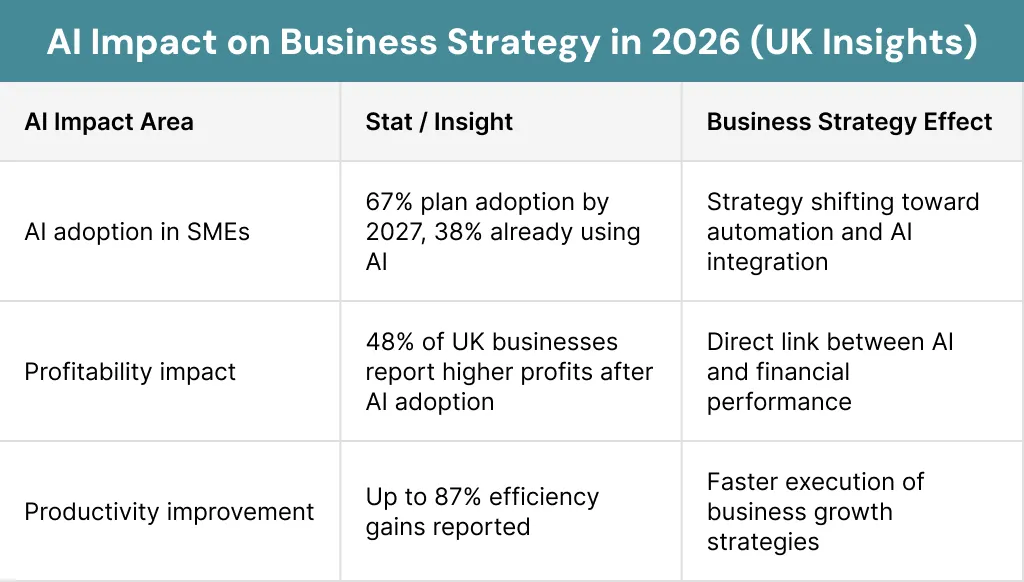
In the UK, 67% of small and medium sized businesses are going to start using AI by 2027 and 38% are already using it every day to get work done. This shows how fast Artificial Intelligence is becoming a big part of the modern business growth strategies.
A business strategy goes beyond planning. It means knowing what you want to achieve, keeping your team on the same page and following through. The companies thriving in 2026 are not necessarily those with the brightest ideas – they are the ones that turn ideas into actionable growth plans and pivot when circumstances demand it.
Key Takeaways
- Modern business strategy is no longer a static document but a continuous system that guides decisions, execution, and adaptation in real time
- A strong business strategy for business success focuses on clarity, alignment, and turning plans into measurable action rather than just ideas
- Effective business growth strategies are built on customer insight, competitive positioning, and the ability to respond quickly to market change
- Sustainable business growth comes from consistent improvements, strong execution, and data-driven decision-making rather than one-off breakthroughs
- Businesses that integrate AI and digital tools into their strategy gain faster insights, improved efficiency, and stronger competitive advantage
- Clear alignment between teams, leadership, and operations is essential for executing business development growth strategies effectively at scale
- The most successful organisations treat strategy as a living cycle, constantly refining their business growth strategies based on performance and feedback
What Is the Business Environment in 2026?
Understanding how businesses operate on a global scale has never been more important. Conditions shift quickly and that makes having effective business growth strategies essential for keeping pace with ongoing.
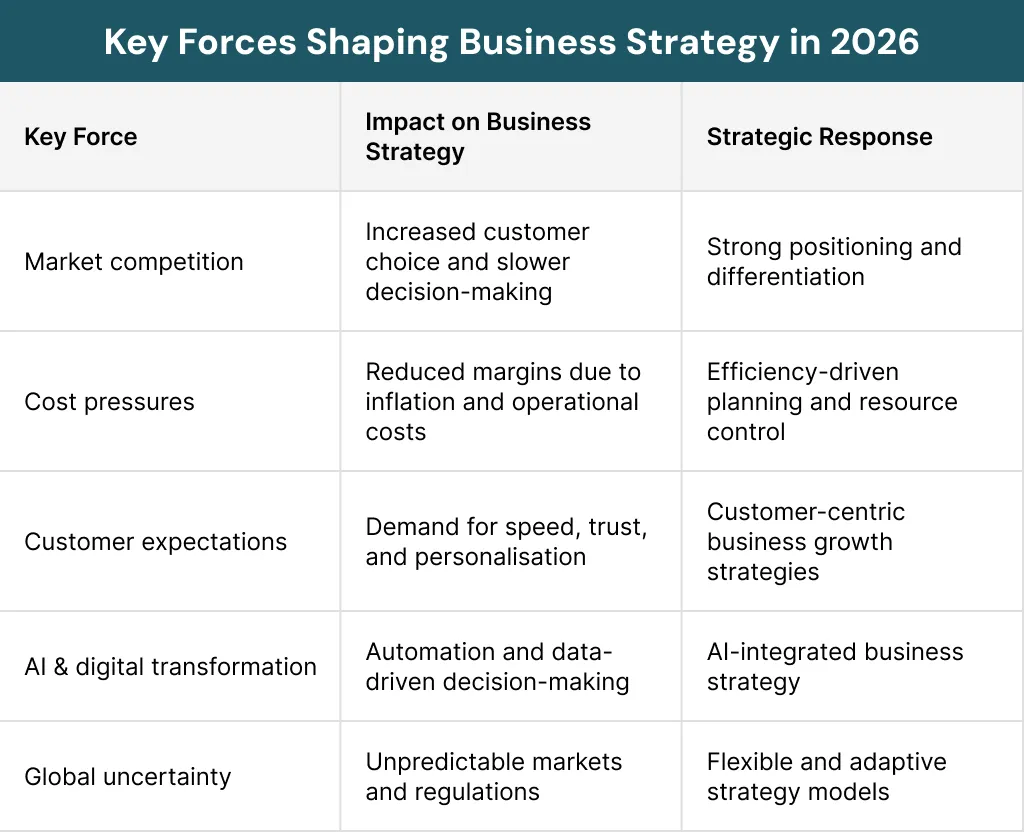
1. Competitive Markets and Customer Confusion
One of the biggest changes in business strategy is that most markets are really crowded now. Many industries now have lots of businesses offering much the same thing. That makes it harder to stand out and more important to have strong business growth strategies.
Nowadays, it is not enough to just have a good product. Businesses should know what they are selling and why it matters to customers.
2. High Costs and Low Profit Margins
Inflation has slowed down in some places but the pressure to pay more is still there. Things like wages, energy, raw materials and logistics are still making it hard for your business to make money.
Every decision matters for small and medium sized businesses. You have to reduce costs as well as investment in business growth strategies. Business strategy and financial discipline now go hand in hand.
3. Changing Customer Expectations
The behaviour of customers has changed a lot. People now care more about the experience they have with your business. They trust the company and feel like they are getting good value for their money. It is not about the price of something anymore. Customer behaviour is really about ethics and sustainability too.
So businesses need to think beyond what they charge. How customers feel about your brand and whether they trust you, plays a big role in long term customer relationships.
4. AI and Digital Transformation
AI is now part of day to day business strategy. It is used for marketing, customer support, forecasting and automation.
It helps businesses move faster and make better decisions as part of core business growth strategies. Data and AI are no longer nice to have, they are central to how modern businesses grow.
In the United Kingdom, 48% of businesses say they make profits after using Artificial Intelligence. A lot of these businesses see their money grow double or more.
5. Global and Economic Uncertainty
In today’s world, businesses have to deal with a lot of changes. One day everything is fine, other days it is not. Rules can change suddenly. Supply chains stop working. The economic conditions can change fast. This means being flexible is very important and a core part of a good strategy in 2026.
What Is a Business Strategy in 2026?
Now after understanding the world businesses are working in, you can look at what business strategy actually means today.
Modern business strategy is the set of decisions and actions that guide how a company competes. It is not a one-off plan, it is ongoing and adapts as things change. It also links closely to business growth strategies that help build long term value.
Strategy without tactics is the slowest route to victory. Tactics without strategy is the noise before defeat. – Sir Winston Churchill, British Prime Minister
1. Strategy Beyond Planning
Strategy is more like a roadmap that shows where a business is going and how it will achieve its goals. But it also has to flex when conditions shift.
2. Strategic Value Creation
At the core, business strategy is about making things valuable for your customers, staff, suppliers and the business itself. Without that, even the best execution will not lead to long term success.
3. Strategy as an Ongoing Process
In 2026, a good business strategy works best when you think of it like a system, not a written document. It links your actions, goals, feedback and changes into one cycle. You decide on a direction, take action, learn from the results and then make adjustments as needed to your strategy and goals.
What Are the Levels of Business Strategy in Modern Organisations?
The business strategy needs to break down into levels to understand how it works inside a company. Each level has a different role to play and all of these need to work together.
1. Corporate Level Strategy
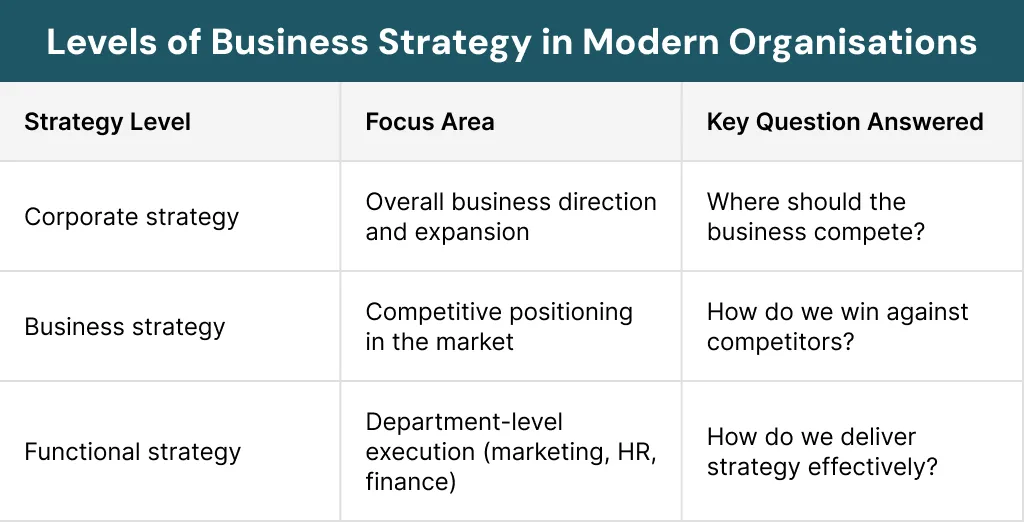
This is the top level. It looks at the big picture; which markets to be in, whether to grow, merge or pull back and where the business is headed long term.
It answers questions like:
- Which markets should we enter?
- Do we diversify, expand or merge?
2. Business Level Strategy
This level is about how your company competes in a specific market. It includes:
- How do you position your company?
- How does your company set prices?
- What makes your company different from others?
It answers questions like:
- Why do customers choose us over others?
- How do we stay ahead against competitors?
3. Functional Level Strategy
This is where each department plays its part; marketing, finance, HR, operations and so on. Every function supports the wider business strategy through day to day actions.
For example:
- Marketing creates awareness and demand
- Finance manages costs and investment
- Operations keeps delivery running smoothly
4. How All Levels Connect Together
Businesses run better when all three levels are working together. Corporate strategy decides the direction. Business strategy defines how you compete. Functional strategy makes everything work at the ground level.
How to Build a Strong Strategic Foundation?
A clear direction is required to start a good business strategy. Many organisations tie this to their business growth strategies right from the start.
1. Vision, Mission and Core Values
A vision shows you direction or where you want to go. A mission explains what the business does. Values help people understand how to behave and make decisions.
These three things keep everyone working towards the same goal, across teams and over time.
2. Setting Strategic Goals
Successful businesses do not try to do everything. They prioritise important things and try to achieve them. When you try to do too much at once, you usually end up doing none of it well.
3. Clear and Measurable Goals
Every plan needs goals that you can track. You need to focus on goals, like:
- Revenue growth
- New customer
- Keep existing customer
If you cannot measure something, it is tough to control it.
4. Use KPIs to Track Progress
Key performance indicators tell you whether the business strategy is working or not. These indicators are:
- Conversion rates
- Customer acquisition cost
- Retention
You should check them often. Then act on what they show.
5. Current Market Position Analysis
Before you decide where to go, you need to know where you are now. That means being honest about your performance, your customers and your place in the market.
What Is Market and Customers?
A good business strategy is built on knowing your customers well. And to do that, you need business growth strategies for data and real research not guesswork.
1. Customer Behaviour in 2026
Customers take time to make a purchase. They do research, compare different options and read reviews. They often involve people in their decision making process. The path to buying something has become longer and harder to predict than before.
2. PESTLE Market Analysis
Businesses use a tool called PESTLE to understand what is happening around them. PESTLE helps them look at six areas:
- Political conditions
- Economic trends
- Social changes
- Technology shifts
- Legal requirements
- Environmental pressures
3. Gathering Customer Insights
Surveys, interviews and customer behaviour data help your business understand what customers really want. The more you listen to customers, the better your strategy becomes.
4. Customer Journey Mapping
The customer journey starts when they first hear about you. It ends when they make a purchase. Sometimes it ends without a purchase. That is where they drop off. You need to track this to improve the customer journey.
5. Insight Driven Decision Making
When businesses use data to make decisions, they are able to target their customers better, waste less money and convert more people into buyers. Data without action is simply information that adds no value. The main goal of using data is to make smarter decisions.
What Is Competitive Positioning and Value Creation?
You really need to know your customers and your market. Then you can figure out where you stand against your competitors. This is important because if you do not have an idea of where you stand, your business growth strategies will be expensive and not very effective.
1. Value Proposition
A value proposition tells customers why they should choose you over others. When it is clear and strong, customers see your value quickly. This makes marketing easier and more consistent because you can repeat what makes you special.
2. Risks of Weak Positioning
When your business positioning is unclear, customers get confused. They take a long time to make a decision. This means you will end up spending more money on marketing. You have to explain your value repeatedly, which is not good for business. Your positioning is key so you need to get it right.
3. Define your Competitive Advantage
Your competitive advantage is what makes you stand out from others. It can be:
- Price
- Quality
- Speed
- Service
- Innovation
When you figure out what your competitive advantage is, you can make a plan that is more focused on that. You can build a business strategy around your competitive advantage.
4. Market Gap Analysis
Gaps appear when customer needs are not being met or when rivals are falling short. These are your best chances to move into new areas and grow faster than the competition.
5. Competing in a Saturated Market
It is crucial to stand out in a busy marketplace. You need to show what sets you apart. This is important because it helps customers understand why they should choose you. When you focus on results customers start to trust you. As trust grows, customers are more likely to return.
What Is the Role of Digital Transformation and AI in Strategy?
The core part of business strategy in 2026 is technology. It shapes how companies plan, run and compete in real time. AI-driven business growth strategies are no longer nice to have. It is a basic requirement for staying competitive.
1. AI in Business Operations
AI is taking over tasks like reporting, forecasting and customer support. This helps teams to do jobs that actually need ideas and thinking. Decisions get faster and more data driven.
2. Improve Efficiency with AI
Artificial intelligence is turning large amounts of data into useful insights. It helps businesses see trends, track how they are doing and make decisions quickly. This means less guesswork and more confidence.
3. Digital Tools as Core Infrastructure
Systems like CRM, analytics and finance tools are now the backbone of how businesses run. They connect departments and help improve visibility. It also helps companies grow in a structured way without losing control.
4. Grow your Online Presence
Most customers usually start their shopping online. That means your website, search visibility and social media are not optional extras – they are the primary ways people find you and decide whether to trust you.
5. Smart use of Automation in Business
Technology should support people in making decisions, not replace them. AI is good for speed and analysis. But context, creativity and big strategic calls still need a human touch.
What Is Marketing as a Connected Growth System?
In 2026, marketing and sales teams should work together not apart. When they are joined up, everything works better. And consistency matters far more than short term efforts in business strategy, improving long term business growth strategies.
1. Marketing Beyond Campaigns
Modern marketing is not about doing one campaign and expecting it to work. It is about creating a system where your strategy, content, sales and data all work together. When these parts work together, marketing becomes more structured and the gap between planning and execution gets much smaller.
2. Data Driven Marketing and Sales Alignment
The best results happen when marketing and sales teams work together. Shared data helps both teams see what works and what does not. This helps them reduce miscommunication and move quickly when a good chance comes up.
3. Data Driven Marketing Decisions
Marketing decisions should be based on facts, not on gut feeling. When you understand how customers act and what gets results, you can spend money wisely and avoid wasting it. Having data makes you more sure about every decision you make.
4. Long Term Consistency
Showing up regularly is very important. It is better than doing a lot of work and then stopping. When you stay consistent, people start to trust you. You also become more visible to people. This gives you better insights over time. Short campaigns can give quick results but they do not usually create lasting momentum.
5. Improving Team Alignment
When teams work in isolation, things slow down. You get mixed messages, delays and patchy results. Clear systems and shared goals fix this. When everyone works together, things get done faster and better.
What Is Innovation and Continuous Improvement?
Innovation is important for every business strategy. It is not just about making new products but also about services, systems and how customers experience your business. The companies that do well are the ones that try out new ideas. They listen to what people think of these ideas and make small changes over time.
Did You Know?
Most business growth doesn’t come from big breakthroughs – it comes from small, consistent improvements made over time.
1. Innovation Beyond Products
Innovation is not about coming up with something new. It also means improving:
- How you deliver a service
- How your internal systems work
- How customers interact with your business
This bigger picture helps companies stay relevant when the market changes.
2. Test and Learn Strategy
The best way to grow is to try things in steps. Then you can learn from what happens. Feedback loops are very helpful. They show you what is working and what is not. This process of testing and then refining things really helps you in making decisions.
3. Adapting Business to Customer Values
Customer values are shifting especially around trust, ethics and sustainability. Businesses that ignore this risk falling behind. Those that adapt stay relevant and keep the trust of their customers.
4. Market Expansion and New Audience
Growth is not about doing the same things over and over. When you reach new people or move into new markets, you are not relying on just one group of people anymore. This means you can get fresh income streams. It also spreads risk.
5. Turn Limits Into Strengths
Budget cuts, tough competition and limited resources can feel like problems. They often make businesses think more carefully and come up with better ideas. The best ideas often show up when you are working with limited resources, not when you have everything you need.
What Are People, Skills and Company Culture?
A good business strategy is not enough on its own. You need to have the right people to make it work. Strong business growth strategies depend on capable teams. If you do not have the right team and culture, then even the best business strategy will not be successful.
1. People First Strategy
People are what make strategy real. Their skills, choices and day to day actions decide whether goals are hit or missed. You can have a brilliant plan but without the right people behind it, it goes nowhere.
2. Competing for Skilled Talent
Most companies are having a hard time finding the right people with the skills they need. The competition for people is really tough especially in fast moving industries. This is not going away any time soon.
3. Invest in Your Workforce
Businesses that train and develop their teams build strength from within. Upskilling staff improves performance and means you rely less on outside hiring over time. It also sends a clear message that you value the people you already have.
4. Flexibility in the Workplace
Work has changed. Most people now expect some level of flexibility or hybrid working. Businesses that offer this find it easier to bring in good people and hold on to them.
5. Culture Driven by Leadership
Strong leaders create a culture where people feel trusted to make decisions and take ownership. Teams that are empowered move faster and handle challenges better. Culture is not a soft extra, it is a core part of how a business performs.
What Is Financial Planning?
Financial discipline is a core part of business strategy. It helps businesses manage money, reduce risk and stay stable when market conditions change. Without tight financial control, even a profitable business can run into serious trouble.
1. Budgeting for Future Growth
Careful spending plans help make sure money goes where it is needed most. Budgeting and forecasting keep growth on track and stop resources being wasted in the wrong areas.
2. Cash Flow Management
Cash flow is the lifeblood of any business. Poor cash flow control is one of the main reasons small businesses fail. The issue is not lack of profit, but lack of cash at the right time.
3. External Funding Options
Loans, investment and other forms of finance can help businesses grow when internal funds are not enough. Knowing what is available and when to use it is an important part of financial planning.
4. Financial Risk Management
Every business faces financial uncertainty. Having a plan for unexpected changes helps reduce the impact when things do not go as expected. The goal is to stay stable, not just survive.
5. Causes of Financial Failure in SMEs
Weak financial planning and poor cash flow control are behind many SME failures. Without financial discipline, long term instability is almost inevitable.
What Is Risk Management in Modern Business Strategy?
A good business strategy includes planning for things that could go wrong. Businesses that develop business growth strategies are far better placed to handle disruption when it comes.
1. Market and Competitive Risk
Markets can shift fast when new rivals arrive or existing ones change their game. These moves can reduce demand or change what customers expect, sometimes overnight.
2. Operational and Supply Chain Risk
Delays, system failures and internal inefficiencies all carry risk. Supply chain problems can hit product availability and knock overall performance off course.
3. Regulatory and Compliance Risk
Laws and rules change. Businesses that fail to keep up can face fines, restrictions or worse. Staying on top of compliance is not optional, it is part of running a responsible business.
4. Strategic Scenario Planning
Scenario planning helps businesses think through what could happen and how they would respond. Having a backup plan means you can respond quickly when things take an unexpected turn.
5. Diversification for Business Resilience
It is helpful to spread your income across different products or markets. It reduces your reliance on one source of income. If one product does not do well, other products help keep the business stable.
How to Measure Performance and Adapt Strategy?
Business strategy is not something you set once and leave alone. It needs to be measured and improved on a regular basis. The more you evaluate, the more flexible and effective your strategy becomes over time.
1. Key performance indicators (KPIs)
KPIs are the key numbers that tell you how the business is doing. Common KPIs include:
- Customer retention
- Conversion rates
- Cost of acquiring new customers
Pick the ones that matter most and track them closely.
2. Smart Data Management
Decisions can become harder because of too much data. You should focus only on the metrics that give useful insights. Keep it simple and stay clear.
3. Strategy as an Ongoing Process
Strategy should shift based on real results, not stay fixed because that is how it was written. Businesses that keep improving based on what they learn stay relevant far longer.
4. Strategic Pivoting
If performance keeps falling, it might be time to change direction. The decision should be based on clear data and honest analysis, not panic or guesswork.
What Is the Strategic Planning Cycle in 2026?
Strategy in 2026 is not a once-a-year exercise, it is an ongoing cycle that shifts with the market. Businesses refine business growth strategies based on feedback and results. It also keeps getting sharper over time.
Smart Insight:
Companies that treat strategy as a weekly conversation, not a yearly document, adapt faster and make fewer costly mistakes.
1. Continuous Strategy System
Strategy is not a fixed document, it is something that evolves. As markets, customers and technology change, your direction needs to change with them.
2. Regular Strategy Reviews
Regular check-ins help you understand what is working and what is not. Feedback from customers and performance data make your decisions sharper and your learning faster.
3. Annual vs Ongoing Strategic Planning
A once a year planning cycle is no longer enough. Businesses that treat planning as an ongoing process can respond to change as it happens, not months later.
4. Result Driven Improvement
The best strategies get better over time because businesses learn directly from what happens. Use your results to sharpen your goals and adjust your direction. Keep learning, keep improving.
What Is Strategy Implementation?
Having a great plan means nothing if it is not carried out well. Many businesses fail not because their strategy is wrong, but because execution is weak or patchy. Clear business growth strategies ensure alignment.
Quick Tip:
If your team cannot explain your business strategy in one sentence, it’s already too complicated to execute effectively.
1. Accountability and Role Clarity
Everyone needs to know what they are responsible for. Clear roles reduce confusion and make sure nothing slips through the cracks.
2. Goal Driven Team Alignment
When everyone knows where the business is headed, their daily work supports the goals. The team’s efforts work together towards the goals. Everyone’s work adds up to make progress. The team work becomes more effective.
3. Resource Allocation and Prioritisation
Time, money and people are limited. Direct them to the priorities that will have the biggest impact. Poor allocation slows everything down.
4. Monitor Progress and Adjust Strategy
Check in regularly to see whether things are on course. When performance changes, act quickly, do not wait for the next review cycle.
5. Reducing Planning and Delivery Gaps
The most common strategy problem is the gap between what was planned and what actually gets done. Strong execution means your strategy lives in the real world, not just on a slide deck.
Case Study
Amazon is an example of a modern business strategy that really works. It began as a bookstore and then grew into a huge business that does e-commerce, cloud computing, logistics and AI.
The reason Amazon is so successful is that it thinks about the customer first and wants to help them in the run. The company makes decisions that make things faster, easier and more valuable for the customer.
This way of thinking helped create things like Amazon Prime, AWS and same day delivery. Amazon does not stick to one plan. Instead it keeps putting money into technology, automation and innovation.
This shows how a clear and flexible plan can turn an idea into a huge business all around the world. Amazon is an example of this. It keeps changing and growing.
Final Thoughts
A good business strategy in 2026 is built on three things:
- Being clear
- Staying aligned
- Adapting fast
Businesses need to know their customers well, use technology wisely and make sure their teams pull in the same direction.
Some companies do really well and they do not always make a lot of plans. The best way to run a business is not fixed. Business strategy gets better over time and it is supported by good business growth strategies.
In the end, modern business strategy is about execution, staying focused and learning as you go. Business growth comes down to how well organisations put their plans into action in real time, not on paper.
Sterling Cooper understands the value of clear, consistent and actionable business strategy. We help businesses turn strategy into practical and results driven business growth strategies that deliver actual outcomes. Contact us today for digital marketing and strategic support.
Struggling with cash flow, reporting, or financial planning?
Sterling Cooper Consultants helps businesses improve treasury management, financial reporting and work efficiency with practical support.
Ready to strengthen your financial processes? Reach out today if you want to manage your accounting reports flawlessly.
FAQs
The difference between treasury and accounting is their financial focus. Accounting manages reporting and compliance, while treasury focuses on cash flow, liquidity, and financial risk.
It depends on your interests. Treasury analysts focus more on forecasting and liquidity, while accountants focus more on reporting and compliance.
Treasury and accounts payable teams work together to manage supplier payments and maintain healthy cash flow across the business.
The advantages and disadvantages of the treasury single account include stronger financial control and better visibility, but also possible operational delays and implementation challenges.
Treasury helps businesses manage liquidity, improve cash flow, and reduce financial risk during uncertain market conditions.
Recent Posts

How to Build a Cash Reserve for Business Stability
August 11, 2026

How to Forecast Cash Flow During Economic Uncertainty
August 6, 2026