

Posted by:
Admin
Date:
April 15, 2026
Category:
blogs
Business Growth Strategies: A Complete Guide to Planning, Execution and Long Term Success
Do you think having a steady business is enough success? If so, then you are missing out on so much. Businesses are meant to grow, yet very few achieve it in a controlled way. Many firms show early promise, then struggle to keep that pace as they grow.
Data from the UK’s Office for National Statistics shows that the five-year survival rate for businesses is just 38.4%, meaning fewer than four in ten firms remain active after five years.. This shows a clear truth. Growth is possible, but it rarely happens without a clear plan.
This is where business growth strategies become essential. Growth is not just about higher income. It is about making the right choices about where to invest, which markets to enter and how to use time and money well.
For accounting professionals and new business owners in the UK, the task can feel more complex. Financial control, rules and cash flow all play a part. Well planned business development growth strategies help link financial discipline with long term goals.
Key Takeaways
- Sustainable business growth does not happen by chance. Define measurable goals, identify where growth will come from (clients, services or markets) and align financial planning accordingly.
- Rely on real financial data (cash flow, profit margins, client acquisition costs) rather than assumptions. Strong finance tracking helps identify what is working and where to invest.
- Especially for small business growth strategies, prioritise activities that deliver the most value with limited resources, such as improving existing services or targeting profitable client segments.
- Retention and upselling are often more cost-effective than acquiring new clients. Regular communication, added value services and trust-building can significantly increase lifetime value.
- Do not rely on a single approach. Blend strategies like market expansion, service innovation and operational efficiency to create balanced and resilient growth.
- Successful execution depends on team alignment, clear communication and the right systems. Growth strategies fail when internal operations cannot support expansion.
- Monitor key metrics (sales growth, retention, profitability) and stay flexible. Markets change, so your business growth strategy should evolve to remain effective.
Why Business Growth Strategies Matter in Today’s Market?
The business world has become more crowded and less stable. New firms enter the market while clients expect better value and faster service.
Without clear business growth strategies, businesses often react to short term pressure instead of working towards long term goals. This can lead to mixed results.
A clear plan brings focus. It helps decision makers choose what matters most, instead of trying to do everything at once. Over time, this builds a stronger and more stable business.
For smaller firms, this matters even more. Many small business growth strategies fail not because the idea is weak, but because there is no clear direction. With fewer resources, it is vital to make the right choices early.
Planning a Business Strategy for Sustainable Growth
A steady growth always requires proper planning. Let’s discuss it below.
What a Growth Strategy Really Involves?
A growth strategy is more than a target for higher sales. It is a clear plan that shows how that growth will happen and how it will last.
Planning a business strategy means finding the right balance between big goals and real limits. Businesses need to aim high, but they must also stay within what they can manage.
If this balance is not right, growth can create pressure. Teams may feel stretched, systems may slow down and costs may rise too fast.
Key Elements of Business Development Growth Strategies
Strong business development growth strategies are built on a few key parts:
- There must be clear and measurable goals. Vague aims often lead to weak results.
- Businesses need a strong view of their market, including what clients want and what rivals offer.
- Financial planning must support the plan. Growth needs funds and those funds must be used with care.
For example, a UK accounting firm may aim to raise income by 25% over two years. To do this, it must decide where that growth will come from. Will it come from new clients, new services, or higher value work? Each path needs a different plan.
The Role of Financial Insight and Data
Good data helps businesses make better choices.
Finance teams play a key role here. They track income, costs and profit. They help show which areas are doing well and which need work.
A strong business growth strategy always relies on real figures, not guesswork.
Learn more about how you can assess your risk tolerance before investing.
Types of Business Growth Strategies Explained
There is no single way to grow a business. The right path depends on the firm, the market and the resources it has. Given below are the few such strategies:
1. Organic Growth Approaches
Organic growth comes from within the business. This may include more sales, better service, or smoother ways of working.
External growth comes from outside actions, such as buying other firms or forming deals.
Both are part of wider business growth strategies and many firms use a mix.
2. Improving Efficiency
Growth is not always about doing more work. In many cases, it comes from doing work in a better way.
By improving systems, cutting waste and using better tools, businesses can increase output without raising costs too much. This is very useful for service based firms.
3. Expanding Into New Markets
Many business development growth strategies focus on reaching new clients. It is about moving into new areas and serving new types of customers.
For example, an accounting firm that works with small local firms may start to serve larger companies. This step needs care but can bring strong results.
4. Innovation
New services can open up new income streams. Innovation does not always mean big change. Most often it is about making current services more useful. This is common in small business growth strategies, where firms can adjust quickly.
The Most Effective Small Business Growth Strategies
Recent data shows signs of steady progress. Small and medium sized businesses have started to recover, with average profits rising by 6.2% over the year to the end of 2025, reaching their highest level in four years.
Small firms often have fewer resources, so their plans must be clear and focused. The following strategies can be followed to achieve steady growth:
1. Focused Growth
Many small business growth strategies aim to get the best results with limited cost. It means focusing on the work that brings the most value.
2. Building Client Relationships
The most important factor which is usually missed out is ‘clients.’ Clients play a big role in growth. Happy clients stay longer and often bring new business. This makes client care one of the most trusted business growth strategies.
3. Using Digital Tools to Scale
Digital tools have made growth easier in many ways. They allow firms to reach more people without big costs. For example, cloud systems allow firms to serve clients across the UK without the need for more offices.
New Business Growth Strategies Used by Leading Firms
As firms grow, their plans often become more detailed. Here is a glimpse:
1. Strengthening the Business
A large part of growth comes from what a firm already does well. Making core services strong helps build a solid base. This is a key part of many business growth strategies.
2. Expanding Into Markets
Growth can also come from moving into other areas. These areas may be related to the main business. For example, an accounting firm may add advisory services to its main work.
3. Making New Revenue Streams
Some firms create new lines of work. This can lead to higher returns, though it also carries some risk.
These plans often form part of wider business development growth strategies.
Get to know about business consulting strategies, benefits and best practices for growth.
Business Transformation Strategy
At certain stages, incremental growth is not enough. Businesses may need to rethink their entire approach. This requires a major shift.
A business transformation strategy becomes relevant when existing methods become obsolete. This may happen due to market changes, technological shifts, or internal limitations.
How to Achieve a Successful Transformation?
Transformation requires commitment at all levels of the organisation.
Key elements include:
- Clear leadership direction
- Investment in technology
- Alignment between departments
Without these, change efforts often fail.
Aligning People and Processes
Growth is not just about numbers. It involves people and culture. Employees need to understand the direction of the business and feel part of the journey. This alignment supports the execution of business development growth strategies.
Business Growth Strategy Framework
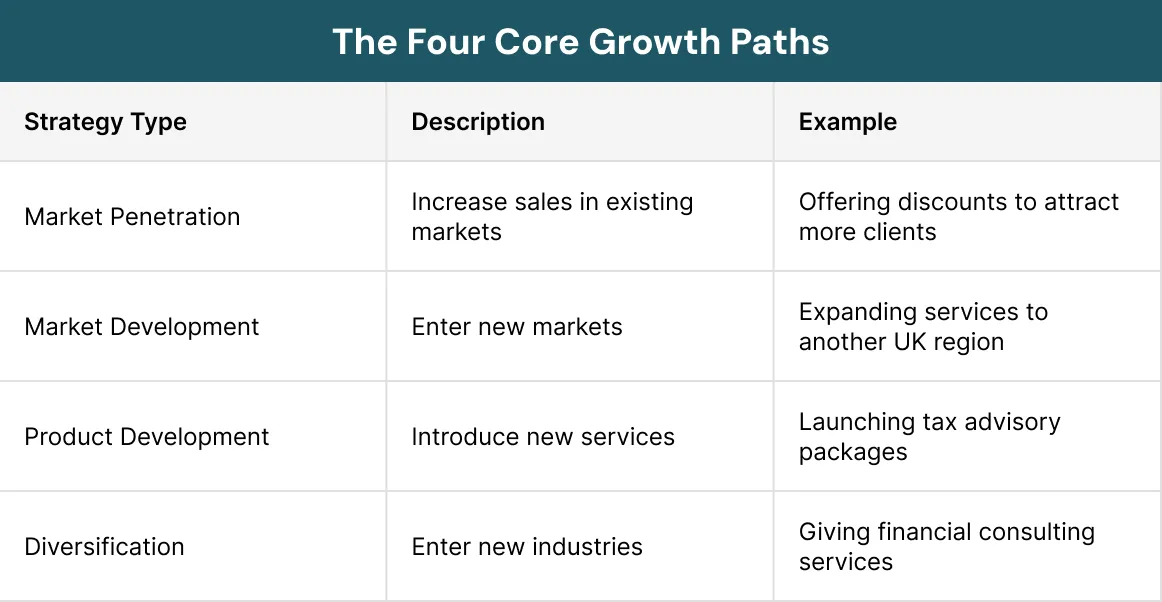
Different paths can lead to one destination and the same goes for growth as well. Most businesses rely on structured frameworks for decision making. These frameworks simplify complex decisions and provide clarity. One widely used such model is given below in the table:
Combining Approaches
Rarely does one method deliver all the results. Effective business growth strategies often combine several approaches.
For example, a firm may improve existing services while also exploring new markets. This balance reduces risk and increases potential returns.
Examples of Growth in the Real World
Getting a general idea is useful, but real cases make things clearer. Looking at how firms grow in practice helps show how business growth strategies work day to day.
1. From Existing Clients
A mid sized UK accounting firm chose to grow by doing more work with its current clients. It did not rush to find new ones. Instead, it improved how it served the clients it already had.
The firm added regular check-ins and gave clear advice on cash flow and tax planning. Over time, clients began to rely on the firm for more than basic services.
This is a strong use of business development growth strategies. The firm built deeper ties with clients. This led to more work and steady income. Referrals also started to increase. So it helped bring in new clients at a low cost.
2. Through Partnerships
A small consultancy firm formed a link with a legal service provider. Together, they offered a combined service for new businesses. This gave both firms access to a wider client base without the need for large spending. It also made their offer more useful to clients.
This approach is common in small business growth strategies. It allows firms to grow in a controlled way while sharing risk.
3. Through Innovation
A finance firm improved its service by giving clients access to live reports through an online tool. This change was not large, but it had a clear impact. Clients valued the ease and speed of access. The firm saw higher client retention and new interest from other businesses.
This is a clear business strategy example. It shows that small, well planned changes can lead to strong results.
Key Points From These Examples
A few points stand out from these cases:
- Growth often starts with what a firm already does well
- Strong client ties lead to steady income
- Simple changes can bring clear gains
This shows that effective business growth strategies do not always need to be complex. They need to be well thought out and applied with care.
Stages of Business Growth
Growth does not follow a straight path. Each stage of a business needs a different approach. Here are these stages:
1. Start Up Stage
At the start, the main goal is to test the idea and find what works. Income may be low and the focus is on learning.
Many small business growth strategies at this stage are based on trial and quick feedback. The aim is to build a base that can grow over time.
2. Growth Stage
Once the business finds demand its focus shifts to scaling. This means more clients and better systems.
At this stage clear business development growth strategies help keep growth under control. Without a plan fast growth can lead to errors and rising costs.
3. Mature Stage
Here growth may get slow. The business has a stable base while the focus turns to improving efficiency and protecting profit.
Refining existing business growth strategies helps maintain strong results even when growth is not rapid.
4. Change or Renewal Stage
At times, a business may need to change its direction. This can happen when markets shift or when old ways stop working.
A clear business transformation strategy helps guide this change. It allows the business to adapt and stay relevant.
How to Turn Strategy Into Measurable Growth?
Planning is only one part of the process. Real results come from strong execution. Some of the ways used for growth are given below:
Using Resources in the Right Way
Funds, time and staff must be used with care. Each investment should support the main goals of the business.
Finance teams play an important role here. They help track spending and ensure that resources are used where they bring the most value.
Strong business growth strategies always link to the careful use of resources.
Building a Culture That Supports Growth
People are key to any plan. Teams need to understand the goals and feel part of the process.
When staff are aligned, business development growth strategies are more likely to succeed. Clear roles and good communication help reduce errors and improve results.
Tracking Progress
Growth must be measured. Without clear tracking, it is hard to know what is working.
Key measures include:
- Sales growth
- Cost to gain a client
- Client retention rate
- Profit levels
These figures help refine business growth strategies over time and keep the business on the right path.
Common Challenges in Business Growth Strategies
Even strong plans can face problems. Being aware of these helps reduce risk. Some common issues faced by businesses are:
Lack of Direction
When goals are not clear, efforts become scattered. Teams may focus on tasks that do not support growth. A key part of effective business growth strategies is clear direction.
Poor Use of Resources
Limited funds can slow growth. This is a common issue that arises while making small business growth strategies. Careful planning and regular review help avoid this problem.
Resistance to Change
Change is usually hard for workers to accept. Some may prefer to stick with old ways. A well planned business transformation strategy helps guide change and reduce the pushback.
Dependence on One Approach
Relying on a single method can be risky. If it fails, growth may stop. That is why strong business development growth strategies involve more than one approach to reduce this risk.
How to Choose the Right Business Growth Strategy?
Each business is different, so the right approach will vary. For this you need to:
Understand Your Goals
Start with clear goals. These will shape your business growth strategies and hence guide your decisions.
Know Your Strength
You must look at your strong points such as skills, team and tools. Choose a path that sits well with what you already do well.
Balance Risk and Reward
Every choice has some risk. The aim is to manage it while still aiming for growth. This is very important in small business growth strategies, where resources are limited.
Stay Flexible
Markets change over time. Plans should be able to adjust when needed. Flexible business growth strategies help businesses stay on track even when conditions change.
How to Build Long Term Growth?
Growth takes your time and effort. It is not just about ideas but about doing the right things in the right way. Many businesses know they want to grow, but they are not sure how to move forward.
Initially, growth can feel a bit challenging. It is also hard to achieve, mainly when financial decisions carry long term implications. With the right support, the process becomes more manageable.
Sterling Cooper Consultants work closely with businesses to develop solutions that suit their needs. From advising on small business growth strategies to supporting large scale expansion, our emphasis is always on clarity and results.
Contact us today to take the next step towards smarter, sustainable business growth with expert guidance tailored to your goals.
Ready to implement effective business growth strategies that deliver real results?
Partner with experts who combine financial insight with practical execution. Get in touch with our team today and grow with confidence.
FAQs
The most effective small business growth strategies focus on retaining clients, managing costs, and targeting the right market. These approaches help build steady income without putting too much strain on resources. Over time, they support controlled and sustainable growth.
Planning a business strategy is essential before any expansion. It helps align growth with financial capacity and market demand, which reduces risk. A clear plan also ensures that resources are used in the most effective way.
Yes, a well structured business transformation strategy can support growth. It helps businesses adapt to market changes and improve how they operate. This often leads to better performance and new growth opportunities.
A simple business strategy example is offering more services to existing clients. This increases revenue without needing large new investments or major changes. It also helps strengthen client relationships over time.
Business development growth strategies focus on expanding opportunities such as partnerships, new markets, and client acquisition. In contrast, general strategies may cover broader areas like operations and management. This makes development strategies more focused on growth outcomes.
Recent Posts

How to Build a Cash Reserve for Business Stability
August 11, 2026

How to Forecast Cash Flow During Economic Uncertainty
August 6, 2026