
Posted by:
Admin
Date:
March 10, 2026
Category:
blogs
What Is IR35 and Why Does it Matter?
Are you worried about paying the right taxes? Understanding tax rules while running a business or working as a contractor can feel difficult.
Tax rules are known to frequently change and many guides do not clarify them thoroughly. This is why people are afraid that they’ll mess up. The issue is that most people struggle to know how IR35 impacts their tax and hiring decisions.
The UK government estimates that changes to IR35 rules may affect around 120,000 private and voluntary sector contractors. This affects a lot of workers and businesses across the UK. It mainly impacts day-to-day choices about:
- Hiring
- Contracts
- Taxes
This blog will help you learn:
- What Is IR35
- Why It Causes Confusion
- Why These Rules Exist
- Inside IR35 vs Outside IR35
- How a Status Is Decided
- Common Mistakes
- Risks and Limits
- How The Rules Affects Different People
- Documents That Support Outside IR35
- How Businesses Can Decrease Compliance Risk
- Why Is It Important Today
- How Professional Guidance Helps
- UK Case Laws
What Is IR35
IR35 is a tax rule in the UK. It allows HMRC to check, for tax purposes, if a contractor is genuinely self-employed or working as an employee. This regulation decides if an income is taxed through PAYE or as business profits. Tax rules can change and confuse business owners and contractors.
IR35 was designed to prevent unauthorised employment.
These rules were enforced in 2000 with three key points:
- Employees pay tax through PAYE
- Businesses pay their own taxes
- Contractors who work as employees should not pay less tax
Why It Causes Confusion
Uncertainty is the biggest problem with these rules. A contractor may think he is doing his own business. A business may think it hired an independent contractor. Tax laws may see the same case differently. This creates risk. It leads people to make compliance mistakes because:
- The rule looks at both, how work is done and the contract
- Small changes can affect tax status
- Official guidance uses legal terms
- Responsibility rules have changed
These mistakes can lead to surprise tax bills for businesses. Income can change quickly. Investors and company leaders also feel the effects because they struggle to hire when status is unclear.
Why These Rules Exist
These rules were established with the intention of making the tax system fair. Without it, two people doing the same job might pay significantly different taxes. For example:
- A full-time employee pays taxes through PAYE
- A contractor carrying out the same work could have paid less tax
The government saw this as unfair and lost tax revenue. The regulation checks how work is actually done, not just what the contract says.
Inside IR35 vs Outside IR35
You must know the tax rules before being able to determine the right status. There are two main status outcomes under this regulation:
Inside IR35
Inside IR35 means the contractor is classified as an employee for tax purposes. Even if the contractor is working through a limited company, the client deducts PAYE tax and National Insurance before payment. Key factors include:
- The client determines how the work is done
- Fixed working hours
- Very little financial risk
- No substitute allowed
If a contractor’s status is Inside IR35, then the business payments are processed through payroll systems. They have to make sure PAYE, National Insurance and reporting obligations are being treated correctly.
For detailed information on employer responsibilities read Payroll Compliance.
Outside IR35
Outside IR35 means a genuine independent business. They take care of their taxes and can be paid without PAYE deductions. This position generally follows the company tax guidelines. Key factors include:
- Greater control over how work is done
- Ability to send a substitute
- Financial responsibility
- Working for different clients
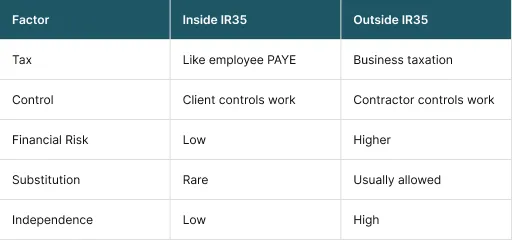
Side-by-side comparison highlights the key differences.
How a Status Is Decided
Important features which are used to determine the status include:
Control
Whether a contract worker decides when and how work gets done? It is likely inside IR35 if the client has more control.
Active Substitution
Is someone else able to do the work? A right to send a substitute is more often outside IR35.
Mutuality of Obligation
Is work expected on an ongoing basis from both sides? Continuous work can often look like employment.
Common IR35 Mistakes
Many problems occur due to common misunderstandings. Avoiding these mistakes lowers risk. Common mistakes are:
- Assuming limited company always equals outside IR35
- Copying contracts from others
- Ignoring daily working practices
- Trusting calculators alone
- Not reviewing contracts regularly
Risks and Limits of IR35
The regulation affects more than just taxes. It also covers the following:
Financial Risk
Financial problems are a major concern for the businesses. Wrong classification may lead to:
- Backdated taxes
- National insurance payments
- Interest charges
Business Risk
Planning and hiring can also get affected. Companies might stop hiring contractors due to uncertainty of their status.
Administrative Work
The extra paperwork and checks are involved in staying compliant. They also need appropriate records. Labels on paper mean less than actions in the world. Real behaviour matters more.
How The Rules Affects Different People
In the UK, these rules affect contractors, companies and investors. It can change how they plan their jobs and spend money. Key groups include:
Business Owners
Tax responsibility may fall on them which is why businesses need to carefully check contractor status.
Contractors and Freelancers
Status under these rules is likely to make a difference in take-home pay.
Investors and Directors
Hiring plans and project costs depend on correct classification.
The General Public
The regulation can also impact the industries like IT, healthcare, engineering and media.
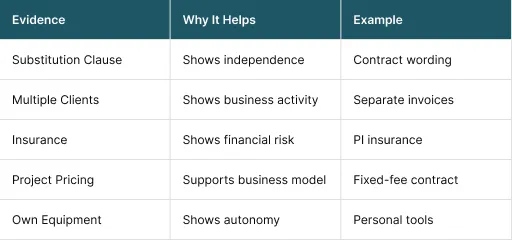
How Businesses Can Lower Compliance Risk
Simple steps help businesses to comply with the rules. Compliance lowers the risk of penalties. Steps include:
- Create clear roles
- Train managers
- Review contracts regularly
- Keep written decisions
It is also critical for contractors and hiring managers to communicate openly. Everyone should know what they have agreed to in terms of working structure.
Contracts should dictate whether businesses will follow suit. They help to ensure that status does not move towards Inside IR35 undetected.
Why Is IR35 Important Today
At first, businesses could choose if a contractor was inside or outside IR35. After the reforms, medium and large private sector businesses have to decide each contractor’s status. Many placed contractors inside the rules to reduce risk.
This increased compliance but caused less flexibility for contractors. As UK rules change, tax systems are becoming organised and digital. Businesses now must manage their status with great care. They also need to keep track of other taxes.
If you want to find out more about how tax will be done differently digitally, see our guide on Making Tax Digital.
How Professional Guidance Helps
Different businesses have different nature. As a result, most businesses require professional advice. Professional support helps to:
- Understand working practices
- Spot risks early
- Improve documentation
- Make consistent decisions
UK Case Laws
These examples show that the law determines if a person is a worker or a business owner.
In Pimlico Plumbers Ltd v Smith (2018), a plumber named Gary Smith worked for Pimlico Plumbers Ltd. The company classified him as self-employed. Mr. Smith said he was in fact working as an employee.
Mr. Smith worked mostly for one company, followed its direction and was under the company control.
The court examined the real working relationship. It also reviewed what the contract said. The Supreme Court of the United Kingdom ruled that Mr. Smith was not completely self-employed.
What mattered most was not the wording of the contract but the real working relationship. The judges said that the company exercised a high degree of control over the employee which made him qualify as a worker.
This case shows that contracts or titles do not decide employment status.
In Uber BV v Aslam (2021), the Uber drivers claimed that they were workers, not independent contractors. Uber argued that the drivers were self-employed and operated their own businesses. The drivers said Uber controlled key aspects of their work through the app.
Uber set the fares. Uber also controlled the access to riders and monitored performance ratings. Drivers had little room to negotiate prices or establish customer relationships of their own. The working arrangement made users dependent on the platform.
The Supreme Court ruled that Uber drivers are workers with rights under UK Law. It focused on how contracts were used, not what was written.
The judges said that Uber’s degree of control indicated an employment type relationship. Now drivers have worker rights with minimum wage and holiday pay. The decision shows how courts evaluate employment status.
Conclusion
IR35 is not about technical tax rules. It is about knowing the nature of a working relationship. This taxation can be tricky and getting it wrong can result in unexpected tax bills, fines, and issues for contractors and businesses altogether.
Take the time to review contracts and examine how work is done. Also, maintaining clear records can reduce risk and ease things for all those involved. As HMRC focuses on employment rules, businesses must act early and not wait for issues to appear suddenly.
With the help of Sterling Cooper Consultants, handling IR35 becomes simple, organised and stress free.
Get in touch today to get your contractor arrangements set up correctly.
IR35 compliance protects your business from costly mistakes and unnecessary stress. Acting early ensures you stay in control and avoid future disputes.
Speak to a specialist today to review your current position and strengthen your compliance with confidence.
FAQs
Traditional accounting software is installed on one computer and can only be accessed there. Cloud accounting works online and stores your data securely on remote servers. You can log in from any device, with internet access. This makes it more flexible and easier to manage.
In most private-sector cases, medium and large companies decide the IR35 status. They must review the contract and the real working setup carefully.
No, it doesn’t. Just having a limited company does not make you outside IR35. HMRC looks at how you really work, not just your business structure.
Online tools can give a rough idea of risk. But they cannot check every detail. A full review is usually more accurate.
Yes, it can. If the way you work changes, your IR35 status may change too. It’s important to review it regularly.
Yes, you can give access to multiple users. Business owners, accountants and staff can log in at the same time. Everyone sees the same updated information. This improves teamwork and reduces confusion.
Recent Posts

How to Build a Cash Reserve for Business Stability
August 11, 2026

How to Forecast Cash Flow During Economic Uncertainty
August 6, 2026