

Posted by:
Admin
Date:
April 20, 2026
Category:
blogs
What Is The Role of a Company Secretary In Modern Businesses?
Do you know who helps a company stay legally compliant, well governed and run smoothly? The answer is often a company secretary. They help a company run its functions in a legal and smooth way. That’s why most firms invest in them.
What Is a Company Secretary
The company secretary (CoSec) is a senior personnel. They make sure the company follows laws and regulations and helps its governance. They play a key role in the firm and help directors work in an effective way.
CoSecs are very important in corporate governance. Corporate governance refers to how a company is run and controlled. The CoSec makes sure decisions are transparent, fair and within the law.
82% of UK boards see the company secretary role as a key partner in governance and business decisions.
They also act as a link between key groups, including:
- The board of directors
- Share holders
- Regulators
- External advisers
This puts them at the centre of the company’s functions.
Key Takeaways
- The role of company secretary is essential for ensuring legal compliance, strong governance and smooth business operations, acting as a key link between directors, shareholders and regulators
- Understanding what a company secretary does highlights their dual responsibilities in administration and advisory work, including meetings, filings and board level guidance
- The duties of a company secretary include maintaining statutory records, ensuring regulatory compliance and supporting corporate decision-making to reduce legal and operational risks
- The company secretary role has evolved from basic administrative work into a strategic governance position that supports transparency, accountability and long term business success
- For businesses, a strong role of company secretary helps improve efficiency, ensure compliance with regulations and strengthen overall corporate governance frameworks
What Does a Company Secretary Do
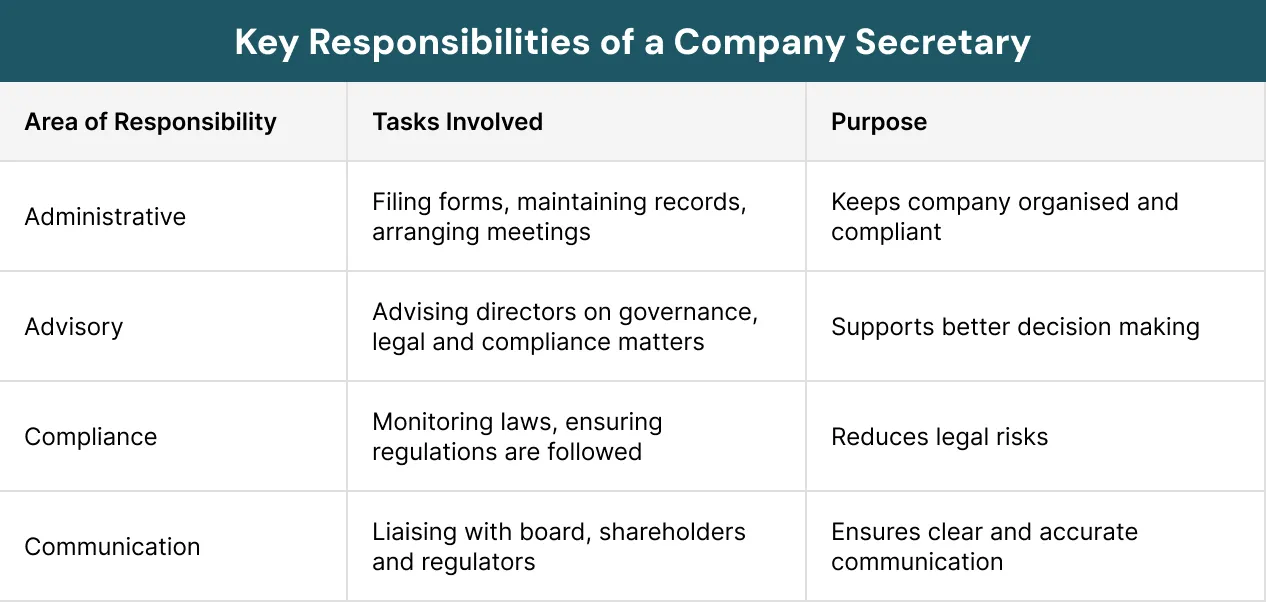
A CoSec can do both admin tasks and advisory functions. The duties of a company secretary on the admin side are:
- Filing forms
- Maintaining the records
- Arranging the meetings
On the advisory side, they guide directors on:
- Governance
- Compliance
- Legal matters
They also help the company run smoothly and make sure rules are followed. Their work helps the business run in a clear and safe way. They also help avoid legal problems.
Evolution of the Company Secretary Role
The position of CoSec has changed a lot over time.
The role of company secretary used to focus on admin work like keeping records and taking notes. Today, it is much more strategic. They help in the major company decisions.
The CoSec gives advice to the directors. The company secretary role makes sure all rules are followed. They also make sure the internal processes are smooth.
About 70% of companies combine the secretary role with other senior jobs. It shows how crucial the role has become.
Key Duties of a Company Secretary
The duties of the CoSec are extensive and essential for a business.
The role of company secretary is to guide the board on how to manage the company. They help directors know their duties. They also make sure the firm follows the law, which keeps its legal standing.
They help with decisions. They provide clear and accurate information. They also:
- Make sure the legal compliance
- Help in good governance
- Communicate with stake holder
Benefits of a Company Secretary for Businesses
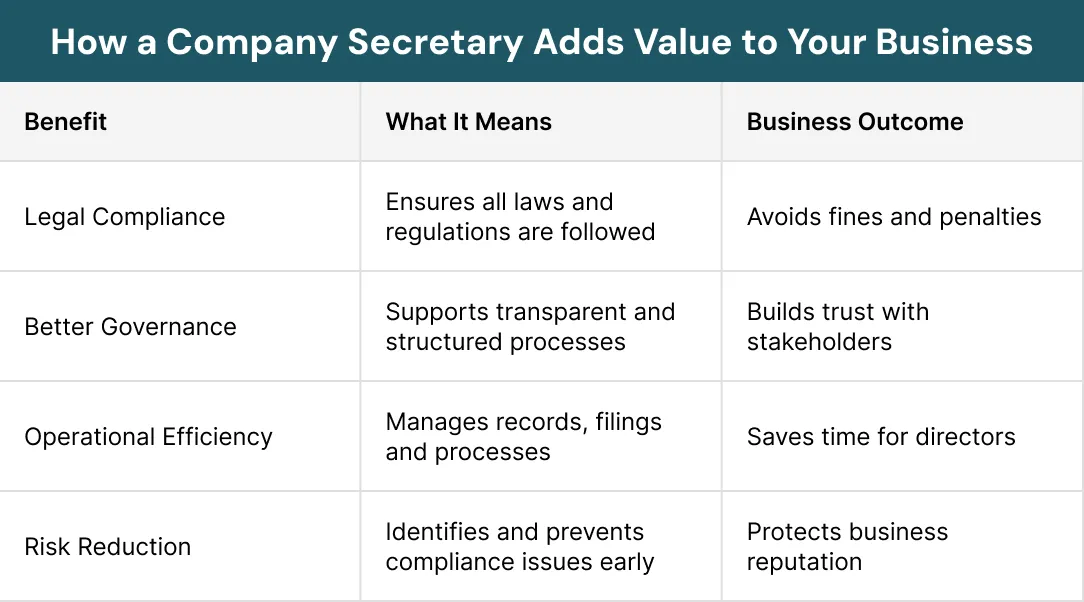
The role of company secretary gives many benefits to a business.
They make sure legal compliance and help avoid fines. They look into governance work. The company secretary role enables directors to focus on strategy.
They efficiency by:
- Managing processes
- Record keeping
- Completing tasks on time
The role of company secretary helps a firm stay well organised and compliant.
Legal and Regulatory Requirements
This part explains the legal requirements for the role of company secretary.
Legal Requirements for a Company Secretary
The need for a CoSec depends on the company. A secretary or chief is crucial for public firms. But by law, private firms do not need one.
However, these duties still exist. If there is no secretary of the firm, the directors usually do this work.
Did You Know?
A company secretary can sign official legal documents on behalf of the company.
Under the Companies Act 2006, public companies must choose a person who is fit for the role. This means the person must have:
- Proper qualification
- Relevant experience
- Association with an expert body
The role of company secretary also has legal duties. If they fail to meet these duties, they may face fines or deal with legal problems.
Appointment and Removal of a Company Secretary
The CoSec is usually appointed or removed by the board of directors. Companies must inform Companies House within a set time when a change happens.
There are also some rules on eligibility for the role. For example, the company’s auditor cannot be the CoSec. In some cases, a company can hire a corporate body instead of one person.
Corporate Governance
This section explains the duties of a company secretary in corporate governance.
Corporate Governance Responsibilities
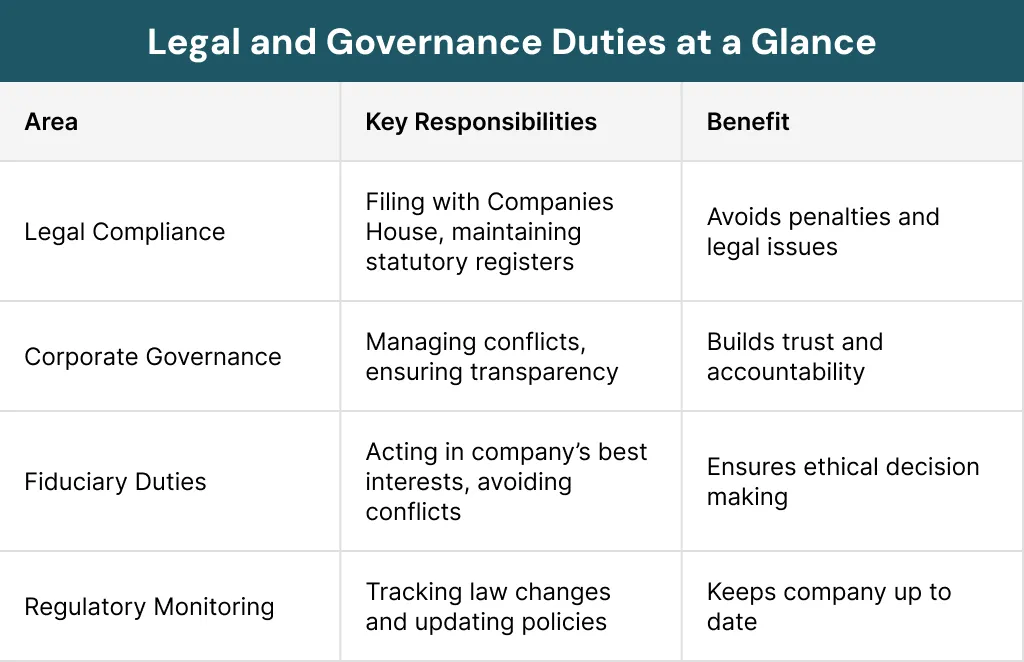
Corporate governance is a key part of the company secretary’s role. They suggest how the company should run and follow best practices.
This includes the following:
- They manage conflicts of interest
- They make sure processes are clear and open
- They make sure rules are followed
They also help the board and its committees do their work well.
The company secretary helps build trust and responsibility in the company. They do this by maintaining good command.
The standard of governance determines the success of a company. – Sir Adrian Cadbury, UK corporate governance pioneer and chair of the Cadbury Committee
Fiduciary Duties and Legal Obligations
The role of company secretary, as a company officer, has fiduciary duties.
These include the following:
- They act in the interests of the company
- They use care and skill in their work
- They avoid conflicts of interest
These things make sure they act in a fair and honest way at all times.
Compliance and Regulatory Monitoring
Checking compliance is an ongoing duty.
The CoSec monitors changes in rules and law. They make sure the company updates its policies and ways of working when needed. They also help keep systems in place so the whole company follows the rules.
Administrative Functions
This section discusses the administrative duties for the role of company secretary.
Organising Board and Share Holder Meetings
Organising meetings is a crucial role of a company secretary. This includes:
- Board meetings
- Group meetings
- Share holder meetings such as Annual General Meetings (AGMs)
The CoSec plans and schedules these meetings. They set the agenda and prepare all the needed documents. During the meeting, they record all details.
They also make sure the meetings follow all the legal rules. They send notices timely to keep everyone informed. After the meeting, they check they have completed the tasks and keep proper records.
Maintaining Statutory Registers
The CoSec must keep statutory registers. These are legal records, which include:
- Register of members
- Register of directors and secretaries
- Register of persons with significant control (PSC)
- Register of charges
All these records must be precise and up to date. Errors can lead to serious legal consequences.
Companies House Filings and Compliance
The CoSec sends all required documents to Companies House.
Annual Filings
- Confirmation statement
- Annual accounts
Event Driven Filings
- Changes in directors or company secretaries
- Share capital changes
- Updates to the registered office address
- Company name changes
If these forms are not sent on time, the company may face fines. This makes the role crucial for the company.
Record Keeping and Documentation
The CoSec also keeps other records, not only legal registers.
These include:
- Financial and tax records
- Work contracts
- Legal papers
- Data protection and legal records
Good record keeping makes sure there is transparency, accountability and smooth operations.
Admin Duties
The CoSec often deals with day to day admin tasks to help the business run well.
These may include:
- Managing pay, VAT and PAYE
- Handling pension plans and staff share plans
- Keeping company documents organised
These tasks help the company run in a smooth and efficient way.
Maintaining the Registered Office
Every company must have a registered office and the CoSec manages it.
This means to make sure:
- The address is a real and valid physical location
- They manage the official post in the right way
- Company details are shown, when needed
The registered office is the main contact point for authorities.
Communication and Stakeholder Management
The CoSec plays a key role in communication inside and outside the company.
They deal with share holders, investors and directors. This keeps communication clear and accurate. They also act as a bridge between the board and other stakeholders.
This builds strong connections. It keeps everyone informed about what the company is doing. This helps everyone understand.
Corporate Operations Support
This section describes the role of company secretary in corporate operations support.
Role in Corporate Actions
The CoSec assists in many company actions, such as:
- Allotments and transfers of shares
- Payments of dividends
- Change of company name
- Restructuring of capital
They make sure all these actions follow the law.
Governance in Listed and Fund Structures
In listed companies and fund setups, the CoSec has extra duties.
Their duties include the following:
- They make sure the rules of stock market are followed
- They manage disclosure and transparency requirements
- They maintain partner lists and reporting obligations
These duties help people trust the market and make sure everyone follows the rules.
Board Support and Development
The role of company secretary helps the board work in a more efficient way.
This includes:
- They arrange board assessments
- They give training and support to new directors
- They prepare governance reports
They also help the board to maintain strong oversight and strategic direction.
Interesting Fact
Company secretaries often sit in every board meeting – but rarely get the spotlight.
Authority and Legal Position
This part highlights the powers and rights for the role of company secretary.
Powers of a Company Secretary
The role of company secretary is not to manage the firm directly. But they do have some legal power in the company.
They can sign official papers and legal forms needed under company law. This includes sending forms to Companies House and signing some legal documents. These are usually signed with a director or on behalf of the company.
They may also sign forms to change the company, such as from private to public or the other way round. These powers are limited but they help the company to meet its legal duties.
Rights of a Company Secretary
The rights of a CoSec comes from their job contract rather than company law.
They have normal work rights, such as:
- Fair pay
- Safe working conditions
- Fair treatment
They do not have special legal rights like directors under the Companies Act 2006.
The CoSec still has a lot of responsibility. They have a strong impact in law and compliance for the company.
Skills and Career Development
The section covers the qualification and career paths for company secretary.
Qualifications and Skills Required
A role of company secretary needs qualifications based on the company and its work.
Private companies: Formal qualifications are not needed. It is still crucial to understand company law, rules and good practice.
Public companies: Rules are strict. The CoSec must have good knowledge and experience. This may include:
- Being part of a professional group
- Having a degree in law, accounting or finance
- Having work experience in a similar role
The Company Secretary role needs skills such as:
- Good communication
- Careful attention to small details
- Good organisation and time use
- Ability to understand complex rules
- Good problem solving and decision making
The CoSec uses these skills every day, which helps them to do their job well.
Career Path and Opportunities
A job as a CoSec gives many career options.
Many people begin in junior jobs, such as an assistant or trainee. From there, they can move up to senior roles like deputy or group secretary.
They can work in many fields, like:
- Private firms
- Government organisations
- NGOs
- Financial institutions
Some work on their own while others join firms. These firms provide secretarial services to different clients. This gives more choice and experience in different fields.
Business Engagement Models
This part discusses business engagement models for the company secretary role.
Outsourcing Company Secretary Services
Many businesses choose to outsource company secretary services. They do this instead of employing someone full time.
This has many benefits:
- Access to skilled and experienced people
- Lower cost than a full time worker
- Work keeps going if staff are away
- Easy to adjust as the business changes
Outsourced services have a team of experts. They understand the company work. They share the tasks among them. This lowers risk and helps the business run well.
Choosing the Right Company Secretary
Selecting the CoSec is a major decision for any business.
Key things to look for in a Company Secretary role:
- Right skills and work experience
- Clear communication and good teamwork
- Strong focus on detail
- Able to handle urgent and time based work
A good CoSec must be proactive. This means they can see issues and address them early.
Special Duties and Liabilities
The CoSec has legal duties and can face penalties if they do not meet them.
The company can blame the secretary if they are unable to follow rules. This can cause the company to pay fines or, in serious cases, legal action.
In special cases like bankruptcy or liquidation, the secretary may have extra duties. For example, they may need to prepare a report on the company’s affairs.
These duties show why the role needs attention and accuracy.
Real Life Example
The Post Office Horizon scandal is a real life example. It affected hundreds of small business owners in the UK. They used a Post Office system to run their day to day tasks. Everything seems fine at the start. However, issues began to appear soon.
Sub postmasters found missing money in their accounts. They reported this but instead of checking the system, they were blamed. This affected many people between 1999 and 2015. More than 900 sub postmasters were wrongly accused. Their lives and business were seriously harmed.
This case shows the importance of good governance. Red flags were ignored and issues were not checked properly. There was not enough control at the top.
With improved governance, they could identify these issues early and may challenge the decisions. This could lower the risks as well.
A CoSec document, distribute and fix issues on time. Good governance does not only mean adhering to rules. It is also about trust, protecting people and helping a business stay strong.
Conclusion
In modern businesses, the role of company secretary is very crucial. It includes:
- Legal work
- Governance of a company
- Admin tasks
- Strategic functions
- Advisory functions
They handle company records, set meetings and assist the board. The role of company secretary makes sure the rules and regulations are followed. This simplifies the operations of the business.
They also act as a bridge between the board, share holder and directors. This keeps communication clear and strong. CoSecs are in favour of:
- Transparency
- Responsibility
- Good control
The role of company secretary is essential for long term success.
In today’s complex business world, there is a growing need for a company secretary, even if it is not required by law. Their skills help lower risk, solve problems and help the business grow.
Sterling Cooper makes sure your business stays compliant, well governed and smoothly managed. Contact us today to speak with our team for tailored support.
Need help keeping your business compliant and well governed?
Sterling Cooper delivers expert company secretarial services to ensure smooth governance and regulatory compliance. Contact us today for reliable corporate support.
FAQs
A company secretary ensures a business stays compliant with laws, regulations and governance standards. They support the board by managing meetings, maintaining records and advising on corporate decisions. Their role also acts as a bridge between directors, share holders and regulators. Overall, they help ensure smooth and legally sound business operations.
The salary of a company secretary in the UK varies based on experience, company size and industry. On average, junior roles may start around £30,000–£50,000 per year. Experienced or senior company secretaries can earn £70,000–£120,000+, with higher packages in listed companies. Executive level roles may earn even more with bonuses.
A degree in law, finance, accounting or business administration is most commonly preferred. These subjects build strong foundations in governance, compliance and corporate law. Many professionals also pursue specialised qualifications like ICSA/CGI certification. Practical experience is equally important for career growth.
Company secretaries need strong knowledge of corporate law, governance and compliance frameworks. Key skills include attention to detail, communication organisation and time management. They must also handle regulatory filings and board level coordination effectively. Problem solving and decision making abilities are highly valuable in this role.
A company secretary can face legal or financial liabilities if compliance duties are not properly fulfilled. This may include penalties for missed filings, incorrect records or breaches of statutory obligations. In serious cases, they may be held accountable for corporate governance failures. Their role requires high accuracy and legal responsibility.
Recent Posts

How to Build a Cash Reserve for Business Stability
August 11, 2026

How to Forecast Cash Flow During Economic Uncertainty
August 6, 2026