Posted by:
Admin
Date:
July 6, 2026
Category:
blogs
Corporation Tax for Small Businesses Explained
Most small business owners do not see any tax issues coming their way. But one day, when the tax bill arrives, it puts pressure on the cash flow of the business. In the UK, corporation taxes are charged against a company’s profits. According to the UK government, the standard rate is 25%.
If you are on the lookout for corporation taxes for small businesses, then you need to know about the rules right from the start. While dealing with the corporation taxes, essential processes are often overlooked.
Corporation tax for small businesses sounds complicated until you understand it. Once that is done, it becomes very easy and clear. All you have to do is know what to pay, when to pay and how to pay. Tax planning will help protect your cash flow and your business from fines and penalties.
Key Takeaways
- Corporation tax applies to profits made by limited companies in the UK.
- The main UK corporation tax rate is 25% on taxable profits.
- Small businesses must register, file returns, and pay HMRC on time to avoid penalties.
- Deadlines matter: tax is usually due 9 months and 1 day after the accounting period ends.
- Allowable expenses can reduce your overall tax bill legally.
- Filing is done online through HMRC using a CT600 return or accounting software.
- Using corporation tax software or an accountant helps reduce errors and saves time.
- Planning ahead improves cash flow and prevents unexpected tax pressure.
What Is Corporation Tax for Small Businesses?
Corporation tax is a tax that a UK limited company pays on its taxable profit. This income may be earned from trading, investment activities or selling business assets.
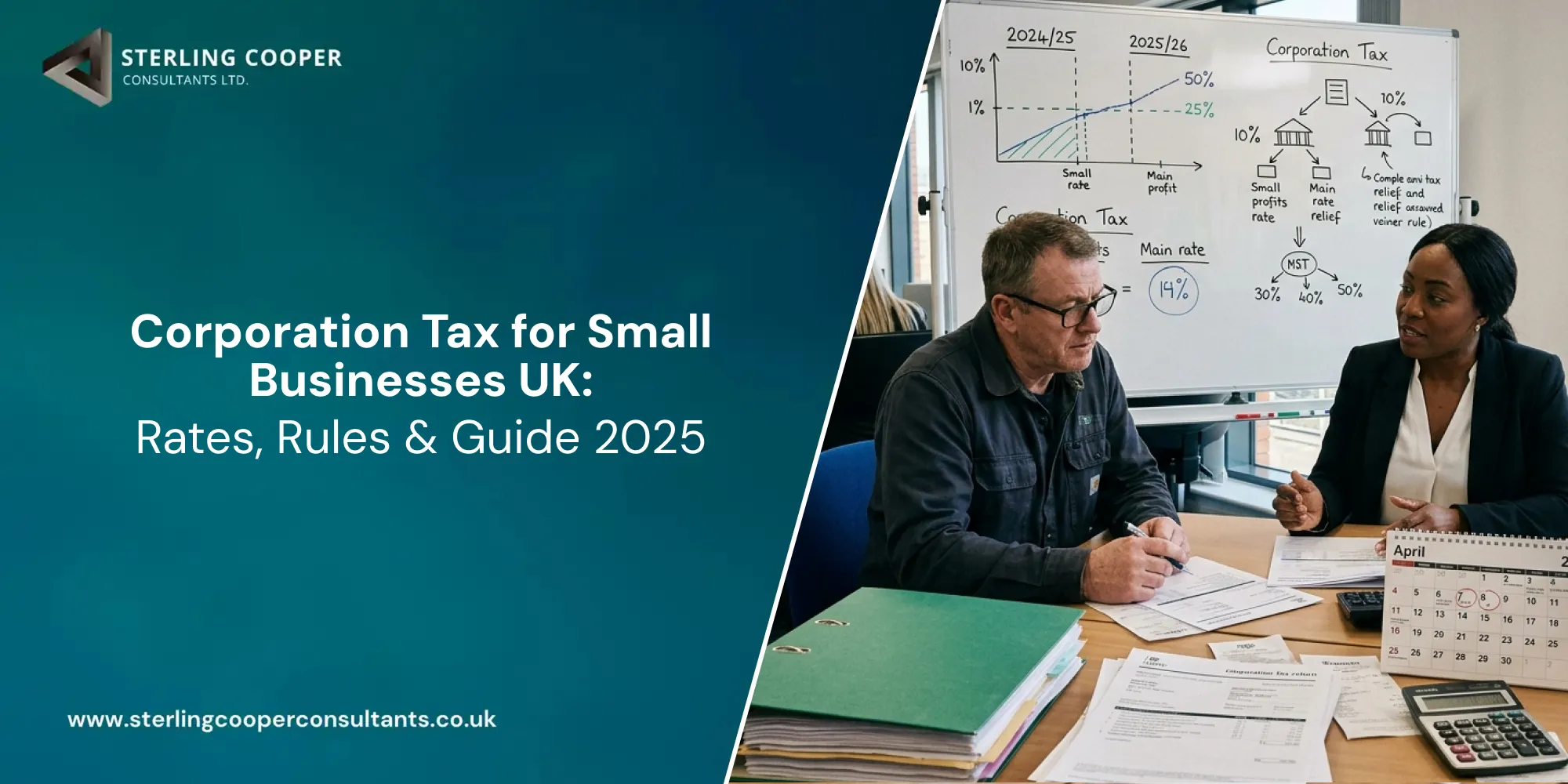
Knowledge about corporate tax for small businesses is necessary to plan their financial matters and comply with HMRC regulations. Small businesses have to pay a 19% profit rate on income up to £50,000. The income exceeding £250,000 is taxed at the 25% main rate. Businesses with profits between £50,001 and £250,000 may receive Marginal Relief, which lowers the amount of tax they pay.
Which Type of Small Businesses Need to Pay Corporation Tax in the UK?
In the UK, corporation tax is paid by limited companies. Corporation tax is also applied to foreign companies that earn income from within the UK. Corporation tax does not apply to sole traders or partnerships. Only registered companies have to pay this tax. This tax becomes due for payment only if a company starts trading and making a profit.
Corporation Tax is charged on the taxable profits of limited companies operating in the UK.
Source: HMRC Corporation Tax Guidance
When Do You Pay Corporation Tax for Small Businesses?
The corporation tax deadline depends on your company’s accounting period. For example, if your financial year ends on 31 March, your corporation tax must be paid by 1 January the following year.
The key deadlines are shown below:
1. Payment Deadline
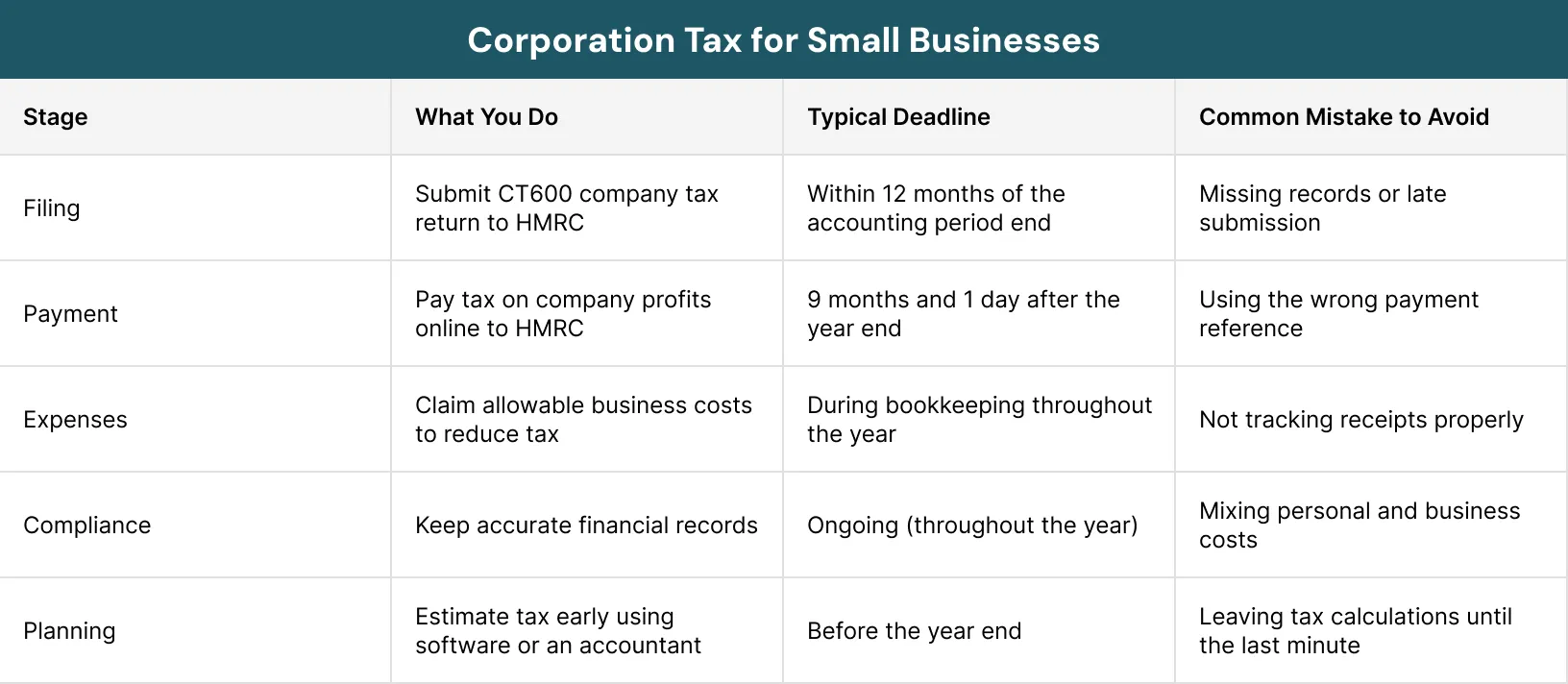
The deadline for paying corporation tax for small businesses is 9 months and 1 day after the end of your company’s accounting period.
2. Company Accounts
The deadline for paying company accounts is 9 months after your financial year-end.
3. Payment Deadline
The deadline for paying your tax returns is 12 months from the end of the accounting period.
Important:
Even if your business is making low profit or loss, you may still need to register for Corporation Tax with HMRC if you are a limited company. Missing this step can lead to penalties.
How to File Corporation Tax for Small Businesses?
For filing corporation tax for small businesses in the UK, calculate your taxable profit, prepare annual accounts and send the Company Tax Return (CT600) to HMRC using authorised accounting software. Record-keeping of invoices, receipts and bank statements is also an essential part of the process.
The step-by-step filing process is as follows:
1. Keep Accurate Records
Keep all business records such as bank statements, invoices and receipts. They will be required for preparing your account and tax returns.
2. Use Commercial Accounting Software
Use HMRC-approved commercial accounting software that supports iXBRL (Inline eXtensible Business Reporting Language) tagging. HMRC’s free service joint filing is not available anymore.
3. Claim Allowable Expenses
You can reduce the amount of taxable profit by subtracting allowable business expenses such as salaries, equipment and travel from your income.
4. Submit to HMRC and Companies House
Submit your Company Tax Return (CT600) form to HMRC and also file your annual accounts to Companies House using your accounting software.
5. Pay Your Corporation Tax
You can pay your tax payments through electronic payment methods, like Faster Payments, CHAPS and Direct Debit. Ensure that the payment is made by the due date.
By following the five steps above, you can file your small business corporation tax with confidence.
Read More: The Ultimate Guide to Small Business Taxes
Important Note
Corporation Tax software is mainly used to prepare and file your CT600 return with HMRC. The right choice depends on whether you want simple automation, professional-level control, or a pay-per-use option.
How to Pay Corporation Tax for Small Businesses?
To pay corporation tax for small businesses, you need to calculate your taxable profit, submit a Company Tax Return (CT600) and pay any tax due to HMRC. The payment deadline is generally 9 months and 1 day after the end of your accounting period.
The steps below explain the process:
1. Calculate Your Taxable Profit
Calculate your profit after deducting costs such as machinery, salaries and training from your income. Your tax depends on your profit level. Tax is 19% when the profit is below £50,000 or 25% when above £250,000, with Marginal Relief applying in between.
2. Choose a Payment Method
HMRC accepts only electronic payments. You can pay via Faster Payments, online banking or telephone banking, direct debit, or using a debit card/credit card (fees might be applicable for corporate cards).
3. File Your Company Tax Return (CT600)
You have to submit the CT600 form and company accounts online via HMRC-approved software or the GOV.UK website. This confirms your final tax calculation.
4. Pay Your Corporation Tax Bill
When you have completed filing your tax returns, pay your corporation tax to HMRC using your chosen payment method. Make sure your payment reaches HMRC within the deadline to avoid penalties.
It is a must to follow this process if you want to file the corporate tax rate for small businesses.
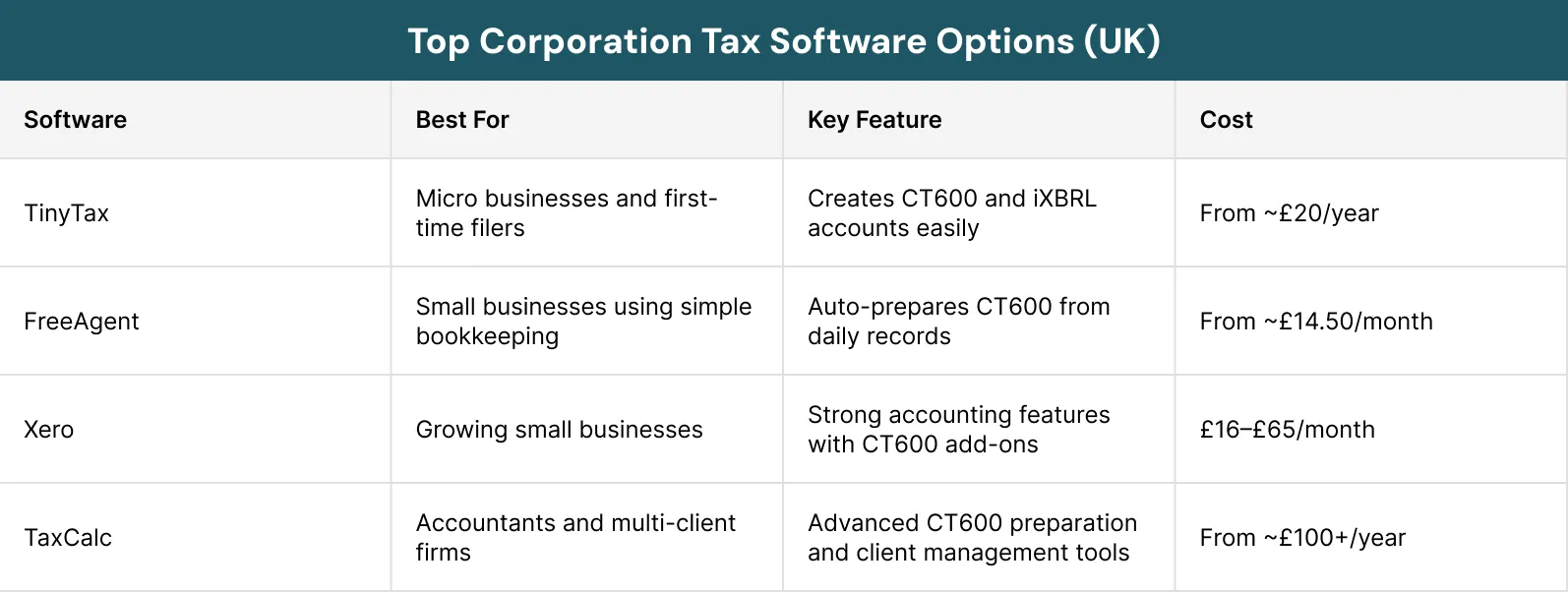
What Is the Best Corporation Tax Software for Small Businesses in the UK?
Corporation tax software varies depending on the size of your business. Small businesses typically go for programs that will do all the accounting work and automatically submit the CT600 form to HMRC.
Given below is the list of the best corporation tax software for small businesses in the UK:
1. FreeAgent
It is suitable for small and single-director companies. FreeAgent creates and files CT600 returns for you automatically based on your accounting records. This software directly submits the file to HMRC and Companies House.
2. TaxCalc
This is best for both the accountants and for preparing taxes. This software allows complete CT600 reporting and filing to HMRC. It is a widely used software among UK accountants.
3. Easy Digital Filing
It suits pay-as-you-go users. The tool enables you to file the CT600 return forms online without monthly subscription fees. You pay only when you file.
The above are the best software options to pay the corporation tax for small businesses in the UK.
Corporation Tax Small Profits Relief Example (HMRC Case Study)
This case study shows the computation of corporation tax, where the rate for small companies was increased from 19% to 20% in the financial year 2007.
The company had an accounting period ending 30th September 2007, having:
- Chargeable profits: £150,000
- Franked investment income: £0
- No associated companies
- Total taxable profits = £150,000
As the period covers two different tax rates, the profit will be divided based on time.
1 October 2006 – 31 March 2007
Tax rate: 19%
Tax: £150,000 × 19% × 182/365 = £14,210.95
1 April 2007 – 30 September 2007
Tax rate: 20%
Tax: £150,000 × 20% × 183/365 = £15,041.09
Total corporation tax due is £29,252.04.
Tip:
Keep track of your business costs throughout the year. Expenses such as rent, software, staff pay, and travel can reduce your taxable profit and lower your corporation tax bill. Good records also make filing your tax return much easier.
Conclusion
Corporation Tax is mandatory for all UK limited companies. Corporation Tax depends on the income that remains once expenses have been deducted. So, planning is crucial right from the start. Knowing about corporation tax for small businesses will ensure that you don’t end up making any errors when it comes to dealing with HMRC.
At Sterling Cooper, we help with bookkeeping and tax consultancy. We make the process simple and easy for you. Get in touch with us now if you want to develop your business with ease.
Need help with your corporation tax?
Sterling Cooper is here to support you. We handle filing, payments, and HMRC compliance in a simple way. Contact us today to get expert help with your taxes and keep your business stress-free and on track.
FAQs
As soon as companies start operating or receiving an income, they must submit a tax return to HMRC once a year. Corporation tax is charged on taxable profits; there are no tax-free allowances for companies, so a company with any amount of taxable profit has to pay.
From 1 April 2023, the main rate of Corporation Tax increased from 19% to 25%.
Corporation tax for small businesses in the UK is a tax on company profit. It is paid by limited companies after expenses are deducted. The rate depends on the profit level.
You can pay corporation tax online to HMRC. Most businesses use bank transfer. Payment must be made within 9 months and 1 day after the accounting year ends.
Yes, most small businesses now use software. HMRC no longer provides free filing tools. Software helps you calculate tax, file CT600, and avoid mistakes.
You must pay within 9 months and 1 day after your accounting period ends. The tax return must be filed within 12 months.
Recent Posts