
Posted by:
Admin
Date:
July 8, 2026
Category:
blogs
Tax-Free Benefits Directors Can Claim
Why do so many company directors in the UK miss out on tax-free small business perks while they can have it easily?
Yes, it is possible but only if they comply with strict rules. Knowing about tax-free benefits for directors is very necessary if you own a limited company. These are specific rewards allowed as per HMRC rules. They allow directors to receive small benefits without paying income tax or national insurance. This is possible only if all conditions are followed precisely.
One of the most significant laws is the £50 limit (tax-free allowance). This implies that a benefit is only tax-free if it is valued at £50 or less. If it goes more than £1, such as £51, then the entire payment becomes taxable. From this, you can guess how strict the rules really are.
Tax-free perks offered to directors can be small gifts, travel (tax-free funds for business journeys) or specific permitted allowances. However, not everything is considered. Some factors that look minor may still be taxed if they do not adhere to the rules.
It is also vital to know that rules can vary based on whether the benefit is for a director or an employee. This confusion causes many directors to overlook legal ways to lower their tax duties.
Certain directors do not utilise these benefits at any point, simply because they do not understand what is allowed.
In this blog, you will learn what directors tax-free benefits mean and how directors can legally use them. You will also explore how to reduce your tax safely while being fully secure and compliant with the rules.
Key Takeaways
- Tax-free benefits for directors can include pensions, mileage claims, trivial benefits, and annual staff events when HMRC rules are met
- Tax-free benefits help reduce personal tax costs while allowing directors to take value from their company in a compliant way
- Tax-free allowance rules vary by benefit type, so it is important to check limits, keep records, and follow HMRC guidance
- Directors tax free benefits often come with extra conditions, such as the £300 annual cap on trivial benefits for close company directors
- Tax-free benefits UK rules allow exemptions for workplace parking, one company mobile phone, working from home support, and certain medical checks
- Tax-free benefits for employees can also apply to directors, although some allowances and limits may differ depending on company structure
- What are tax-free benefits? They are approved perks or allowances that can be provided without creating Income Tax or National Insurance charges when all qualifying conditions are met
What Are Tax-Free Benefits for Directors?
Tax-free benefits for directors are relatively minor amenities a company provides to its directors. However, a key rule is that these perks must not be considered as part of your normal salary or wages. Also, the directors must follow HMRC rules so no additional tax is charged.
These perks are usually offerings like small gifts, holiday-related benefits or simple company-provided items used for work. These payments are not given in the form of cash.
In simple words, they are a way for business owners to receive a few extra benefits from their company. Yet, this is done without paying extra tax, as long as the laws are followed.
However, this does not mean that everything is allowed.
There are several clear rules:
- The reward cannot be cash or something like cash
- It cannot be given for high performance or achieving targets
- It must be kept within set value limits when restrictions apply
- It cannot be part of a salary exchange plan
If all these rules are adhered to, then the benefit can stay free of taxation. This is why it is very significant for directors to be aware of what tax-free perks really are. If they don’t, they might by mistake violate the rules and end up paying tax.
Tax planning is not about avoiding tax; it’s about arranging your affairs so that you pay the right amount of tax under the law.
Anita Monteith, Chartered Tax Adviser and former Technical Manager, The Chartered Institute of Taxation (CIOT)
Tax-Free Benefits for Directors in the UK
In the UK, there is no one specific tax-free cap for company directors. Instead, there are particular rules that apply to different types of scenarios.
So, tax-free benefits for directors are not all in a single place. They are divided into categories like travel, small gifts and work costs.
Here are some easy examples:
- When you go somewhere for work, you can claim funds back using HMRC set costs
- Minor presents are tax-free only if each one is estimated at £50 or less
- Business activities are tax-free but only up to £150 per person
All these laws combined make the full system of tax-free allowance for directors. However, there is a very crucial point to remember.
Tax-free benefits for directors only continue to be tax-free if every rule is adhered to. If even one rule is ignored, you may be required to pay tax on it.
That is why directors usually cautiously combine salary and dividends. They also use HMRC-certified tax-free perks where appropriate. They follow all this to manage their money in a smart way.
Tax-free Benefits for Directors vs Employees
Tax-free benefits for directors and employees are certainly not identical. There is typically greater freedom for employees. They can usually receive small tax-free perks if they comply with HMRC rules. These advantages are fundamental and easier to give.
Directors, particularly in small privately owned companies, have tougher rules. For example, employees can get multiple allowed benefits without strict limits. Directors may have annual restrictions on some perks.
Directors must also maintain more accurate records and paperwork. So, directors are required to plan extra wisely when utilising tax-free perks.
The rules are monitored strictly by HMRC to make sure everything is honest and correct.
When directors comply with the rules properly, these benefits continue to be valid. They can also be very helpful and save you a few bucks.
Tax-Free Benefits for Directors in the UK
UK company directors may be eligible for specific business perks if they comply with HMRC rules. However, each benefit is subject to clear limits to guarantee fairness and compliance.
Learn more: Dealings with HMRC tax investigations
These perks are explained one by one below:
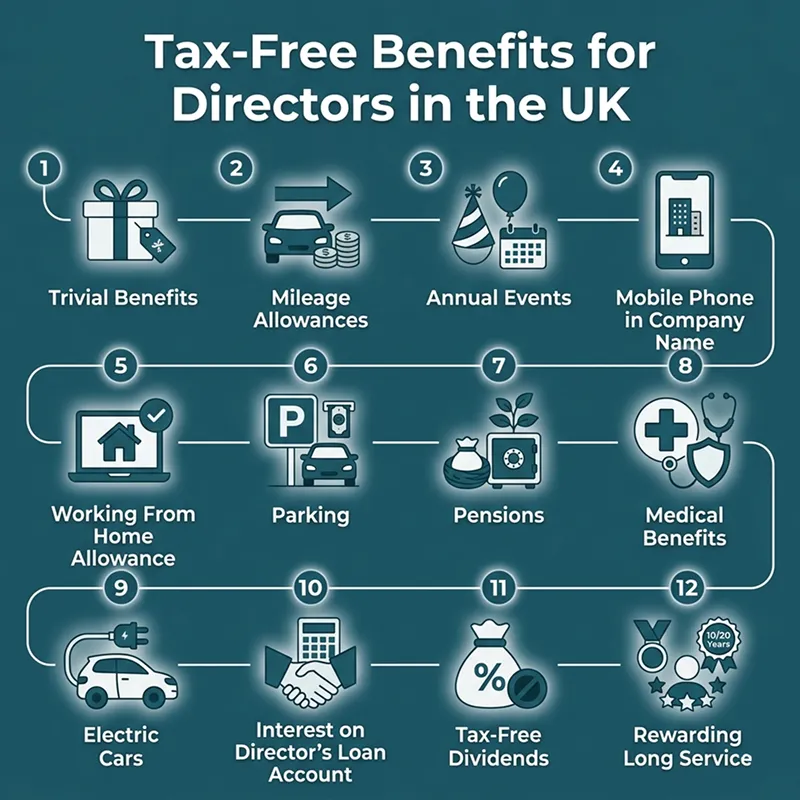
1. Trivial Benefits
Trivial benefits are small gifts provided by the company. Every gift is required to be of £50 or lower. If it exceeds more than £50, it is no longer tax-free.
Directors in small firms can only receive £300 worth of value per year. These gifts are non-cash items provided by the company. They are just kind actions, not compensation for work.
Did You Know?
Directors of close companies can receive up to £300 per tax year in trivial benefits, provided each benefit costs £50 or less and meets HMRC’s qualifying conditions.
2. Mileage Allowances
If a director makes use of their own car for business trips, the company can afford to pay them back. The amount is fixed by the government for each mile.
It is £0.45 per mile for the initial 10,000 miles. After that, it is £0.25 for every mile. However, every journey must be documented concisely.
3. Annual Events
Companies can pay for special occasions like Christmas parties or corporate team days. Each person can go for up to £150 per year. If the rules of the limit are followed, the event is free of tax. It is very helpful for people to relax and enjoy time with one another.
4. Mobile Phone in Company Name
If the phone agreement is in the company’s name, the business can pay the fee for it. Only one phone for each person is usually permitted. However, you have to use that phone for work.
5. Working From Home Allowance
If a director works from home, the company can help with additional expenses. This takes into account utility costs like electricity, heating and internet. This reward is helpful for paying the cost of working from home.
6. Parking
If parking is needed for your work, it can be tax-free. However, you have to link it to your business and not for personal use.
7. Pensions
A company can deposit funds into a director’s pension. This is one of the greatest lasting advantages. However, there is a per-year limit that must not be exceeded.
8. Medical Benefits
There are certain health checks that are free of tax. They are helpful in finding health problems ahead of time. However, private medical insurance is usually subject to tax.
9. Electric Cars
Electric business cars generally have reduced tax expenses. This is the reason that they are cheaper than petrol or diesel vehicles. They are a sensible selection for a variety of directors.
10. Interest on Director’s Loan Account
If a director contributes money to the company, the business may pay interest. Within specific bounds, some of this may be free of tax. HMRC reporting is necessary in some specialised situations.
11. Tax-Free Dividends
Directors can receive company earnings as dividends. Every year, a certain amount is free from tax. Anything higher than that amount is taxed depending on income rules. Dividends must be earned from actual company profits.
Related: The complete guide to UK dividend tax for beginners
12. Rewarding Long Service
Long-term directors may be compensated by their employers. They can provide up to £50 for each year of service.
It needs to be a gift, not cash or salary. Also, it is a standard way to express a thank you for their loyalty.
How Trivial Benefits Compare to Other Unique Benefits?
Some job-related perks are basic, while others are more complex. Thus, trivial benefits are the most basic ones that exist. These often consist of low-cost gifts or small non-cash benefits offered by the employer.
If they comply with the rules, you do not impose a tax on them. You also do not need to submit reports to them.
Other benefits are not the same; for example, advantages like a company car or private medical insurance are often taxed. This indicates that you may have to impose tax on them.
This is the reason that trivial benefits are valued so much, particularly by directors. They are simple to use and give flexibility without lots of documents.
However, there is still a rule to follow and if they are not managed effectively, tax charges can be applied. So they must be utilised carefully under UK tax rules.
Tax Tips and Compliance Checklist
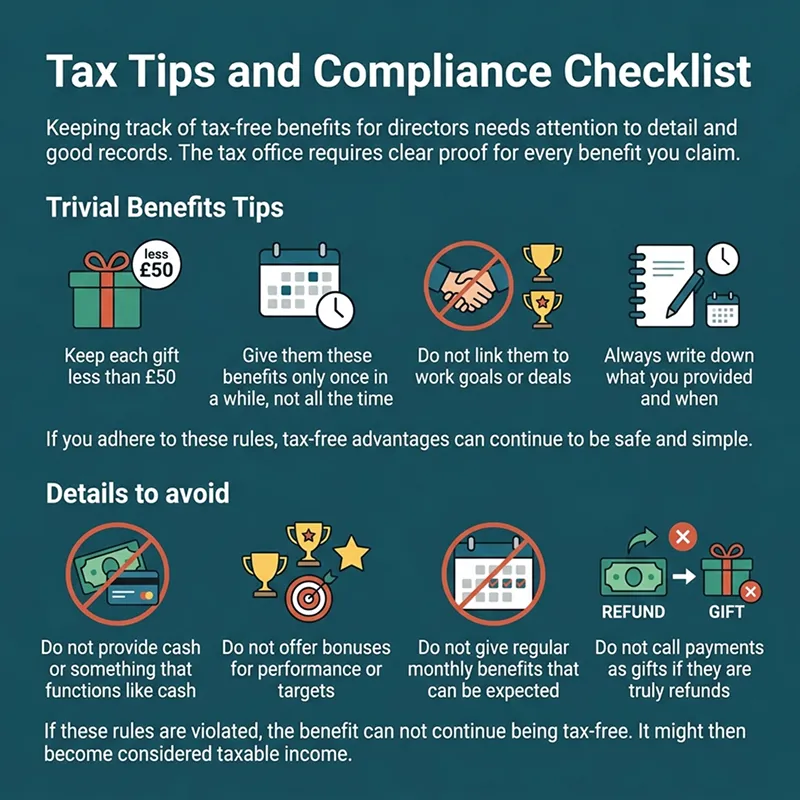
Keeping track of tax-free benefits for directors, needs attention to detail and good records. The tax office requires clear proof for every benefit you claim.
Let’s break this down into simple regulations you can easily comply with:
Trivial Benefits Tips
Some of the tips for trivial benefits are given below:
- Keep each gift less than £50
- Give them these benefits only once in a while, not all the time
- Do not link them to work goals or deals
- Always write down what you provided and when
If you adhere to these rules, tax-free advantages can continue to be safe and simple.
Details to avoid
There are some factors that you must avoid:
- Do not provide cash or something that functions like cash
- Do not offer bonuses for performance or targets
- Do not give regular monthly benefits that can be expected
- Do not call payments as gifts if they are truly refunds
If these rules are violated, the benefit can not continue being tax-free. It might then be considered taxable income.
What to Avoid!
A tax-free benefit can become fully taxable if it exceeds HMRC limits, is linked to work performance, or is provided as cash or a cash-equivalent voucher. Always check the qualifying rules before claiming.
Starting as a Limited Company Director
For newly hired business owners, knowing about tax-free benefits for directors is vital for setting up a tax-efficient system.
When carried out effectively, tax-free benefits for directors help lower unneeded tax while raising total financial quality. However, directors must always find a harmony between compliance and planning.
Many firms integrate salary, dividends and tax-free benefits for directors to improve overall income.
Case Study: Tax-free Benefits for a UK Company Director
A small UK limited company director was looking to take minor benefits from the business without paying more tax. Instead of raising his salary, the director opted for trivial perks as per HMRC rules.
Over the year, the company provided the director a wide range of small gifts. For example, a birthday present, a Christmas gift basket and a small voucher. Each item was carefully kept within the £50 limit per benefit, so it remained tax-free.
The total value of all benefits was also kept in balance with the £300 yearly limit for directors of a limited company. This is the highest level permitted with no tax charges.
All rules were complying with, so the director did not pay income tax or national insurance on these benefits. Also, these were not necessary to be considered as salary by the company.
However, the primary rule was firm: if any single gift went above £50, the entire amount would have become taxable.
Final Thoughts
Knowing about tax-free benefits for directors is mandatory for any person who manages a UK limited company. These benefits enable directors to obtain legal, tax-efficient advantages while staying fully aligned with HMRC rules.
Tax-free benefits for directors act as practical ways to reduce overall tax liability. You can apply this to trivial perks and mileage allowances, pensions, remote work support and yearly events.
When applied accurately, they can help reduce the total tax you are required to pay. When carried out as an aspect of a structured strategy, they can make a major difference.
However, compliance still remains the most crucial factor. Every benefit must satisfy HMRC criteria and precise records must always be preserved. Even minor errors can change tax-free benefits for directors to taxable income, resulting in unnecessary penalties.
When organised well, tax-free benefits for directors become a major part of a wider compensation plan. By adding together salary, dividends and approved allowances, directors improve efficiency while remaining fully in line with UK tax rules.
At Sterling Cooper, we understand the importance of tax-free benefits for directors legally and efficiently.
If you want assistance with organising your tax position, contact us today to get qualified guidance for your limited company.
Unsure whether you're making the most of the tax-free benefits available to directors?
We help limited companies identify tax-efficient opportunities while staying fully compliant with HMRC rules.
We’ve helped hundreds of business owners optimise their remuneration strategies and maximise available allowances. Reach us today.
FAQs
UK employers can provide perks or allowances that are exempt from income tax and National Insurance when HMRC conditions are met. Common examples include trivial benefits, mileage allowances, workplace parking, employer pension contributions, and annual staff events. Understanding what tax-free benefits are can help both businesses and individuals make the most of available tax-efficient opportunities.
Tax-free benefits for employees may include qualifying trivial benefits, approved mileage payments, workplace parking, certain medical screenings, and employer pension contributions. These benefits can help improve employee rewards packages while remaining tax-efficient for both the employer and employee, provided all HMRC rules are followed.
As a director of a limited company in the UK, you can claim expenses that are wholly, exclusively, and necessarily incurred for business purposes. Common allowable expenses include business travel, mileage, accommodation for business trips, professional subscriptions, office supplies, business phone costs, training relevant to your role, and certain home office expenses. Keeping accurate records and receipts is essential to support any claims and ensure compliance with HMRC requirements.
The tax-free salary for directors in the UK depends on the current personal allowance and National Insurance thresholds, which may change each tax year. Many directors choose to take a salary up to a tax-efficient level and then draw additional income through dividends. This approach can help minimise overall tax liabilities while remaining compliant with HMRC rules. It is advisable to review the latest thresholds or seek professional advice to determine the most tax-efficient salary for your circumstances.
The most tax-efficient way to pay a director in the UK is usually a combination of a low salary, dividends (if the company is profitable), and tax-free benefits where eligible. A common approach is to take a salary up to the National Insurance threshold to preserve state benefits, then withdraw additional income as dividends, which are often taxed at a lower rate than salary.
On top of this, directors can use HMRC-approved tax-free benefits such as trivial benefits, mileage allowances, employer pension contributions, and certain allowable expenses to improve overall tax efficiency. The exact mix depends on company profits, personal tax position, and HMRC rules, so it is often reviewed annually with an accountant to ensure compliance and optimisation.