
Posted by:
Admin
Date:
May 8, 2026
Category:
blogs
Why Every Growing Retail Business Needs a CFO
Why do retail businesses with higher sales still struggle? Because sales alone does not ensure profit. Proper financial control, cost management, cash flows and strong CFO leadership are required to make a business successful.
Retail businesses often start with energy, drive and a strong focus on sales. Owners spend most of their time bringing in customers, managing stock and giving a good shopping experience. These things matter, but they can take focus away from something just as important, good financial leadership.
When you look at businesses, you see that they have a lot of financial problems that are hidden. These problems include:
- Changes in demand
- Low profit margins
- Rising costs
- Uneven cash flows
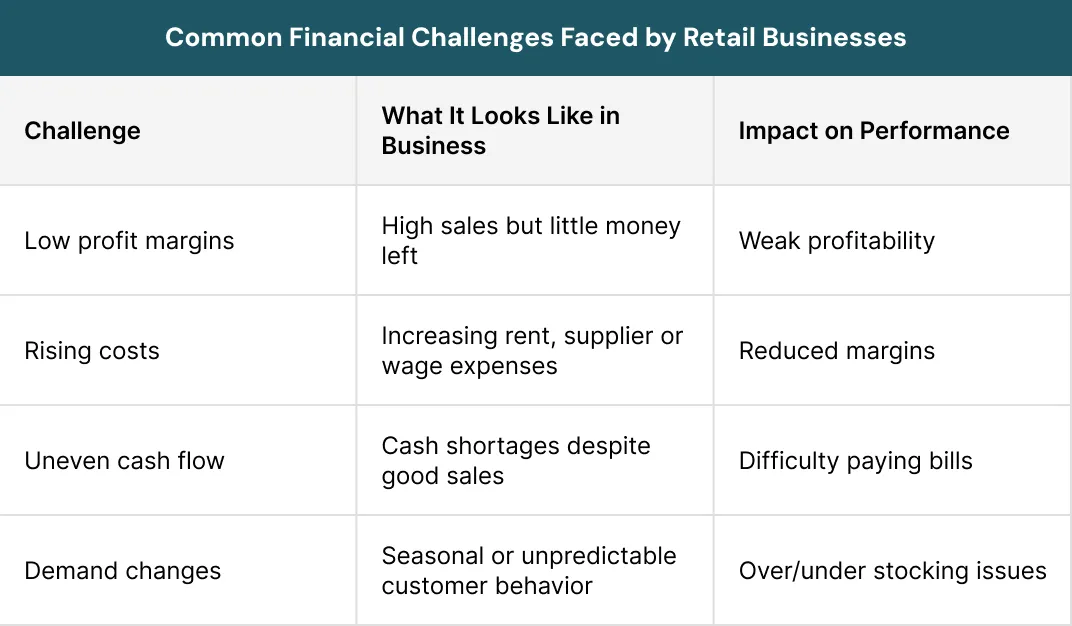
A business can look like it is doing well from the outside. It can still have big problems on the inside if it does not manage its finances well.
A lot of people think that making a lot of sales means a business is successful. This is not always true. Sales growth does not mean it is doing well. The average profit margin for a business in the United Kingdom is about 8.8% in 2025. This shows how small businesses retain their revenue.
Retail businesses can make a lot of money from sales and still have problems if they do not control costs or lack proper financial planning. Many retail businesses fail because they do not understand how to manage their finances, not because they do not have customers.
This is why financial management is very important for businesses. Having a plan helps retail businesses turn sales into real profits, keeps costs low and helps them grow steadily. The chief financial officer is an important person in this process. They help retail businesses think clearly, get organised, manage finances and make long term financial plans.
Key Takeaways
- A chief financial officer is not just a finance manager; they guide strategy, improve cash flow and turn sales into real profit. Understanding what is a CFO helps business owners see the value beyond basic accounting
- The CFO meaning in business is focused on future growth, not just past data. They use financial insights to support better decisions on pricing, stock, hiring and expansion
- Retail businesses should not rely on sales alone. Strong financial planning, cost control and forecasting led by a chief financial officer are key to long term success and stability
- A virtual CFO small business solution can give growing companies access to expert financial leadership without the cost of a full time hire, making it a practical option for scaling businesses
- Knowing when a company needs a CFO is critical. Warning signs include falling profit margins, cash flow issues, weak financial reporting and rapid growth without proper systems
- A chief financial officer helps manage risk, improve efficiency and build clear financial systems. This ensures the business can handle uncertainty and continue to grow in a controlled way
- Investing in the services of a chief financial officer is not just a cost but a strategic step. It helps avoid costly mistakes, improves profitability and supports sustainable business growth
Understanding the Role of a CFO in Modern Business
A chief financial officer does much more than manage numbers. To answer, what is a CFO, you need to look at their wider responsibilities.
They look after the financial health of a business and guide it towards steady growth. Their work includes planning, making forecasts, studying financial data and turning that data into clear business actions. It is important to look beyond numbers to understand the CFO meaning in business.
Unlike traditional finance roles, a chief financial officer focuses on the future rather than just the past. They help a business see where it is going, not only where it has been. This shows the true CFO meaning in business.
Understanding what is a CFO becomes easier when compared with other roles:
- A bookkeeper records daily transactions and keeps financial records up to date
- An accountant prepares financial statements and handles tax related tasks
- A chief financial officer interprets financial data, builds strategies and supports decision making
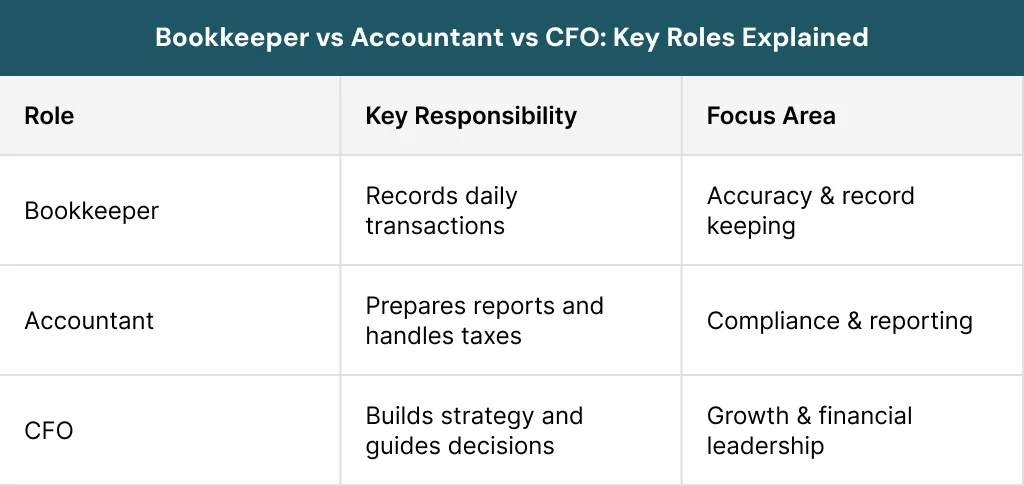
This difference matters. Bookkeepers and accountants are more concerned about accuracy and compliance. However, the chief financial officer focuses on direction and growth.
Retail businesses gain a lot from strong financial leadership early. As operations grow, financial decisions become more complex. Pricing, stock, growth plans and hiring all affect finances. Without expert help, these decisions are often based on guesswork instead of clear data.
The Evolution of the CFO Role in Today’s Market
The job of the chief financial officer has changed a lot over time. In the past, they mainly took care of reporting and making sure the company followed the rules. Today, they have a much wider role as key leaders in a business.
1. From Financial Reporting to Strategic Leadership
Modern chief financial officers help shape business growth strategies. They work with leaders to guide growth, evaluate opportunities and manage risks. Their role now goes beyond finance into:
- Daily operations
- Planning
- Improving results
2. Digital Transformation and Business Growth
The use of digital tools is another big change. A chief financial officer now helps bring in new systems, automate tasks and use data to improve how a business runs and makes decisions.
3. Fractional and Outsourced CFO Models
Businesses also have more flexible ways to hire financial leaders. Instead of a full time chief financial officer, many choose:
- Fractional (part time support)
- Outsourced services
These models help small or growing retail businesses get expert help without the cost of a full time senior role. This makes strong financial leadership easier to access than before.
The Role of Technology and Data in Growth
Modern retail businesses create a lot of data every day, from sales to customer behaviour. But data on its own is not useful unless it is studied and used well. This is where a chief financial officer plays a key role.
1. AI and Automation in Finance
A chief financial officer uses AI and automation tools to analyse data. The aim is to get insights from this data and use them in decision making. These tools are helpful to get the work done faster. They also improve the accuracy of the work.
2. Cloud Based Forecasts and Real Time Dashboards
Cloud systems are really helpful for businesses. They can look at their data at any moment. Business owners do not have to wait for monthly reports. They can simply use these dashboards to monitor performance anytime. It helps them in making faster and better decisions.
3. ERP and CRM Integration
They also integrate systems such as:
- Enterprise Resource Planning (ERP)
- Customer Relationship Management (CRM)
By linking these systems, they create one clear view of the business. This helps track sales, stock, finance and daily operations more easily.
4. Data Driven Decisions
With clear data, decisions are not based on assumptions. They are based on facts. This leads to better pricing, smarter inventory management and stronger business results overall.
Core Functions of a CFO in a Retail Business
A chief financial officer in retail has many duties, but they all support one aim building a stable and profitable business. This clearly reflects the CFO meaning in business in practice.
1. Financial Planning, Budgeting and Forecasting
A key role is financial planning. This includes setting budgets, forecasting future results and making long term plans. These help the business grow while avoiding risk.
2. Cash Flow and Financial Control
It is crucial for any business to manage cash flows. For retail businesses, it can be very tough because they have to deal with sales that go up and down with the seasons. This can cause problems when customers pay late and create gaps in cash flow. A chief financial officer makes sure there is enough money to run daily operations.
Interesting Fact:
Retail businesses often lose money through slow moving inventory.
3. Cost Management
A chief financial officer also manages costs. They review unnecessary spending and cut those extra costs. This helps improve profit and use resources well.
4. Financial Reporting and Compliance
The chief financial officer handles financial reports and ensures compliance. Clear reports build trust and keep the business in line with legal needs.
5. Risk Management
A chief financial officer also manages risk. They spot possible problems, such as market changes or supply issues and plan how to deal with them. This helps the business stay stable in tough times.
Support in Retail Business Growth
A CFO plays a key role in helping retail businesses grow in a clear and steady way. When a company grows without a plan, it can put a lot of stress on finances. The company can achieve long term success with the right support.
1. Planning for Growth and Scale
A chief financial officer helps create clear plans for growth. They set goals that are achievable and figure out how to achieve them. Whether it is opening new shops or adding new products, they make sure each step is based on good financial analysis.
2. Identifying Profitable Growth Opportunities
They also find the best ways to grow. Not all growth is good. Expanding in the wrong way can lead to loss. A CFO checks each option to make sure it fits the business’s financial goals.
3. Supporting Product, Pricing and Market Decisions
A chief financial officer helps with key decisions like what to sell, how to price it and which markets to target. They use data to implement these decisions and minimise risk.
4. Improving Operational Efficiency
A chief financial officer also helps improve daily operations and find ways to cut waste. They also improve processes and make better use of resources. This helps the business to operate smoothly and gain more profit.
Role of CFO in Cash Flow and Profitability Management
Cash flow is commonly referred to as the lifeblood of a retail business. Even a profitable business can fail if it runs out of cash. This makes cash flow one of the most important areas a chief financial officer manages.
1. Preventing Liquidity Gaps
Retail businesses can have high sales but still face low cash. This may happen due to late payments, high stock costs or weak planning. A CFO helps prevent this by planning cash flow and managing working capital.
Did you know?
Many profitable businesses still fail due to cash flow issues.
2. Improving Working Capital and Collections Cycles
A chief financial officer also works to improve how cash moves in and out. They may be able to negotiate better prices with suppliers and handle incoming payments properly. This assists in keeping smooth cash flow.
3. Strengthening Profit Margins
Profit is another key focus. A CFO looks at the financial performance of the company and makes sure the company growth brings more revenues, not just more sales.
They do not just reduce expenses, but make sure that every pound they spend is really valuable for their business. This helps improve the company results. It also supports steady and long term growth.
Revenue is vanity, profit is sanity but cash is reality. – Alan Miltz, Managing Director of Pearl Business Improvement.
Strategic Decision Making
A key role of a chief financial officer within a retail business is to transform financial data into clear and useful insights. This is a practical example of what is a CFO in action. Many owners have access to numbers, but without clear meaning, those numbers do not help much. A chief financial officer fills this gap.
Instead of relying on guesswork or short term thinking, decisions are based on financial data. They look at reports, identify trends and see what must be done to produce the best results.
1. Supporting Pricing, Staffing and Inventory Decisions
This helps with the areas like setting prices, hiring staff and managing stock. For example, a chief financial officer can see if a product is really making a profit after considering all the costs. They can also decide if hiring more staff will help or just add extra cost.
Quick Tip:
Focus on profit per product, not just total sales.
2. Tracking Performance
A chief financial officer also tracks performance. They set key measures (KPIs) that match business goals. These help owners see what is working, spot problems and adjust plans when needed.
3. Real Time Data for Faster Decisions
When you have updated information, you can make decisions fast and you will feel more confident about them. This is very important in the retail business because customer demands and market trends can change very quickly.
Managing Risk and Uncertainty in Retail Operations
Retail businesses are always dealing with things that can change at any time. You do not know what might happen. There are a lot of things that can affect the results of the business. Without good planning, these risks can cause serious money problems.
The failure in retail business has increased by more than 5% in 2025 due to financial pressure. This will also continue in 2026.
1. Identifying Risks Early
A CFO helps find risks early. They can spot problems before they grow by looking at market trends and business data. This helps the business take action before things get worse.
2. Economic Uncertainty and Scenario Planning
A chief financial officer does scenario planning. For example, the company will see what happens if the sales of the company drop or the costs rise. This helps the company to prepare plans for situations and make sure the company can handle tough times.
3. Supply Chain and Inventory Risk Management
The major risk in a retail business is supply chain issues. Sales can be affected by delays, shortages or higher prices. A chief financial officer works with other teams to reduce these risks. They can minimise these risks by having multiple suppliers or managing inventory better.
4. Planning for Crises and Continuity
When things get tough, a simple financial plan is really important. A chief financial officer makes sure the business is ready to deal with problems while staying stable.
Strengthening Financial Systems and Controls
Financial systems need to improve with business growth. Without a system, it is hard to manage your finances. Mistakes start to happen all the time.
1. Building Scalable Financial Systems for Growth
A chief financial officer sets up systems that can grow with the business. These systems can handle sales and more complex processes as the business gets bigger.
2. Improving Internal Controls and Financial Accuracy
A chief financial officer also improves internal controls. These make sure financial processes are correct, consistent and safe. They help reduce errors, fraud and poor handling of finances.
3. Making Reports and Workflows Simple
They make reporting easier and more efficient. Instead of using old reports that are hard to understand, they set up simple systems that provide financial data on time.
Clear information and better accuracy are key to making decisions and building trust. Good financial data helps investors, lenders and partners to be confident in the business.
Supporting Funding and Investor Relations
Outside funding is often required for growth, such as loans or investors. It is not just a good idea to get this funding, rather it needs strong financial planning.
1. Preparing Financials Data for Funding
A chief financial officer ensures the business is ready to get funding. They do this by preparing financial reports, plans and forecasts. They do this to show the strength of the business. This builds trust with lenders and investors.
2. Improving Credit and Funding Readiness
They also improve the business’s financial position to get funding easily. This may include:
- Managing debt
- Improving cash flow
- Strengthening overall performance
3. Managing Investor Communication
A chief financial officer communicates honestly with investors. They share information and provide regular updates to build trust and long term support with investors.
4. Structuring Capital for Growth
A chief financial officer also figures out how to use funds in a smart way. They do this by ensuring that a business has a mix of debt and investment. This supports growth without putting too much pressure on the company.
Support in Retail Growth and Scaling
When a retail business is growing, it is an exciting time. It also means the business will have to deal with some financial problems.
The retail business needs careful planning for things like opening new shops or adding new products or even entering new markets.
A CFO helps make sure this growth makes financial sense. They review costs, expected returns and risks for each option. This helps stop the business from taking on too much.
1. Funding Growth without Debt
A chief financial officer finds the best ways to fund growth. They make sure the business does not borrow much money. This helps keep its finances strong.
2. Tracking Profit
During growth, it is important to track profit for each shop, product or sales channel. A CFO checks this closely to make sure growth is steady. If something is not working well, they suggest changes.
3. Maintaining Profitability
Most importantly, a CFO helps keep profit steady during growth. When a company grows fast without any control, it can lead to big losses. The company needs the right guidance to stay under control and be profitable.
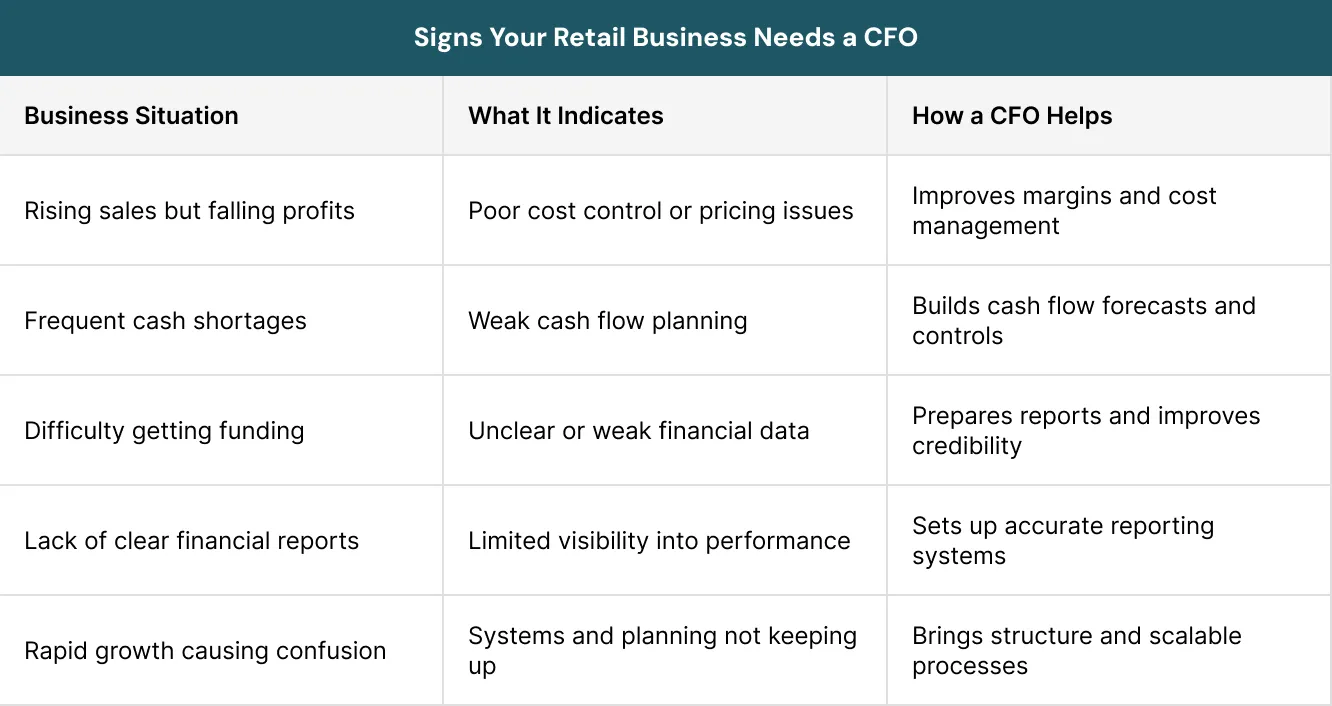
Signs Your Retail Business Needs a CFO
Most companies wait a long time to hire a chief financial officer. This section also answers what is a CFO and when a company needs a CFO. They think they are not ready for a chief financial officer. There are clear signs that tell you that it is time for financial leadership.
1. Inconsistent or Declining Profit Margins
If the sales of a company are going up but the profit is not, then something is wrong. It means that the company has some problems with costs or the processes. This needs to be fixed so that the company can make profits.
2. Cash Flow Issues
It is a warning sign for a company when it has strong sales but low cash. This usually means weak financial planning or poor cash control, which is not good for the company’s future.
3. Difficulty Securing Funding
If you are finding it hard to get loans or attract investors, it probably means your business does not have strong financial data.
4. Lack of Reliable Financial Reporting
If you do not have reliable reports, it is really hard to know what is going on with your business. This makes it difficult to choose wisely.
5. Rapid Growth Outpacing Financial Systems
Fast growth can make things complex. If systems and processes cannot keep up, a chief financial officer can bring the structure and skills needed to manage it well.
Choosing the Right CFO Services Provider
Choosing the right chief financial officer is an important step. The first step is to understand your business’ needs. Every business is different and so are their needs. It depends on the size of business, nature of work and goals.
1. Assessing Skills and Experience
Experience is very important while choosing a chief financial officer. A chief financial officer with retail experience will understand key issues like stock control, pricing and seasonal sales.
2. Outsourced, In House or Fractional Chief Financial Officer
Businesses can choose between:
- In house chief financial officer
- Outsourced chief financial officer services
- Fractional chief financial officer (part time)
Each has its own benefits. Outsourced and part time options are more flexible and cost efficient, while an in house CFO offers full time support.
3. Transparent Pricing and Deliverables
It is important to have clear pricing and a clear list of tasks. This helps you know what you are paying for and how much value you are getting.
4. Aligning CFO Services with Long Term Goals
In the end, the chief financial officer services should match your long term goals and help your business grow in a steady and sustainable way.
Cost, ROI and Value of CFO Services
Many business owners worry about the cost of hiring a chief financial officer. But looking only at cost can be misleading. What matters more is the value they bring.
1. Common Pricing Options
A chief financial officer’s services come in different pricing options. These include full time roles, part time support or outsourced services. This gives businesses the choice to choose what fits their budget.
2. Improve Profitability and Efficiency
A CFO can deliver strong returns on investment (ROI). They help increase profit by improving efficiency, cutting costs and finding new opportunities.
3. Measuring ROI
They also help avoid costly mistakes. Poor decisions, inefficient spending and weak planning can lead to losses. A chief financial officer helps reduce these risks.
4. Why CFO Services are Worth the Cost
In many cases, the gains from better planning and control are greater than the cost of hiring a chief financial officer. This makes it an investment that supports growth, not just an expense.
How to Get Started with CFO Services
Bringing a chief financial officer into a business starts with checking if you are ready. This means looking at your financial issues, growth plans and where expert help is needed.
1. Steps To Hire a CFO
Once the need is clear, the next step is choosing the right type of support. Many businesses begin with a part time or outsourced chief financial officer for more flexibility.
2. What To Expect in the First 90 Days
The early stage includes reviewing financial data, learning how the business works and setting key goals. In the first 90 days, they build a clear view of the finances and deal with urgent issues.
3. Setting Financial Priorities and KPIs
It is important to set clear financial goals. These may include better cash flow, higher profit or plans for growth. Setting key measures (KPIs) helps track progress.
With the right approach, adding a chief financial officer can be smooth and very useful for the business.
Real Life Example
Tesco is one of the largest retail businesses in the UK. Back in 2014 Tesco had some serious problems. The profits were falling and costs were high. There were also issues with its financial reports. From the outside, business looked strong but there was a problem in managing finances.
During this time, a chief financial officer, Alan Stewart, helped get the company on track. They worked on fixing cash flow and cutting extra costs. They make sure financial reports are clear and accurate. This helped Tesco understand its real position.
Tesco made some important changes. It stopped wasting money, kept a track of its stock and focused on the parts of the business that were making profit. These changes were made after financial planning, not just guessing.
Tesco became a stable company over time. It started making profits again and people began to trust it once more. This shows that having strong financial leadership is very important for a retail business. This can turn a struggling business into strong and successful again.
Conclusion
As retail businesses grow, they need to move from reacting to problems to planning ahead. Relying on intuition or basic finance methods is no longer enough for success.
A chief financial officer brings structure, clear insight and strong leadership. They help businesses move beyond just making sales to building solid and profitable operations.
By managing cash flow, improving how the business runs, supporting decisions and reducing risk, a CFO plays a key role in long term success. They make sure growth is not only achievable but also sustainable.
In the end, building a stable and growing retail business needs more than ambition; it needs clear financial planning. A chief financial officer provides this highlighting a CFO meaning in business.
The key point is simple, a chief financial officer’s services are not just for large companies. They are important for any growing retail business that wants to succeed, stay competitive and grow over time.
Sterling Cooper understands the challenges of turning retail sales into real and lasting profit. With expert CFO support, we help businesses improve cash flow, control costs and make smarter financial decisions for sustainable growth. Contact us today for expert services.
Ready to take your retail business to the next level?
Contact us today to discover tailored CFO solutions designed to help your business grow smarter and faster.
FAQs
CFO stands for Chief Financial Officer. They are responsible for managing a company’s financial health, including planning, budgeting and reporting. A CFO also helps guide business strategy using financial data.
No, the CEO holds the highest executive position in a company. A CFO is responsible for managing the company’s finances and financial strategy, but they usually report directly to the CEO.
Yes, a CFO role can be stressful. They handle financial risks, cash flow, compliance and major decisions. However, strong systems and planning can help reduce pressure.
A CFO typically has a degree in finance, accounting or business. Many also hold professional certifications like ACCA, CIMA or CPA. Experience in financial management and leadership is essential.
A CFO helps turn sales into profit through strong financial planning. They manage cash flow, control costs and support decision making. This ensures stable growth and long term business success.
A retail CFO manages finances specific to retail operations. They handle cash flow, pricing, inventory costs and profit margins. They also support growth decisions using financial data.
A CFO brings structure and clarity to business finances. They reduce risk, improve efficiency and support strategic growth. This helps businesses stay profitable and competitive.
CFOs face challenges like managing cash flow, rising costs and economic uncertainty. They must also ensure accurate reporting and handle financial risks. Balancing growth with financial stability is a key challenge.
Recent Posts