

Posted by:
Admin
Date:
July 9, 2026
Category:
blogs
Why Cash Flow Problems Cause Profitable Businesses to Fail
Have you ever thought about the reason why a successful business can still run out of money?
Many owners believe that high sales and profits ensure that every aspect is under control. However, that statement is not always true. Timing errors and late payments are usually the primary causes of cash flow problems. Also, the cause may be how money actually circulates in a business.
This is the point at which most business cash flow problems arise, even in firms that look successful on paper.
The transfer of money into and out of a company is referred to as cash flow. That shows whether it can meet its daily costs when they are payable.
Most business owners think that profit is the ultimate metric of success. If a brand is profitable, it must be secure. If sales are increasing, the business must be powerful. However, in real life, this isn’t always the situation.
The latest UK report indicates that more than 1.57 million UK firms are carrying late invoices in 2026. This highlights how overdue payments remain one of the major causes of cash flow problems at present.
Even profitable firms suffer when cash is stuck, which shows that cash flow matters more than profit in daily life.
In this blog, you will learn why profitable firms fail and what leads to cash pressure. You will also explore how to detect early warning signs before they become serious.
Key Takeaways
- Causes of cash flow problems often include late payments, high costs, poor planning, and too much money tied up in stock, so track cash closely
- Business cash flow problems can affect profitable firms, so check cash in and out, not just sales and profit reports
- Solutions to cash flow problems include faster invoice payments, lower costs, better forecasts, and keeping a cash reserve for slow periods
- Businesses with cash flow problems should act early by finding the cause and making clear changes before cash shortages grow
- How to solve cash flow problems starts with good cash tracking, strong payment terms, and a plan for future income and costs
- What cash flow problems mean is a gap where money leaving the business is higher than money coming in, making it hard to pay bills
What Are Cash Flow Problems?
Cash flow is the exchange of money that flows into and out of a business. Money is received from customers and is paid out through wages, rent, stock buying, taxes, utility bills and loan payments. When greater amounts of cash leave instead of coming in, the business faces financial strain. This pressure can result in business cash flow problems.
One of the primary causes of cash flow problems is timing issues. A customer may purchase something now but make payments after a few months. In the meantime, bills must still be paid right now.
Such a gap is one of the initial causes of cash flow problems that many owners fail to recognise.
A lot of businesses with cash flow problems continue to look good on paper. Sales are strong and profit seems stable but cash is limited in the bank.
A company can be profitable on paper and still fail if it does not have enough cash to pay its bills.
Warren Buffett, Investor and Chairman & CEO of Berkshire Hathaway
Cash Flow vs Profit: Why They Are Not the Same
Profit is a core term in accounting that indicates financial gain. However, cash flow refers to the transfer of cash in and out of a company during a period of time. Therefore, they are not the same indicators of financial success.
A business may show a profit based on a £100,000 sale. However, if the payment is received after two months, cash is not available. This lag is among some of the primary causes of cash flow problems in growing firms.
Many business owners fail to understand this difference, which turns into one of the hidden causes of cash flow problems. Even profitable firms can face stress when cash is not received on time.
This is the reason that some firms with cash flow problems have trouble even when sales are up.
Quick Insight!
A profitable business can still fail if its cash is tied up in unpaid invoices, stock, or future expenses. Profit shows performance, but cash flow shows whether the business can pay its bills today.
Why Profitable Businesses Still Experience Cash Flow Problems?
Profitable firms usually get bigger fast. They recruit staff, purchase stock and increase spending but cash goes out sooner than it comes in.
This growing gap is one of the most significant causes of cash flow problems. An additional serious issue is that invoices are submitted late while costs continue on a daily basis.
Rapid growth, improper planning and weak oversight are common causes of cash flow problems in growing firms. Many owners only discover the issue when severe stress builds up.
This is how business cash flow problems show up even in growing firms.
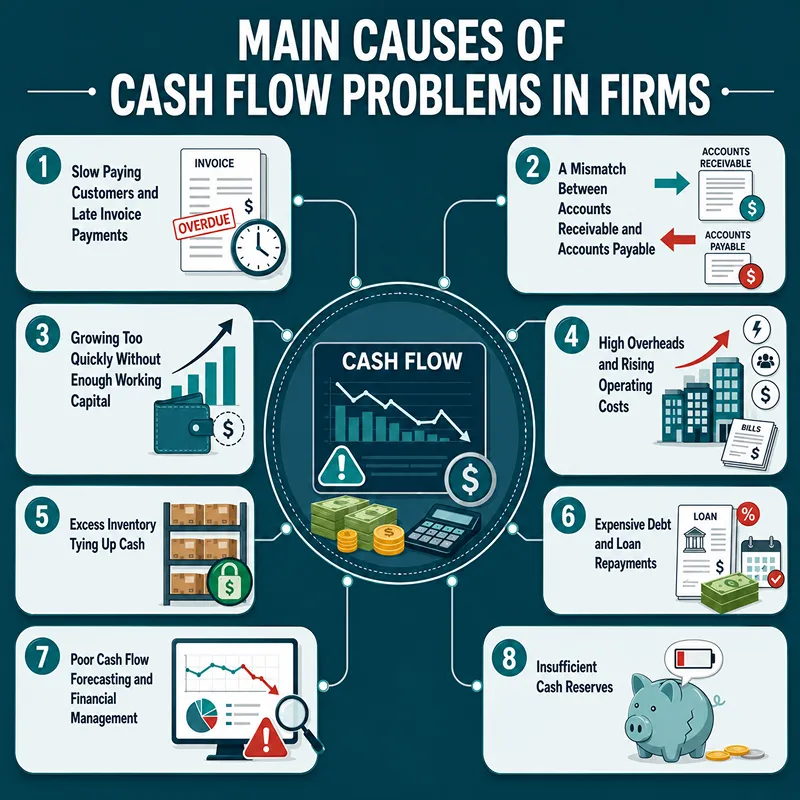
Main Causes of Cash Flow Problems in Firms
There are plenty of reasons leading to cash shortfalls. Pending payments are one of the most harmful causes of cash flow problems. When clients fail to make payments, cash becomes tight right away. This is a routine concern for businesses with cash flow problems.
The second major problem is poor financial timing, which has remained one of the most ignored causes of cash flow problems.
The following are the primary usual causes of cash flow problems in daily business activities:
1. Slow Paying Customers and Late Invoice Payments
One of the biggest causes of cash flow problems is paying late. Certain clients require 30, 60 or even 120 days to make payments.
This leads to financial strain because expenses still have to be paid. Many firms with cash flow problems have difficulty due to a number of huge delayed invoices.
This is considered one of the most common causes of cash flow problems in small and mid-sized firms.
2. A Mismatch Between Accounts Receivable and Accounts Payable
When vendors must be paid out prior to when customers pay, a gap is created. This imbalance is one of the primary causes of cash flow problems.
This matter often results in direct business cash flow problems, especially in trading and retail based firms.
3. Growing Too Quickly Without Enough Working Capital
Fast progress is always desired but it comes with several challenges. Growth needs sufficient cash for staff, stock and routine activities. Most businesses with cash flow problems fail during expansion because cash is locked in pending invoices.This can turn into one of the overlooked causes of cash flow problems.
4. High Overheads and Rising Operating Costs
Certain fixed expenses, such as rent, salaries and utilities, can go up rapidly. If earnings do not align, pressure increases.
This is a further significant group of causes of cash flow problems that gradually lowers existing cash.
5. Excess Inventory Tying Up Cash
The amount of stock stored in warehouses is cash that cannot be utilised. This is among some of the realistic causes of cash flow problems.
Many firms with cash flow problems possess too much stock and cannot transform it into cash swiftly.
6. Expensive Debt and Loan Repayments
Loans help progress but repayments lower existing cash. A lot of debt is one of the lasting causes of cash flow problems.
This usually gives rise to business cash flow problems when repayment deadlines are strict.
7. Poor Cash Flow Forecasting and Financial Management
Without proper preparation, cash shortfalls show up unexpectedly. Poor prediction is one of the easily avoidable causes of cash flow problems.
Most firms with weak planning become businesses with cash flow problems even when sales are healthy.
Learn more: Business growth guide
8. Insufficient Cash Reserves
There is no financial security when a company has limited or no cash buffer to depend on during crises. Thus, even minor sudden costs or lags in income can interfere with daily routines and cause unexpected financial stress.
This lack of financial resources is one of the major causes of cash flow problems. This is because the firm has nothing to rely on when cash inflows unexpectedly slow down.
Warning Signs Your Business Has Cash Flow Problems
Even successful companies can deal with business cash flow problems without discovering it very soon. The warning signs often show up in routine tasks before the scenario becomes severe. Here’s what you need to look for:
1. Struggling to Pay Suppliers on Time
One of the early warning signs is a delay in vendor payments. When a company does not have a sufficient amount of existing cash, bills start building up. Owners may begin asking for more flexible payment terms or be at risk of not meeting payment deadlines altogether.
This can negatively impact supplier trust and may result in tougher payment conditions in the future. It also indicates that inflowing cash is not in line with outgoing costs.
2. Difficulty Meeting Payroll and Operating Expenses
Pressure on salaries is another warning sign. Cash flow is already under stress if a company is unable to pay salaries and rent on time. The firm is also under pressure if utility bills or basic working costs are not paid on the due date.
Even if sales are looking good, timing gaps between income and expenses can lead to shortfalls. This is one of the most serious causes of cash flow problems in developing firms.
3. Increasing Reliance on Credit or Short-Term Borrowing
When companies start relying on credit cards, overdrafts or temporary loans to stay functioning, it shows cash assets are low. While taking out loans can help with growth, frequent use for daily costs is a warning sign. It indicates that the company is not producing enough internal cash to support itself.
4. Declining Cash Balances Despite Strong Sales
A difficult but common sign is increasing sales with less cash in the bank. This usually happens when payments received from customers are postponed while costs are paid promptly. As a result, profit may appear good on paper but actual cash keeps falling. This gap is one of the most obvious signs of secret cash flow problems.
Best Practices to Prevent Future Cash Flow Problems
Resolving cash flow problems is essential but avoiding them is even more beneficial. Effective financial routines lower the chance of issues coming back.
The following are crucial practices that help keep a steady cash flow:
1. Monitor Working Capital Closely
Operating capital indicates how easily a company can pay for temporary costs.
Monitor receivables, payables and stock routinely. If money is trapped in pending invoices or extra stock, cash flow will reduce fast.
Continuous tracking will allow you to deal with problems before they develop.
2. Maintain a Cash Buffer
A cash buffer helps protect your business during sudden declines in revenue or postponed payments.
Try to keep sufficient reserves to pay for at least a few weeks of necessary costs. This creates financial breathing room during pressure periods.
3. Track Key Cash Flow Metrics
Major metrics involve cash flow rate, payment cycle time and cost ratio.
Being aware of these numbers helps detect initial warning signs. If costs go up quicker than income, corrective action can be carried out right away.
4. Create a Realistic Growth Plan
Fast progress without planning usually results in cash shortfalls.
A practical growth plan involves balancing sales expansion with existing cash supplies. It guarantees that recruiting, purchasing and growth happen in line with financial resources.
Managed expansion keeps cash flow steady and reduces financial risk.
What Happens When Cash Flow Problems Are Ignored?
Neglecting cash flow issues does not make them go away. Rather, it usually causes them to become more severe over time. Minor delays in payments or planned gaps slowly turn into major financial stress.
In the end, the company begins losing control over its daily stability. What starts as a small concern can affect routine tasks, connections and even survival.
When you are unable to find the causes of cash flow problems and they are left untreated, this creates many issues. They start impacting every aspect of the company in different ways:
1. Disrupted Daily Operations
When cash is limited, routine tasks become hard to carry out. Business owners begin to postpone vital payments such as rent, salaries and payments to suppliers. This results in internal pressure and slows down normal operations.
Teams fail to maintain attention to detail because the priority changes from progress to survival. Stock orders are put on hold, services get interrupted and clients may suffer from poor service. Over time, this impacts the entire performance of the company and lowers efficiency in all of its divisions.
2. Missed Growth Opportunities
Cash flow problems directly hinder business progress. Even if consumer demand is high, there is no available cash to invest in growth, advertising or new items.
Firms may postpone recruiting trained staff or upgrading technology. They may also ignore massive buying deals or new business opportunities.
Competitors with greater cash flow proceed ahead while weaker firms remain stuck in place. This gap becomes more difficult to recoup over time.
Related: Business growth strategies
3. Damaged Supplier and Lender Relationships
Suppliers and lenders depend on on-time payments. As soon as dues are put on hold multiple times, trust begins to break down. Suppliers may lower the credit terms, ask for initial payments or stop working with the company overall.
Banks and financial partners also regard delayed payments as a risk warning. This can result in lower credit limits or trouble in obtaining future funds. Once trust is broken, restoring these ties takes time and regular financial control.
4. Increased Risk of Insolvency
If cash flow problems persist without a proper fix, the company can hit a critical stage. Even profitable firms can become troubled if they cannot pay temporary payments on time.
Costs keep building up while accessible cash keeps reducing. In the end, the company may fall behind on payments or depend too much on loans to stay operational. As a result, a turnaround becomes tough and in serious cases, the company may shut down despite having solid sales on paper.
How to Solve Cash Flow Problems?
Cash flow problems often arise when money going out is more rapid than money coming in.
The good news is that there are solutions to cash flow problems with better control, planning and financial control.
Below are the practical steps firms use for the solutions to cash flow problems properly:
Step 1. Improve Invoice Collection and Credit Control
Delays in payments are one of the most common causes of cash flow problems. The quicker you gather money, the more stable your cash position becomes.
Start by submitting invoices soon after the delivery of a product or service. Do not postpone billing because delays directly impact cash flow. Provide specific payment terms like 7, 14 or 30 days and promise that they are fully clarified. They should also be decided upon prior to when work takes place.
Follow up regularly on late billings. Even a minor pause in collection can lead to stress in paying salaries, suppliers and other fixed expenses. Numerous firms also reduce the risk by allowing minor discounts for prompt payments.
Step 2. Reduce Unnecessary Overheads
Increased fixed fees can take away cash even when sales are steady. Assessing costs helps determine areas where money is being used up.
Look closely at subscriptions, unutilised services, excess staff expenses and ineffective tools. Eliminate anything that does not directly support revenue or routine tasks. Minor monthly bills often build into large annual financial losses.
The aim is not to reduce everything but to keep only what adds real value to the company.
Step 3. Optimise Inventory Management
Too much inventory holds cash, while too little stock can prevent sales. Proper stock is essential for a stable cash flow.
Monitor which items move fast and which continue to be in storage. Avoid ordering too many slow-selling items. Utilise demand forecasting to arrange purchase orders based on real sales trends.
This guarantees that cash is not locked up in idle inventory and stays available for daily tasks.
Step 4. Build and Maintain Cash Reserves
A cash reserve serves as a financial security net during weak sales periods or sudden costs.
Set aside a minor amount of income regularly, even during profitable months. This results in stability during economic crises or payment lags.
Firms with sufficient funds can survive tough times without depending on loans or urgent credit.
Step 5. Forecast Cash Flow Regularly
Cash flow prediction helps you identify upcoming money gaps before they arise.
Create weekly or monthly estimates that show expected income and costs. This allows quick action, such as putting off unneeded bills or accelerating payments.
Ongoing prediction transforms cash handling from reactive to proactive.
Step 6. Review and Restructure Business Debt
Debt is considered a serious issue when repayment stress is greater than cash inflow.
Look over all existing loans and repayment plans. If payments are too high, look into restructuring options such as increasing repayment terms or changing to reduced interest plans.
This lowers monthly stress and increases temporary cash flow.
Step 7. Use Business Financing Strategically
Outside funding can help deal with timing gaps but it must be utilised cautiously.
Temporary financing like overdrafts or billing funding can support sudden needs. However, it should not be utilised to pay for constant losses.
The most important thing is to utilise financing as a bridge, not a lasting solution.

Best Practice!
Review your cash flow regularly, track unpaid invoices, control costs, and keep a cash reserve. Small checks each month can prevent bigger cash problems later.
Case Study: Profitable on Paper, Failure in Reality
Patisserie Valerie was a renowned UK café company that had more than 200 stores. The business was earning £100 million in annual sales. It seemed to be strong and even indicated £28 million in cash.
However, in October 2018, that all broke down. Auditors detected scams in the accounts and the real story came out soon enough:
- The firm stated that it had £28 million in cash
- About £10 million in debt was hidden
- Total accounts were falsely reported by roughly £94 million
The reason for all this was secret money transfers, false invoices and fake bank statements.
The result was severe because 70 stores were closed and 900+ jobs were gone. Thus, the company broke down within weeks.
The lesson
This case study teaches us that profit and cash are not the same. A company can seem to be doing well and still be covering up a crisis. Therefore, always confirm actual cash balances rather than depending only on recorded figures.
Conclusion
Cash flow problems do not arise suddenly. They grow from delayed payments, rapid progress, higher expenses and incorrect planning. If you leave it unchecked, they can ruin even a profitable business.
The good news is that such issues are easily avoided. More accurate prediction, faster collections and stricter budget control go a long way. Proper practices now will protect your business in the future.
Sterling Cooper understands these issues and helps firms spot causes of cash flow problems early. We build a thorough plan to deal with these issues with confidence.
Contact us today and take the initial step to build a stronger and more trustworthy business.
Struggling with cash flow gaps despite making a profit?
Our experts help businesses improve cash flow, manage risks, and find practical solutions.
We have helped with cash flow challenges and supported businesses in building stronger financial control. Reach out today.
FAQs
Cash flow problems happen when a business does not have enough available cash to cover its regular expenses, even if it is making a profit. This usually occurs when money coming into the business is delayed while payments such as wages, supplier bills, rent, and taxes still need to be paid. Poor cash planning, late customer payments, high costs, and rapid growth are common reasons businesses face cash flow issues.
To solve cash flow problems, businesses should first identify where money is being delayed or spent unnecessarily. Improving invoice collection, setting clear payment terms, reducing avoidable costs, managing inventory, forecasting future cash needs, and building a cash reserve can all help improve cash flow. Regular monitoring of income and expenses allows businesses to spot problems early and take action before they become serious.
Several factors can affect cash flow, including customer payment delays, operating costs, inventory levels, loan repayments, sales changes, and business growth. A company may face cash flow pressure when expenses increase faster than income or when cash is tied up in unpaid invoices and stock. Regular cash flow tracking helps businesses manage these factors and avoid future problems.
Startups, construction companies, manufacturing firms, wholesalers, and businesses with long payment terms are often more vulnerable to cash flow problems. These businesses usually have high upfront costs, delayed customer payments, or large amounts of money tied up in stock and projects before they receive income.
Businesses with low overheads, quick customer payments, and recurring income models often have stronger cash flow. Examples include subscription-based businesses, digital services, consulting, and businesses that receive upfront payments. However, good cash flow depends more on effective money management than the type of business itself.
Recent Posts

How to Build a Cash Reserve for Business Stability
August 11, 2026

How to Forecast Cash Flow During Economic Uncertainty
August 6, 2026