

Posted by:
Admin
Date:
August 11, 2026
Category:
blogs
How to Build a Cash Reserve for Business Stability
Have you ever wondered how many companies enter insolvency in the UK each month? In June 2026 alone, 1,845 companies were declared insolvent. This is how quickly a business can go into a financial crisis.
Unpredictable bills, late payments or unexpected declines in sales can wipe out your budget. It’s impossible to foresee all the random costs you may encounter, but you can plan for them. You can set up cash reserves for business to avoid cash flow problems.
In this guide, you will learn how to build cash reserves for business stability. It explains how to determine the cash reserve requirements for your company and the common mistakes to avoid. For most small businesses in the UK, maintaining a 3 to 6 months cash reserve to cover their basic operating costs is the benchmark to follow. However, the correct amount depends on your industry, cash flow and business risks.
Key Takeaways
- Build a cash reserve that covers 3 to 6 months of essential expenses.
- Keep your reserve in a separate savings account.
- Automate regular savings into your reserve.
- Improve cash flow by reducing unnecessary spending and managing late payments.
- Review your reserve regularly as your business grows.
What Is a Cash Reserve Account?
A cash reserve account is a business savings account used to save money set aside for emergencies, business stability or unexpected expenses. This reserved account works as a financial buffer and is kept separate from your regular account. It gives you the confidence to make decisions without short-term panic.
How to Build a Cash Reserve for Business Stability?
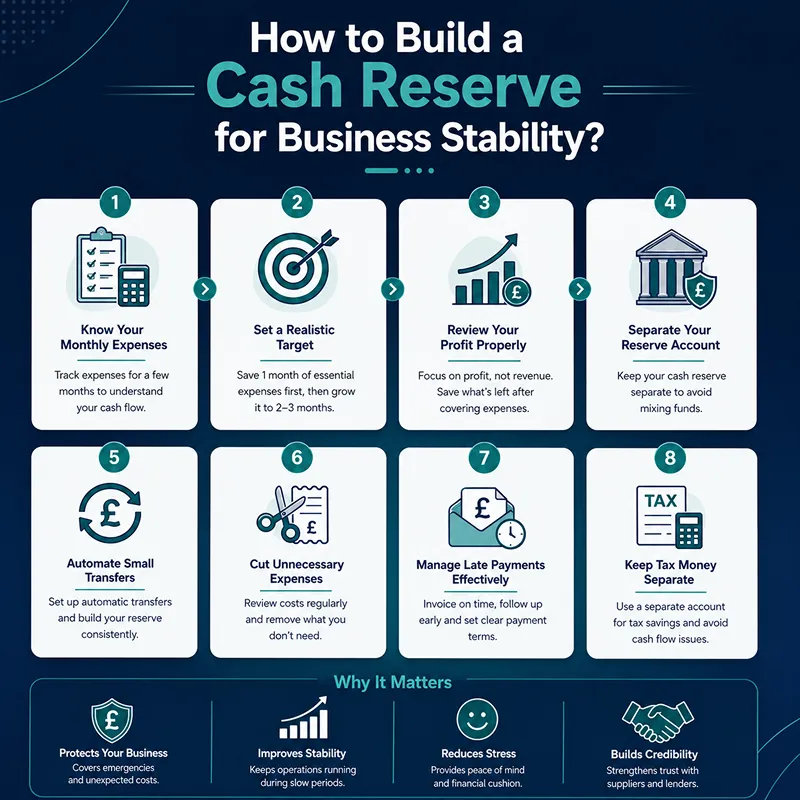
Here are the simple steps that you need to take in order to build a cash reserve for business stability:
1. Record Monthly Expenses
Record your spending for a couple of months. Where does all your money really go? After you can visualise your real cash flow in and out, you’ll have the data you need to determine how much you should save. This is the first step towards a good cash reserve.
2. Set a Realistic Target
Don’t try to build up a huge reserve right away. Initially, save for at least one month’s worth of necessary costs. After that, gradually increase the amount of time to two or three months and perhaps longer if you are comfortable. The crucial thing is to keep it manageable, so you don’t blow your cash flow over the board trying to save some reserves.
3. Analyse Your Profits
Another key factor while building a cash reserve is monitoring your profits accurately. It’s easy to get excited about “big sales numbers,” but profits are what let you save. Regularly review what’s left after you cover expenses. That’s the money you can actually put away in your reserve.
“Revenue is vanity, profit is sanity, but cash is king.”
— Alan Miltz
4. Separate Your Reserve Account
Always keep your cash reserve account separate from your regular account. This will help you avoid mixing up your funds and spending them without noticing. A separate reserve account makes sure you protect your savings and stay focused on your goal.
5. Automate Transfers
Make regular transfers from your regular account to the cash reserve for business accounts. Auto transfers will help to keep your reserve growing without having to monitor them from a human perspective. Always begin with a small amount that your business can easily afford. Repeated small transactions, such as a weekly or monthly transfer, add up. If you’re making more money, raise the amount and start quickly putting more into your reserve business account.
“Do not save what is left after spending, but spend what is left after saving.”
— Warren Buffett
6. Reduce Unnecessary Expenses
Make it a habit to regularly review your business expenses and identify potential cost-saving opportunities that don’t impact your day-to-day business. Subscription to tools is more expensive than it seems and it is something we hardly take a note of. Regularly check the subscriptions and cancel all unused ones.
Additionally, renegotiate service contracts and determine the costs that have been slowly increasing over time. After you have cut your unnecessary costs, be sure to put them into your cash reserve for business accounts and NOT into other items. After a while, you will realise that even small frequent savings can help you create a greater financial cushion.
7. Manage Late Payments Effectively
Delayed payments often disrupt your cash flow and badly affect your cash reserve for business. To avoid this, set clear payment terms, send invoices to the customers on time and follow up before they become overdue. In addition, offer your customers convenient payment options and charge late fees when necessary to manage late payments effectively.
8. Keep VAT and Corporation Tax Separate
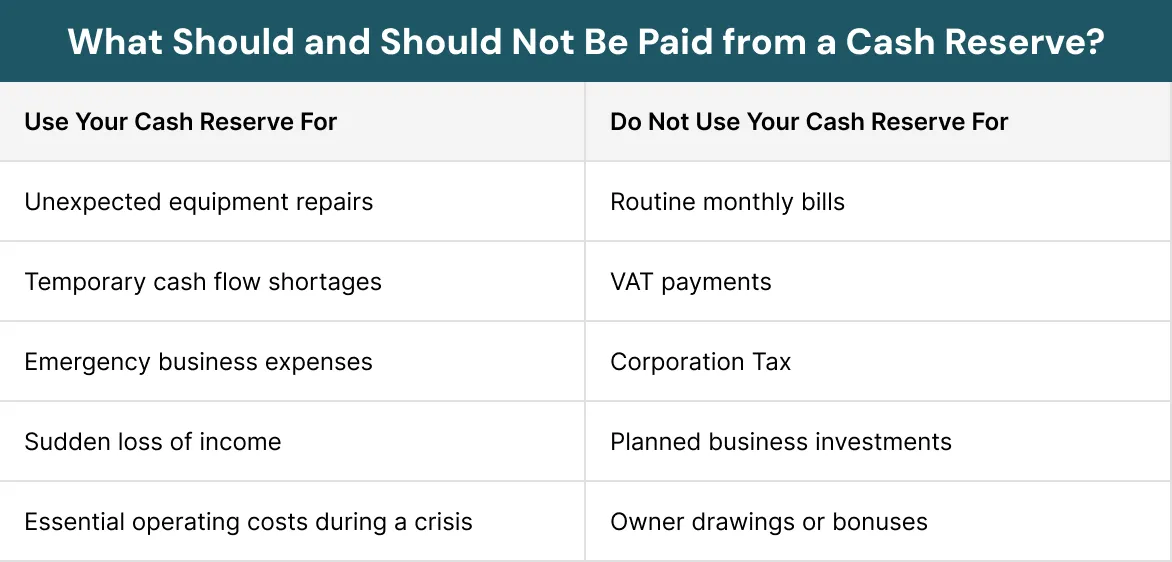
Don’t mix up your VAT or Corporation Tax funds in your cash reserve. Instead, set up a separate account to manage your taxes. Initially, this might not be a concern for you. However, as your revenue grows, setting aside money for taxes becomes increasingly important. Separate tax savings protect your cash reserve from unexpected withdrawals. It also helps you avoid cash flow problems and keeps your emergency funds available for genuine business needs.
How Much Cash Should a Business Have in Reserve?
A business must have three to six months of fundamental operating expenses in an instant-access savings account. This buffer helps you manage late payments, unexpected emergencies and gaps in your order pipeline. However, this isn’t the standard hardcore number. The right time frame varies based on the nature of your business. A well-established business with consistent demand can operate with a smaller cash reserve. However, seasonal businesses or those with unpredictable incomes should aim higher. If your revenue is unstable or clients pay late, you need a bigger buffer.
How Do You Calculate Your Cash Reserve?
To calculate your cash reserve, first, you need to understand your essential monthly costs, such as payroll, rent, utilities, insurance, loan repayments and subscriptions. Then, multiply your essential monthly cost by the number of months you want to cover. For example, if your essentials cost is £15,000 a month, you must target £45,000 for three months or £90,000 for six months. Here is the formula that you can use to calculate your cash reserve target:
CashReserveTarget = EssentialMonthlyOperatingExpenses×NumberOfMonths
Common Mistakes When Building a Cash Reserve for Business
While creating a cash reserve for business, make sure to avoid the following common mistakes. If you overlook these mistakes, they can cause long-term financial problems.
1. Mixing VAT or Corporation Tax with Reserves
One of the most frequently observed mistakes is mixing up your VAT or corporation Tax with your reserve. In this case, when tax bills arrive, your reserves vanish. Therefore, it’s always recommended to use separate deposit accounts for taxes and day-to-day funds to protect the integrity of your funds.
2. Saving Too Aggressively
Another mistake that businesses often repeat is saving too aggressively. If you try to save too much too quickly, it can disrupt your working capital. You need to understand that consistency matters much more than the size of the initial deposits. Building your cash reserve for business accounts slowly but consistently reduces the chances of unexpected cash flow problems.
3. Ignoring Regular Reviews
As your business grows, your cash reserve for business targets should evolve alongside it as well. If you ignore your ongoing cash flow figures or do not update your targets, unexpected market fluctuations may affect your business badly.
4. Treating the Reserve as Spending Money
If you treat your business cash reserve as spending money, you could leave your business unprepared for unexpected expenses. Remember, a cash reserve is meant to be an emergency buffer. Consider separating your funds into categories or accounts for routine operations, planned investments and emergency reserves. This helps you avoid impulse withdrawals and ensure money is available when it is needed most.
5. Failing to Prepare for Worst-Case Scenarios
Always be prepared for worst-case scenarios to manage extended disruptions. You must prepare a three to six-month cash reserve for essential expenses to ensure business stability.
“Prepare for the worst; expect the best.”
— Benjamin Disraeli
How a Cash Reserve Improves Stability: Case Study
John Lewis Partnership, a well-known UK retailer, planned to get a precise view of its financial strength during uncertain times. So, they carefully examined their cash flow and ran through a series of potential stress scenarios. This includes everything from sharp drops in sales to unexpected expenses. After analysing the data, they decided to keep £100 million set aside as a permanent reserve, just in case circumstances changed. They made sure this reserve was kept separate from the money they used for daily operations or long-term projects, so nothing got mixed up.
This simple move made John Lewis more resilient. They had cash ready for emergencies, but they didn’t let extra money sit around doing nothing. The takeaway? Set cash reserves for business based on the real risks your business faces, not just arbitrary numbers.
Did You Know?
A cash reserve is not an investment fund. It should remain easily accessible so you can use it immediately during emergencies, unexpected expenses or temporary cash flow shortages without disrupting your business.
Conclusion
Building a cash reserve for business stability helps your business stay financially stable during unexpected expenses and temporary cash flow disruptions. You can start with a small but consistent amount. Also, make sure to monitor your cash flow regularly and adjust your savings as your business evolves. If you are unsure how much you should reserve, Sterling Cooper Consultants can help you improve your financial stability through expert cash flow and budget planning.
Need expert financial guidance?
Sterling Cooper Consultants provides professional Financial Advisory services to help your business make informed financial decisions and achieve long term stability.
FAQs
A cash reserve account is a separate business savings account used to set aside money for emergencies, unexpected expenses or temporary cash flow shortages. It helps businesses stay financially stable during difficult periods.
Yes. A cash reserve and a cash buffer both refer to money set aside to protect a business from unexpected expenses, reduced income or temporary cash flow problems.
Most financial experts recommend keeping at least 2 to 3 months of fixed business expenses in cash reserves. Businesses with seasonal or unpredictable income should aim for 3 to 6 months of expenses.
Yes. Many business savings accounts and cash reserve accounts earn interest while keeping your funds accessible when needed. This allows your reserve to grow while remaining available for emergencies.
Without cash reserves, unexpected expenses or delayed customer payments can quickly create cash flow problems. This may force a business to borrow money, delay payments or reduce essential business spending.
Recent Posts

How to Forecast Cash Flow During Economic Uncertainty
August 6, 2026

How AI Is Changing Bookkeeping for Small Businesses
August 5, 2026