Posted by:
Admin
Date:
July 20, 2026
Category:
blogs
Common Self Assessment Mistakes and How to Avoid Them
A self-assessment tax return is a process that is completed annually by millions of people within the UK. Yet many still leave it until the deadline. HMRC reported that 11.48 million returns were filed by 31 January, with 475,722 submitted on the final day and more than 27,000 in the final hour alone.
When tax returns are rushed, mistakes become more likely. A missed detail or incorrect figure can lead to unexpected tax bills, penalties, interest charges or time spent correcting avoidable self-assessment errors.
In this guide, you will learn the most common Self Assessment mistakes, why they occur, how to avoid them and how to file your HMRC Self Assessment tax return correctly.
Key Takeaways
- Register for self assessment early to receive your UTR and avoid filing delays.
- Keep accurate financial records throughout the year to make tax reporting easier.
- Report all taxable income, capital gains and other required information correctly.
- Claim all eligible expenses, tax reliefs and allowances to avoid paying more tax than necessary.
- Double-check your return before submission and correct any mistakes promptly if you find them later.
What Is Self Assessment?
Self-assessment is a system that HM Revenue and Customs (HMRC) uses to collect Income Tax and National Insurance. Most employed people have tax deducted from their wages. However, individuals with untaxed income must submit an annual tax return. This includes self-employed people, landlords and some higher earners. They use the tax return to report their income and calculate their tax bill.
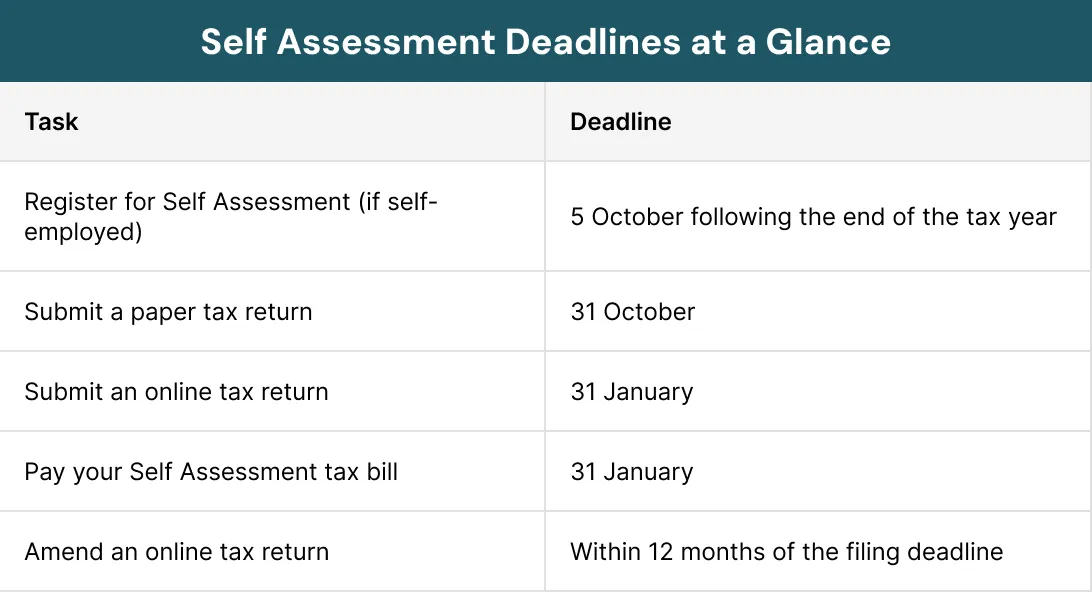
The table below highlights the main Self Assessment deadlines you should remember before filing your tax return.
Common Self Assessment Mistakes and How to Avoid Them
Let’s discuss the most prevalent HMRC self assessment mistakes and how to prevent them:
1. Registering for Self Assessment Too Late
Late registration can delay your Unique Taxpayer Reference (UTR). As a result, you may not submit your tax return on time. This also increases the chances of late filing penalties.
How to Avoid It
To avoid this self-assessment mistake, you must register through the official Self Assessment Registration portal before the deadline. After registration, HMRC will send you a UTR. Note down the UTR number as you’ll need it to file your actual tax return.
If you miss the registration deadline, i.e., October 5, you can return and pay your tax bill by the filing date, i.e., January 31. If your tax liability is calculated and fully paid by this date, HMRC typically waives the late registration penalty.
If you’ve overlooked both deadlines but have a reasonable excuse (such as serious illness or IT failures), you can appeal the decision through the official tax appeals portal. In that case, HMRC may waive the penalty.
Did you know?
HMRC received over 27,000 Self Assessment tax returns in the final hour before the 31 January deadline, showing how many people leave filing until the last minute.
2. Not Keeping Proper Records
If you are not keeping your income and expenses well-documented, you can overlook some of your income or understate your allowable business expenses. This may lead to an incorrect tax return, over-payment of taxes or an enquiry from HMRC.
How to Avoid It
Keep accurate records throughout the year and use accounting software where possible. Record all income, expenses, invoices, receipts and bank transactions in one place. If you are unsure what to report, speak to a qualified accountant before submitting your tax return.
3. Not Reporting Capital Gains
Many people only report their income and overlook capital gains. If you sold shares, an investment property or other chargeable assets in the tax year, you may need to declare the gain and pay Capital Gains Tax (CGT). Otherwise, it may result in an incorrect tax return and extra tax charges.
Remember, not all sales are subject to tax. You may qualify for tax exemptions or fall within the tax-free allowance. However, it’s important to check whether a sale needs to be reported.
How to Avoid It
Review any assets you sold during the tax year and calculate your capital gains before filing your tax return. Make sure to record the purchase price, the sale price and any associated costs. They are necessary for you to accurately calculate your gain. If you do not know whether you have to pay tax or what the amount is, you should contact a qualified tax adviser or accountant.
4. Ignoring Pension Contributions
Often, people do not remember to report their pension payments or do not record the correct amount on their tax return. As a result, they may miss valuable tax relief or submit an incorrect tax return. You can correct this self assessment mistake by logging into your account and amending the return within 12 months of the filing deadline.
How to Avoid It
To prevent this self-assessment mistake, make sure you save details of all pension contributions you made in the tax year and submit the tax returns accordingly. Check your pension statements or contact your pension provider if you’re unsure about the amounts. If you are entitled to more tax relief than you’ve currently claimed, be sure to claim it before filing your return.
5. Not Declaring Charitable Donations
If you fail to register your Gift Aid charitable donations on your tax return, you may be missing out on valuable tax relief. Charitable donations are gifts, usually in the form of money or qualifying gifts, made to registered charities. Eligible Gift Aid donations can be claimed as an additional tax relief for higher or additional rate taxpayers. However, if you have taken Gift Aid benefit but paid insufficient tax, you may need to pay back some of the tax relief that you claim for the charity.
How to Avoid It
Only claim Gift Aid if you’re eligible. Maintain details of all Gift Aid donations you make during the tax year. Include them correctly on your Self Assessment tax return to claim any tax relief you’re entitled to and avoid reporting errors.
6. Failing to Claim All Allowable Expenses
Failing to claim all allowable expenses usually won’t result in a penalty. However, it can increase your tax bill. Allowable expenses are costs that are completely and exclusively related to running your business. For example, self-employed individuals can claim business expenses like travel, office supplies and professional services. If you don’t claim them, you may pay more tax than necessary.
How to Avoid It
Separate business and personal finances to keep track of expenses more easily. Track your business costs all year round and keep receipts or invoices as proof. Accounting software can also be used to keep your records organised. Before claiming expenses, check the guidance from HMRC to find out if they’re allowed.
7. Not Checking Personal Allowances and Tax Reliefs
Not checking your personal allowances and tax reliefs can also increase your tax bill. These are tax benefits that can reduce the amount of tax you pay based on your personal circumstances. For example, you may qualify for Marriage Allowance, pension tax relief or other HMRC reliefs. If you don’t claim them, you could end up paying more tax than necessary.
How to Avoid It
To prevent this self-assessment mistake, you can check what allowances and tax reliefs are available before filing your Self Assessment tax return. See if you have the legal right to claim them and have properly reported them on your tax return.
8. Forgetting to Include the Right Supplementary Pages
Forgetting to include the correct supplementary pages can make your Self Assessment tax return incomplete. Supplementary pages are additional sections used to report specific types of income or gains. For example, you may need them if you’re self-employed, receive rental income, have foreign income or need to report capital gains. Missing these pages can delay the processing of your return or result in HMRC asking for more information.
How to Avoid It
To avoid this HMRC self assessment mistake, you must check which sources of income you had during the tax year before completing your tax return. Make sure you include all the supplementary pages that apply to your circumstances.
9. Making Calculation Errors
Manual calculations can easily lead to self-assessment mistakes. Even a small error when entering figures or calculating tax can affect your return. A slight error can result in paying too much or too little tax, delay the processing of your return or prompt HMRC to contact you to correct the information.
How to Avoid It
To avoid this, double-check all figures before submitting your tax return. Compare them with your records, such as invoices, bank statements and payslips. If you file your return online, use HMRC’s automatic calculations where possible. This can help reduce the risk of errors.
10. Skipping the Final Review Before Submission
Once you fill out your tax return, it’s easy to submit. But without the last review, there can be expensive self-assessment mistakes. There is a possibility that you may input the wrong numbers, forget to include all the necessary information or fail to include the proper supplemental pages. The processing of your return may be delayed if there are even minor errors or information is incorrect, which may result in a penalty.
How to Avoid It
Spend a few minutes reviewing your tax return before you submit it. Verify all figures and sections are correct. Ensure that you’ve provided the correct supplemental pages and claimed any eligible expenses and tax reliefs. A final review will help you catch errors before it becomes expensive.
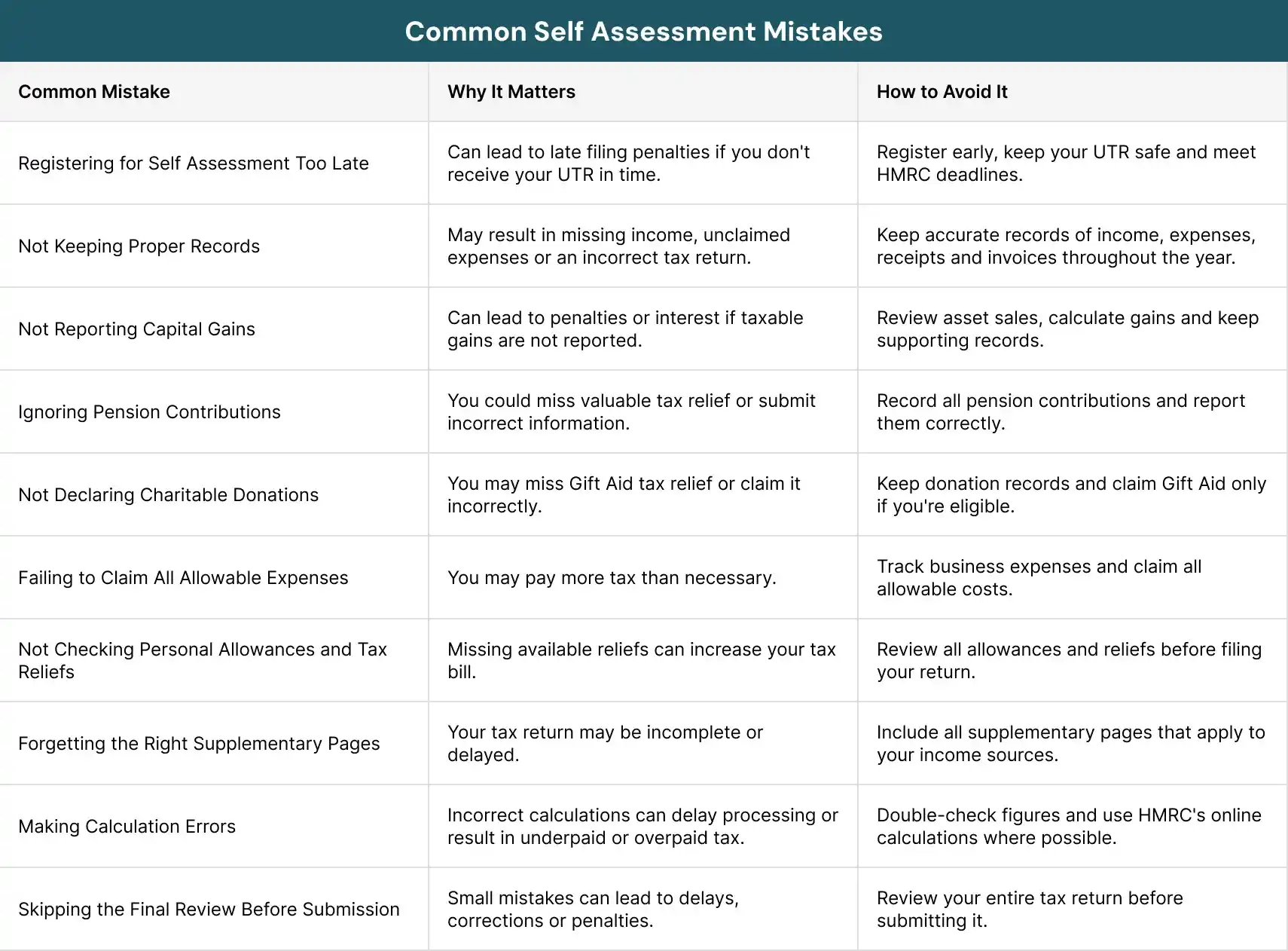
The table below summarises the most common Self Assessment mistakes, why they matter and how to avoid them.
How to Correct a Self-Assessment Mistake?
You can correct an error even if the tax return has already been filed. HMRC allows you to amend a tax return within 12 months of the original filing deadline. For example, if you submitted your 2024/25 tax return, you can amend it until 31 January 2027.
Once your return is updated, your tax bill could be adjusted. You might need to pay more tax if you underreported your income. If you overpaid, you may receive a refund instead.
Correct the mistake as soon as you find it. Fixing self-assessment mistakes early can help reduce interest and penalties. It also keeps your tax records accurate.
Did you know?
If you discover a mistake after submitting your Self Assessment tax return, you can usually amend it within 12 months of the original filing deadline instead of submitting a new return.
Final Check Pays Off: Case Study
Mr Dolan submitted a Self Assessment return with incorrect information about his UK dividend income and tax residency status. HMRC investigated the return and imposed a £46,199.63 penalty. HMRC claims the error was deliberate. The First-tier Tribunal found the mistake was careless, not deliberate, and reduced the penalty to £19,799.84. The case shows why you should check complex tax rules and review your Self Assessment return carefully before filing.
Conclusion
Filing your Self Assessment tax return before the HMRC deadline helps reduce unnecessary penalties, interest and delays. Avoiding most self assessment errors can be achieved by maintaining accurate records and reviewing your numbers. It is also important to know about any tax reliefs and allowances that you are eligible for, as these may help to reduce your tax bill. If you find a self-assessment mistake in your return, fix it as soon as you can to minimise the chances of extra charges. Sterling Cooper Consultants helps individuals and businesses stay compliant with HMRC requirements through expert tax advice, accurate tax return preparation and ongoing compliance support.
Need Help With Your Self Assessment?
Avoid costly mistakes and file your Self Assessment tax return with confidence. Sterling Cooper Consultants offers expert self-assessment preparation, filing and tax compliance support to help you stay compliant with HMRC. Contact us today to make your tax return simple and stress-free.
FAQs
The most common self assessment mistakes include registering late and failing to keep proper records. Many taxpayers also forget to report all taxable income or capital gains. Other common mistakes include missing allowable expenses or tax reliefs, making calculation errors and submitting a tax return without a final review.
No. HMRC does not manually review every Self Assessment tax return. Most returns are processed automatically, while HMRC uses its Connect system to identify inconsistencies, unusual claims and differences between your return and information received from other sources.
HMRC is more likely to investigate if your business operates in a high-risk industry, especially one that handles a lot of cash. Filing tax returns late or reporting income that does not match your lifestyle may also attract attention. Sometimes, HMRC also targets specific industries as part of its compliance checks.
Avoid submitting your Self Assessment tax return with missing or incorrect information. You should also avoid filing late, claiming ineligible expenses, overlooking tax reliefs and skipping a final review before submission.
Yes. HMRC can make mistakes, including incorrect tax calculations, penalties or assessments. If you believe HMRC has made an error, you should review the decision and contact HMRC as soon as possible to have it corrected.
Recent Posts