

Posted by:
Admin
Date:
March 27, 2026
Category:
blogs
Why Annual Reports Still Matter for Businesses in 2026
Do business owners feel anxious because of annual reporting? Business owners normally feel stressed at the year end due to reporting concerns. They need to check multiple documents and invoices. The directors of a company try to keep everything in order. Given all this hassle, you might wonder whether this reporting still matters. Or is it just a waste of time.
The registration of 5.2 million limited companies at the start of 2024 suggests a boost in business activity. They all need to file their accounts on time to avoid penalties.
Failing to meet a deadline incurs a penalty of £150. Delaying the submission of reports every quarter adds to that penalty. That is why annual reports must be submitted in time.
In this blog, you’ll learn:
- What is an annual report
- Performance reports vs. basic accounts
- Why annual monitoring reports matter
- Importance of annual confidential reports
- Why annual reports build business trust
- Using annual reports to plan for growth
- Common filing mistakes
- Filing your report without the stress
- UK case study
What Is Annual Performance Report
The annual report lays out everything your company did last year, both financially and otherwise. It’s not just a formality or a tax requirement. It shows the performance of your business to everyone, from the government to clients.
Many people think an annual report is just paperwork for taxes. That is not completely true. It shows your numbers with the story behind them, summing up what you accomplished over the past year. This includes:
- A balance sheet
- A profit and loss account
- A director’s report
Using Annual Reports to Plan Growth
The annual report gives you an idea of the current position of a business. This also helps you understand its future. The report allows you to look at profit margins. You will be able to see what is making the most money in your business. Without this information, you are just guessing when to make decisions for the future.
You can spot patterns by looking at annual reports from previous years. It shows if you have been spending in the wrong direction or if a certain service is not popular anymore. This allows you to move your resources to areas that offer the best returns.
This is why it is often suggested to use a clear payroll report to track your staff costs within these larger records. You just make growth planning much easier when you have hard facts backing up your ideas.
Performance Reports vs Basic Accounts
It is easy to mix up different reports businesses put out. Annual accounts stick to the numbers, which usually are:
- Income
- Expenses
- Assets
A performance report digs deeper. It looks at why your company performed the way it did and how you got those results. These reports turn complex data into something your whole team can actually use and understand. These reports go beyond money to:
- Track team targets
- Show product success
- Highlight efficiency trends
- Reveal non-financial wins
- Simplify data for teams
Why Annual Monitoring Reports Matter
Whether you’re in construction or healthcare, annual monitoring reports are essential. You could face legal inspections or temporary shutdowns if you are not complying.
Keeping these reports up to date all year saves you from unnecessary hassle. Typical areas they cover:
- Safety standards
- Environmental compliance
- Data protection
If your records aren’t in order, inspections get stressful fast and you risk fines or delays. Maintaining thorough reports isn’t just about avoiding trouble. It shows everyone from regulators to your customers that you care about doing things right.
In this world, nothing can be said to be certain, except death and taxes.
– Benjamin Franklin
Importance of Annual Confidential Report
In some sectors, the annual confidential report is used to keep track of internal growth and staff quality. While this is not a public document, it is a vital part of your business’s health.
It ensures that your most valuable people are being looked after and given the right training. These reports help you:
- Identify who is ready for a promotion
- See where your team might need more help or better tools
- Keep a record of professional conduct over several years
- Ensure that your company culture stays strong as you grow
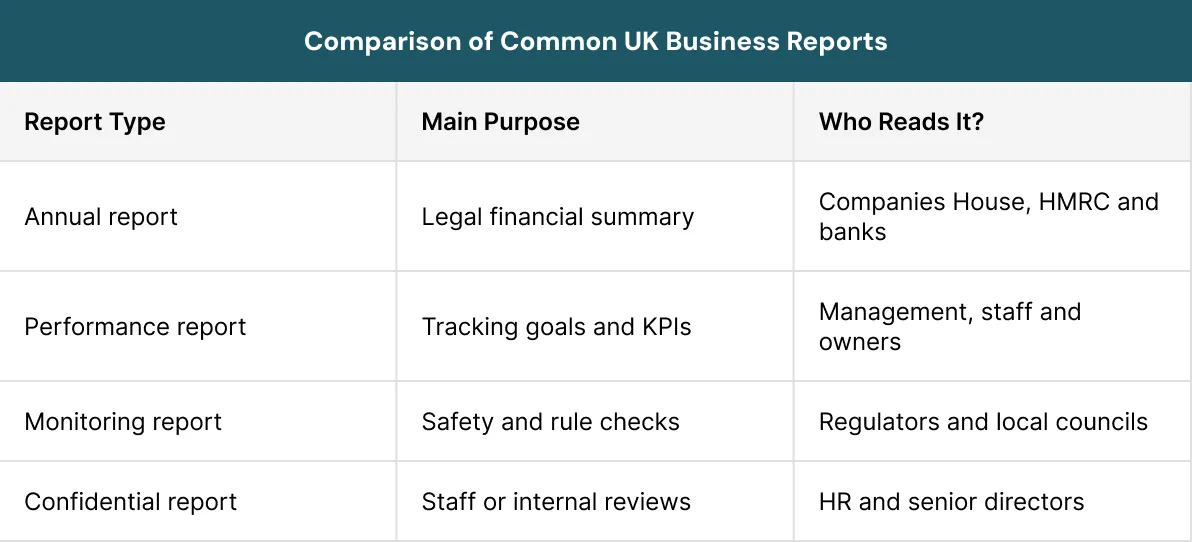
The table below explains the purpose and use of each reporting type.
Why Reports Build Business Trust
Trust is the base of every sale and every partnership in today’s business world. An annual report gives your customers, staff and investors a reason to believe in your brand. It shows that you are not afraid to be open about how you manage your money and your duties.
By sharing your achievements and challenges, you can establish trust with people. That trust sets you apart in a world where people worry about hidden fees or bad management. If a bank or a supplier wants to work with you, they will often check:
- Whether you file reports on time
- If your numbers are clear and easy to follow
- How stable your business looks on paper
If they see strong and clear reports, they are more likely to trust you with a loan or a credit line.
Why Investors Focus on Annual Reports in 2026
If you look at where things are heading by 2026, investors want more than just quick returns. They want to see a stable and lasting business model. They use annual reports to look deeply into how your business really works. They check if your cash flow is strong enough to handle a slow month or a change in the market. They focus on areas such as:
- Cash flow strength and stability
- Clear income and expense records
- Ability to handle market changes
- Long-term growth potential
If you cannot provide a clear annual report, investors will likely walk away. They see poor reporting as a sign of weak management and lack of control.
On the other hand, a clean report acts as a strong sales tool. They want to know you run a safe, solid business where their money is protected. With so much data available, being open and honest in your reports lets everyone know you are someone they can rely on.
Common Filing Mistakes
It takes 20 years to build a reputation and five minutes to ruin it. If you think about that, you’ll do things differently. – Warren Buffett
This applies perfectly to your annual report. One dishonest report or a missed deadline can destroy years of hard work. It also badly affects trust with your clients.
When the business is legal, then you are protected from fines and mistrust of customers. However, if you are not complying, more drastic issues can happen. In some serious cases, it can even get closed.
Beyond large fraud cases, the “strike-off” process is often used by Companies House. The Registrar can dissolve a company from the register if it is inactive under the Companies Act 2006. This usually happens when required filings are missed or delayed.
When a company is struck off, it is not considered as a legal entity. This can cause serious issues such as:
- Directors can lose their limited liability protection
- The Crown could claim your business assets
- Banks might freeze or close your accounts
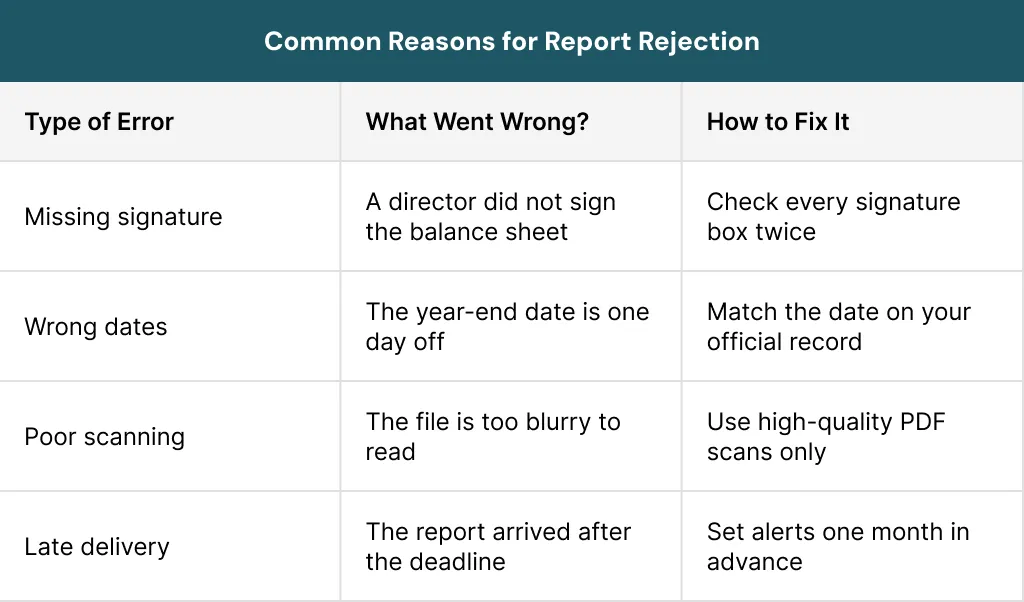
A lot of businesses run into trouble just because they mess up their reports. Sometimes it’s something very small. It may be an overlooked detail, a box not ticked or something minute. But that tiny slip up can cause big headaches. Lost paperwork leads to delays or even outright rejection. All for something you could’ve dodged if you had caught it early. The issues are usually the same, such as:
- Missed filing deadlines
- Wrong or incomplete financial information
- Mistakes in company details or records
Filing Your Report Without Stress
It does not have to be a race against the ticking clock to get your annual reports ready. With a simple plan, you can turn a stressful month into a smooth task. Many owners have found that working a little bit each week can make the task much easier.
This is much better than doing it all in one go. To remove the hassle, businesses should try to follow the steps listed below:
Keep Digital Copies of Every Receipt
Use an app to scan your bills as soon as you get them.
Set a Monthly Review Date
Spend one hour every month checking your bank balance against your records.
Define Your Performance Goals
Write down the things you want to achieve this year to help explain success for your business.
Speak to a Professional Early
Do not wait till the last moments to ask for professional help. Discussing with professionals early provides enough time to cater to potential problems.
Related: Outsourcing Accounting Services
Check Your Filing Dates
Mark your Companies House and HMRC deadlines on your calendar clearly. Missing those dates means losing a chunk of your profit in fines.
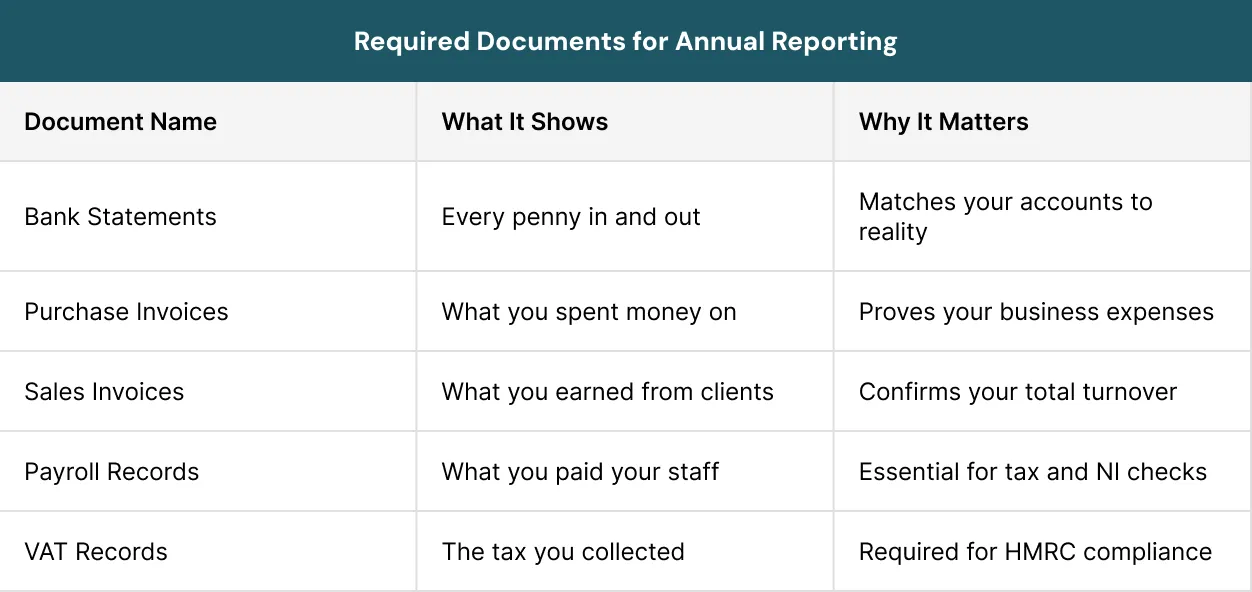
Gather All Required Evidence
Having your paperwork ready before you start will save you a lot of headaches. Make sure you have all the documents listed in the table below before you start filing.
Key Point:
Small errors in filing can lead to significant fines from HMRC.
UK Case Study
The collapse of the café chain Patisserie Valerie highlights the importance of correct reporting. For years, the business appeared stable on the surface. Its financial reports showed the company was performing well and meeting its obligations.
However, a gap of around £40 million was later discovered in the company’s accounts. This gap had not been visible in earlier reports. It later became clear that the financial records were not accurate and the true level of debt had not been properly shown.
As a result, the published accounts created a misleading picture. Once the issue became public, the impact was immediate including:
- Investor confidence dropped sharply
- Banks became more cautious in their support
- The company faced severe cash flow pressure
The business eventually went into administration. This led to store closures and job losses across the UK.
Financial reports must be both accurate and honest. Filing on time is not enough if the information itself is not correct. For directors, the risks go beyond financial loss. Poor reporting can lead to:
- Loss of trust from lenders and investors
- Damage to the company’s reputation
- Impact on more business opportunities
Conclusion
Your annual report in 2026 is more than an item on your list. It’s about creating your company’s reputation and knowing where you’re headed. A good, plain-language report builds trust, keeps you on the right side of the law and gives you a better sense of where your business stands.
But don’t stop there and get to the bottom of things. Understand and see what the numbers mean. Figuring out what’s working and what needs to change to make your future plans solid. Your report speaks for your business, showing others how you’re doing and what you stand for.
If you start early, everything will be easier. You won’t be scrambling at the last minute and things will be neater overall. Over time, it will become a routine that can give your business stability and set it up for growth. Once reporting is a second nature, you’ll build a company that people can trust, one that is clear and trustworthy.
Sterling Cooper helps you understand what annual reporting data is and how to present it in the best possible light.
Get in touch today to improve your annual reports and stay compliant with ever evolving standards.
When you have a clear picture of your finances and performance, the fear goes away.
You can make plans with confidence because you know exactly where you stand.
Book an appointment to handle your annual report in the best way possible and start seeing it as a tool instead of a problem.
FAQs
There is no set length, but for a small UK firm, it is usually between 10 and 20 pages. This includes your balance sheet, profit and loss, and a short director's report. The goal is to be clear and helpful rather than long and boring. Quality is always more important than the number of pages.
Yes, you can write the narrative and the director’s report yourself. However, it is wise to have a professional check your financial figures. This ensures you are following the UK GAAP rules and that your math is perfect before you send it to Companies House.
An annual report is a public document sent to Companies House to show the general health of your business. A tax return is a private document sent to HMRC to calculate how much tax you owe. While they use the same data, they serve two very different purposes.
It is not a legal requirement for very small "micro-entities" to have a separate performance report. However, many successful directors choose to create one anyway. It helps them track their internal goals and show their progress to potential partners or lenders.
If you find a mistake after you have filed, do not panic. You can file amended accounts with Companies House. This replaces the old report with the correct one. It is always better to fix the error as soon as you see it to maintain your reputation for honesty.
Recent Posts

How to Build a Cash Reserve for Business Stability
August 11, 2026

How to Forecast Cash Flow During Economic Uncertainty
August 6, 2026