
Posted by:
Admin
Date:
March 16, 2026
Category:
blogs
Driving Innovation and Long Term Growth Through Research and Development
Innovation is not luck or magic. It is the end result of organised work. It comes from research, testing, learning, improving and trying again. Research and development in business refers to the systematic work used to test and make new ideas or products.
R&D turns companies’ doubts into progress. It helps companies create better products, services and methods. R&D focuses on:
- Supports long-term progress.
- Helps businesses stay ahead of others.
- Reduces possible damage to business.
- Provides financial support through research and development tax credit.
A large number of businesses are spending money to earn more from new ideas, products and tools. The UK’s R&D budget was £55.6 billion in 2024.
This blog will cover:
- Definition of R&D.
- The key features and main types of research and development.
- Importance of research and development for long term business growth.
- Steps involved in the R&D process with real world examples.
- Common challenges and success factors in research and development.
- R&D tax credits and government incentives support innovation.
- Reduction in business risk and support for future expansion through research and development.
What Is R&D?
Research and development (R&D) is an efficient way through which companies introduce new products and services to the market. It also includes improving processes along with products and services within the company.
Companies make an effort to bring doubts into business development through R&D. Research and development is done through study and testing to achieve solutions and scientific progress.
R&D consists of two main parts:
1. Research
Research is the finding of new knowledge and increasing the current technical or scientific understanding. It answers your questions like:
- How does it work?
- Why does it happen?
- Can this be possible?
Research includes the studying of new materials, procedures, equipment and methods.
2. Development
The real solution to the research results is called development. It is the step where ideas are turned into real results, like:
- Minimum viable products (MVPs).
- Early product models.
- Tests to check if an idea will work.
- New digital tools.
- Better ways of working.
R&D fills the gap between theory and real solutions. It helps the businesses to work on the idea and turn it into earnings.
The Role of R&D in Science or Tech
Science is the organised study of the physical and natural world through observation and trying ideas. Whereas the actual results of this knowledge are called technology.
Did You Know?
From 1 April 2023, mathematical advances can also be treated as science, even if they are not directly related to the physical universe. This is an important update because it expands what qualifies as scientific work.
The focus of R&D must be on improving the areas related to science or technology. The updates must be recognised as seen by an expert in that field.
The changes in scientific or technical approach in such a way that they are clearly better than before are called a noticeable update. The regular improvements or minor changes are not included in this.
The progress in this field must be helpful to the overall industry.
What Are Scientific or Technological Doubts?
A project qualifies for the research and development tax credit if it tries to fix scientific or technological doubts.
Doubts exist when:
- An expert is not sure if something can be done.
- An expert does not know how to do it, even after checking all the available information.
This means the solution must not already be known. The work must involve trying ideas and problem solving.
Businesses must explain:
- What was the issue?
- What did they do to try to solve it?
- What worked and what didn’t?
- Why was the solution not easy to find?
The Basic Features of Real Research and Development
The Frascati Manual gives you the five important elements of real R&D, which are:
- Progress
It involves creating something new or much better products, services or processes.
- Doubts
It refers to solving problems that do not have clear answers.
- Trials
Tests ideas, checks results and improves them based on the results.
- Expert involvement
The work is done by skilled and capable professionals.
- Proofs
It involves keeping records and showing results.
R&D aims to solve technical problems. The problem is not technical if it relates to regular updates or testing.
Types of Research and Development
R&D activities fall into three main types:
1. Basic Research
Basic research aims to grow knowledge. It focuses on understanding main ideas. For example, studying the properties of a new material.
2. Applied Research
Applied research uses knowledge to solve clear technical problems. For example, improving battery performance.
3. Real Development
This applies test results to get return on samples, products or methods.
These stages show the full roadmap from discovery to delivery.
Why Research and Development Is Important for Long Term Growth
R&D does not usually create immediate earnings. Instead, it builds long term expertise and long term success.
The table below shows why businesses spend money on R&D:
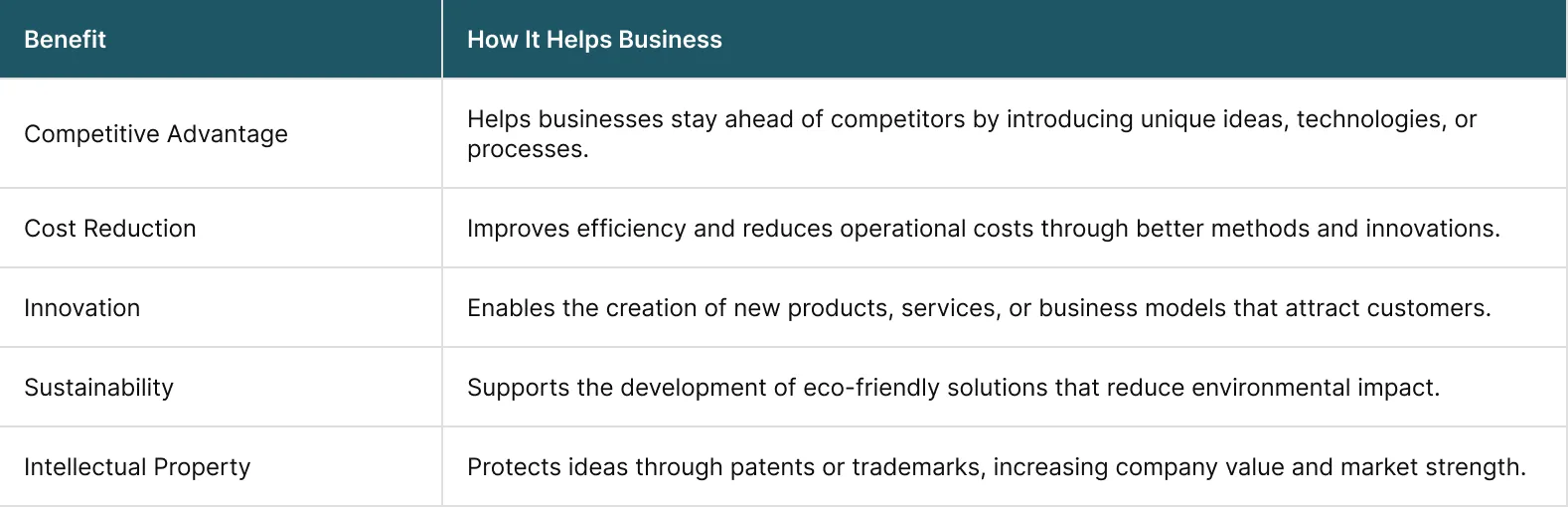
R&D often leads to ownership claims, trademarks and copyrights. These protect new ideas and create an improved market strength.
Quick Insight
Global businesses spend trillions on research and development and it reached $2.3 trillion in 2019.
High tech, media, network services, pharmaceutical and industrial areas were among the key parts who invested money. This shows how important invention is for modern economies.
The R&D Steps in Business
R&D follows organised steps. This organised approach separates it from routine business improvement.
The typical R&D steps includes:
- Identify a Problem or Goal
It defines a real problem you want to solve.
- Research Existing Knowledge
Study reports, patents and earlier work to understand what has already been done.
- Plan an Experiment
Decide what you want to test or find out.
- Design Experiments or Models
Using trial runs, samples or basic test products (MVPs) to explore solutions.
- Test and Check
Test and check by collecting data and checking the results.
- Apply Results
Use successful results in real products or procedures.
This cycle repeats until a real solution is found.
What Is R&D Life Cycle?
The R&D life cycle includes five business stages:
- Creating the Idea
Coming up with the first thought or method.
- Building the Design
It means making models and solving specialised problems.
- Testing and Improving
Improving the sample by using trial and error.
- Increasing Production
Make more products or extend services.
- Selling and Making Income
Bring the product or service to the market.
Not all R&D succeeds. Some projects fail. But even failures create learning and knowledge.
Real World Examples of Research and Development
Research and development takes place in many industries. Businesses use R&D to improve products, solve technical challenges and create modern solutions. Examples can be seen in the table below:

The above examples show that R&D is not only for large companies. Small businesses can also create new products.
Comparing R&D Success
Businesses need to see whether their R&D activities are successful. R&D success can be checked in two main ways, which are:
Quantitative Checks
These are results that can be checked using numbers or data.
Qualitative Checks
These results are harder to check but are still very important.
R&D success is not only about income or return. Even when a project does not succeed in the market, it can still provide valuable knowledge that supports future new ideas and business growth.
Paying for Research and Development
R&D is expensive and sometimes it is difficult to invest into it. Companies can use the below mentioned options to fund R&D:
- Use your own savings.
- Apply for a government subsidy.
- Work with universities.
- Get money from sponsors.
- Raise money online through fundraising platforms.
The UK offers research and development tax credits through mixed schemes, Enhanced R&D Intensive Support (ERIS) and Research and Development Expenditure Credit (RDEC).
In some countries, research and development tax credits provide discounts on tax to be paid. In the UK, companies must be required to pay Corporation Tax to meet the rules.
To claim, activities must:
- Make new or updated products, methods or software.
- Have technical doubts and challenges.
- Test and try different solutions.
Proper written records are essential
The Challenges of Research and Development
R&D brings you many benefits. However, it also involves risk and difficulty. New developments are not easy.
Some common challenges include:
1. Financial Loss
R&D projects do not always succeed. A business may spend time and money without guaranteed return. Cash flow can become unpredictable. This may be hard to manage for small businesses.
2. Technical Limits
Some technical problems are very hard. Systems may fail early during testing. Engineers and scientists need to try different approaches before fixing the issue.
3. Time Pressure
Many R&D projects take years before they create a market return. Long development plans can put stress on teams and spending plans.
4. Lack of Skilled Staff
R&D requires trained professionals. There may be limited access to specialist staff, scientists, engineers or better equipment.
5. Requirements by Law
Following rules adds cost and difficulty. Businesses must meet laws and industry rules while developing new products.
R&D is essential to stay strong in the market. Companies that avoid new ideas may fall behind.
Want to know more about how to save money on your business strategies? Check out this blog on Best business strategies for businesses.
How Research and Development Tax Credit Supports Progress
Governments understand that R&D involves temporary drops in profits. To encourage new ideas, they offer tax benefits.
In the UK, R&D tax assistance supports companies working on modern projects in science and technology. Only companies that are liable for UK Corporation Tax can be entitled.
About 46,950 companies in the United Kingdom claimed research and development tax credits in the tax year 2023-24. This shows thousands of companies use tax assistance to support their R&D.
The main UK plans include:
- RDEC.
- ERIS.
- Mixed R&D scheme.
To meet the conditions for tax benefit, a project must:
- Try to make progress in science or technology.
- Solve technical or scientific problems.
- Create a clear improvement.
- Be recognised as valuable by an expert.
The work must not be connected to the arts, history and culture subjects or social sciences.
A company must explain:
- What doubts or problems existed?
- Why was it not easy to solve?
- What tests or experiments were done?
- What worked and what did not?
Written evidence is the key. Records of work, testing and results must be kept carefully.
After confirming rules, businesses must check which R&D costs can be claimed. These may include staff costs, materials, software and subcontractor fees depending on the rules.
R&D tax credits help improve cash flow. They can reduce tax to be paid or provide financial support. This financial help can then be put into further better solutions, driving long term progress.
If a company has worked on progress and is not announced by law, then it can still be counted for research and development tax credit.
The Importance of Records and Proof
R&D requires clear notes and records. Businesses must keep:
- Records of experiments.
- Reports of tests.
- Notes on what failed and what was changed.
- Technical explanations from experts.
Experts should be in a position to show that the work done was not clear. They need to explain why the problem could not be solved by a trained professional.
Good record keeping must be part of routine business practice. Tax refunds may fail without proper records.
Intellectual Property and Protecting Invention
R&D usually leads to intellectual property (IP), such as:
- Patents
- Trademarks
- Copyrights
Protecting IP is very important. Businesses should:
- Secure ownership claims before sharing ideas openly.
- Register logos or brand names.
- Protect designs and copyrights.
New ideas should be promoted by businesses. Delivering a speech at conferences or writing a blog will help to find supporters and sponsors.
Planning is very important to protect ideas. It will get harder once ideas are public.
Protecting IP helps businesses grow in the long term by:
- Making it harder for competitors to copy.
- Increase the value of the company.
- Attracting business supporters.
How R&D Reduces Business Risk
At the start, results are not clear which makes R&D hard. But R&D reduces business damages in the long run.
It helps businesses:
- Keep up with market changes.
- Use new systems.
- Stay ahead of competitors.
- Work more efficiently.
- Reduce manufacturing costs.
Companies that spend money on R&D are better prepared for future challenges. R&D also improves intellectual property, which protects market position. Tax credits further reduce financial waste by supporting cash flow.
The Future of Research and Development
R&D is always changing. New areas include:
- Artificial intelligence.
- Automated workflows.
- Data testing.
- Nature friendly solutions.
- Hydrogen energy systems.
- Environment friendly materials.
There is also a strong trend for team work. Businesses are working more with:
- Educational institutes.
- Research organisations.
- Industry experts.
Knowledge transfer between the education sector and industry supports faster solutions. There is an increase in the use of data driven methods and improved trial runs.
The future of R&D is in teamwork, testing and following progress.
R&D Is Not the Same as Innovation
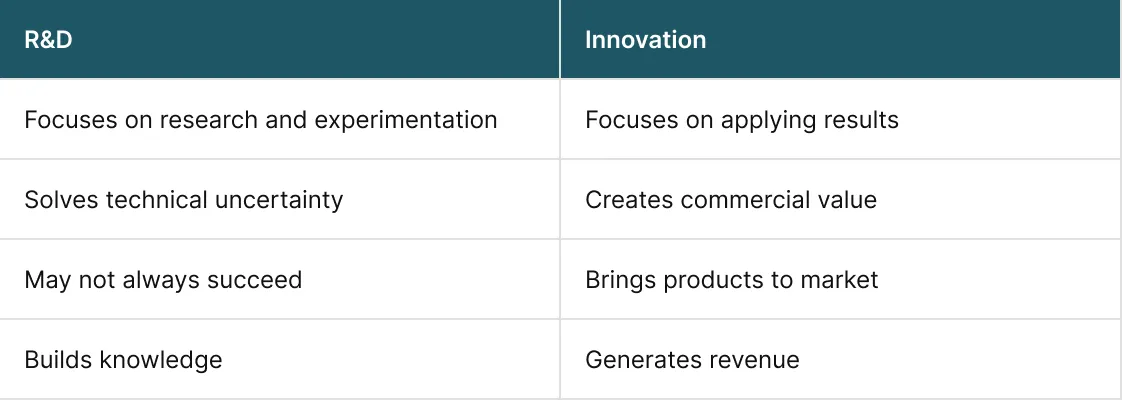
It is important to understand the difference between R&D and invention. Both are required for long term progress.
The following table shows the key difference between R&D and innovation:
Small Businesses and R&D
Small businesses can also do R&D. It helps them create new ideas and stay competitive in the market. They may:
- Solve defined technical problems.
- Improve internal company procedure.
- Develop new digital tools.
- Test new materials.
Small and new companies need smart solutions when they invest in R&D. Even with a small amount of money, they can:
- Use their own money carefully.
- Apply for government help.
- Work with universities.
- Get funding from new projects.
- Raise money through online money raising platforms.
R&D tax credits for growing business are more valuable. They help reduce financial risk.
Driving Long Term Progress Through Planned New Developments
Creating new ideas and achieving long term progress needs more than short term thinking.
It requires:
- Clear goals.
- Focus on science or systems.
- Smart testing and experiments.
- Skilled professionals.
- Proper records and written proofs.
- Good financial planning.
- Managing challenges carefully.
- Protecting intellectual property.
R&D turns unknown problems into clear progress. It supports:
- New products and services.
- Better business efficiency.
- Long term business development.
- Edge over competitors.
- Stronger market position.
- Better financial performance.
Governments support R&D through tax benefits because new ways help to build the economy.
Businesses can build long term expertise by putting money into R&D. They create value for themselves as well as for industries. R&D spending needs careful tracking, and using cloud accounting can help manage costs and cash flow efficiently.
Conclusion
Driving better solutions and long term progress is not a single task. It is a constant flow.
Research and development (R&D) is the organised method businesses use to explore unknown, test ideas and create scientific or tech boosts.
Businesses achieve the following through R&D:
- Create clear improvements.
- Solve unknown problems.
- Test and experiment with ideas.
- Make scientific or systems progress.
- Work with experts.
- Keeping proper notes and records.
It has a defined cycle from idea generation to bring products to market. In house capital sharing, government grants, project funding, partnerships and tax benefits are the main money sources of R&D.
The basic challenges involved in R&D are:
- Financial drop
- Technical limits
- Time stress
- Legal problems
The setback is reduced by RDEC and ERIS tax support programmes in the United Kingdom.
R&D helps in building intellectual property, better efficiency, reliability and market strength.
R&D increases knowledge, useful know-how and strength. This helps businesses grow in the long term. Through R&D, companies move from:
- problems to progress.
- ideas to actions.
- short term survival to long term success.
The new ideas in businesses cannot be achieved by mistake. It is the result of organised research, continuing development and testing.
Sterling Cooper understands this and puts money wisely in research and development to better prepare for the future. Contact us and start building a smarter development strategy.
Ready to Turn Innovation Into Growth?
Speak to our team today and discover how strategic marketing can amplify your R&D impact.
FAQs
Research and development (R&D) is important because it helps businesses test new ideas, solve technical problems, and create improved products or processes. It reduces uncertainty through experimentation and evidence. Without R&D, innovation would lack structure, technical validation, and long-term direction for sustainable growth.
The main function of research and development is to create scientific or technological advances. It identifies problems, carries out testing and experimentation, builds prototypes, and applies findings commercially. R&D improves efficiency, strengthens competitiveness, and supports long-term business growth through structured innovation.
Research and development create new knowledge through testing and experimentation. Innovation applies that knowledge to deliver value in the market. In simple terms, R&D focuses on solving technical uncertainty, while innovation turns those solutions into commercial success and measurable business growth.
The need for innovation is driven by competition, changing customer expectations, new technologies, cost pressures, and sustainability goals. Businesses must continuously improve products and processes to remain competitive, increase efficiency, and adapt to market changes.
Innovation is important because it helps businesses stay competitive, improve efficiency, and create new revenue opportunities. It also strengthens brand positioning, reduces operational costs, and supports long-term growth in changing markets.
Recent Posts

How to Build a Cash Reserve for Business Stability
August 11, 2026

How to Forecast Cash Flow During Economic Uncertainty
August 6, 2026