
Posted by:
Admin
Date:
March 12, 2026
Category:
blogs
The Complete Guide to UK Dividend Tax for Beginners
Received a dividend but unsure how much tax to pay? You are not alone.
According to the UK government, the dividend allowance is only £500 for the 2025/26 tax year. Before recent tax changes, the allowance was £5,000. In such a short time, the allowance dropped, meaning more people now have to pay dividend tax.
From April 2026, dividend tax charges will rise for basic rate and higher rate taxpayers. Therefore, some people may have to pay more tax on dividend income. The £12,570 Personal Allowance and the £500 dividend allowance will remain the same for the 2026/27 tax year.
This means some investors must pay dividend tax for the first time.
If you invest in shares, you are more likely to receive dividends.
A dividend is money you receive from a company’s profits. Tax on dividend is the tax on that money.
Many new investors ask:
- How is the tax on dividends calculated
- Are UK dividends taxed
You should understand these terms as soon as possible. Once you know about tax on dividends, updates won’t surprise you. If you are a company director, small investor or business owner, understanding it is beneficial.
In this blog, you will explore:
- What is the tax on dividends
- How does the Personal Allowance of £12,570 work
- What Is Included in the £500 Dividend Allowance
- The current rates for dividend tax UK
- How are dividends treated inside ISAs and pensions
- Lower your tax bill on dividend income in legal ways
- The right time to report dividends to HMRC
What Are Dividends for Taxes?
A dividend is money a company pays to its shareholders from profit. You are more likely to receive a dividend if you own shares. Moreover, this is typically paid per share.
For example, if you own 1,000 shares and receive 5p per share, you will receive £50.
When Are Dividends Paid?
When a dividend is made, no tax is deducted from it. This is why paying the required tax is your responsibility. There are several ways for the company to distribute these dividends. The ways are given as follows:
- Monthly
- Quarterly
- Semi-annually or twice a year
- Annually
What Is Dividends Tax?
Dividend tax is the extra charge that you need to pay when you receive money from company profits. This applies if you own those shares.
When a business makes a profit and pays part of it to shareholders, that amount is known as a dividend. The UK government taxes this income separately from the salary.
First, you have to use your Personal Allowance and after that your £500 dividend allowance applies in the UK. If you have any income above this, the dividends are taxed according to your income band.
Based on your total income, the rate can be 8.75%, 33.75% or 39.35%. This is also known as the tax rate for dividends UK, which depends on your overall earnings.
For more understanding, check out our guide on 2025 to 2026 tax year updates.
Personal Allowance
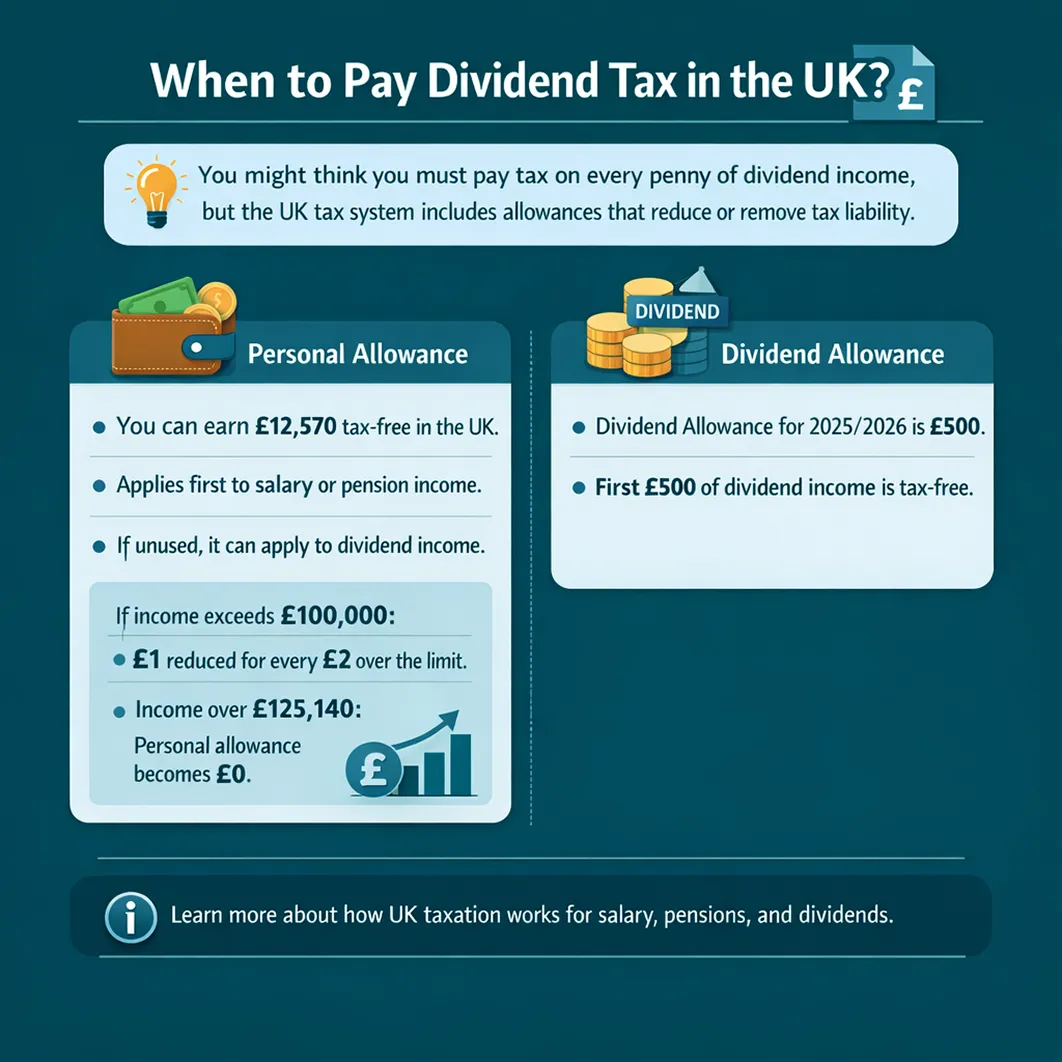
You are allowed to earn £12,570 without any tax in the UK. To your pension income or salary, this applies first. In case it is not used, it can apply to dividends.
Your Personal Allowance decreases by £1 for every £2 over £100,000 when your total income goes beyond £100,000. And when income reaches £125,140, your Personal Allowance becomes zero.
Dividend Allowance
You can also understand this term as how much dividend is tax free? When you utilise your Personal Allowance, the dividend allowance applies. The allowance is £500 for the 2025/2026 tax year. This means that no matter what your tax band is, your dividend income’s first £500 is tax-free.
Here’s a breakdown of how the dividend allowance has changed over the past few tax years:
| Tax Year | Dividend Allowance |
|---|---|
| 6 April 2026 to 5 April 2027 | £500 |
| 6 April 2025 to 5 April 2026 | £500 |
| 6 April 2024 to 5 April 2025 | £500 |
| 6 April 2023 to 5 April 2024 | £1,000 |
| 6 April 2022 to 5 April 2023 | £2,000 |
| 6 April 2021 to 5 April 2022 | £2,000 |
Why Did the Dividend Allowance Drop From £5,000 to £500?
The dividend allowance was £5,000 when it was first introduced in the 2016/17 tax year. It allowed investors to receive up to £5,000 in dividends without paying tax.
But the government of the UK lowered this amount step by step. First, it dropped in 2018 to £2,000, then in 2023, it dropped to £1,000 and now it is £500.
This change was made to raise tax income and improve fairness in the system. The government wants people who earn from investments to pay tax. The aim is to make it like a tax on job pay.
Impact on Small and New Investors
A lower allowance means more people must now pay tax on dividends. Some small investors may now exceed the tax-free limit and therefore may need to report dividends to HMRC.
New investors should now learn dividend tax rules early. If dividends go above £500, you may have to pay tax.
Effect of Total Income on Your Dividend Tax Bill
If you want to know the tax rate for dividends UK, it is your income that determines it.
When you get a £20,000 salary from your company and receive £60,000 in dividends, it will be done as follows:
- The dividends will be taxed at 8.75%, which is the basic rate.
- The remainder will be taxed at 33.75%
On the other hand, if the salary is £60,000 and you receive £20,000 in dividends:
- Your salary uses the lower tax band first.
- The dividends will be taxed at a higher rate.
How Much Tax Is on Dividends?
The tax that you pay is decided according to your income band, which is given as follows:
- For additional rate taxpayers, it is 39.35%
- For higher rate taxpayers, it is 33.75%
- For basic rate taxpayers, it is 8.75%
These percentages represent the rate for dividends tax UK and they apply after your allowances have been used.
The table below shows tax bands and dividend tax rates:
| Total Income Band | Tax Band | 2025/26 Tax Rate | 2026/27 Tax Rate |
|---|---|---|---|
| Personal Allowance | £0 to £12,570 | 0% | 0% |
| Basic Rate | £12,571 – £50,270 | 8.75% | 10.75% |
| Higher Rate | £50,271 – £125,140 | 33.75% | 33.75% |
| Additional Rate | £125,141 or more | 39.35% | 39.35% |
Dividend Tax Calculator
Want to estimate your dividend tax?
Use the official UK government calculator to check how much tax you may pay on your savings or dividend income: Calculate My Dividend Tax
Why Is Dividend Tax Important?
To create long-term wealth, dividend plays a key role. Some important points are given below:
- Every year, some businesses increase dividends, which can help your income keep up with high prices
- This will give you a stable income even in retirement
- With reinvested dividends, your portfolio can improve over time
However, due to cuts in the dividend allowance, more people now have to pay tax on their dividends. Due to this, small investors must also become aware of the implications of tax.
Pros and Cons of Taking Dividends vs Salary From a Company
People who run a company can take income as salary or dividends. Both of these options have their own limits and benefits.
| Income Type | Pros | Cons |
|---|---|---|
| Salary |
|
|
| Dividends |
|
|
Do Dividends Inside an ISA Affect Dividend Tax?
In the UK, an ISA (Individual Savings Account) is a tax-free savings or investment account. Dividends earned inside an ISA are tax-free and do not need to be reported to HMRC.
This is one of the most effective ways to reduce the amount of tax you may have to pay. The ISA allowance per year is £20,000 and dividends within an ISA do not reduce the allowance.
For more ways to save on taxes, check the top tax saving tips. It shows how ISAs and allowances can help lower your tax.
How UK Dividends Work for Non-Residents
The tax rules are slightly different for people who receive dividends from UK companies but live outside the UK. Sometimes, the tax rules of the UK for non-residents are not the same as those for residents.
Impact of Withholding Tax and Double Taxation Treaties
In general, withholding tax is not applied to UK dividends paid to non-residents.
This means the whole dividend is paid to you and no UK tax is deducted. However, you may have to pay tax in the country where you live. Some countries tax dividends earned from foreign companies.
The UK has tax treaties with many countries. They help prevent investors from paying tax twice. These agreements ensure that the same dividend income is not taxed twice. Sometimes, tax paid in one country can lower the tax due in another.
Non-resident investors should check the tax rules in their country of residence. Also check whether a tax treaty with the UK applies.
Is a Limited Company for Dividend Tax More Tax Efficient?
A limited company may pay less tax on dividends than a sole trader in some cases. Here, the profits of the company are taxed first according to Corporation Tax and people are paid from post tax profits.
People only have to pay tax if they receive dividends. It may lower the overall tax bill.
How to Report Dividend Tax UK to HMRC?
You must report to HMRC if your dividends are more than £500. If the dividends fall within £500 and £10,000, you can:
- Update your tax code with HMRC
- Add them to your self-assessment return
You must complete a self-assessment tax return if your dividend income is more than £10,000.
Consequences of Late or Incorrect Dividend Reporting
HMRC may charge penalties if the dividend income is reported late or inaccurately. Interest may also be included on any unpaid tax.
Sometimes, HMRC can review earlier tax returns or request additional information. Due to this, the total amount you may have to pay may increase.
Therefore, keeping correct records and reporting dividend income on time is important.
How to Reduce Dividend Tax UK Legally?
Here you can find some useful strategies that you can use to legally reduce the amount of tax you pay:
Use the Dividend Allowance
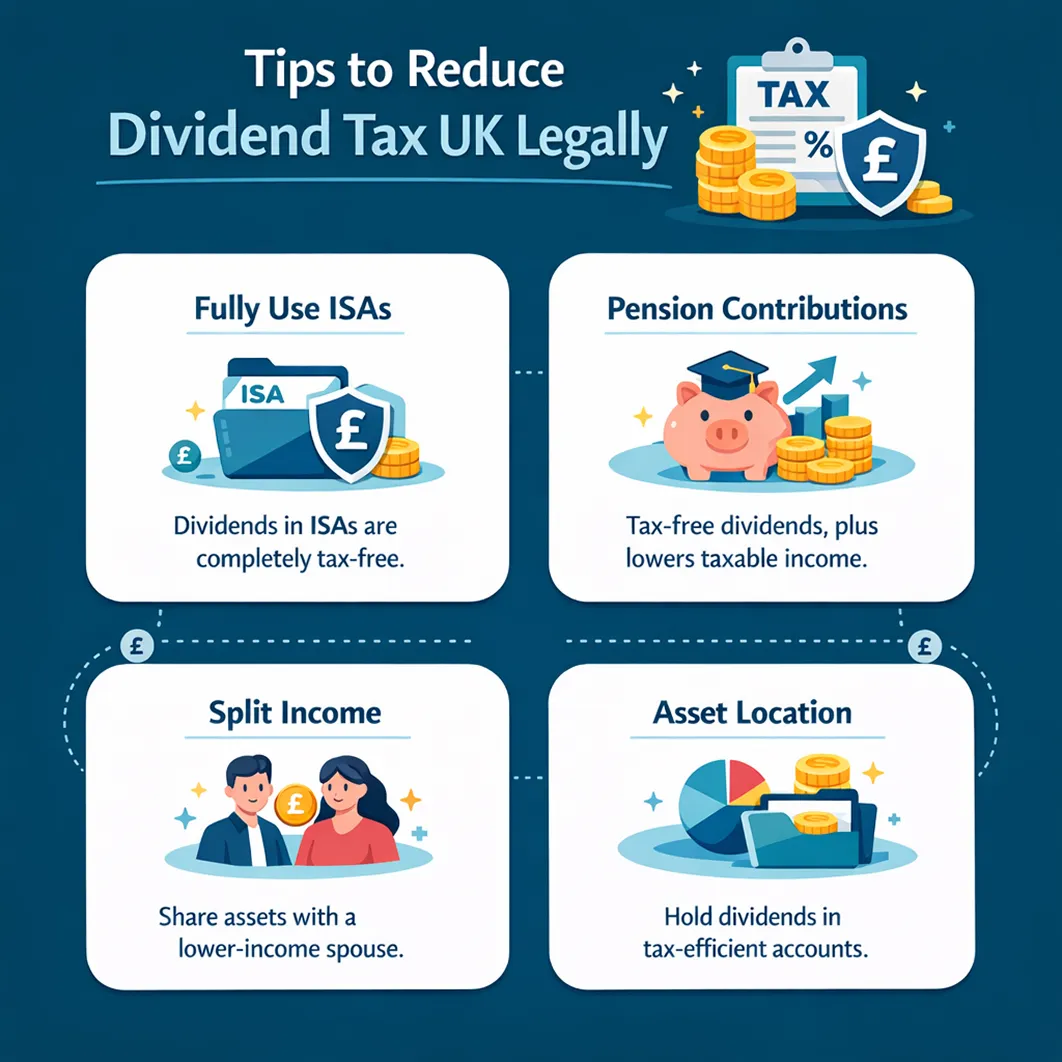
The first £500 of dividend income each tax year is tax-free. You do not pay dividend tax if your dividends stay within this limit.
Invest Through an ISA
Inside an ISA, any dividends are free of tax.
Pension Contributions
Dividends in pensions, like Self-Invested Personal Pensions (SIPPs), are tax-free. Making additional contributions to a pension can also reduce your taxable income.
Split Income
In case you are married, you can split your assets with your spouse under the low income condition. This helps lower your overall tax.
Asset Location
Give priority to dividend paying finances inside tax-free wrappers like ISAs.
Final Thoughts
Dividend tax is easy to understand. Once you know the basics, it becomes easy to manage. Every new thing takes time to understand and becomes easier if you learn in small steps. This is because they look tiny but make a big difference.
First, you need to know your income band, as your total income determines the rate of tax you will pay. To calculate tax, dividends and salary are combined to work together.
The next step is to utilise your allowance completely. £500 dividend allowance has the same importance as the £12,570 Personal Allowance. By using pensions and ISAs, you can manage your dividend income efficiently and reduce the amount of tax.
It is important to keep accurate records. Track your dividend payments during the year and report them to HMRC when needed.
Stay updated with changes in tax rules. In recent years, the dividend allowance has decreased suddenly and it has become more important. Also, these rules change with time, so it’s necessary to stay alert to the new trends.
You stay in control if you understand how taxes on dividends work in the UK. Smart planning helps you keep more of your investment income, whether you are a company director or an investor.
At XoomPlus, we know the importance of clear financial guidance. We assist company owners and individuals in handling it properly.
Contact us today to calculate your tax liability and stay compliant.
Still unsure about how dividend tax works in the UK?
At XoomPlus, we help investors and business owners understand and manage dividend tax correctly.
Contact us today to make sure your dividends are reported correctly and you avoid unexpected tax bills.
FAQs
The rate of tax payable ranges from 8.75% to 39.35%, depending on the rate of income tax you pay. From 6 April 2026, the UK dividend tax rates will be:
- 10.75% basic rate
- 35.75% higher rate
- 39.35% additional rate
There is a separate Dividend Allowance on top of the Personal Allowance, where you only pay tax on any dividend income above £500. The dividend tax rates start at 8.75% for basic rate taxpayers, 33.75% at the higher rate and 39.35% at the additional rate.
A dividend is a payment a company can make to shareholders if it has made a profit. You cannot count dividends as business costs when you work out your Corporation Tax. Your company must not pay out more in dividends than its available profits from current and previous financial years.
You can calculate a stock's dividend yield by dividing its total annual dividends by the stock's current share price. Companies can start, stop, reduce, or increase their dividend payments at any time. So it's important to understand that dividend yield is not a guaranteed return rate.
It's a percentage of the current share price. For example, say it's 6% annually per £20 share, you'd make £1.20 per year per share. If they pay that monthly, it would be 0.10 per month or quarterly, it would be 0.30 every three months. However, dividends can change depending on share price and market volatility.
Recent Posts

How to Build a Cash Reserve for Business Stability
August 11, 2026

How to Forecast Cash Flow During Economic Uncertainty
August 6, 2026