Posted by:
Admin
Date:
January 22, 2026
Category:
blogs
How to Start and Manage a Business from Home?
Approximately 70% of new businesses start at home, contributing £300 billion to the economy. At present, there are around 2.9 million home-based businesses that are playing a significant role in uplifting the economy of the UK..The increasing popularity of a home-based business can be explained by flexible work patterns, online technologies, and the need to improve a work-life balance. Running a business from home may therefore be lucrative to you and your company. Here is all you need to know about starting a business from home.
Is it possible to run a business from your home? All the important information you need
Running a business from home is not against the law many small businesses, sole traders and freelancers are making it big in this situation. However, there are legal compliances that you have to follow to ensure that you are running your business within the law.
When are you a Home-based business?
You are considered to be running a business from home in the following conditions:
- Your work involves selling goods or services to make a profit (this can be online, app-based or face-to-face work).
- You handle several customers or clients.
- You have set prices of what you offer.
- You supply your own equipment or tools.
- You have employed people or partners to help you.
- You are assuming major functions of the business.
Even if your business is small, like selling things on social media, you can still fall under this category. You just have to meet these conditions.
Running a Business from Home Council Rules
There are some cases in which running a business from home does not require any permissions. This is mainly when your business is quiet and does not involve visitors. It implies that the residential nature of your property is not changing; hence, you don’t need permissions.
You might, however, be required to obtain the approval of different parties in certain cases. It will depend on the impacts that your business will have on your home and neighbouring areas. Here are some of the permissions that you might need to seek:
1. Local council or planning office
You have to seek their permission if your business is causing any of the following:
- An observable and increased volume of people (e.g. clients or staff foot traffic).
- Putting up of signs to market your business.
- Stockpiling of business-related goods away from the property.
- Making physical alterations to the house.
2. Landlord
You need to take permission from your landlord. This is because sometimes your agreement of tenancy prohibits any kind of commercial activity on the property.
3. Mortgage provider
Your mortgage terms might restrict the use of the property for running a business from home. In this case, you have to seek permission from your mortgage provider.
Common types of home businesses allowed
Here are some of the common examples of businesses that are permitted to be run from home:
1. Web-based-services
This includes consulting, content creation, virtual assistance, and digital marketing.
2. Home-based services
Childminding, personal training, therapy and tutoring fall under these services.
3. Online retail
These services include dropshipping, print-on-demand, and selling handmade goods.
4. On-call services
If you are a plumber, electrician or IT support and you operate from home but service your clients externally, then you fall under these services.
5. Creative professions
These professions include artists, graphic designers, writers, and photographers.
6. Entertainment and media
This sector includes influencers, streamers, YouTubers and podcasters.
“While manufacturing firms are often found on a specific business site owing to space requirements, service firms are relatively more often home-based. Services firms also move less often from a non-business site to a business site, and move from a business site to a non-business site more often than manufacturing firms do”
Veronique Schutjens et al.
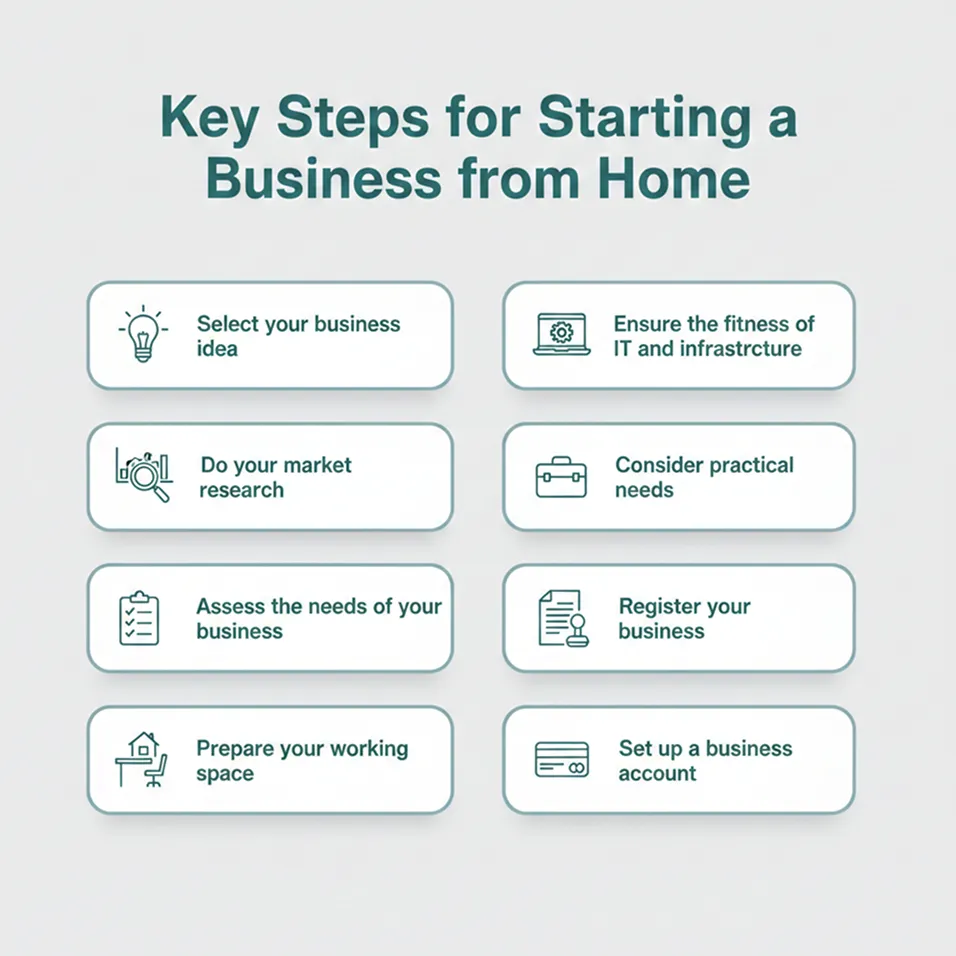
Key Steps for Running a Business from Home
Following are the main steps of opening a business at home:
Step 1: Select your business idea.
Among the ones that can be implemented at home, find the one that suitss your abilities. More so, think about your lifestyle and objectives.
Step 2: Do your market research
You have to research on your market before committing your money and time. These are some of the aspects you can look into:
- Does anybody need your service or product?
- Who is your competitor?
- What are the issues that your business is addressing?
- Check interest either by speaking to some potential customers or executing small test campaigns.
Step 3: Assess the needs of your business
Before running a business from home, assess if your business is suitable to be run from this environment. Asking yourself the following questions is a good place to start:
- Is my space sufficient?
- Will my living areas be intruded by business activities?
- Does it need any special equipment, storage or safety measures?
- Will it cause harm to others in the house (e.g. children or pets)?
- How do I go about expanding or hiring employees in the future?
Step 4: Prepare your working space.
To maintain a long term productivity, make sure that you organise your working environment adequately. The following are some of the essential tips that can be embraced:
- Find a particular corner in your house so that you can work with less interruptions.
- Purchase required furniture and equipment, a good desk, an ergonomic chair, light, etc.
- Separation between work and home life will prevent burnout and make work professional.
Step 5: Ensure the fitness of IT and infrastructure
Since your work will mostly be remote or online, make sure that your tech and connectivity are efficient. Here are some tips for this step:
- Ensure that your computer, printer and internet connection are stable and at speed.
- Sign up for a cloud-based storage to backup files safely (e.g., Google Drive, Dropbox).
- Do not count on your hard disk alone; it is always good to back up important files frequently.
Step 6: Consider practical needs
Consider the following practical needs if they are applicable for business:
- Find out whether your business will bring inconveniences to the neighbours (e.g. traffic of clients, noise, deliveries, etc.).
- In case you use a vehicle, is it good to carry goods or equipment?
- Do you have a nearby postal service when shipping products regularly?
Step 7: Register your business
Depending on the structure of your business, register with the appropriate registration bodies. Make sure that you know your tax obligations. Moreover, educate yourself on National Insurance and VAT.
Here are the registration bodies based on your status:
- Sole trader: Register for self-assessment with the HMRC
- Limited Company: Register with the Companies House. Inform HMRC.
Step 8: Set up a business account
To manage your finances better, open a separate bank account while running a business from home. Other than this, consider the following tips:
- To keep a record of incomes and expenditures, use accounting software (such as QuickBooks or FreeAgent).
- It may be helpful to seek prior advice from an accountant, particularly about permissible expenditure and recordkeeping.
Managing Your Business from Home: Key Aspects
Here are some things you should have in mind when you are running a business from home.
1. Managing Time And Adhering To Routines
When you are running a business from home, you need to ensure that you are making good use of your time. Here are some things you can do:
Set clear goals
Break your goals down into steps that you can take, and focus on the tasks that will have the biggest impact to get the most out of them.
Avoid multitasking
Concentrate on one thing at a time to reduce stress and increase quality.
Practice efficiency techniques
Using strategies such as Pomodoro (in 25 min work and make short breaks). This makes you more productive.
2. Marketing your business
To make your business visible, invest in its effective marketing. Here are some of the tips:
Social media presence
Put good content on your site regularly to foster a relationship, as well as brand recognition.
Local listings
Hook the local customers with Google My Business and local directories.
Batch content creation
Assign group tasks, such as photo shoots or email drafts, in time blocks in order to increase efficiency.
3. Keeping financial records
Keep your records transparent and ready for taxes. Use bookkeeping services to maintain your finances. Here are a few tips for this:
- Record every payment
- Choose the right accounting method
- Keep detailed receipts and invoices
- Use appropriate software
- Know when to outsource
- Understand double-entry basics
The effects of running a business from home on tax
Running a business from home may save you some costs, but there are important tax considerations that you need to pay attention to. Here are some of the key aspects of your tax responsibility.
1. Council Tax vs Business Rates
While running a business from home, you’ll have to pay council tax because your home is a residential property. You may be liable for business rates if you use a specific part, such as a garage or shed, as a shop. To describe clearly, you may have to pay business rates under the following conditions:
- You hire workers who work in your house
- Customers come regularly to your business
- You have significantly changed your land to conduct business on it
Find out with your local council if you are unsure. In other instances, you might be entitled to the Small Business Rate Relief. More info: GOV.UK Business Rates
2. Capital gains tax on home sales
By the Private Residence Relief, you are exempt from the Capital Gains Tax. However, in case you have used a section of your residence for any business purposes (e.g., a room turned permanently into an office or stores), then you may have to pay a CGT on that percentage upon the sale of the house. For instance, assuming that one-fifth of your residence was in exclusive use of business, CGT can be applicable on the gain of 20 per cent when one sells the property.
In order to benefit financially by not paying CGT, it is advisable to use rooms as both business as well as domestic premises.
3. Claiming Allowable Expenses
Having a business at home allows you to offset allowable expenses, thereby lowering your net taxable profit. These are:
- Heating and electricity
- Council tax
- Internet and phone bills
- Rent or mortgage interest
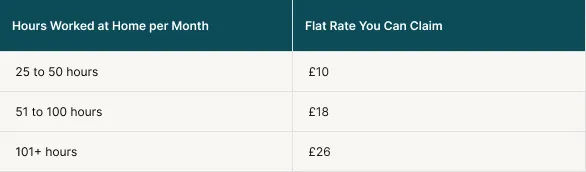
You can either:
- Determine the exact proportion of each bill that is used for business purposes
If you work from home for 25 or more hours per month, use HMRC’s simplified expenditure flat rate.
4. Impact on Self-Assessment Tax Returns
This is applicable to you if you are a sole trader or in partnership running a business from home. You’ll have to report your expenses and income on a Self-Assessment tax return. You can claim working expenses in this case as well to lower your taxable income. Take the following steps:
- Keep proper records and receipts.
- Maintain records of permissible expenses.
Advantages and disadvantages of home based business.
The advantages and difficulties of operating home based like a business are as follows:
Advantages of having a home-based business.
The advantages of conducting business at home are very numerous. Here are some of them.
- You don’t have to rent a separate space and pay extra bills.
- You can be in charge of your own schedule, i.e, flexible working hours.
- You can spend more time with your family since you are not only at home, but you also save additional commute time.
- You have everything you need in the reach of your hand.
Challenges of running a home-based business
A major challenge in running a business from home in the UK is that residential properties are zoned for domestic living. So, you must ensure that you take the following steps:
- Keep the residential character of your home the same.
- Be mindful of your neighbours.
- Stick to regulations of your local authority.
Can any business be conducted at home in UK?
No, it is not. But, in case your business in any way affects the neighbourhood, then you should apply to plan permission. The planning department of your local council will help you out provided that you are joining a commercial area.
Conclusion
Running a business from home offers flexibility, savings and healthy work life. Nevertheless, you should adhere to legal regulations, manage your workspace, and be aware of your tax liability. Your home-based business can be successful with the right planning and strategy.
Ready to take your home business to the next level?
Sterling Cooper Consultants offers expert Business Advisory & Consultancy to help you navigate regulations, optimize your operations, and ensure success. Get expert advice today!
FAQs
No, just make sure to seek appropriate permissions from the local council where applicable.
If your business has any impact on the neighbourhood, or your business is changing the residential status of your home, then you must make them aware.
Yes, there are certain expenses such as internet bill, mortgage interest, or council tax that you can claim.
You need public liability insurance if customers are entering and leaving your home. If there are employees on premises, you also need employer’s liability insurance.
It depends on the type of your business. For instance, you need a license for childcare, dog breeding, ear piercing, etc.
Recent Posts

How to Build a Cash Reserve for Business Stability
August 11, 2026

How to Forecast Cash Flow During Economic Uncertainty
August 6, 2026