Posted by:
Admin
Date:
May 20, 2026
Category:
blogs
Making Tax Digital for Income Tax: A Practical Guide for UK Taxpayers
The taxation system is undergoing changes in the UK but not everyone understands what the future holds from April 2026.
Many taxpayers postponed tax payments until the last minute. They just rely on papers, receipts and one annual payment to manage everything. Now, this practice is gradually changing in the UK. Making Tax Digital (MTD) for Income Tax will soon enter into force and it will bring many changes to the taxation system of sole traders and landlords.
From 6 April 2026, taxpayers must follow MTD if they earn more than £50,000 a year from business or rental income. This means many sole traders and landlords should check their 2024-25 income early, so they know if the new digital tax rules apply to them from April 2026.
As of April 2026, a lot of people will have to maintain their digital files and send information to HMRC after a period of months. Making Tax Digital for Income Tax might seem complicated at the start. However, once you understand everything about it, it will become simpler.
Key Takeaways
- Making Tax Digital for Income Tax starts from April 2026 for those earning over £50,000, so early preparation using proper systems and planning is essential for smooth compliance
- Under digital tax UK, taxpayers must keep digital records and send quarterly updates, meaning regular tracking of income and expenses is now a core habit, not a yearly task
- To make tax digital work effectively, choosing the right Making Tax Digital software or bridging tools is important, especially for those moving from spreadsheets or paper records
- The MTD UK system does not change tax rates or payment deadlines but it changes how and when reporting happens, so understanding timelines like quarterly deadlines and 31 January is critical
- Good record keeping in UK digital tax reduces errors, improves forecasting and helps avoid penalties linked to late submissions or missed updates
- Landlords and sole traders should review their 2024-25 income early, separate finances and test software to stay ready for Making Tax Digital for Income Tax requirements
- Professional support can help simplify digital tax UK compliance, especially for those with multiple income sources or limited experience with Making Tax Digital software
What Is Making Tax Digital for Income Tax
Making Tax Digital for Income Tax is a system by HMRC to move tax reporting online. Instead of one yearly tax return, people must keep digital records and send updates through software.
Making Tax Digital leads to fewer mistakes, better accuracy and less pressure at the end of the year.
This means income and expenses must be recorded as they happen. Software is then used to send updates to HMRC every quarter. At the end of the year, a final declaration is submitted to confirm the full tax position.
This system does not change how much tax is paid. It only changes how and when information is reported.
Who Needs to Follow Making Tax Digital for Income Tax
From 6 April 2026, Making Tax Digital will apply to certain taxpayers. It applies if a person is registered for Self Assessment and earns income from self-employment, property or both. The key condition is income level.
If qualifying income is more than £50,000, MTD must be followed from April 2026. This income is based on the 2024–25 tax return.
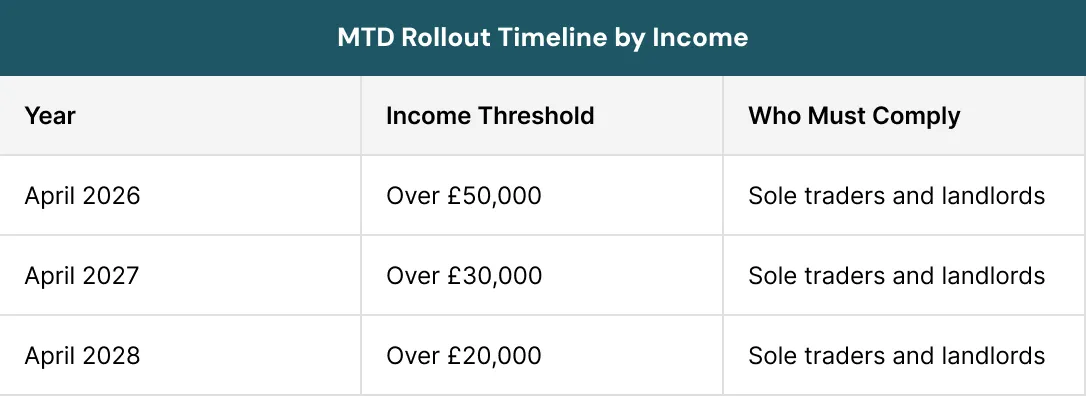
Over time, MTD UK will cover more taxpayers:
- From April 2027, the threshold will drop to £30,000
- From April 2028, it will drop again to £20,000
What Counts as Qualifying Income
Qualifying income means gross income that refers to income before expenses. This includes revenue from businesses and rent incomes. In joint ownership, the share of one person is considered.
This implies that many individuals who were previously not affected will soon be included in Making Tax Digital for Income Tax. That is why early preparation is important.
What Will Change Under MTD
The biggest change is how often tax information is reported. Each update shows a summary of income and expenses. It is important to understand that these are not final tax calculations.
The measure of intelligence is the ability to change.
– Albert Einstein, theoretical physicist
At the end of the tax year, a final declaration is still required. This confirms total income, adjustments and the final tax position.
What Stays the Same Under MTD UK
Payment stays the same under MTD. Tax is still paid on 31 January and 31 July where required. So the system becomes more regular but not more complicated in terms of tax rules.
Key Point:
MTD changes how and when tax is reported, not how much tax is paid.
What Are Quarterly Updates
Instead of sending reports once a year, updates must be sent to HMRC every three months. These are called quarterly updates.
They show how much income and expenses happened in that period. They do not calculate tax and only give HMRC a running view of finances.
What Are the Quarterly Update Deadlines
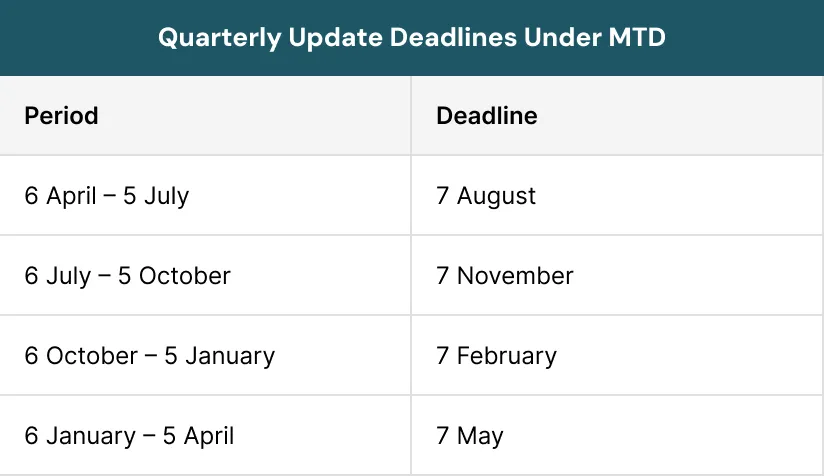
For most people, the tax year is divided into four parts. The first period runs from 6 April to 5 July. The update must be sent by 7 August. The same pattern continues every three months. Each update must be submitted within one month after the period ends.
If there is a mistake in one update, it can be corrected in the next one. This makes the system more flexible than the old yearly return.
For someone with more than one income source, like a business and rental property, separate updates may be needed for each.
What Happens at the End of the Year
Even with quarterly updates, the yearly process does not disappear. A final declaration must still be submitted by 31 January after the tax year ends. This step confirms the full income for the year, such as:
- It includes adjustments like capital allowances, losses or private use.
- Other income must also be included. This can be salary, bank interest or pensions.
- The system often pre-fills data from quarterly updates. This makes the final step easier.
- Tax is still due on the same dates as before. Nothing changes in payment deadlines.
Do You Need Special Software
Yes, you need software to make tax digital. HMRC does not provide its own software. This means you must choose the right software that can connect with HMRC systems.
This is not a new idea in the UK’s digital tax system . From April 2022, VAT-registered businesses must use MTD compatible software for digital records and returns.
The software is used to keep records, send updates and submit the final return. Spreadsheets alone are not enough. However, they can still be used if connected to bridging software. Bridging software acts as a link between spreadsheets and HMRC.
Many people choose cloud-based tools. These tools can connect to bank accounts and track transactions automatically.
Choosing the right software depends on the type of income, number of transactions and personal preference. Starting early gives time to learn how the software works without pressure.
How to Choose the Right Software
The selection of the software influences the digital tax UK process. The proper software should communicate with the HMRC system. It needs to support digital tax management. Furthermore, it should be user-friendly; especially for beginners in accounting software use.
Some individuals might need a simpler application for tracking income and spending. For those who have different sources of income, a more complex software might be needed.
If one uses the spreadsheet to calculate their income and tax liability, the bridging software will help to transfer data automatically.
It is crucial to look at the ability of the software to send quarterly and final declaration data. Sometimes, separate software can be used for these actions. Early testing can help not to make mistakes later on.
What Records Need to be Kept Digitally
Under MTD, records must be kept digitally. This includes income, expenses, dates and categories. For example, a sole trader must record sales, costs and business expenses. A landlord must record rent received and property costs.
Good record keeping makes quarterly updates easier and reduces the risk of mistakes. Waiting until the end of the year is no longer suitable.
For landlords, all UK rental income is treated as one property business. Even if there are multiple properties, they are combined.
Retail businesses may use daily totals instead of recording every single sale. Some taxpayers can also use simplified expense methods.
Are There Any Exemptions
Some people may not need to follow MTD. Exemptions are available for those who cannot use digital systems. This may be due to age, disability, health conditions or lack of internet access.
In some cases, people without a National Insurance number by a certain date may also be exempt for that year.
However, exemptions are not automatic in most cases. An application must be made and approved by HMRC. If approved, the person can continue using the traditional Self Assessment system.
What Happens If You Do not Comply
Not following MTD rules can lead to problems. Late submissions of reports may result in penalties. HMRC uses a system where points are added for missed deadlines. After reaching a limit, a financial penalty is applied.
Penalties Matter:
Missing quarterly deadlines may lead to HMRC penalty points and fines.
There may also be compliance checks and increased attention to records. This is why it is better to prepare early. Mistakes are more likely when systems are rushed at the last moment.
How to Prepare for Making Tax Digital for Income Tax
Preparation should start before April 2026 for Making Tax Digital for Income Tax. Waiting for long periods of time can create stress and mistakes. The following steps can help you prepare:
- You need to check the 2024-25 tax return. This shows if income is above £50,000. If yes, MTD will apply from April 2026
- Then, look at how records are kept now. Paper notes or mixed personal and business spending can create problems later. Moving to digital records early makes the change easier
- Choosing software is another important step. It should be HMRC-compatible and simple to use. Testing the software before deadlines begin helps build confidence
- It also helps to separate business and personal finances. A separate bank account makes tracking income and expenses much clearer
Preparation is not only about tools. It is also about habit. Recording income and expenses regularly becomes part of daily work.
What Role Do Accountants and Agents Play
Accountants and agents help many people with MTD. Accountants and tax agents support with setting up software, managing records and sending updates. Some people may handle records themselves but need help with final submissions.
Agents must use an Agent Services Account to manage MTD tasks. They also need proper authorisation from clients before acting on their behalf.
There can be one main agent and also supporting agents. This allows flexibility, especially for people with complex income.
However, for large businesses, getting clients on board takes time. There is no such option to get all the clients on board together. Each individual client has to be registered separately.
What Are the Benefits of Making Tax Digital for Income Tax
The following are the benefits of Making Tax Digital for Income Tax:
- Regular updates mean fewer surprises at the end of the year. It becomes easier to see how much tax might be owed
- Digital records also reduce errors. Manual mistakes are less common when software is used
- Another benefit is better planning. With updated data, budgeting becomes more accurate
- For accountants, it allows more ongoing support instead of last-minute work in January
So while the system requires change, it can improve how finances are managed.
What Challenges Might Come Up
Some challenges might come up with Making Tax Digital for Income Tax. These challenges can be managed with early preparation and proper planning. These are following:
- Some people may find the transition difficult at first
- Learning new software can feel confusing. This is common, especially for those who have used paper records for many years
- There may also be concerns about cost. Some software tools require payment and there may be extra accounting fees
- Time management is another challenge. Quarterly deadlines mean work must be done more regularly
- For agents, there may be increased workload due to more frequent submissions
How to Handle These Challenges
You can handle these challenges with small changes now and can prevent bigger issues later, such as:
- Starting early Making Tax Digital for Income Tax is the best way to reduce problems
- Trying software before it becomes mandatory helps build comfort. Watching HMRC videos or joining webinars can also help understanding
- Breaking tasks into small steps makes the process easier. Recording transactions weekly instead of monthly can reduce pressure
- Getting professional help is also useful. Accountants can guide through setup and ongoing tasks
- Clear communication between taxpayers and agents makes the process smoother
Real Life Examples
The following examples help explain how Making Tax Digital for Income Tax affects sole traders and landlords.
1. A Sole Trader Under MTD UK
A sole trader running a small service business earns £60,000 in the 2024–25 tax year. This means MTD will apply from April 2026.
Instead of preparing one yearly return, income and expenses must be recorded digitally throughout the year. Every three months, a summary is sent to HMRC.
At the end of the year, a final declaration is submitted. This includes any adjustments and confirms the tax position. If records are updated regularly, the final step becomes much easier.
2. A Landlord With Multiple Properties Under MTD UK
A landlord owns three rental properties in the UK. All rental income is treated as one property business. This means records for all properties are combined.
Income such as rent and expenses like repairs must be recorded digitally. Quarterly updates must cover the full portfolio.
If the landlord previously calculated everything once a year, this will need to change. Records must now be updated more often with Making Tax Digital for Income Tax. This helps give a clearer picture of income during the year.
Conclusion
Although Making Tax Digital for Income Tax is a significant transformation, it does not have to be discouraging. It will help you get ready with confidence.
Digital tax UK is just shifting from annual reporting to frequent updates. With digital documents and the right tools, Making Tax Digital for Income Tax can become easy to manage. Some of the key steps are:
- Early income evaluation
- Selection of the right software
- Development of beneficial practices
Sole traders and property owners who earn more than £50,000 must plan for this change by 2026. Individuals whose earnings fall below the £50,000 threshold should prepare themselves, as they will be required to adopt Making Tax Digital for Income Tax in future years.
When you make tax digital, it will help tax reporting easier, more accurately and less stressful. Besides, Making Tax Digital for Income Tax will aid in the efficient management of financial information on a continual basis.
Sterling Cooper understands the importance of staying prepared, complying and being confident about Making Tax Digital for Income Tax.
Contact us today and talk to one of our experts right now and have your MTD sorted out before deadlines approach.
Struggling to keep up with Making Tax Digital for income tax and worried about missing deadlines?
Expert support helps set up the right software, manage records and stay fully compliant-trusted by many UK sole traders and landlords.
Contact us today and get clear guidance and take control of your MTD setup before the next deadline arrives.
FAQs
Making Tax Digital for Income Tax is HMRC’s online tax reporting system for sole traders and landlords. It means keeping digital records, sending quarterly income and expense updates and submitting a final declaration at year end. It changes how tax is reported, not how much tax is paid.
Making Tax Digital applies to Self Assessment taxpayers with self-employment or property income. It starts from April 2026 for income over £50,000, April 2027 for over £30,000 and April 2028 for over £20,000. Income is measured before expenses.
No, quarterly updates do not replace the full annual process. They only report income and expenses during the year. A final declaration is still required by 31 January to confirm total income, adjustments, other income and final tax due.
Quarterly updates are due every three months. For most taxpayers, the deadlines are 7 August, 7 November, 7 February and 7 May. Each update must be submitted within one month after the quarter ends.
Yes, Making Tax Digital requires compatible software that connects with HMRC. The software is used to keep digital records, send quarterly updates and submit the final declaration. Spreadsheets can only be used if linked to bridging software.
If MTD rules are not followed, HMRC may charge penalties. Late submissions can lead to penalty points and repeated missed deadlines may result in a financial penalty. Poor records may also increase the risk of HMRC checks.
Yes, exemptions may apply if someone cannot use digital systems because of age, disability, health conditions or poor internet access. In most cases, exemption must be applied for and approved by HMRC before using the old Self Assessment process.
Before April 2026, check the 2024-25 tax return to see if income is above £50,000. Then move to digital records, choose compatible software, test the system early and separate business and personal finances.
Recent Posts

How to Build a Cash Reserve for Business Stability
August 11, 2026

How to Forecast Cash Flow During Economic Uncertainty
August 6, 2026