
Posted by:
Admin
Date:
July 29, 2026
Category:
blogs
What Happens If You Miss a Confirmation Statement Deadline?
Did you know Companies House removed over 16,000 companies from the register between 2023 and 2024 as part of efforts to tackle non-compliance activity?
If you own a company in the UK, then there are some key legal tasks that you must take care of.
One of the key tasks is meeting your confirmation statement deadline each year. Many people focus on tax returns and accounts, but they forget this filing.
Missing a confirmation statement deadline may seem like a small issue at first. However, it can lead you to warnings from Companies House, public compliance issues and even company strike-off.
“Keeping company records accurate is a key responsibility of every director.”
– Companies House Guidance
Key Takeaways
- A confirmation statement deadline is a legal filing requirement that every UK limited company and LLP must meet each year.
- A confirmation statement (CS01) confirms that your company information held by Companies House is accurate and up to date.
- All companies must file a confirmation statement, including dormant and non-trading businesses.
- The filing deadline is 14 days after the end of the 12-month review period.
- Missing a confirmation statement deadline will cause your company record to show as overdue on the public register.
- There are no automatic late filing penalties for a late confirmation statement, but Companies House can still take enforcement action.
- If you miss the deadline, file the confirmation statement as soon as possible and correct any inaccurate information before submission.
- Common reasons for missing a filing include forgetting the date, authentication code problems, poor record-keeping, and confusion with annual accounts.
- Setting reminders, maintaining accurate records, and seeking professional support can help you avoid a late confirmation statement in the future.
- Staying compliant with Companies House requirements protects your business, supports credibility, and helps prevent unnecessary legal and financial risks.
What Is a Confirmation Statement (CS01)?
A confirmation statement is also known as CS01. It is an annual filing that must be submitted to Companies House. It confirms that your company’s details on the public register are correct and up to date.
This includes details such as directors, shareholders, registered office details and people with significant control (PSC). If details have changed, they should be updated before you file.
Why Does Every UK Company File It?
Limited companies and LLPs of the UK have a legal duty to file it. This applies whether your business is active, dormant or not trading.
The purpose is to ensure that Companies House holds the correct and current details. Right records help customers, banks, investors and suppliers to trust your business.
Missing a confirmation statement deadline can make your company appear non-compliant. This may create issues for you when you are dealing with lenders.
Who Needs to File a Confirmation Statement?
Many people think that only active businesses need to file it. But in reality, almost every registered company has this obligation.
The filing requirement applies on the size of the company, income or trading status. Understanding who needs to file a CS01 helps you to prevent a late confirmation statement.
1. Limited Companies
Every private and public limited company that registered in the UK must submit a CS01 each year.
Even if nothing has changed within the business, directors still need to confirm that all info remains accurate.
If you fail to meet the confirmation statement deadline, then it can lead to compliance concerns and Companies House action.
2. Limited Liability Partnerships (LLPs)
LLPs are also required to file the CS01. The process is very similar to that used by limited companies.
The filing helps Companies House to maintain accurate info about members and registered offices.
An LLP that misses its confirmation statement deadline may face the same enforcement action as a limited company.
3. Dormant and Non-Trading Companies
Many people believe that dormant companies do not need to file. This is incorrect.
Even if a company has not traded during the year, it must still submit a CS01 and annual accounts where required.
If filing obligations are ignored, a dormant company can still receive the warnings for a late confirmation statement.
Did You Know?
Thousands of dormant companies are struck off each year because directors fail to meet basic filing duties.
What Expenses Can a Limited Company Claim?
The range of expenses to claim for limited company tax purposes is wider than many directors think. Here are some expenses that you can claim for a limited company:1. Office Rent and Workspace Costs
Office rent is one of the most common business expenses. If your company rents premises to operate from, the rent paid is usually a tax deductible. The cost of leasing offices, co-working spaces and meeting rooms can often be claimed. These costs are directly linked to the business activities.1.1 Utility Bills and Running Costs
You need electricity, water and internet access to run a business. These costs are usually allowable when they are related to the business concern. Claiming these costs helps you to ensure that profits are not overstated.1.2 Office Supplies and Stationery
Every business needs the basic supplies. Pens, paper, folders and printers are all examples of the expenses. These purchases may seem small, but they can add up over a year. Office supplies are among the simplest expenses to claim for limited company tax purposes. Because they are clearly linked to day-to-day operations.1.3 Printing and Courier Cost
Courier services used to ship goods. These costs can also be claimed. Printing costs for brochures, forms and documents for a business usually qualify as well. Companies should retain receipts and invoices to support these expenses to claim for limited company.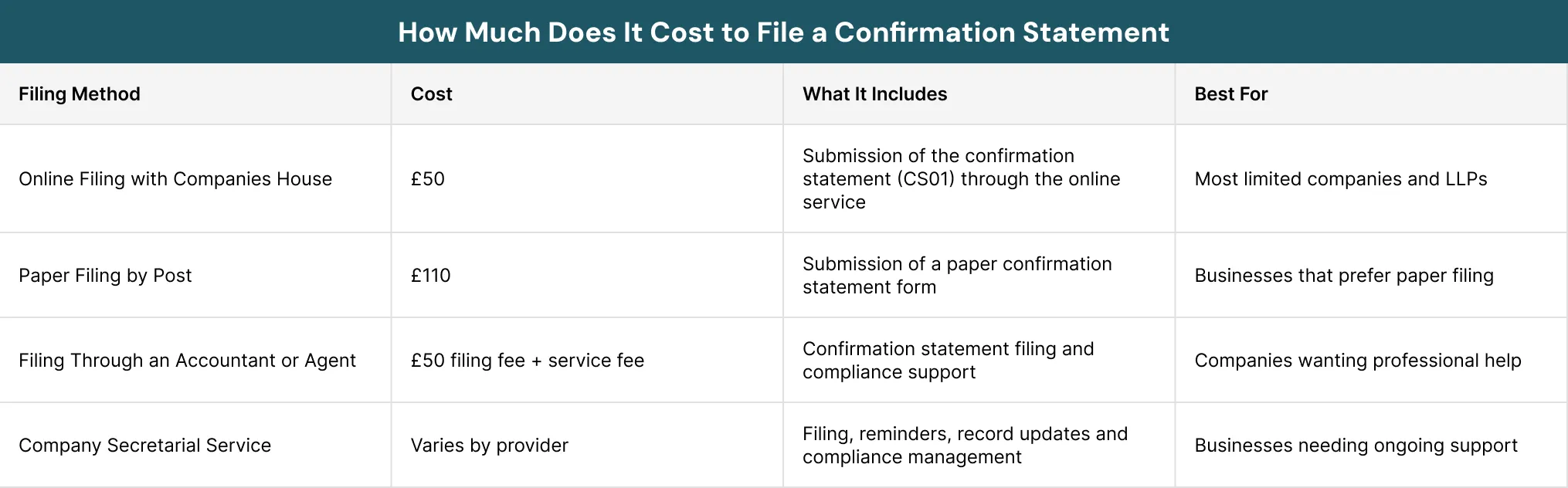
Pro Tip:
Filing online is usually the quickest and most cost-effective option. It also reduces the risk of missing your confirmation statement deadline because you receive instant submission confirmation.
Confirmation Statement Deadline Explained
Every company has a filing due date. Knowing where to find it is essential for you to stay compliant.
A missed confirmation statement deadline often happens because directors simply lose track of the date.
How to Check Your Due Date?
The easiest way to check your due date is through your Companies House account.
You can also search your company on the Companies House register and review the previous filing records.
Checking your due date regularly helps you to avoid a late confirmation statement.
Example of a Confirmation Statement Deadline
Imagine your company was formed on 10 June 2025.
Your review period would normally end on 9 June 2026. You would then have until 23 June 2026 (14 day rule) to file the confirmation statement.
What Happens If You Miss a Confirmation Statement Deadline?
Missing a CS01 deadline does not usually result in an instant fine. However, it can create serious issues related to compliance.
If delays continue then there is a greater risk of an enforcement action.
1. Your Company Will Be Marked as Overdue
When you miss the filing, The records of Companies House will show that your confirmation statement is overdue.
This information is publicly visible and can be seen by customers, lenders, suppliers and also investors.
An overdue filing may raise concerns about how the company is being managed.
2. Public Visibility of Non-Compliance
Companies House records are available to the public. Anyone searching for your company can see whether your filings are up to date or not. A late confirmation statement may create doubts about your business.
This can be especially damaging when you are seeking finance or new contracts.
3. Impact on Company Reputation
Public records of the company helps to build trust among the investors. When you miss the filings then banks, investors or suppliers may question the reliability of your business.
Filings on time helps to protect your reputation and also support the future growth of your business.
Pro Tip:
If you miss a confirmation statement deadline, file as soon as possible rather than waiting for a reminder.
Common Mistakes That Cause Missed Deadlines
Many companies miss the filing dates due to simple errors.
Common mistakes include:
- Forgetting the deadline
- Losing the authentication code
- Assuming accounts and confirmation statements are the same
- Poor company record keeping
Small mistakes can quickly lead to a late confirmation statement.
Did You Know?
A confirmation statement and annual accounts are two completely different legal filings.
What to do if you miss your confirmation statement deadline?
Missing your CS01 deadline is stressful, but it is not the end of the road. The most important thing is to act quickly and not ignore the issue.
Companies House does not usually charge an automatic fine for a missed confirmation statement deadline, but delays can still lead to warnings, strike-off risk and also damage the record of your company. The faster you act, the lower the risk of further action.
1. File your confirmation statement immediately
The first step is to submit your CS01 as soon as you realise it is overdue.
Even if you have missed the confirmation statement deadline, filing now shows the compliance and reduces risk.
Do not wait for reminders from Companies House. A late confirmation statement should always be treated as urgent. Delays can make your company appear inactive or poorly managed.
Pro Tip:
If you are unsure about details, still file first and correct errors later. This is better than waiting and missing your confirmation statement deadline further.
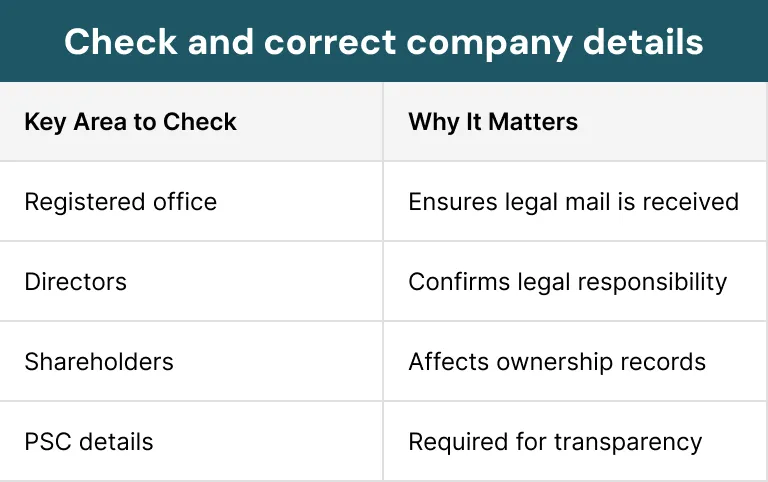
2. Check and correct company details
Before submitting your overdue filing, you have to review all the company info carefully. This includes directors, shareholders, PSC details, office address and share capital.
A late confirmation statement is often caused by outdated records, so fixing errors at this stage is very important. Incorrect data can create compliance problems in future.
How the Confirmation Statement Review Period Works?
The review period is the time frame that is used to find when your next filing is due. Understanding how it works can help you to avoid missing a confirmation statement deadline.
Many directors assume that the filing date stays the same every year. However, the review period can change if you file early.
12-Month Review Period
Every company has a review period that usually lasts 12 months. It begins either on the incorporation date or the statement date of the last confirmation statement.
During this period, Companies House expects that records of the company remain accurate and up to date. If you make any major changes in a business then you have to report it when it happens.
Knowing your review period is one of the easiest ways to avoid a late confirmation statement.
How is the Statement Date Calculated?
The statement date is the date on which you confirm that the info of your company is correct and up to date.
All details included in the filing should reflect the position of the company on that specific date. This ensures the public register remains accurate.
The statement date is important because it determines your next confirmation statement deadline.
Filing Deadline: The 14-Day Rule
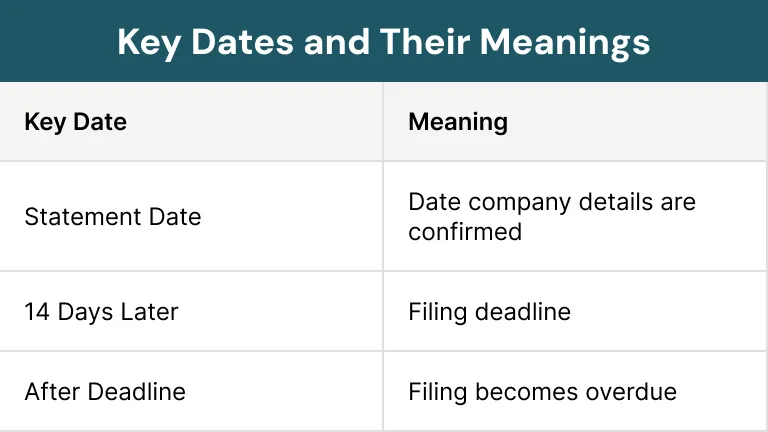
After the statement date, companies have 14 days to submit their confirmation statement.
If the filing is not delivered within this period, it becomes overdue. Companies House may then begin sending reminders or warnings to you.
Many directors think that they have a full month to file, but the 14-day rule is strict.
Case Study: Missing a Confirmation Statement Deadline
James who runs a small marketing agency in Manchester. The business had been trading successfully for several years. But he became busy managing client projects and overlooked his annual CS01 deadline.
Because the filing only happens once a year, James assumed he still had plenty of time. A few weeks later, he noticed that Companies House had marked his company record as overdue.
The Problem
Shortly after missing the CS01 deadline, James applied for a business loan to support growth of his company. During the lender’s review, the overdue filing appeared on the Companies House register.
The Solution and Outcome
As soon as James realised the issue, he submitted the late CS01 online and also he checked all details of the company for accuracy.
The filing was accepted by the Companies House, and the overdue status was eventually updated.
This simple change has helped him to avoid future issues and maintain a strong business reputation.
Key Lesson:
Even a small filing like a confirmation statement can affect funding applications, business credibility and compliance status if it is overlooked.
Conclusion
Meeting your CS01 deadline is one of the key legal duties for a UK company. The filing confirms that Companies House holds accurate info about your business and helps to gain trust of banks, investors, suppliers and customers.
A late confirmation statement does not normally result in an immediate penalty. But ignoring the issue can lead to warnings, legal action and even company strike-off. These risks can affect the reputation of your company.
The best approach is to keep your company records accurate, monitor filing dates and submit your CS01 on time every year.
By planning ahead, you should use reminders and seek help from experts where needed.
At Sterling Cooper, we help you to stay compliant with Companies House requirements, so you never have to worry about missing a CS01 deadline.
Worried about missing your next confirmation statement deadline?
Feel free to contact us today. We handle your filings and compliance tasks, so you can focus on running your business with confidence.
FAQs
Yes. If you miss the filing date, you can still submit the statement. It is best to file as soon as possible to reduce the risk of further action from Companies House.
There are no automatic financial penalties for a late confirmation statement. However, continued failure to file can result in enforcement action, prosecution, or strike-off procedures.
If you miss the deadline, Companies House issues an automatic warning (not a fine) and continued failure to file can lead to prosecution of directors and the company being struck off the register.
You can check your filing date by logging into your Companies House account or searching for your company on the Companies House register.
Yes. Dormant and non-trading companies must still submit a confirmation statement each year, even if no company information has changed.
Recent Posts