Posted by:
Admin
Date:
May 21, 2026
Category:
blogs
What Disabilities Qualify for VAT Exemption?
Living with a disability often requires special equipment to maintain a normal quality of life. However, this equipment comes at a cost with VAT, which makes it difficult for most people to buy it. In the UK, the government has allowed VAT exemption for disabled people so that they can buy goods without the need to pay VAT.
According to a source, in the UK a household with at least one disabled person has to face an additional cost of £975 per month.
The government has introduced this scheme to help disabled people. It makes buying special equipment like mobility aids, wheelchairs, adapted cutlery, shower chairs, etc. easier.
Many people might have heard about the value added tax exemption scheme. However, they don’t know who is actually exempt from VAT and how this scheme works. They assume that they just need a disability certificate to qualify for the VAT relief scheme. This is not true. There are certain criteria set by HMRC which makes you eligible for this scheme.
If you are someone who wants to know if you are eligible for the VAT scheme or not, then this guide is for you. In this guide, we will see in detail what VAT is. We will also explore what makes you eligible for a value added tax exemption.
Key Takeaways
- Disabled people with long-term physical, mental, or chronic conditions may qualify for VAT exemption for disabled people under HMRC rules.
- You do not need PIP (Personal Independence Payment), DLA (Disability Living Allowance), or a Blue Badge to claim VAT relief.
- VAT exemption for disabled people removes the standard 20% VAT from eligible disability products and services.
- VAT-free items may include wheelchairs, mobility aids, stairlifts, adjustable beds, bathroom aids, and emergency alarms.
- Products must usually be designed specifically for disabled people and used personally or domestically.
- People over 60 may qualify for a reduced 5% VAT rate on certain mobility aids and home adaptations.
- Claiming VAT relief is simple and usually only requires a short eligibility declaration form.
- VAT relief may also apply to repairs, installations, home adaptations, and charities supporting disabled people.
In order to understand VAT exemption for disabled people, first let’s see what VAT is.
What Is VAT?
VAT (Value Added Tax) is a tax that is charged on goods or services sold in the country. The standard VAT rate for the UK is 20% as of 2026. It means that whatever product you buy, an additional 20% will be charged on it.
According to HMRC:
‘VAT is a tax added to most products and services sold by VAT registered businesses.’
VAT is charged on goods ranging from everyday household items to electronics and furniture. In the UK, VAT is collected by HMRC. The money collected through VAT is used to fund public services.
Read more: VAT on Private School Fees
What Is VAT Exemption for Disabled People?
VAT exemption for disabled people means that eligible disabled persons can buy disability equipment without the need to pay VAT. Suppliers will not charge you an additional 20% at the time of sale. For example, if a mobility aid costs £1,000 with VAT, then you will have to pay only the original price, which would be around £833.
The VAT relief scheme is introduced by the government of the UK so that disabled people do not have to pay an additional 20% to buy specialised equipment. It is important to know that not every single item bought by disabled people will become VAT free. Only certain products and services that meet HMRC conditions come under VAT exemption for disabled people.
Example of VAT Exemption in Practice
A person with mobility issues buys a wheelchair priced at £1,000 including VAT. With value added tax exemption for disabled people, they only pay around £833. This shows how the scheme directly reduces financial burden.
Who Is Eligible for Value Added Tax Exemption in the UK?
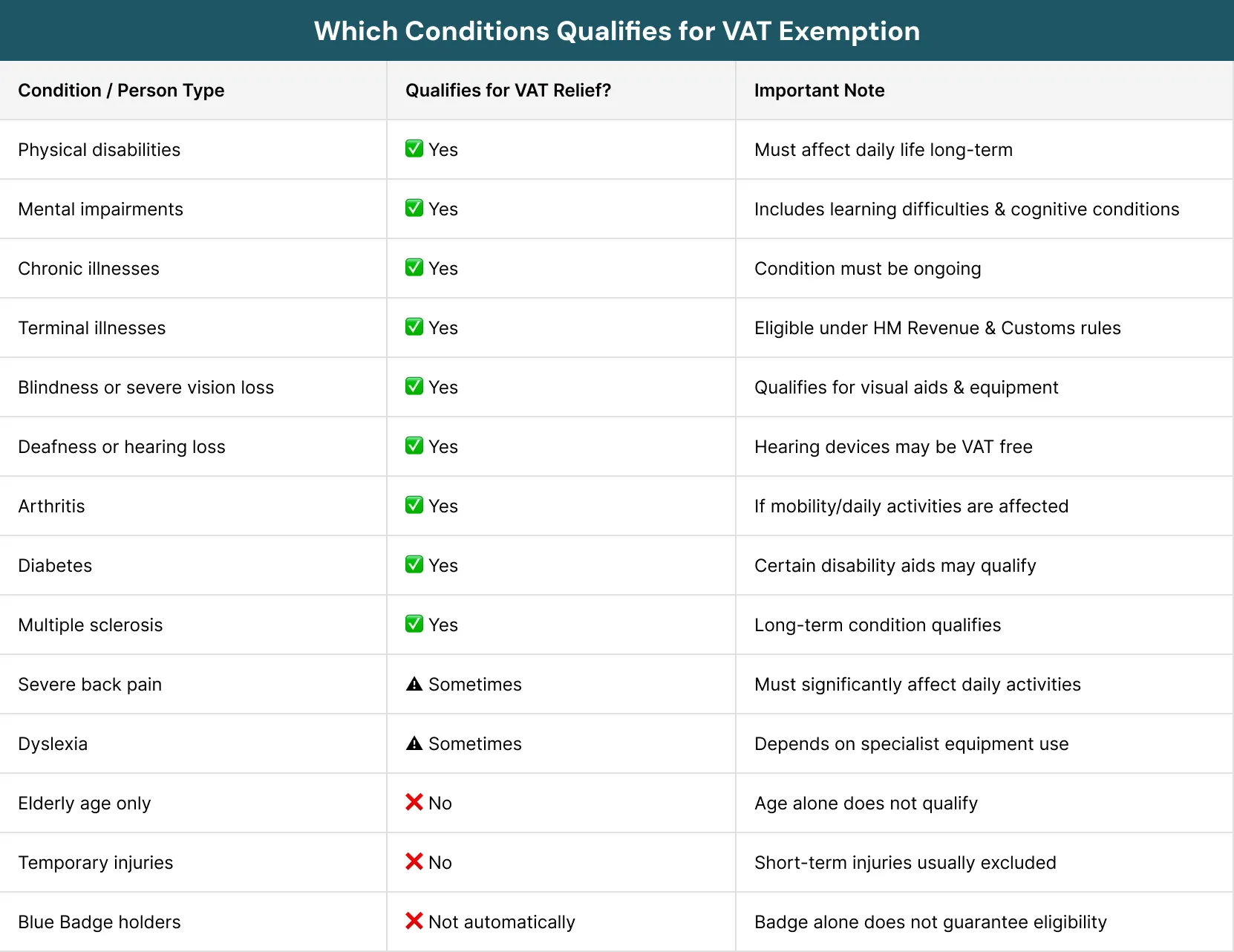
If you are chronically sick or disabled, then you are eligible for VAT exemption for disabled people.
Under the guidelines of HMRC, a person with any kind of:
- Physical disability
- Mental impairments
- Chronic illness
- Terminal illness
Or any condition that has a long term effect on the ability to carry out daily life tasks qualifies for the VAT exemption for disabled people scheme.
Many other conditions like asthma, blindness, deafness, diabetes, epilepsy, cancer, heart disease and multiple sclerosis may also be exempted from VAT if they have a significant effect on your daily life.
Certain common conditions also qualify for VAT if they have a long term effect on daily life. Examples include back pain, dyslexia, psoriasis, etc.
Once you qualify for the value added tax exemption for disabled people scheme, you can easily buy goods without the need to pay VAT. Common goods and services that are exempted from VAT for disabled people include:
- Mobility aids like wheelchairs, mobility scooters, etc.
- Medical equipment like adjustable beds, riser recliner chairs, etc.
- Emergency alarms
- Blind aid devices
- Communication aids
One misconception you might have heard is that elderly persons are also exempted from VAT but that’s not true. Being elderly does not automatically make you eligible for the exemption scheme. They will only qualify if they have a disability and chronic illness that affects their daily life activities severely.
Quick Eligibility Checklist
You may qualify for value added tax exemption for disabled people if:
- You have a long term illness or disability
- Your condition affects daily activities
- The product is designed for your condition
- You are buying for personal use
- You can complete a VAT relief form
Important Detail
Temporary injuries like a broken leg usually do not qualify for VAT exemption because HMRC only considers long-term conditions.
VAT Exemption List for Disabled
Many disability products come under the VAT relief scheme. Here’s a list for disabled people who are exempted from VAT.
- Wheelchairs, which include manual wheelchairs, powered wheelchairs, walking aids, etc.
- Adjustable beds specifically designed for disabled persons
- Stairlifts and chair lifts, which include ceiling hoists and transfer hoists
- Bathroom and toilet aids, which include commode chairs, shower stools, toilet frames, bath lifts and accessible sanitary devices
- Low vision aids, which include magnifiers, braille equipment, white canes and specialist reading aids
- Hearing aids, which include induction loops, text telephones, vibrating pillows and TV hearing devices
- Hoist and lift equipment, which include transfer equipment, lifting slings and standing aids
- Home change, which include wheelchair ramps, installing stairlifts, adapting shower rooms and installing alarm systems
- Emergency alarm systems used to contact carers, family members and emergency support services
In addition to this, certain assistive technology products may also come under VAT if they are specifically designed to help disabled persons. Examples include voice recognition systems, communication systems and accessibility technology under.
It is important to note that certain products like ordinary wheelchairs are not exempted from VAT, as they are also used for general purposes.
VAT relief may also apply to adaptation services, repair and maintenance of the qualifying products. This means that you do not have to pay VAT for repairing, servicing and installing such products.
What Does Not Qualify for Value Added Tax Exemption
- General use products not designed for disability
- Luxury or non essential items
- Items bought for business use
- Items used by non disabled individuals
Which People/Products Are Partially Exempt from VAT?
Partial exemption VAT refers to a situation where some disability products are sold without VAT, while some products are subject to reduced VAT (5%) or standard VAT (20%).
People over the age of 60 who are not chronically ill fall under the category of reduced VAT for some products.
Some products which are not specifically designed for disabled persons but help them, e.g. standard recliners or wheelchairs, are subject to reduced VAT.
If a disabled person has bought a car, then the car itself will be subject to full VAT. However, wheelchair adaptation for the car will be VAT free under VAT exemption for disabled people.
HMRC Rules You Should Know
- The product must be for personal use
- The item must be designed or adapted for disability
- The buyer must meet eligibility criteria
- A VAT relief form must be completed
Pro Tip
Always ask the supplier whether the product is VAT exempt before making payment online or in-store.
How to Claim VAT Exemption
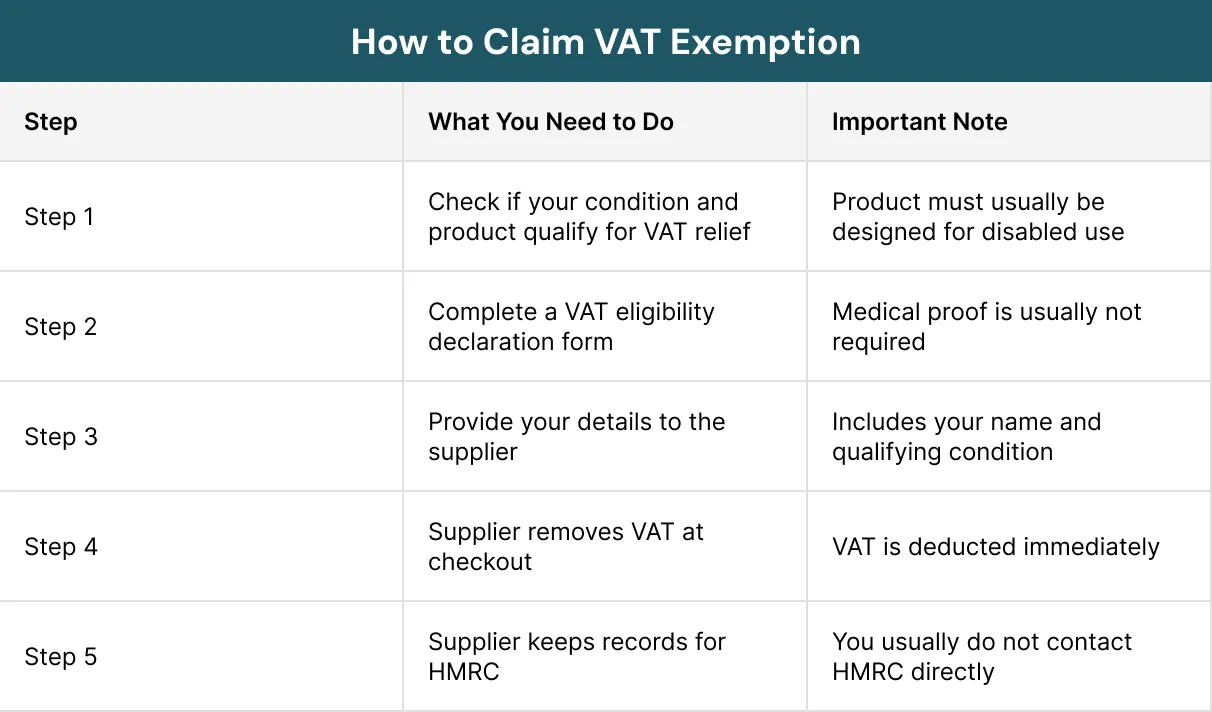
Many people think that claiming VAT is a difficult thing but it’s actually a simple process. Following is a breakdown:
1. Confirm Your Eligibility
To claim a value added tax exemption for disabled people, you have to first confirm your eligibility. You must ensure that your condition qualifies for VAT and that the item you need also qualifies.
2. Complete VAT Declaration
You have to complete a VAT relief form to confirm that you have a disability or chronic illness that makes you eligible for VAT relief under VAT exemption for disabled people. You also have to declare that you are using the item for personal or domestic use.
The form usually contains:
- Your name
- Your condition
- VAT confirmation
3. Suppliers Remove VAT
Once your eligibility has been confirmed, suppliers remove VAT from your purchase. They keep records for HMRC, so you do not need to contact HMRC directly.
VAT claims are handled completely by suppliers and they apply for VAT relief under VAT exemption for disabled people.
Step by Step Buying Process
- Choose a qualifying product
- Confirm eligibility
- Fill out VAT relief form
- Supplier removes VAT
- Complete purchase
Do You Need to Fill a VAT Declaration Form to Claim VAT Exemption for Disabled People?
To claim a value added tax exemption for disabled people, completing the VAT relief form is the most important step. Many people lose the benefit simply because they do not understand how this form works.
The VAT declaration is a simple statement where you confirm that you are eligible for an exemption and that the product is for personal or domestic use. This form is required by suppliers so they can legally remove VAT from your purchase.
The form usually asks for basic details such as your name, address and the nature of your condition. You do not need to provide medical proof, but your statement must be honest and accurate.
It is important to understand that this form is not sent by you to HMRC. Instead, the supplier keeps it as a record in case HMRC asks for proof later. This is why filling it correctly is essential when claiming VAT exemption for disabled people.
You may be asked to complete this form:
- At checkout in a physical store
- Online before making payment
- Or sometimes after placing an order
If the form is not completed, the supplier cannot apply exemption and you may be charged full VAT.
Always double check your details before submitting. Incorrect or false statements can lead to penalties, even if done by mistake.
Do You Need Medical Proof to Claim VAT?
No, you usually do not need medical proof to claim VAT. You do not require any medical evidence like a doctor’s letter or certificate.
You only need to make a statement that confirms you are eligible for a value added tax exemption for disabled people. Avoid making false statements, as this may lead to penalties.
Good to Know
You normally do not need to send medical proof to HMRC. Most suppliers only require a simple eligibility declaration form.
VAT Relief for Charities
VAT relief may also apply to certain charities that support disabled people. These charities support disabled people through care services, medical support and accessibility services.
Charities may be exempt from VAT on:
- Disability aids
- Accessibility equipment
- Medical supplies
- Adapted vehicles
This may also fall under conditions similar to VAT exemption for disabled people.
VAT Exemption for International Customers
International customers who buy disability products from the UK are not usually charged VAT. However, they may have to pay customs charges or import tax depending on their country.
Some countries allow tax free imports of disability products, while others apply local taxes. These rules are separate from VAT exemption for disabled people.
VAT Exemption in the UK vs Other Countries
The UK offers VAT exemption for disabled people at the point of sale, while many other countries require refunds or partial tax relief after purchase.
Common Misconceptions About VAT Relief
Here are some common misunderstandings about value added tax exemption for disabled people:
- Elderly people automatically qualify (not true)
- Every disabled person qualifies (both person and product must qualify)
- All disability products are VAT free (only specific products qualify)
- Benefits like a blue badge are required (not true)
- HMRC approval is needed (self declaration is enough)
Read more: Common Errors on VAT Returns
Importance of VAT for Disabled People
VAT exemption for disabled people is important because it reduces financial burden. Many disability related products like wheelchairs, adjustable beds and mobility scooters are expensive.
In addition, home changes and assistive technologies also cost money. Removing VAT can save thousands of pounds.
It improves the quality of life by making essential products more accessible. It also helps charities reduce their operating costs.
How Much Can You Save?
With VAT exemption for disabled people, removing 20% VAT can save hundreds or even thousands of pounds on equipment like mobility aids, home change and medical devices.
Final Thoughts
There is no doubt that disability products come as an additional expense. The VAT exemption scheme for disabled people by the UK government is a great step in managing this cost.
VAT schemes can only be used properly if you have complete knowledge about them. You must know which products and conditions qualify for VAT exemption for disabled people. Always confirm that both the product and your condition qualify before buying.
Many people miss out on value added tax exemption for disabled people simply because they are unaware of the eligibility criteria. The process is simple. No medical evidence is required. You only need to make a declaration. It can become difficult only when there is a lack of understanding about eligibility, products and the process.
Understanding VAT exemption for disabled people can sometimes be confusing. Sterling Cooper Consultants can guide you on eligibility, qualifying products and correct declarations to ensure you do not miss out on available relief. Reach out to us today.
At Sterling Cooper, we help you stay compliant and reduce tax stress.
Trusted by UK individuals and businesses, we make VAT relief and exemption easier to understand. Contact us today!
FAQs
Yes, disabled people can receive VAT relief on certain eligible products and services designed specifically for disability use. However, VAT relief is usually applied at the time of purchase, meaning you do not pay the VAT upfront rather than claiming it back later.
You may qualify if you have a long-term physical or mental condition that affects your daily activities.
Physical disabilities, mental impairments, chronic illnesses, and terminal illnesses may qualify for VAT relief if they have a long-term effect on daily life. Conditions such as blindness, deafness, diabetes, epilepsy, arthritis, multiple sclerosis, cancer, and severe mobility issues can qualify under HMRC rules. Temporary conditions, minor injuries, or simply being elderly do not usually qualify for full VAT exemption.
No, having a Blue Badge alone does not automatically qualify you for VAT exemption.
Eligibility depends on whether you have a long-term disability or chronic illness that affects your daily activities under HMRC rules. You can still qualify for VAT relief even if you do not receive benefits or have a Blue Badge.
Yes, arthritis can qualify for VAT exemption if it has a long-term and substantial impact on your ability to carry out everyday activities. Under HMRC rules, chronic conditions such as arthritis are considered eligible when purchasing qualifying disability-related products or services. The products must also be for personal or domestic use to receive VAT relief.
To apply for VAT exemption in the UK, you usually need to complete a simple VAT eligibility declaration form provided by the supplier. You must confirm that you have a qualifying long-term disability or chronic illness and that the product is for personal or domestic use. Once approved, the supplier removes the VAT at the time of purchase.