Posted by:
Admin
Date:
May 18, 2026
Category:
blogs
What is Auditing in Accounting?
Can you trust a business just by looking at its financial reports? That is where auditing in accounting becomes important.
Auditing helps businesses to check accuracy of their financial records. In simple words auditing is the process of reviewing the financial statement.
It is also the process of reviewing the overall transactions of the company.
It also builds the trust between the company and its stakeholders such as investors and banks.
Research shows that 83% of audit functions are currently using AI to improve their audit in 2026.
Key Takeaways
- Auditing in accounting helps businesses verify that their financial records are accurate, transparent, and compliant with laws and accounting standards.
- Accounting and auditing work together, but they have different roles. Accountants prepare financial records, while auditors examine and verify them for accuracy.
- Auditing improves financial transparency, increases investor confidence, and helps businesses build trust with stakeholders, lenders, and customers.
- The main types of auditing include internal auditing, external auditing, government auditing, and forensic auditing, each serving a different business purpose.
- Auditors play an important role in fraud prevention and risk management by identifying financial errors, suspicious activities, and weaknesses in internal controls.
- Modern technologies such as Artificial Intelligence (AI), cloud-based software, and data analytics are transforming the auditing industry and improving efficiency.
- Emerging trends like ESG audits, cryptocurrency audits, and AI governance audits are creating new opportunities for auditors in the future.
- Essential skills for audit accountants include analytical thinking, communication, attention to detail, project management, and regulatory knowledge.
- Businesses that perform regular audits are more likely to improve operational efficiency, reduce financial risks, and make smarter financial decisions.
- As the financial world continues to evolve, auditing remains a critical tool for ensuring business accountability, compliance, and long-term success.
Purpose of Auditing in Accounting
Auditing in accounting is the process of checking financial records of the company. It helps businesses to confirm that their reports follow the legal rules.
The main purpose of an audit is to build trust. It also helps to find the errors and improve the financial records.
Why Do Businesses Need Auditing?
Businesses need auditing in accounting because it helps them to maintain their financial records.
Without it hidden issues will be ignored which create bigger issues in future.
One of the most common reasons is that it helps to stay compliant with laws and tax rules. It also helps businesses to avoid penalties.
Accountant vs Auditor
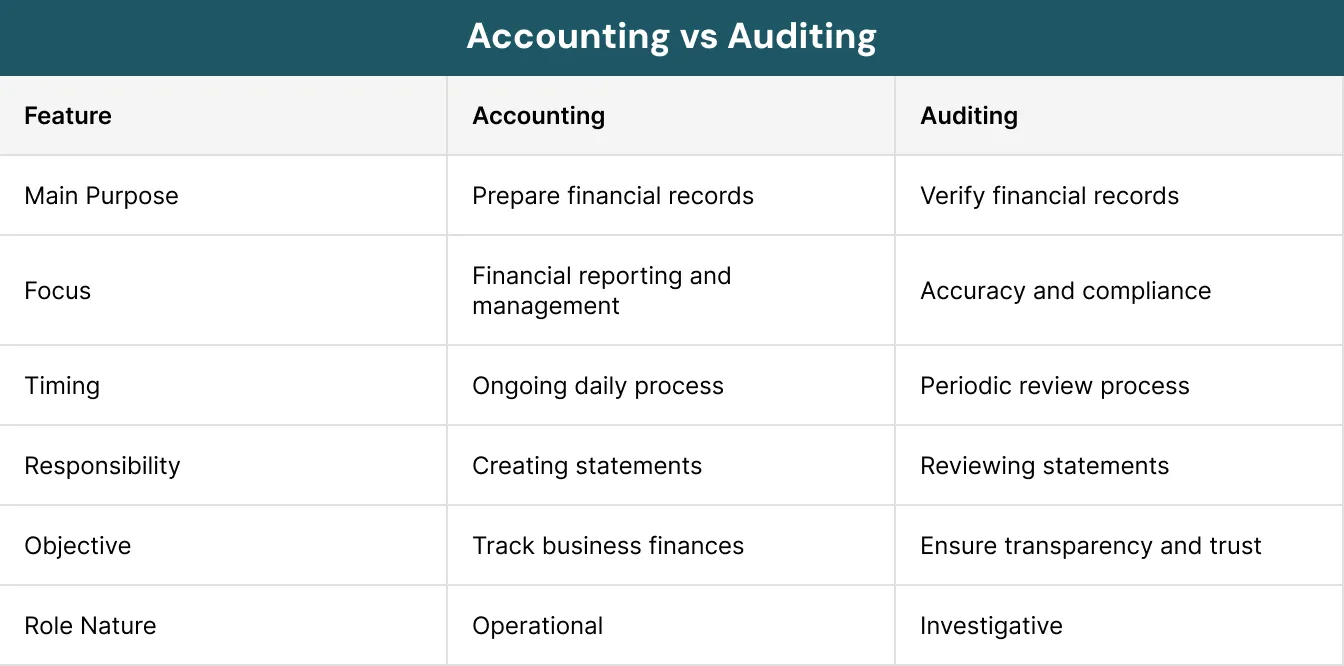
They both are connected to each other but they have different roles.
Role of an Accountant
The role of an accountant is to manage the financial activities of the business. They work on preparing the reports, recording transactions and also handling the taxes.
They help businesses to understand their financial records. They also make plans for future growth of the business.
Role of an Auditor
The role of an auditor is to review the financial records to ensure that they are correct. They also help businesses to improve their internal controls.
In many cases they can act as financial investigators.
Why Auditing in Accounting Matters in Modern Business?
Auditing in accounting helps businesses to remain financially secure. It gives confidence to stakeholders that records of the company are reliable.
It can help modern businesses to identify the problems and also manage the legal risk.
It also helps to find the errors. Once the errors are found it helps to improve the financial statements.
Financial Transparency and Investors Trust
Financial transparency means being honest about the financial records of the company.
It also helps to improve the reputation and strength of the company. This can ensure to maintain a good relationship with stakeholders.
Audits help businesses to provide accurate reports to investors. This can help to gain the trust of the investors.
Types of Auditing in Accounting
There are some main types of auditing in accounting which include:
- Internal
- External
- Government
- Forensic
Here we have explained these types below which will help you to better understand each type:
1. Internal Auditing in Accounting
Internal auditing in accounting is conducted in a company to review the financial systems.
It also helps businesses to follow the policies of the company. It ensures that all departments are doing their work in a proper way.
2. External Auditing
This type of auditing is carried out by the auditors from outside the organisation. Their role is to review the financial records and give an opinion.
It helps to increase the trust among the investors. It also confirms whether financial reports of the company are accurate or not.
3. Government Auditing
It ensures that businesses should comply with tax laws and regulations. These audits are performed by the government.
In this process auditors of the government review financial records to confirm that taxes are reported in a proper way.
4. Forensic Auditing
This type of auditing investigates the financial records to uncover fraud. It is important because it helps to detect financial crimes.
To stop these crimes, auditors work closely with the legal teams and law agencies.
What is the Process of Auditing in Accounting?
The process of audit follows a structured approach to review the financial information.
With the help of a proper audit process you can improve the efficiency. You can also ensure that financial records are reviewed carefully.
This process includes:
- Planning
- Testing
- Reporting and Opinions
1. Audit Planning
Planning is the first stage of the process of the audit. At this stage you define the objectives and timeline of the audit before starting the review.
During the planning, auditors identify the high-risk areas. This can help them to focus on the important issues.
It helps the audit to run smoothly and also helps to avoid missing the information.
2. Evidence Collection and Testing
At this stage auditors collect the evidence by reviewing documents. This includes invoices, receipts and also bank statements.
They also check the transactions to confirm the accuracy. It can help auditors to identify the errors or any fraud.
In this process audit tools and software make it easy to collect the evidence.
3. Reporting and Opinions
After completing the review, now auditors prepare a report which can explain their findings.
The report highlights the issues related to financial records which are found during the audit.
In the last step they also give their opinions to improve the financial system. These opinions can help businesses to achieve good results.
Read more: Understanding the Accounting Cycle: Step-By-Step Breakdown
Skills Required for Audit Accountants
An audit accountant must have technical skills and also problem solving skills.
Strong skills help them to identify rare issues and also help to manage complex tasks. They must be able to solve the problem in a given time.
As technology grows day by day, they also need digital skills to stay updated with market trends.
Analytical Skills
Analytical skills help them to review financial data and to identify the issues and possible fraud.
They must also understand the information and risks. It allows them to solve problems and make good decisions during the audit.
These skills help them to detect fraud and ensure good financial reporting.
Other Skills
During the audit, they must work with managers on a regular basis. Strong communication skills help you to explain issues in a better way.
Project management skills are also important because audits depend on deadlines and planning.
Good teamwork helps them to complete audits in a better way.
Role of Technology in Auditing in Accounting
Technology plays a key role in today’s audit. It helps to perform the audit in a better way, which is the need of modern businesses.
It also helps businesses to secure financial records during the audit. Auditors now use digital tools and software to improve their speed.
Role of AI
AI helps auditors to manage large amounts of data quickly. It can also help to identify wrong transaction and fraud risks.
AI also helps to improve efficiency but human work is still important. Because the final opinions should be given by auditors.
Cloud-Based Audit
Cloud-based audit allows you to access the financial information from anywhere. During the audit this can help to improve teamwork.
Data analytics tools also help you to identify trends. With the help of these tools, you can also review large amounts of data quickly.
These tools help you to improve audit quality and also help businesses to make better financial decisions.
Also Read: 5 Ways Cloud Accounting Can Save You Time and Money
What are the Audit Trends in 2026?
The auditing industry grows day by day as businesses adopt the new tools.
Future audit trends focus on digital assets like Cyber security and AI. These areas are more important for businesses.
Auditors who develop modern skills will have a good chance of growing in the future.
Role of Cryptocurrency and AI Audits
Crypto audits work on digital assets and blockchain transactions. As crypto grows, your business needs a proper system to manage the risks.
AI audits help to inspect how companies use AI to make decisions.
These types of audits are more important because technology continues to transform the global business.
What are the Challenges for an Auditor?
As an auditor, you may face many challenges, such as changes in technology. You must adapt to these changes quickly to stay effective.
Companies now expect from auditors that they provide deeper insights and faster results. You must be able to handle more complex financial systems.
You may also face pressure to balance the technology with human judgement.
AI Risks and Regulatory Concerns
AI helps you to improve audit structure. But if the system makes wrong decisions then it can also create risks. You must monitor these tools carefully.
For the perfect use of AI and data protection Regulatory audits are introducing new rules. It is important that audit firms must stay updated with these changes.
Conclusion
Auditing in accounting is an important part of any business. It helps businesses to maintain accurate and reliable financial records.
From detecting fraud to improving the financial issues, it helps to support better business decisions.
Both internal auditing in accounting and external auditing play an important role in protecting businesses from financial risks.
As technology continues to change the way of business, auditing in accounting will become more advanced in future.
Businesses and professionals who adapt to these changes will get success in the future.
At Sterling Cooper, we know the value of auditing in accounting. Our team is available to help you in this process.
Struggling to manage financial records, tax rules, and compliance requirements?
Contact us today and get professional auditing and accounting guidance for your business.
FAQs
The three main types of audits in accounting are internal audits, external audits, and government audits.
The main purpose of auditing is to check whether a company’s financial records and statements are accurate, reliable, and compliant with accounting standards and legal regulations.
The “Five C's” of Internal Auditors are Criteria, Condition, Cause, Consequence, and Corrective action.
An audit is an independent examination of an organization's financial records to ensure they are accurate and comply with established accounting standards.
Common types include internal, statutory, cost, tax, secretarial, forensic, government, compliance and IT auditors.
Recent Posts

How to Build a Cash Reserve for Business Stability
August 11, 2026

How to Forecast Cash Flow During Economic Uncertainty
August 6, 2026