

Posted by:
Admin
Date:
May 15, 2026
Category:
blogs
Payroll Deductions: A Complete Guide to the UK Deductions From Pay
When you are paid on a monthly basis, it seems very simple. You just have to work and earn your salary, which is then deposited into your bank account. But you need to know that the money that will be paid to you is not your total earnings.
Before the payment gets transferred, different amounts are deducted from it. Almost everyone working in the UK has payroll deductions.
HM Revenue & Customs reports that in 2022-2023, the UK government received an income tax of nearly £814 billion, with the majority of this income tax collected through payroll processing systems. This clearly signifies the importance of deductions as part of payroll, as it isn’t only about earning by individuals, but it’s also about the overall economic state of the country.
The amount that is deducted from the gross income before the net salary amount is paid is known as the payroll deductions. This might include income tax deduction and contributions to the National Insurance Fund and pension funds.
Thus, when people look for information on UK payroll deductions, they actually want to learn about adjusting their salary amount before it gets transferred into their bank accounts.
Key Takeaways
- Payroll deductions are taken from gross pay before employees receive their net salary.
- They include tax, National Insurance, pensions, student loans, and other approved deductions.
- UK payroll runs through the PAYE system, where employers handle deductions and send them to HMRC.
- Deductions are either mandatory (required by law) or voluntary (based on employee agreement).
- Employers must ensure deductions are correct, legal, and clearly shown on payslips.
- The basic payroll flow is: gross pay → tax → NI → pension → other deductions → net pay.
- Employees can challenge incorrect deductions by first speaking to their employer, then raising a formal complaint if needed.
- Payroll is more complex today due to loans, pensions, benefits, and salary sacrifice schemes.
Payroll Deduction in the UK
These are the deductions which are automatically made from your salary before getting the salary paycheck.
This way, employers can be assured that taxes and other deductions will automatically be made before the employee makes any payments himself.
How Do Salary Deductions Work Through the UK PAYE System
Deductions from salary in the UK are made under the Pay As You Earn (PAYE) system.
Tax, National Insurance, and any other deductions are calculated by your employer before paying you your salary.
You won’t have to worry about working out your deductions, as all of that will be done for you automatically.
How Payroll Deductions Work in Real Time
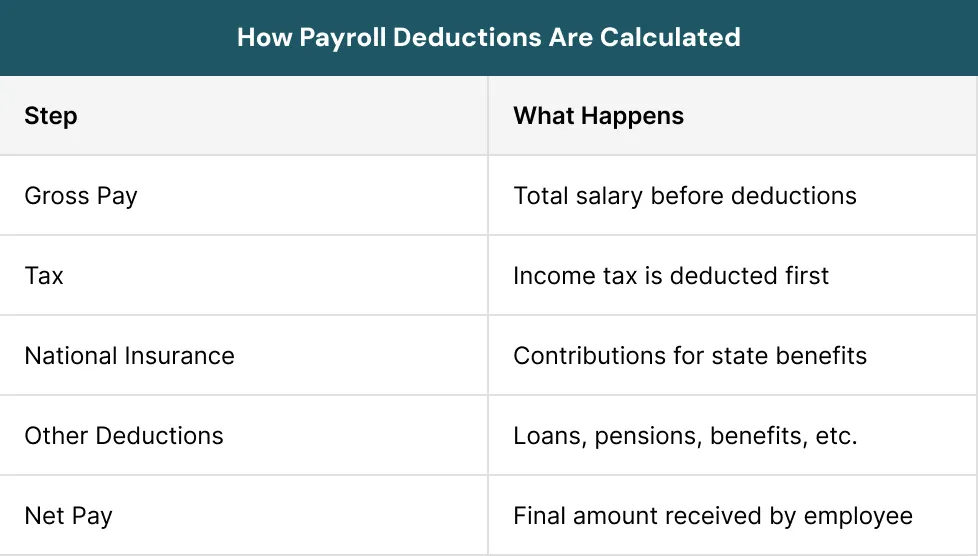
Payroll deduction is a system applied each time salary deduction takes place. It starts from your gross salary, which is your total salary before any deductions.
Such deductions from pay in the UK start with income tax and national insurance payments. The other deductions include contributions to pension schemes.
The amount left after deductions is the net salary. The process of salary deductions is now computerised, thus reducing any manual deductions. Most employees can find these deductions on their pay slips.
Quick Insight
Payroll deductions are not random. They are carefully calculated based on the laws of accounting in the UK under PAYE.
Why Do Payroll Deductions Exist
They are vital in maintaining the financial systems of individuals and the public sector. They are crucial in making fundamental decisions that fulfil some conditions.
The reasons for payroll deductions are to:
- Meet health needs and other public services
- Finance state pensions schemes
- Administer employee benefits and contribution schemes.
- Follow legal rules
If salary deductions are not made, it will be hard to maintain sectors like health care and pension schemes.
“Paying tax is part of living in a civilised society”
by Oliver Wendell Holmes Jr.
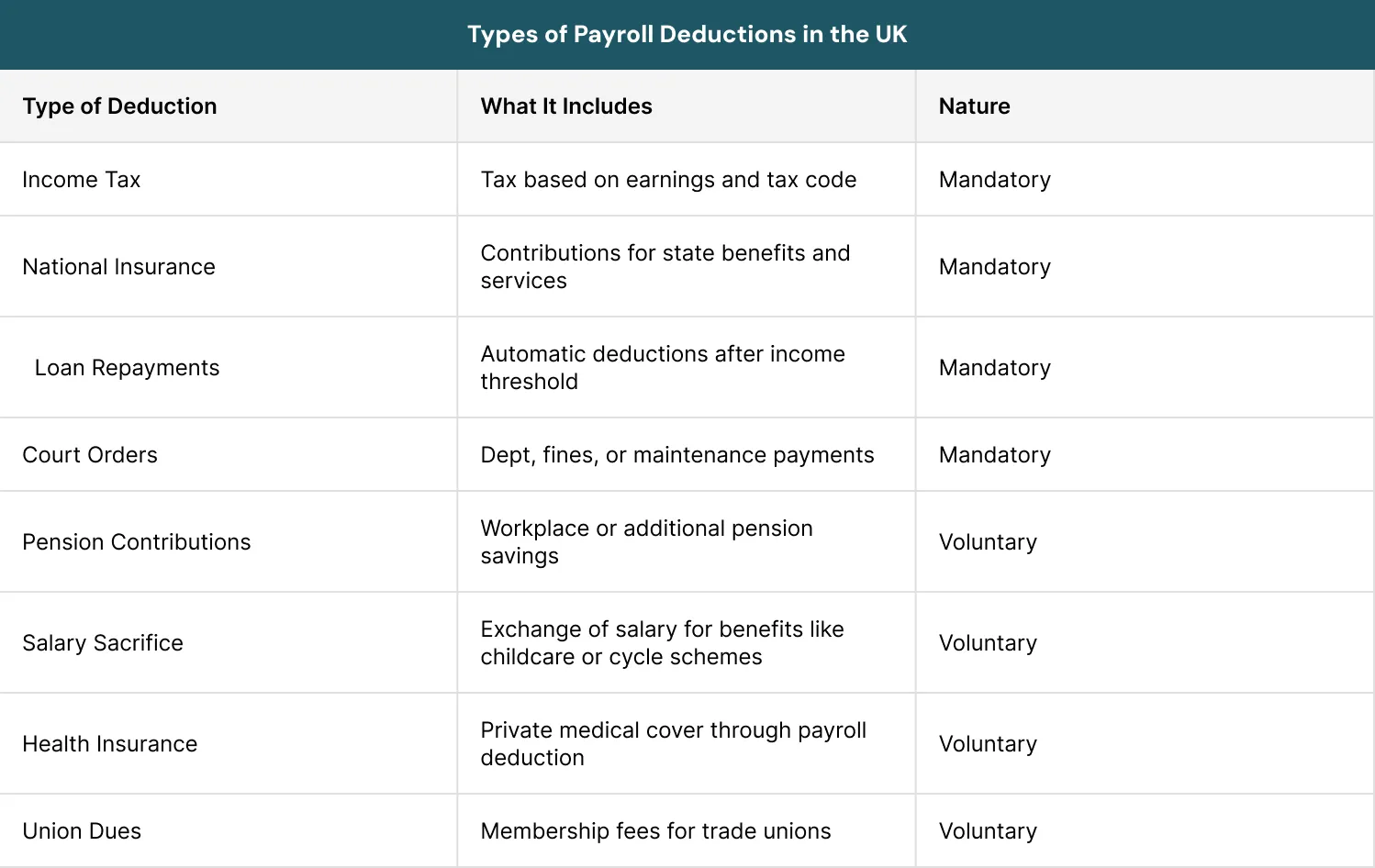
What Are the Types of Payroll Deductions in the UK
They can be categorised into two different categories.
1. Mandatory Deductions
These deductions from pay in the UK are mandatory by law and must be made by all employers.
The deductions are:
- Taxes on income
- National Insurance Contributions (NICs)
- Student loan repayments
- Court-ordered deductions (e.g., debt repayment or maintenance payments)
These are mandatory deductions and are the core of the UK payroll system.
2. Voluntary Deductions
These deductions are not mandatory and are based on the employee’s consent.
These are:
- Pension contributions
- Health insurance
- Union dues
- Salary sacrifice
What Are Mandatory Payroll Deductions
Let’s take a look at the most vital payroll deduction.
1. Income Tax
Income tax is one of the biggest deductions from the salary in the UK. Salaries below the personal allowance level are not subject to tax. Tax is charged according to their income brackets. This way, the richer people pay more and the poorer people pay less.
2. NICs
Services that are vital are financed by National Insurance.
They include:
- Pensions from the state
- Healthcare system
- Benefits for mothers and sick workers
Both employees and employers make contributions under the PAYE system.
3. Student Loan Repayment
In case the employee has taken a student loan, they will have to pay it back automatically once they cross a certain salary limit. This is why most students usually become aware of such deductions once they start working full-time.
4. Deductions Ordered by the Court
The courts may require the employer to deduct money for:
- Payment of debt
- Child support
- Fines
How Employers Handle Payroll Deductions
Employers have a vital part to play in ensuring deductions are correct.
They must:
- Use the right tax codes
- Use PAYE
- Provide data to HMRC
- Make sure workers aren’t underpaid
Businesses often use payroll and accounting services to help manage payroll calculations, reporting and compliance requirements. It is equally vital for firms to learn about the process of payroll deductions in the UK.
Read more: The Complete Guide to Payroll Management
How to Calculate the Payroll Deductions?
The process is the same for calculating payroll deductions, which is used throughout the UK payroll system. So, the amount will vary depending on your salary and other personal situations.
To understand this process correctly, you have to know your gross salary first.
Taxable income is calculated based on your earnings and tax rules. Once your income exceeds the threshold, you will make payments for your National Insurance contribution. In case you have any student loans, you will make payments for student loans at a fixed rate based on your income, which exceeds the threshold.
You also pay for additional amounts like pension contributions, healthcare and trade union membership fees, depending upon your arrangements.
What Are the Common Mistakes to Avoid in Payroll Deductions in the UK
Even though there is an automatic processing of salary deductions in many firms, there is always a possibility of an error. This can cause financial inaccuracies, legal violations or confusion among workers. So, it is essential to understand typical mistakes in salary deductions in the UK.
Consider the most frequent errors associated with the process of deduction in the UK.
1. Incorrect Tax Codes
Among the most widespread mistakes in salary deductions in the UK, there are cases where incorrect tax codes were used. The tax code refers to the numerical figure that determines the amount of tax that will be deducted from the salary.
The mistake that will happen in using the tax code is that people will get taxed too much or not enough.
This implies that it is crucial to always ensure that the codes are updated with the help of information from HMRC. At the same time, employees can check whether the amount of tax deducted from their pay slip seems unusual.
2. Ignoring National Insurance Thresholds
However, NICs are subject to particular income levels, which means that a misinterpretation of these figures may lead to deductions being calculated incorrectly.
This is because if an employee’s income is below the threshold, then no deduction for National Insurance will take place; however, if the system does not update these figures correctly, the deduction will occur. This is the reason why a basic knowledge of how salary deductions work could help both employers and employees make fewer mistakes.
3. Miscalculation of Student Loan Repayments
The repayments of the students’ loans are made in accordance with the repayment plan, which sets out thresholds and rates.
One mistake which may happen when processing students’ loan repayments is selecting the incorrect repayment plan or making repayments sooner than required. Also, the employer might not receive relevant notifications about the need to stop or start the student loans deduction.
4. Misunderstanding Salary Sacrifice Schemes
The salary sacrifice scheme is where employees sacrifice some of their salary for the benefits of the workplace, like the pension schemes and child-care support.
There are ways through which salary sacrifice reduces the amount of income that is taxable; however, care needs to be taken.
Employees may sometimes presume that all the benefits received will lower their tax bill; this does not always apply, all the time owing to recent legislation.
The salary sacrifice can have an effect on the overall salary received, depending on whether it is not well managed and can even interfere with one’s eligibility for receiving other perks such as statutory payments and pensions.
5. Failure to Review Payslips Consistently
Most employees depend entirely on the payroll system, meaning that they never go through their payslips properly.
The payslip contains all the deductions from salary in the UK. Such includes the tax paid, pension, national insurance and other deductions. Employers need to ensure that they make it clear to their employees what the deductions are.
6. Lack of Proper Payroll Systems
Manually managed payroll systems are vulnerable to errors made by the personnel involved in calculating deductions. Without any systems for controlling these actions, the processes will likely be inconsistent.
Modern payroll systems automate deduction processes and help comply with the new requirements. They also make it easier to provide reports for HMRC.
It becomes more important as payroll and the additional deductions become more complex.
7. Not Staying Informed about Legal Requirements
The regulations on running payroll are regularly amended in the UK. This requires employers to stay abreast of changes in order not to fall foul of the law.
Tax band changes or National Insurance rates can affect payroll and the calculation of relevant sums. Such information is crucial to staying compliant.
This will protect both employees and employers under the legislation.
What Is a Typical Payslip Breakdown in the UK
A payslip provides a clear breakdown of salary deductions in the UK.
A typical payslip will include:
- Gross pay
- Tax deductions
- National Insurance
- Pension contributions
- Deductions (if any)
- Net pay
In other words, if your gross salary is £2,500, there might be some deductions for tax, National Insurance and pension contributions before you get your final pay. And that is precisely why your final pay will always be less than the contract amount.
Real Life Example of Payroll Deductions System
We will look at an example from our practical experience, in which we will be able to see how the system works.
Let’s say there is a case of an employee who is earning £3,000 monthly.
In the above salary,
- The income tax is charged
- The national insurance charge is made
- The student loan charge is added
- The pension charge is made
- And even some optional benefits, such as insurance, might be considered
All these charges will be made from the gross salary and the employee will receive his or her net salary.
Why Are Payroll Deductions Becoming More Complex
UK payroll processes have seen great development over time.
In the olden days, deductions would only be made for taxes and National Insurance purposes. Now, employees may experience:
- Student loan repayments
- Auto-enrollment pensions
- Salary sacrifices
- Employee benefits
- Deductions ordered by the court
All these factors combine to make pay deductions quite complicated in the UK. Thus, most firms now utilise payroll software to avoid mistakes.
What Is the Disagreement Regarding a Payroll Deduction
In some cases, employees may realise that deductions from pay in the UK are made, yet they do not know the reason behind these deductions.
The first thing to do is always communicate. Workers should talk informally with their employer about why the salary deduction occurred.
In case this does not help, workers may lodge a formal complaint. This will allow the employer to conduct an official investigation.
In case of unresolved disputes, workers may take the case to an employment tribunal under unlawful deduction or breach of contract.
Moreover, there are strict deadlines here too. In most cases:
- A single deduction should be reported within 3 months minus 1 day
- Deductions made several times should be calculated from the latest occurrence
- Sometimes, when deductions take place over a period of time, the claim period can be for as long as 2 years.
These regulations provide justice for all deductions from salary in the UK.
What Happens When You Leave a Job
Payroll deductions will not necessarily stop once employment comes to an end.
In almost all instances, the employee is entitled to get their entire wages up until their last day at work. Nevertheless, the employer is allowed to make:
- Loans owed
- Overpayments
- Repayments contracted
There might be occasions where several deductions can be made in one final payment because there are outstanding balances.
That is why it is important to know about salary deductions in the UK even after employment ends.
How Payroll Deductions Are Reported to HMRC
However, payroll is not only concerned with making deductions from salaries in the UK but also with the proper reporting of these deductions. In the UK, employers have to make proper reports of their payroll information to HM Revenue and Customs through the Pay As You Earn (PAYE) scheme.
A Full Payment Submission (FPS) has to be submitted by the employer:
- Before the payday
- Containing the details of the salary
- With all the deductions
Payroll reporting is usually handled through payroll software or professional payroll support services to help maintain accurate records and submissions.
Important Detail
Payroll reporting is equally as important as payroll accounting. Payroll errors in reporting will impact tax reporting, pension contributions and employee benefits.
What Is the Role of Salary Sacrifice in Payroll Deductions
The salary sacrifice may lower one’s tax liability, but it needs to be handled carefully. It is not allowed to bring salaries below the National Minimum Wage and it has to be planned ahead.
Examples of salary sacrifice may include:
- Pension payments
- Cycle-to-work programs
- Childcare assistance
This makes it an essential aspect of modern salary deduction systems in the UK.
What Are the Legal Protection for Employees
The UK law offers comprehensive protection from unfair payroll deductions.
The employer needs to ensure that:
- The deductions are legal
- The employees are notified beforehand
- The payslip reflects all the deductions
- Minimum wage standards are followed
The unlawful deduction may become grounds for legal action and monetary punishment. Thus, the UK deductions from pay are transparent and justifiable.
Conclusion
Payroll deductions play a vital role in how salaries are calculated in the UK. Whether it is taxes and NICs or pensions and any other deductions that may be negotiated, payroll deductions help in ensuring that the employee receives their pay without issues and that public services are adequately funded.
Knowing how payroll deductions are made helps both the employee and the employer to make sure that everything is done within the law.
At Sterling Cooper Consultants, we specialise in payroll management, accounting and compliance, helping firms navigate all these issues with ease. If you need help with payroll or compliance, you can contact us for expert assistance.
Tired of dealing with payroll deduction issues and UK compliance requirements?
Get in touch with Sterling Cooper Consultants today and gain expert advice regarding payroll and business management and we will help you comply with all the required regulations.
FAQs
Deductions from salary in the UK include Income Tax, National Insurance and student loan repayments. Some voluntary deductions like pensions, insurance and union fees may also apply. These are taken before you receive your net pay.
Income tax depends on your earnings and tax band. Most people pay 20%, 40%, or 45% based on income levels. The exact amount varies according to your tax code and personal situation.
Payroll deductions work by subtracting required or voluntary amounts, such as tax, National Insurance, pensions, or benefits, from an employee’s gross pay before they receive their final salary.
You can calculate your payroll deductions by subtracting taxes, National Insurance, pension contributions, and other deductions from your gross salary to find your net pay.
A £100,000 salary typically results in around £65,000 to £67,000 take-home pay. This includes deductions for tax and National Insurance. The exact amount depends on pensions and other deductions.
Recent Posts