Posted by:
Admin
Date:
May 12, 2026
Category:
blogs
The Ultimate Guide to Small Business Taxes
Are you excited to run a small business in the UK but don’t know the details of its tax system? Most small businesses focus on daily operations, clients and progress. However, it is important not to overlook tax duties.
Small business taxes in the UK are the various costs imposed by the government. These fees apply to profits, earnings, sales and jobs. In general, this consists of business rates, national insurance, VAT, income tax and corporation tax.
In 2025, the UK private industry had about 5.7 million businesses. 5.64 million of them were small enterprises with 0–49 workers. This means that nearly 99% of UK businesses are classified as small. This detail also clarifies that for the UK economy, small business and taxes are so important.
For instance, when sole traders earn profits, they have to pay income tax on them. However, limited companies have to pay corporation tax on the revenue of the company. This points out the vital role of business tax for small business in the UK economy.
According to HMRC policies, all businesses must keep correct records and file their taxes on time. If you do not pay all the taxes on time, this will result in cash flow pressure, interest charges and penalties.
Learning about your tax obligations early allows you to plan more wisely. Also, you will sell your services in a more effective way and will avoid hassle later.
In this blog, you will explore the workings of small business and taxes in the UK. You will also know what you have to pay and how to keep yourself in compliance.
Key Takeaways
- Small business tax rules depend on your business structure, profit level, and HMRC filing duties
- Business tax for small business owners may include VAT, Income Tax, National Insurance, and Business Rates
- Small business corporation tax applies to limited company profits after allowable expenses and reliefs are deducted
- Small business company tax becomes easier to manage with good record keeping and digital accounting software
- Small business and taxes are easier to handle when you understand deadlines, compliance rules, and tax-saving options
What Is Small Business Tax in the UK?
Business tax for small businesses involves HMRC collecting payments on the income, profits and sales. The aim of this policy is to make contributions to the public services like pensions, facilities and healthcare.
No matter how small a business is, it is impacted by tax laws. The primary concern is that the tax is neither flexible nor optional. It follows exact deadlines and structured reporting systems.
You must remember it; otherwise, you will get penalties promptly. Thus, it is not just compliance that makes you understand your tax responsibility.
Therefore, knowing your tax duties is more than just compliance. It means that you have to protect your business from financial risk and keep it stable for a long time.
Knowing small business and taxes is vital to staying compliant and preventing unneeded economic fines.
Small business taxes are not only about staying compliant. They are about building a business that can grow with confidence, manage cash flow wisely, and stay prepared for change.
Sarah Mitchell, UK Small Business Tax Adviser
What Business Structures Impact Small Business Tax?
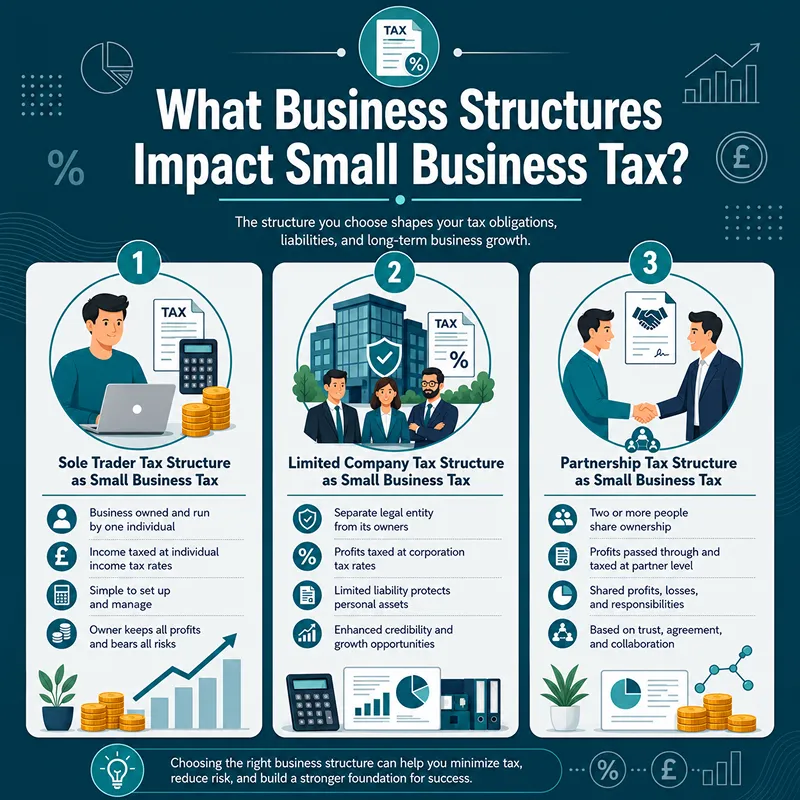
For the system of your tax, a business structure is the basis for it. This framework must decide which form to submit and how to pay taxes. Also, it tells how profits are handled.
Each business structure has different levels of difficulty and duties. You should select one that greatly affects your workload and compliance obligations. These rules are explained below:
1. Sole Trader Tax Structure as Small Business Tax
Most of the small business tax examples are sole traders. Legally, you and your business are the same entity.
In other words, you use self assessment to pay tax on your business profits. On the basis of those points, you also pay national insurance.
Between business and personal financial affairs, there is no separation. Although this provides full authority, this also means that you must be responsible for any tax that is due.
When your earnings become more than your personal allowance, tax becomes payable. This is why it is so important to keep records from the very beginning.
2. Limited Company Tax Structure as Small Business Tax
In legal terms, a limited company is separate from its owner. This setup results in a distinct tax structure.
The company has to pay the corporation tax on its earnings. Directors usually receive income through a mix of salary and dividends.
Dividends are taxed through self-assessment, while salaries are taxed via PAYE. In many cases, this structure offers more tax planning choices.
However, in comparison to sole traders, it also needs compliance work, accounts setup and more reporting.
Learn more about dividends: The complete guide to UK dividend tax
3. Partnership Tax Structure as Small Business Tax
Two or more individuals share ownership of the company in a partnership. The earnings are divided among all the partners.
Each member is liable for national insurance and income tax on their portion of profits. All this is carried out by means of self assessment.
The partnership itself also registers separately with HMRC. To prevent conflicts concerning profit distribution and tax responsibility, it is important to have clear contracts.
What Is Small Business Corporation Tax?
Whatever expenses limited companies incur, they pay corporation tax on their profits. Profits are determined by taking out salaries, costs and allowances from income.
On the other hand, sole traders do not have to pay corporation tax. They self assess this tax and give their report to HMRC.
Corporation Tax Rates and Thresholds
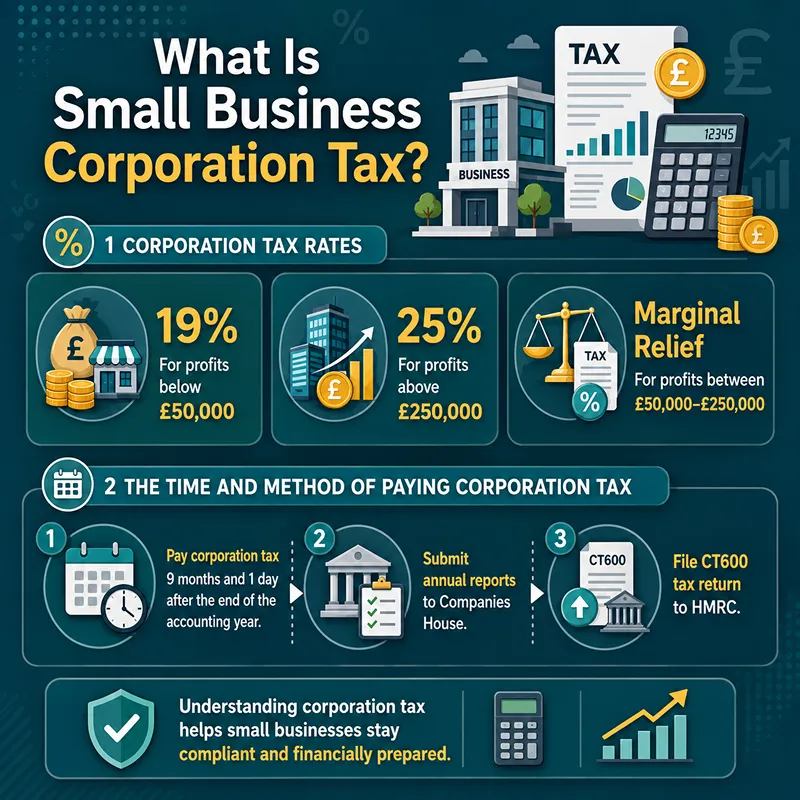
The rate of corporation tax relies on the profit levels. For small business tax, it includes:
- 19% for little profits (lower than £50,000)
- 25% for profits more than £250,000
- A range of £50,000–£250,000 utilises marginal relief
This system ensures that the fair tax increases as profit increases.
The Time and Method of Paying Corporation Tax
Corporation tax is paid 9 months and 1 day after the end of the accounting year. Companies need to file:
- Annual reports to Companies House
- Tax return to HMRC (CT600)
You can use the online platform of HMRC accounts to make payments. You must not wait for a bill; you need to calculate and pay taxes on time.
Important Detail
Even if your limited company makes no profit, you may still need to file a company tax return unless HMRC confirms your business is dormant.
What Counts as Taxable Profit?
Taxable profit is the profit on which tax is calculated. It is found by subtracting allowable expenses, salaries and tax reliefs from total income.
It may include many expenses, such as:
- Workers pay
- Rent
- Equipment
- Marketing expenses
This decreases the overall amount of taxes due.
What Is Small Business Income Tax?
Profits derived from dividends, salaries and business profits are subject to income tax. It only comes into play if you earn more than £12,570 a year. Also, income tax is payable by sole traders and company directors similarly.
Personal Allowance and Tax Bands for Small Business Tax
A tax-free personal allowance of £12,570 is permissible in the UK. After that, income is taxed according to bands.
Moreover, higher income means more costly rates of tax. This process is applicable to workers, sole traders and directors.
Self Assessment System for Small Business Tax
Income is reported and taxes are figured out using self-assessment.
You must do the following:
- Sign up with HMRC
- Obtain a Unique Taxpayer Reference (UTR)
- File tax return annually
The due date is 31 January each year. Thus, if you did not submit on time, it will result in penalties.
Income Tax for Directors vs Sole Traders
Sole traders must pay tax on profits. On the other hand, directors must pay tax on:
- Salary through PAYE
- Dividends through self assessment
However, both should report their earnings every year to HMRC.
What Are NICs for Small Business Tax?
With the help of national insurance, public services and pensions are funded. This rule is the same for self-working people, employers and employees. The amount that they should have to pay depends on their status and earnings.
Employee NICs for Small Business Tax
Class 1 NICs are paid for by employees.
They must make payment for the following:
- 12% on income below the lower limit
- 2% on earnings above
It’s taken out by default through PAYE.
Employer NICs for Small Business Tax
Employers must also pay NICs on the salaries of the staff. They pay about 13.8%-15% more than the lowest possible earnings. For recruiting staff, this is an added expense.
Self-Employed NICs for Small Business Tax
The people who are self-employed must pay:
- Class 2 NIC (if eligible, flat rate)
- Class 4 NIC (according to the profit)
Self-employed workers use self assessment to calculate and submit NICs.
What Is VAT for Small Business Tax?
Value added tax (VAT) is a UK consumption tax applied to goods and services, which businesses collect from customers. Firms then pay this VAT to HMRC, while reclaiming VAT on their own business transactions.
VAT is a tax added to most products and services in the UK. Companies pay VAT to HMRC after collecting it from clients. On business transactions, they can also claim back VAT.
VAT Threshold and Registration Rules
In the following cases, you must sign up for VAT:
- When turnover goes above £90,000 in 1 year
- Or if it is expected within 1 month
To reclaim VAT, you can also sign up free of charge.
VAT Rates in the UK
The rates of VAT consist of:
- 0% no rate
- 5% lower rate
- 20% standard rate
VAT Returns and Making Tax Digital (MTD)
VAT is paid to HMRC on a three-month basis. You must file your taxes online through approved software. Paying taxes in this way is called making tax digital (MTD). If you did not pay VAT on time, you will have to pay fines ahead.
Related: Complete guide to VAT accounting schemes
What Are the Business Rates for Small Business Tax?
The taxes made on commercial properties are business rates. They are applicable to:
- Factories
- Warehouses
- Offices
- Shops
Home businesses might not always pay them.
When Business Rates Apply
If you have to use other than residential property, you have to pay business rates. You can be exempted if you work from home. However, in some cases exceptions apply, such as:
- Clients visit regularly
- Property is designed specifically for business
- Employees work from home
Business Rates Relief for Small Business Taxes
The business tax for small business relief is accessible to companies. However, this relies on usage and property value. Some businesses have to pay lower charges or nothing at all.
What Are Other Small Business Taxes?
There are also some extra charges that small businesses might have to pay, depending on the activity.
Capital Gains Tax
Small businesses may have to pay capital gains tax if they sell business assets for profit. The things involved in it are equipment, shares and real estate. Tax relies on the earnings, after expenses are taken out.
Stamp Duty Land Tax
This is another form of business tax for small business which is paid when purchasing land or property. This amount depends on the type of property and value.
Industry-Specific Taxes
There are many industries that pay additional taxes, such as:
- Gambling tax
- Tobacco tax
- Alcohol tax
All these taxes are imposed through controlled sectors.
What Are Small Business Tax Registration and Deadlines?
The due dates for your small business and taxes are according to the type of your business.
Self Assessment Registration
Once you start trading, register the self assessment by 5 October. Each year, you must file your tax return by 31 January.
Corporation Tax Registration
Within 3 months of trading, limited companies must register for corporation tax.
VAT Registration
When turnover increases above £90,000 or is voluntarily reported sooner, you must register for VAT.
What Is Making Tax Digital (MTD) in Small Business Tax?
The digital tax system of HMRC is called MTD. With the help of this, businesses can keep online information safe. Use its software to submit the tax returns.
What MTD Means
This system has replaced the paper details with online systems. With the help of this updated system, accuracy has improved a lot and errors have been reduced.
Who Must Follow MTD
The businesses that are already registered with VAT must already follow it. Over time, an income tax MTD is set up.
Allowable Business Expenses for Small Business Tax
With the help of allowable expenses, businesses can lower their taxes.
Common Allowable Expenses
Some of the common allowable expenses are as follows:
- Equipment
- Supplies
- Staff salaries
- Marketing
- Travel
- Office costs
These costs decrease the taxable profit.
Tax Reliefs and Allowances
Businesses might claim the following:
- Investment allowances
- R&D relief
- Pension contributions
These allowances minimise corporation tax.
Importance of Record Keeping
It is vital to keep records and receipts safe. The reason is that you can take help from these invoices in case of need. All the crucial information is written over it.
Compliance and Penalties for Small Business Tax
Compliance with all legal regulations is referred to as HMRC. With the help of this, you can lower the risk of penalties and legal issues.
Common Compliance Areas
Its main areas are as follows:
- Health & safety
- AML regulations
- Data safety
- Employment law
- Tax laws
Results of Missing Deadlines
It’s important to file on time because, in case of delay, you may face the following:
- Legal action
- Fines
- Interest charges
What Are the Tips for Managing Small Business Tax?
You can make your tax system easy if you plan properly. Some effective tips are given below:
Budgeting for Tax Payments
For tax bills, keep some money safe and don’t spend it on other expenses. With the help of this strategy, you will not encounter cash flow problems.
Quick Tip
Set aside money for taxes every month instead of waiting for deadlines. This helps you avoid cash flow problems when VAT, self-assessment, or corporation tax payments are due.
Using Accounting Software
You can use some accounting software, such as QuickBooks and Xero. These tools are very helpful in lowering mistakes and they are time-saving too.
Hiring an Accountant.
If you hire an accountant for your tax-related matters, it will reduce risk and stress a lot. An accountant is very helpful in:
- Compliance
- Filing returns
- Tax saving
Case Study: An Improved Tax Management Helped a Rising Small Business
A developing hospitality business in the UK had roughly 50 workers. They had difficulty with tax management and VAT reports after low assistance from their prior accountant.
The company had ignored many VAT claims and did not know much about financial education. Also, they did not understand the relief of available taxes.
The business introduced an improved financial organisation and regular reporting to enhance the situation. Also, it set up a more structured VAT process.
This way, the company paid VAT returns on time and reclaimed overlooked tax reliefs. In addition, got a clearer and more open awareness of its finances.
As a result, the company lowered its tax burden and improved compliance. The business becomes able to manage cash flow and economic planning.
This real-life example reveals that when the tax management is organised and the record keeping is correct, it can support lasting business growth.
Final Thoughts
Once you understand the basics of UK small business tax, they become easier to manage. However, at the start, they seem to be complicated. Business rates, national insurance, VAT, corporation tax and income tax all rely on your business income and structure.
For instance, limited companies and sole traders follow different due dates and tax rules. Also, HMRC wants businesses to keep up-to-date online details and stay compliant all year.
However, if you plan properly and record correctly, businesses can avoid fines and handle cash flow more smoothly.
Paying HMRC does not mean that you are aware of taxes; rather, it is all about managing a stable and profitable business.
At Sterling Cooper, we know the worth of practical and clear business instructions. Contact us today if you want to learn more about enhancing your business skills and staying up to date.
Struggling to keep up with small business taxes and HMRC deadlines?
We help businesses understand complex topics with clear, practical guidance and reliable support. We have helped many businesses stay informed and organised.
FAQs
Small business corporation tax is the tax limited companies pay on their taxable profits. In the UK, the rate depends on profit levels, with smaller businesses often qualifying for the lower Corporation Tax rate.
Small business company tax usually includes Corporation Tax, VAT, PAYE, and National Insurance responsibilities. Limited companies must report profits to HMRC and file tax returns within the required deadlines.
Self-employed people can reduce higher-rate tax by claiming allowable expenses and making pension contributions.
Keeping profits below the higher-rate threshold may also help reduce tax liability. However, tax planning should always follow HMRC rules and reporting requirements.
The 60% tax trap happens when people earning over £100,000 start losing their personal allowance.
This creates a much higher effective tax rate on income between £100,000 and £125,140. Pension contributions and salary planning may help reduce the impact.
Small business tax is usually calculated based on profits after allowable expenses are deducted.
The type of tax depends on your business structure, such as a sole trader or a limited company. You must also consider VAT, National Insurance, and any applicable reliefs or allowances.
Recent Posts
How to Build a Cash Reserve for Business Stability
August 11, 2026
How to Forecast Cash Flow During Economic Uncertainty
August 6, 2026