
Posted by:
Admin
Date:
September 2, 2026
Category:
blogs
When Should a UK Business Outsource Bookkeeping Services?
Bookkeeping is one of those tasks that can seem manageable when a business is small. A few invoices need recording, bank transactions need checking and receipts need filing. But as the business grows, these tasks can quickly take up more time and become harder to manage accurately.
This raises an important question. When should a UK business outsource bookkeeping services?
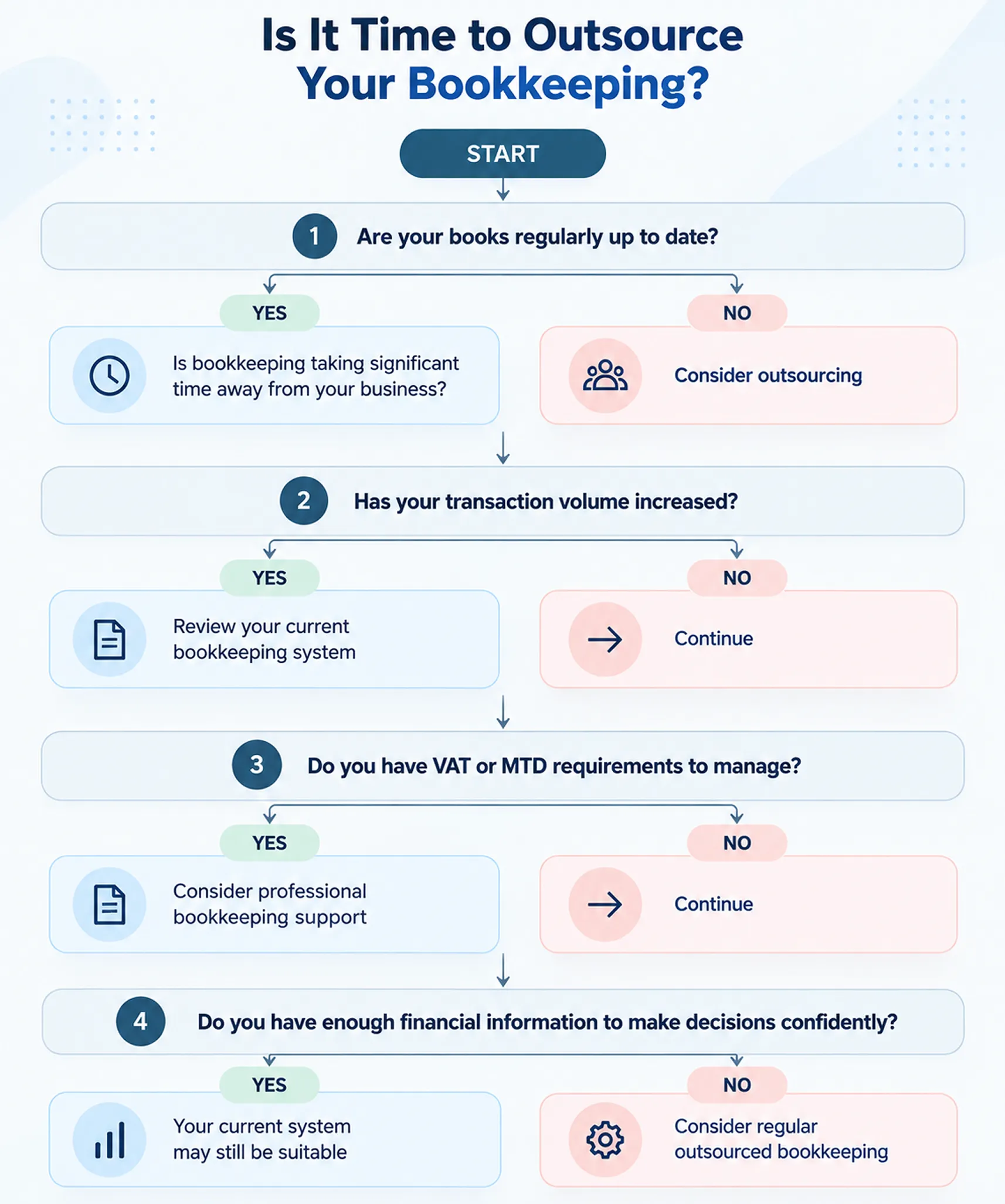
The answer is not based on turnover alone. A business may need support when its records are regularly behind, financial administration is taking time away from running the business or VAT and Making Tax Digital (MTD) requirements are becoming harder to manage.
For some businesses, outsourcing provides a more reliable way to keep records up to date without hiring a full-time bookkeeper.
Key Takeaways
- Falling behind with bookkeeping can be a sign that it is time to outsource.
- Growing transaction volumes can make in-house bookkeeping harder to manage.
- VAT and MTD requirements can increase the need for accurate, timely records.
- Outsourced bookkeeping services can save business owners time and reduce routine financial administration.
- You can outsource bookkeeping without giving up oversight of your business finances.
- The right time to outsource depends on your workload, the complexity of your finances and your business needs.
What Does Outsourced Bookkeeping Involve?
Outsourced bookkeeping means paying an external professional or firm to manage some or all of your day-to-day bookkeeping.
The work can include recording sales and expenses, reconciling bank accounts, managing invoices, tracking payments and preparing financial information for your accountant. Depending on the provider, bookkeeping services may also include VAT support, payroll processing and management reports.
The exact service can be tailored to your business. A small sole trader may only need help with monthly bookkeeping, while a growing limited company may need regular transaction processing, bank reconciliations, VAT records and management information.
Outsourcing does not necessarily mean handing over every part of your financial administration. You can choose the tasks that need professional support while retaining control of your business finances.
When Should You Outsource Bookkeeping Services?
There is no single point at which every UK business should outsource its bookkeeping. However, several signs can indicate that your current approach is no longer working effectively.
1. Your Bookkeeping Is Always Behind
If invoices, expenses and bank transactions are regularly left unrecorded for weeks or months, this is one of the clearest signs that you may need additional support.
Out-of-date records make it harder to understand how your business is performing. You may see money in the bank but still have unpaid invoices, upcoming bills or tax liabilities that are not reflected clearly in your day-to-day financial records.
HMRC requires businesses to keep accurate records that support their tax reporting obligations. For self-employed individuals, these records must cover income, expenses and relevant VAT and PAYE information. The requirements vary according to the type of business and its circumstances. You can find further details in the official GOV.UK guidance on business records for self-employed people.
Outsourcing can help establish a regular bookkeeping process, keeping records updated rather than allowing them to become another task to catch up on.
Tip
Bookkeeping is more useful when it is kept up to date throughout the year. Regular records can give you a clearer view of cash flow, outstanding payments and business performance rather than leaving everything until the end of the financial year.
2. Bookkeeping Is Taking You Away From the Business
Business owners often start by doing their own bookkeeping because it appears cheaper than paying someone else.
This can work when transaction volumes are low. The problem arises when bookkeeping starts taking hours that could be spent on customers, sales, staff or business development.
Professional accounting support can help business owners spend less time on routine financial administration and more time on other areas of their business.
If you regularly find yourself spending evenings or weekends dealing with invoices, bank reconciliations and financial records, it may be worth calculating how much that time is costing your business.
Outsourcing may be a practical option if the time you spend on bookkeeping is affecting your ability to manage operations, serve customers or grow the business.
3. You Are Struggling With VAT Deadlines
VAT registration can add another layer of financial administration.
VAT-registered businesses must follow digital record-keeping requirements under Making Tax Digital for VAT. Certain VAT records must be kept digitally using compatible software, and businesses must use compatible software to submit their VAT returns.
This does not mean every VAT-registered business needs outsourced bookkeeping. However, if preparing VAT information creates regular deadline pressure or you are unsure whether transactions have been recorded correctly, professional support can make the process easier to manage.
Keeping records accurate and up to date throughout the VAT period can also reduce the pressure of preparing a return at the last minute.
4. Your Business Is Growing Quickly
Growth can turn bookkeeping from a simple monthly task into a much larger process.
You may have more customers, suppliers, invoices, expenses and payment methods to reconcile. An online retailer, for example, may need to match sales across different platforms. A business taking on employees may also have payroll records to manage.
At this stage, the issue is not necessarily that bookkeeping has become more difficult. It may simply be that the volume of transactions has increased beyond what your existing process can comfortably handle.
Outsourcing bookkeeping services can give a growing business access to regular financial support without immediately creating a full-time bookkeeping role.
5. You Need Better Financial Visibility
Bookkeeping should do more than record what has already happened. Accurate records give you information that can help you understand how your business is performing.
If you only check your bank balance to see whether the business is doing well, you may be missing important information.
For example, your business may have a healthy bank balance because several customers have recently paid their invoices. At the same time, large supplier bills or tax payments may be due soon.
Up-to-date bookkeeping can help you see income, expenses, outstanding payments and cash movements more clearly. This information can support better decisions about spending, payment terms and future commitments.
6. You Are Preparing for Making Tax Digital
Making Tax Digital is another reason some businesses may decide to outsource their bookkeeping.
From 6 April 2026, Making Tax Digital for Income Tax applies to sole traders and landlords with qualifying income above £50,000. The threshold is due to fall to above £30,000 from April 2027 and above £20,000 from April 2028.
Those within scope must use compatible software to create and maintain digital records of relevant income and expenses and send quarterly updates to HMRC. The requirements apply to qualifying self-employment and property income, rather than automatically applying to every business.
For a business owner who has always managed records manually, this can be a good time to review the current bookkeeping process. You can find further information in the official GOV.UK guidance on choosing software for Making Tax Digital for Income Tax.
You do not have to outsource simply because MTD applies to you. However, if the new requirements add work that you do not have the time or confidence to manage, outsourcing may be worth considering.
What Bookkeeping Tasks Can You Outsource?
The scope of outsourced bookkeeping services can vary depending on your business and the provider you choose. Common tasks include:
- Recording sales and purchase transactions
- Reconciling bank and credit card accounts
- Raising and recording invoices
- Recording business expenses
- Monitoring accounts payable and receivable
- Preparing information for VAT returns
- Providing payroll support
- Maintaining digital accounting records
- Producing regular financial reports
- Preparing information for year-end accounts
You can choose to outsource all these tasks or only the areas that are creating the most pressure.
For example, a business owner may continue to raise customer invoices but outsource bank reconciliation and monthly bookkeeping. Another business may need more comprehensive support with transaction processing, VAT records and regular financial reporting.
The most suitable arrangement depends on the work you need help with, the complexity of your records and the level of oversight you want to retain.
Case Study of a Small Digital Business Spending Three Hours a Day on Record-Keeping
HMRC researched how digital technology businesses managed their financial records. One small digital media and entertainment business used Xero for bookkeeping but also relied on a spreadsheet to track sales, performance against projections and profit margins.
The owner was spending around two hours a day on record-keeping and another hour updating the spreadsheet. As sales increased, the administrative burden was expected to grow. The owner was considering paying an external accountant to take over the record-keeping.
This example shows how bookkeeping can become increasingly time-consuming as a business grows, even when accounting software is already in place. It also highlights the importance of considering the time spent maintaining separate records and spreadsheets when deciding whether to outsource.
Conclusion
There is no fixed turnover or business size at which outsourcing bookkeeping becomes necessary. The more useful question is whether your current system is still working for your business.
If records are falling behind, financial administration is taking too much time or VAT and MTD requirements are becoming harder to manage, outsourcing may be a sensible next step.
Good bookkeeping gives you a clearer view of your business and helps keep important financial records accurate and up to date. The right time to outsource is often before bookkeeping becomes a serious problem rather than after it has already started affecting your business.
Need Help With Your Bookkeeping?
If you are spending too much time on bookkeeping or are unsure whether your business needs additional support, get in touch with Sterling Cooper Consultants.
Our team can discuss your bookkeeping needs and help you find the right level of accounting and bookkeeping support for your business.
FAQs
Yes, outsourcing bookkeeping can be worthwhile if financial administration is taking too much of your time or your records are becoming difficult to manage. It can also provide regular support as your business grows. Whether it is cost-effective depends on the amount of work involved, the cost of the service and the time you could otherwise spend running your business.
A small business should consider outsourcing when bookkeeping is regularly behind, transaction volumes are increasing or the owner no longer has enough time to manage the records properly. It may also be worth considering when tax reporting requirements become more demanding.
Yes, you can outsource routine bookkeeping while retaining oversight of your business finances. You can still review reports, monitor cash flow and make key financial decisions. Agreeing on responsibilities and reporting arrangements with your provider can help you maintain visibility of your finances.
Yes, bookkeeping services can help maintain the digital records needed for Making Tax Digital when the provider has the relevant software and expertise. The work required depends on whether MTD applies to your business and which services the provider offers. You should confirm the scope of support before engaging a provider.
No, VAT registration does not automatically mean you need outsourced bookkeeping. However, VAT-registered businesses must meet digital record-keeping and filing requirements under Making Tax Digital for VAT. Professional support may be useful if managing these records and deadlines is becoming difficult.
Not always. Outsourcing can be useful when you need regular bookkeeping support but do not have enough work to justify employing someone in-house. Hiring an in-house bookkeeper may make more sense when the business has a large and consistent finance workload or requires someone to manage financial administration on a daily basis.
Recent Posts