

Posted by:
Admin
Date:
April 1, 2026
Category:
blogs
The Complete Guide to Payroll Management
Did you miss a payroll deadline or make a pay error recently?
People expect their pay to arrive on time and without any slip ups. A single mistake is enough to trigger fines, which can be a headache for everyone involved. This is where proper payroll management becomes important.
Pro Tip:
The right approach today can prevent costly issues tomorrow.
Many directors think payroll processing is just about salaries. In reality, it involves tax rules, reporting, compliance and accurate records. Payroll becomes more complex and harder to manage when the business grows.
Employers can face penalties of up to £400 per month under UK Government rules. This depends on the number of employees and if payroll reports are submitted late under Real Time Information (RTI). This shows how small delays can quickly become costly problems.
In this blog, you will learn:
- What is payroll management
- Why payroll management is important
- What are payroll management problems
- How payroll processing works
- What documents are required for payroll management
- What are payroll management costs in the UK
- What are the risks and limitations of payroll
What Is Payroll Management?
Payroll management means handling employee pay, tax and deductions in the right way. It makes sure staff are paid on time and in the right amounts.
It covers wages, bonuses, tax deductions, pensions and reporting to HMRC. It also includes record keeping and compliance.
Payroll keeps your employee payments accurate, organised and legally compliant.
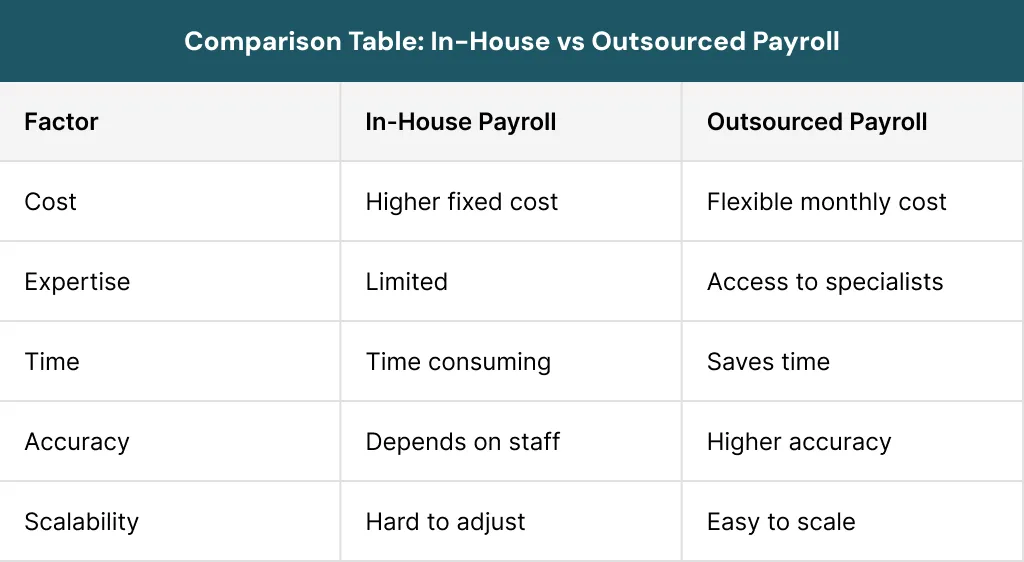
In-House and Outsourced Payroll
In-house payroll suits those businesses that have a low number of employees. Outsourcing is popular for businesses that need flexibility or do not want the headache of payroll processing. Some companies keep payroll processing in-house, while others choose to outsource. Factors that decide which system to use are:
- Cost
- Expertise
- Time
- Accuracy
- Scalability
Why Payroll Management Is Important for Businesses?
Payroll matters not just for your team, but for your business too. Accurate and timely pay keeps your staff happy and it keeps things running smoothly. If payments are delayed or wrong, trust can break quickly.
On the other hand, HMRC expects accurate reporting and compliance. Good payroll system helps to:
- Maintain employee trust
- Avoid HMRC penalties
- Keep financial records clear
- Support smooth business operations
Take care of your employees and they will take care of your business. – Richard Branson
Compliance Requirements
Payroll processing is not just about payments. It also involves strict legal duties. If you ignore payroll rules, you are at risk of penalties and audits. Businesses must:
- Register as an employer with HMRC
- Follow PAYE rules
- Submit RTI reports on time
- Keep payroll records for at least 3 years
- Provide payslips to employees
How Payroll Supports Business Growth?
Payroll processing is not just a task. Clear payroll data helps businesses grow with confidence. With good payroll systems, businesses can:
- Track employee costs
- Plan budgets better
- Manage cash flow
- Make informed decisions
Payroll Problems Businesses May Face
Payroll gets complicated fast, especially as your business grows. If something goes wrong, you do not just risk unhappy employees. You could face fines and jeopardise your company’s stability. Lots of businesses run into issues such as:
- Incorrect tax calculations
- Missed reporting deadlines
- Poor record keeping
- Confusion over changing rules
- Employee data errors
Key Components of Payroll Management
Payroll management is a system made up of different parts and each one needs to work. If just one part slips, the whole process can stop. The key parts are:
- Employee information: Tax codes, salary, contract details
- Earnings: Wages, bonuses, overtime
- Deductions: Tax, National Insurance, pensions
- Compliance: HMRC reporting and rules
- Payments: Transferring salaries on time
Decision Making Stage: What Matters Most?
At this stage, focus on what adds value. Ask yourself:
- Is payroll taking too much time?
- Am I confident in my reports?
- Are my records compliant?
If not, it may be time to improve your system.
How Payroll Management Works?
The payroll system follows a clear and repeatable process in each pay cycle. Every pay cycle follows a set routine. Each step counts, making sure people get paid correctly and the business stays in line with UK regulations.
Even tiny mistakes at one stage can cause trouble down the line. So, it really pays to stick to the process.
Collect Employee Data
In the first step, you need accurate employee details like:
- Hours worked
- Salary info
- Tax codes
- National insurance numbers
- Changes since the last cycle
Keep this info updated and you will dodge calculation errors and apply the right taxes.
Calculate Gross Pay
After the first step, calculate gross pay. The right gross pay is important because everything else depends on it. You tally up:
- Basic wage or salary
- Overtime
- Bonuses
- Commissions
Apply Deductions
After gross pay is calculated, required deductions are applied. Take out the right deductions such as:
- Income tax
- National insurance contributions
- Pension payments
- Student loans
These deductions must follow current HMRC rules to avoid penalties.
Submit RTI to HMRC
Businesses have to report payroll details to HMRC using Real Time Information (RTI). This submission is done on or before payday.
It tells HMRC how much employees are paid and how much tax has been deducted.
Pay Employees
After all calculations and submissions are complete, employees are paid. When it’s time to pay up, payments usually go out via bank transfer.
It is important that people get their pay on time and that it is correct. It builds trust and keeps disputes away. This lays the foundation for a stable team and a thriving business.
Maintain Records
You have to keep all payroll records safe. If you’re in the UK, the law says you need to hang on to them for at least three years. That includes:
- Payslips
- Tax information
- RTI submissions
Keeping everything organised helps a lot when you get audited and it just makes future payroll runs much smoother.
Documents Required
Payroll really hinges on having records that are accurate and complete. Lose a document and you’ll end up dealing with delays or compliance issues. Key documents are:
- Employee contracts
- Tax codes from HMRC
- Timesheets or attendance records
- Payroll reports
- Pension details
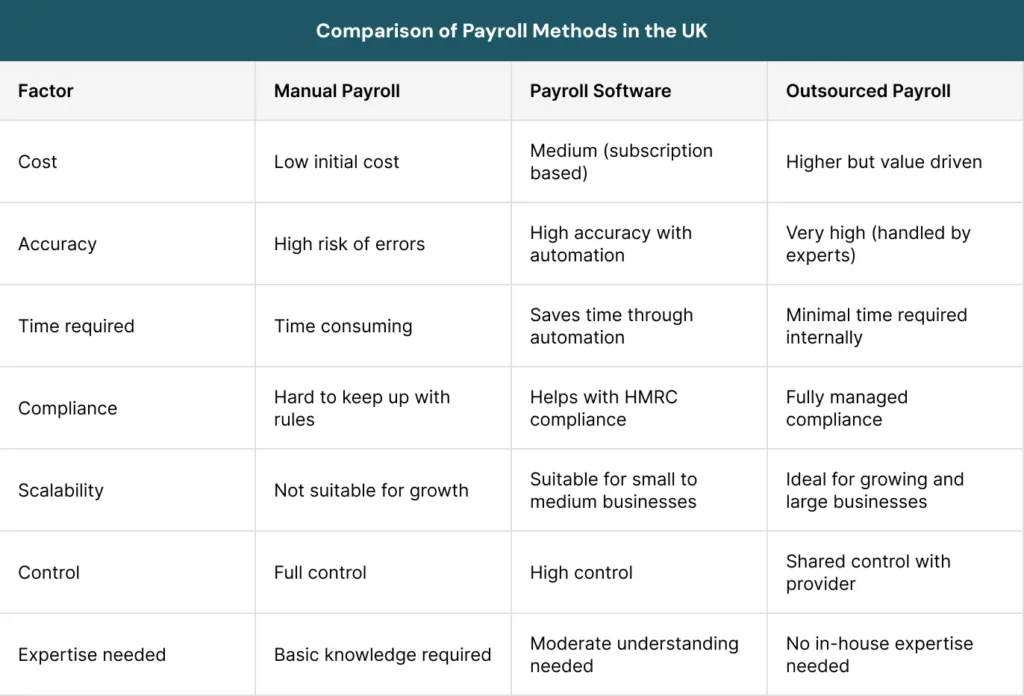
Payroll Methods in the UK
How you handle payroll depends on your business size, budget and how much you really know about payroll. Every approach has its ups and downs.
So, picking the right one makes a big difference and cuts down on mistakes, which saves time.
Manual Payroll
Manual payroll processing is basically spreadsheets or simple record keeping. This can work if you have only got a small number of staff. But it’s slow and easy to mess up, especially with taxes or pay.
As your business grows, manual payroll gets tricky and mistakes start piling up.
Payroll Software
Payroll software takes care of calculations, tax deductions and reporting automatically, so you don’t have to stress about mistakes or waste time.
Most programs can link up with HMRC for real-time submissions. If you are running a business and want things done right, this is a solid choice.
Outsourced Payroll
Outsourced payroll means handing over payroll tasks to an external provider. These experts manage calculations, compliance and reporting on your behalf.
This method reduces the need for in-house staff and saves time as well. It is helpful for those who deal with complex payroll requirements.
Common Payroll Mistakes to Avoid
Payroll mistakes are common but avoidable. These mistakes can cost a lot. Avoid these errors:
- Missing RTI deadlines
- Wrong tax calculations
- Poor record keeping
- Ignoring rule updates
- Not checking payroll reports
Risks and Limitations of Payroll Management
Payroll management has some challenges. The risks that can cause issues are:
- Human errors
- Data security concerns
- System failures
- Changing regulations
How to Reduce Risks?
Although the system is not risk free, common errors can be reduced. These can be avoided when businesses:
- Use reliable software
- Keep records updated
- Review payroll regularly
- Stay informed on changes
Key Point:
Even a small payroll error can lead to penalties or employee disputes if not corrected quickly.
Payroll Software and Automation
Payroll software is a game changer for most businesses now. Automation handles tasks, slashes errors and saves serious time. It is especially good for businesses that are growing or have difficult payroll systems.
Automated payroll processing helps reduce errors and saves time by:
- Calculating tax automatically
- Generating payslips
- Submitting RTI reports
- Storing records securely
UK Case Law
Autoclenz Ltd v Belcher (2011) highlights the importance of proper payroll and worker classification. In this case, a group of car valeters were treated as self-employed under their contracts. However, the company controlled how and when they worked.
Workers said their day to day reality made them employees, even though the paperwork called them contractors. They did not really control their work and the company called the shots. That brought up questions about whether they got the right pay and employment rights.
The UK Supreme Court did not just read the contracts, they looked at how things actually worked. The judges ruled that the workers really were employees. This meant they were entitled to basic rights such as minimum wage and paid leave.
This case shows that payroll and employment status must reflect real working conditions. Businesses cannot rely only on written terms if those terms do not match how work is actually carried out.
Conclusion
Payroll processing is not just about paying people, it keeps your business running smoothly. Get it right and everyone gets paid on time, taxes are sorted and you stay on the right side of HMRC. Get it wrong and suddenly you are drowning in stress. That is why a clear, reliable system is not optional, but a necessity.
As your team grows, things only get trickier. More employees bring more paperwork, extra rules and more chances for mistakes.
But if you keep things structured and organised, you cut down on errors and build trust with your team. Employees notice when you pay attention to the details and that trust pays off.
A solid payroll system makes everyday life easier for everyone. Whether you do it yourself or hire someone else, the goal never changes. It keeps your tasks simple, accurate and consistent. Do that and you set yourself up for steady growth.
Sterling Cooper helps you make payroll management easy and stay compliant. Strengthen your payroll process with a system built for accuracy and efficiency.
Contact us today for a smooth and easy transition that fits your business.
Struggling with payroll errors and missed deadlines?
Build a payroll system that keeps your business compliant and your team paid on time. Our experts handle the details so you can focus on growth.
Book an appointment today to make payroll simple and stress free.
FAQs
PAYE stands for Pay As You Earn. It is the system used by HMRC to collect income tax and National Insurance directly from employees’ wages. Employers must calculate and report these deductions each pay cycle.
Small businesses can manage payroll manually, but software makes the process easier and more accurate. It helps reduce errors, saves time and ensures compliance with HMRC rules.
Payroll can be run weekly, fortnightly or monthly. The choice depends on your business and employee contracts. The key is to stay consistent with your payment schedule.
Late payroll reporting can lead to penalties from HMRC. It may also create issues with employee payments and tax records. Timely reporting is important to avoid these problems.
Yes, payroll errors can be corrected by updating records and submitting revised information to HMRC. However, frequent errors may lead to compliance concerns, so it is best to minimise them.
Recent Posts

How to Assess Your Risk Tolerance Before Investing
March 30, 2026

Why Annual Reports Still Matter for Businesses in 2026
March 27, 2026