
Posted by:
Admin
Date:
March 26, 2026
Category:
blogs
What Is the Employment Rights Bill 2025 and How Will It Affect Workers?
Have you ever felt uncertain about your work? Some people worry about job safety from time to time. Others feel unsure about their rights at work. Business owners also struggle to keep up with changing working rules. This is why the Employment Rights Bill 2025 has been introduced.
Polling by Opinium for IPPR, the TUC and Persuasion UK shows that around 70% of business leaders believe stronger employment rights will improve productivity.
According to the UK Government, most employees must currently complete 2 years of continuous service before they can claim unfair dismissal protection. This leaves many workers without full protection in the early stage of their job. This gap is one of the main reasons behind the Employment Rights Bill UK.
In this blog, you’ll learn:
- What is the Employment Rights Bill
- How the Employment Rights Bill 2025 changes existing laws
- When the Employment Rights Bill will become law
- How it affects workers and businesses
- Key risks, limits and real UK context
What Is the Employment Rights Bill 2025?
The 2025 Bill is a major update. It improves worker protection. It also makes rules easier to understand.
This bill is one of the most important employment law changes in recent years. This Bill focuses on:
- Fairness
- Clarity
- Modern work needs
It aims to:
- Give workers rights earlier
- Improve job security
- Support fair pay and leave
- Protect flexible and gig workers
What Changed in 2025
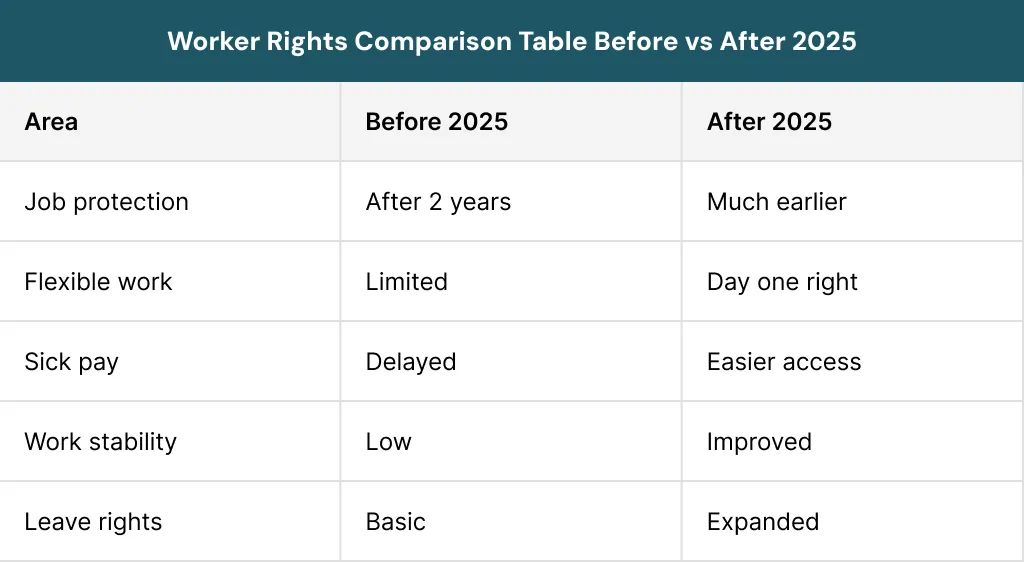
Earlier laws were based on older patterns of work. Many rights depended on how long someone had worked in a job. The previous rules worked in the past, but they created gaps in modern jobs such as:
- Unfair dismissal rights
- Flexible working rights were limited
- Zero hours workers had less protection
- Sick pay rules were strict
- Parental leave access was limited
Later, the Employment Rights Bill 2025 introduces key changes. These updates reflect how work has changed in recent years. These include:
- Shorter wait time for dismissal protection
- Day one right to request flexible work
- Better sick pay access
- More stable hours for workers
- Stronger family leave rights
Key Changes in the Employment Rights Bill UK
Now let us look at what the Employment Rights Bill UK actually changes. The aim is to close existing gaps. It also aims to improve fairness. The new law will affect employers and workers. The key changes include:
- Earlier access to unfair dismissal rights
- Flexible working from day one
- Improved sick pay rules
- Better protection for zero hours workers
- Stronger parental leave rights
Why the Employment Rights Bill 2025 Matters
Work is no longer the same as it was a few years ago. Many people now work in flexible roles, part time jobs or gig work. A new approach was needed due to these changing working conditions. This shift has created gaps in protection. Key issues included:
- Workers lacked early protection
- Rules were hard to follow
- Some roles were not fully covered
- Disputes increased over time
Labour is not a commodity. Franklin D. Roosevelt
This simple idea highlights why fair work rules matter. It reflects the core principle behind worker protection.
How Will the Employment Rights Bill Affect Workers?
Employers are focused on how workers will be affected. The Employment Rights Bill 2025 brings both benefits and changes. Overall, the aim is to create a fair system. The positive effects include:
- Better job security
- Faster access to rights
- More stable working hours
- Improved work life balance
Possible Challenges
This shift will also bring some changes, which are:
- Some rules may take time to apply
- Workers may need to understand new rights
- Not all roles will change at once
UK Case Law
In Uber BV v Aslam, few Uber drivers challenged the status of their employment. They argued that they should be treated as workers.
Uber maintained that they were self employed individuals operating their own businesses. The drivers argued that their work was tightly shaped by the platform.
The Court found that Uber controlled key aspects of the work. Prices were set by the company, not the drivers. Access to customers was controlled through the app and performance was closely tracked using a rating system.
This setup gave drivers very little control over how they worked or how they built relationships with passengers. Over time, many drivers became financially dependent on the platform.
The UK Supreme Court held that the drivers qualified as “workers” under the law. The Court looked at how the working arrangement operated in practice.
It found that the degree of control exercised by Uber indicated a worker relationship rather than self employment. As a result, drivers became entitled to basic employment protections, including:
- Minimum wage
- Paid annual leave
This decision highlights that courts assess real working relationships instead of relying only on contractual wording.
This case also shows gaps in old laws. The Employment Rights Bill 2025 aims to prevent such issues.
How Will the Employment Rights Bill Affect Employers?
The 2025 Bill doesn’t only give rights to the workers. It creates a balanced relationship between employers and workers. The changes may take time but improve clarity. Employers will need to adjust their systems. They will also need to reconsider processes. The responsibilities of a business are:
- Update contracts
- Train staff
- Improve record keeping
- Respond to flexible work requests
Day One Rights Explained
One of the biggest updates in the Employment Rights Bill 2025 is called day one rights. Workers now get key protections from their first day of the job. They will not have to wait long periods. These new protections include structured setups and could leave a real mark. The key changes are:
- Flexible work requests
- Basic job protection
- Clear contract terms
Impact on Different Types of Workers
Each group of workers will experience changes in a different way.
Full Time Workers
Their work setup is often more structured. The impact can be seen in ways such as:
- More protection
- Better leave rights
- Clearer contracts
Part Time Workers
Their rights have often been limited in the past, making these updates more relevant. Some key impacts are:
- Fairer treatment
- Equal access to benefits
- More stability
Gig Workers
This is where gig workers really sit in the middle of all of this. They have suffered and this Bill is attempting to give them an even chance.
Updates are more even for them as their work was always a little unorganized. This Bill does for them:
- Better clarity of where they stand legally
- Improved pay protection
- Less uncertainty
Employer Responsibilities Under the New Bill
Employers need to keep up too. Their systems must comply with the new standards, or they risk getting in trouble.
Following the right duties is not about the law. It will also help them avoid arguments later on. The key duties include:
- Provide clear contracts
- Keep accurate records
- Follow fair pay rules
- Handle worker requests properly
Technology and Systems
A lot of companies now use digital tools to track work stuff. These tools make it easier to manage everything from employee schedules to compliance. These tools help to:
- Store data safely
- Track staff records
- Automate payroll processing
- Reduce errors
Common Mistakes to Avoid
Mistakes can still happen in any business. If businesses do not keep up, it can turn into a compliance mess. So noticing these errors early helps avoid the problems. Here is what they need to watch for:
- Ignoring updates
- Not training staff
- Poor documentation
- Delayed changes
Risks and Limitations of the Bill
The Bill brings benefits but it is not perfect. You have got to balance the benefits and drawbacks. The risks that can affect businesses are:
- Slow rollout
- Early confusion
- Pressure on small firms
How to Reduce Risk
The risks can be avoided if businesses:
- Stay updated
- Keep records clear
- Use expert help
Key Point:
Early preparation reduces risks and keeps your business compliant.
When Will the Employment Rights Bill Become Law?
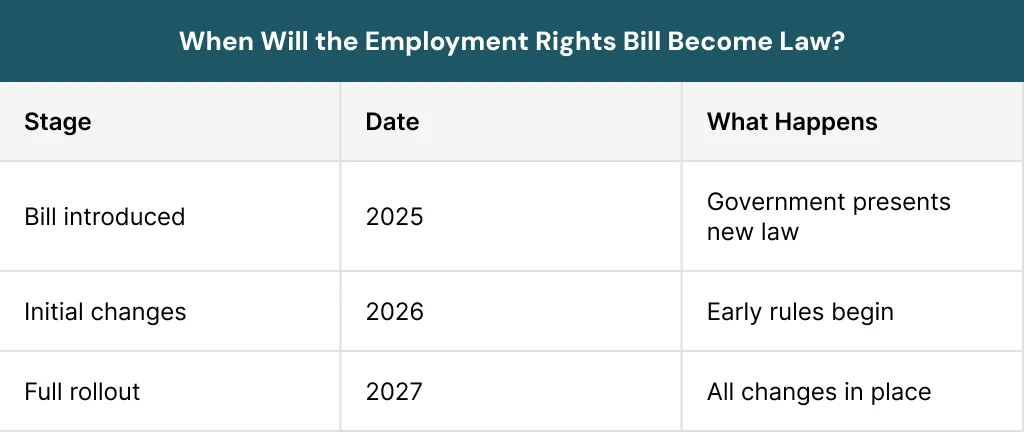
The Bill will not kick in all at once. It is going to roll out bit by bit. Spreading the changes in over several stages allows businesses to catch their breath and figure things out as they go. There is a timeline given that shows what is coming out and when.
How Businesses Can Prepare
Businesses should devise a straightforward process to tackle the changes smoothly. Organizing things properly keeps stress and confusion low.
1. Review Current Policies
First go through your contract and terms.
2. Update Employment Terms
Look if they are in line with new rules and updates.
3. Train Your Team
Make sure everyone understands what is different.
4. Monitor Legal Updates
Keep yourself updated with the changes down the line.
5. Documents Businesses May Need
- Employment contracts
- Staff records
- Payroll data
- Leave records
Many firms rely on payroll reports to stay compliant with regulations.
Conclusion
The Employment Rights Bill 2025 focuses on:
- Fairness
- Clarity
- Early access to work rights.
For workers, this means better protection from the very start of their job. It also reflects changes over time such as flexible and gig based roles.
For businesses, the changes may require updates in:
- Systems
- Contracts
- Processes
The Bill will result in clearer rules and fewer disputes in the future. Businesses that prepare early are more likely to handle these changes smoothly and avoid unnecessary risks.
The success of the Bill will depend on how well workers and employers adapt to changes. With the right approach, the Bill can support a more stable and fair working environment.
With the help of Sterling Cooper Consultants, handling changes in UK employment law becomes simpler, more organised and stress free.
Get in touch today to stay prepared and manage these changes with confidence.
Employment Rights Bill 2025 compliance protects your business from costly mistakes and unnecessary stress. Acting early helps you stay in control and avoid future disputes.
Speak to a specialist today to review your current position and strengthen your compliance framework.
FAQs
Yes, the Bill is expected to apply across most sectors. However, some industries may see changes at different stages depending on the implementation schedule.
Employers may still refuse requests; however, they must provide valid business reasons. The process will be more structured, transparent and fair under the new framework.
In many cases, yes. Employers may need to update employment contracts to reflect new rights and ensure compliance with updated legal standards.
Probation periods may still exist; however, workers are expected to gain stronger protections during this period, reducing gaps in early stage employment protection.
Workers should review their employment contract and stay informed about legal updates. Seeking professional guidance can also help them better understand their rights and position.
Recent Posts

Step-by-Step Guide to Managing Small Business Accounts
March 19, 2026

What Is FRS 102? A Simple Guide for UK Businesses
March 18, 2026