Posted by:
Admin
Date:
May 20, 2026
Category:
blogs
Making Tax Digital for Income Tax: A Practical Guide for UK Taxpayers
Making Tax Digital (MTD) is changing how UK businesses, sole traders and landlords keep tax records and report information to HMRC. Those covered by the rules must keep certain records digitally and use compatible software.
The rules vary by tax type. VAT-registered businesses generally need to follow MTD for VAT, while MTD for Income Tax is being introduced in stages. From 6 April 2026, it applies to individuals with qualifying income above £50,000, with the threshold falling to above £30,000 in 2027 and above £20,000 in 2028.
This guide explains who needs to follow MTD, when the rules apply and how to prepare.
Key Takeaways
- Growth can come from existing products, new products, existing markets or new markets.
- Market penetration focuses on selling more existing products to existing customers.
- Product development means creating new products for an existing market.
- Market development means taking existing products or services into new markets.
- Diversification combines a new product with a new market.
- Businesses should review their results and change their approach when needed.
What Is Making Tax Digital (MTD)
Making Tax Digital (MTD) is a UK government initiative designed to modernise how taxpayers keep records and report information to HMRC. Those within the relevant rules must maintain digital records and use compatible software to submit information. MTD currently covers VAT and Income Tax. VAT-registered businesses already follow MTD for VAT, while MTD for Income Tax is being introduced in stages for qualifying sole traders and landlords. The initiative is intended to support more accurate record-keeping and reduce errors in tax reporting.How Does Making Tax Digital Work
For MTD for Income Tax, qualifying sole traders and landlords use compatible software to keep digital records of their income and expenses. They then send quarterly updates to HMRC and complete the required year-end process. HMRC reported that more than 436,000 sole traders and landlords had submitted their first quarterly update by August 2026. The exact requirements vary depending on whether you are following MTD for VAT or MTD for Income Tax.When Do I Need to Comply with MTD Rules?
The date you need to comply depends on which MTD rules apply to you. All VAT-registered businesses must keep relevant VAT records digitally and submit VAT Returns using MTD-compatible software. This requirement has applied to all VAT-registered businesses since April 2022. For Income Tax, MTD is being introduced in stages based on your qualifying income. The following table shows when the rules apply: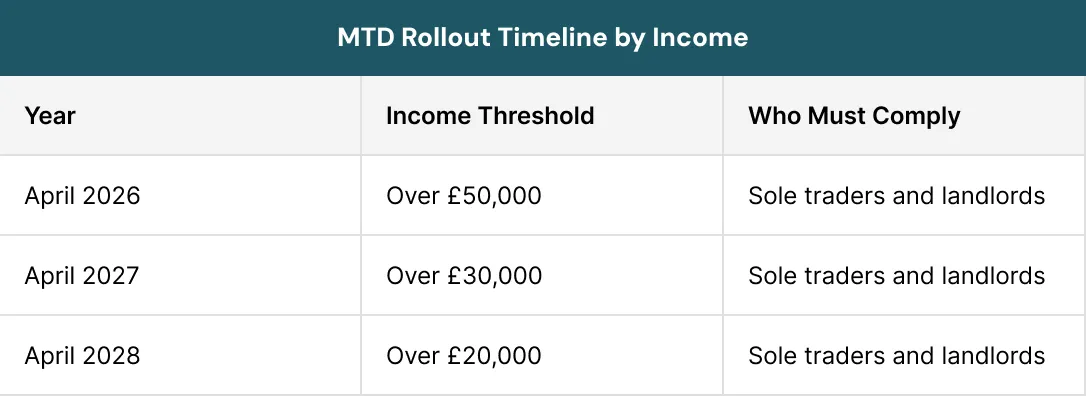
Qualifying income means your total gross income from self-employment and property before expenses.
What Digital Records Do I Need to Keep?
The records you need depend on the MTD rules that apply to you. For MTD for Income Tax, qualifying sole traders and landlords need digital records of their self-employment or property income and expenses. They must also retain supporting records, such as invoices and bank statements.
For MTD for VAT, digital records generally include details of sales, purchases, supplies, VAT charged and VAT claimed. Accurate records make it easier to check your figures before submitting information to HMRC
How to Prepare for Making Tax Digital
If MTD for Income Tax applies to you, preparing your records and software in advance can make the transition easier.
Check Your Qualifying Income
First, calculate your total gross income from self-employment and property before taking away any expenses. If your combined income is more than £50,000, you must follow MTD for income tax starting from 6 April 2026. Future thresholds drop to £30,000 from 6 April 2027 and £20,000 from 6 April 2028.
Choose Compatible Software
HMRC does not provide free software for Making Tax Digital, so you need to use compatible commercial software or bridging software that works with spreadsheets. Choose software that supports the digital record-keeping requirements and allows you to record sales and expenses. Setting up and testing the software early can also help you become familiar with recording transactions before you need to submit your first update.
Sign Up with HMRC
To sign up for MTD for Income Tax, use the official UK government website and follow the steps provided. You will need to provide information about your income sources and connect your compatible software as part of the process.
Once you have signed up, make sure you have completed the necessary setup before submitting your first quarterly update. Your compatible software will be used to keep digital records and send the required updates to HMRC.
Submit Quarterly Updates
Once you are using MTD for Income Tax, you need to send four quarterly updates each tax year for each relevant self-employment or property income source. These updates summarise your income and expenses and are submitted through your compatible software. They are not tax returns.
For standard tax-year update periods, the deadlines are 7 August, 7 November, 7 February and 7 May. You will then need to submit your tax return by 31 January following the end of the tax year. Your quarterly updates feed into this tax return, but they do not replace it.
How Sterling Cooper Helps You with Making Tax Digital
Making Tax Digital can feel challenging when you are unsure which rules apply to your business. Sterling Cooper can help you understand your MTD responsibilities and prepare for the changes. Our team can review your current records, explain your reporting requirements and help you choose a suitable approach to digital record-keeping.
We can also support you with organising your tax information and understanding key HMRC deadlines. With the right guidance, you can approach MTD with greater confidence while staying focused on running your business.
If you are unsure whether Making Tax Digital applies to your business or need support preparing for the changes, contact us today to discuss your requirements with our team.
FAQs
Making Tax Digital is an HMRC initiative requiring those within the relevant rules to keep digital tax records and use compatible software to submit information to HMRC.
MTD for Income Tax started on 6 April 2026 for those with qualifying income above £50,000. The threshold falls to above £30,000 from 6 April 2027 and above £20,000 from 6 April 2028.
Yes. Those within the MTD rules generally need compatible software to keep digital records and submit the required information to HMRC.
For MTD for Income Tax, you normally need to send four quarterly updates each tax year, followed by the required year-end process and tax return.
The consequences depend on the obligation missed. HMRC has penalty rules for certain late submissions and payments. However, penalty points will not apply to late quarterly updates during the 2026–27 tax year.
Recent Posts