

Posted by:
Admin
Date:
February 5, 2026
Category:
blogs
How Do You Register a Business the Right Way?
Registering a business in the UK depends on the structure you choose. The process also includes some important changes introduced in 2025 and 2026. From 1 February 2026, the standard digital incorporation fee for a company increased from £50 to £100. Mandatory identity verification for new directors and other individuals in scope also began on 18 November 2025. This means older business registration guides may not reflect the current process or fees.
This guide explains how to register a business in the UK based on the structure you choose, including the main registration steps, tax requirements and checks to complete before you apply.
Key Takeaways
- Sole traders generally register with HMRC for Self Assessment rather than Companies House, while a private limited company costs £100 to incorporate digitally.
- Identity verification is now part of the Companies House process for new directors, with separate verification requirements for PSCs.
- Your business structure determines where you register, what filings you need to make and how liability is treated.
- Checking the company name, registered office address, directors, PSCs and SIC code before applying can help avoid delays.
- Registering a company name does not guarantee that it cannot later be challenged under company-name rules.
Choose the Right Structure First
Your business structure affects where you register, what tax responsibilities you have and how liability is treated. For many new UK businesses, the main options are sole trader, private limited company and limited liability partnership (LLP):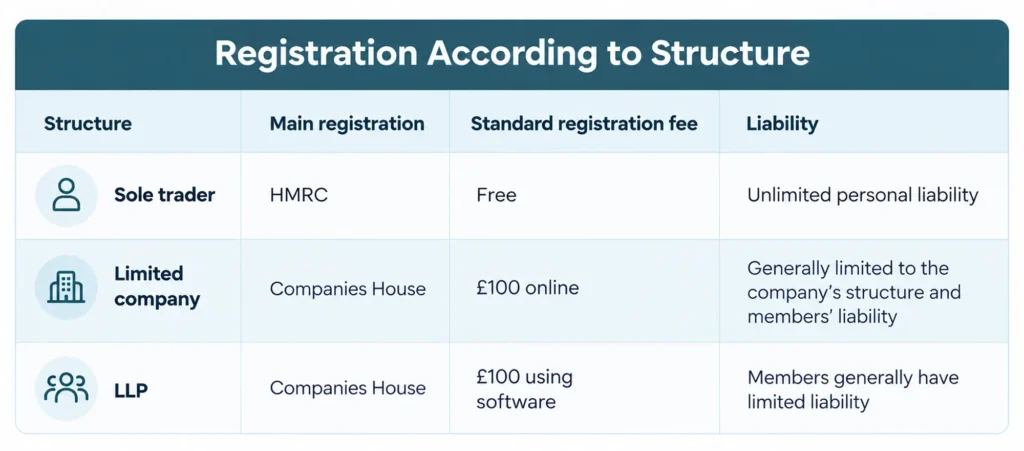
A sole trader is usually the simplest structure. You register for Self Assessment with HMRC when required. If your gross trading income is more than £1,000 in a tax year, you generally need to register for Self Assessment.
A limited company is a separate legal entity from its owners. It can provide limited liability, but it also brings additional reporting, accounting and filing responsibilities.
An LLP combines elements of a partnership with limited liability. It must have at least two members and at least two designated members. The LLP is registered with Companies House, while its members generally pay tax on their share of the profits through Self Assessment.
Choose the structure before starting the registration process because the requirements differ between them.
How to Register a Business Step by Step?
Once you have picked a structure, the actual registration process runs through a fairly fixed sequence as follows:Step 1: Pick a Name
For a limited company or LLP, check that your proposed name complies with Companies House rules and is not too similar to an existing company name. Also check relevant trademarks before building your brand around it.Step 2: Verify Your Identity
New company directors must complete the required identity verification, while PSCs have separate verification requirements. You can verify your identity through GOV.UK One Login or an Authorised Corporate Service Provider.Step 3: Register Your Business
To register a business, sole traders generally register with HMRC for Self Assessment when required, while limited companies and LLPs register with Companies House. For a company, you will need information such as the registered office address, directors, PSCs and SIC code. A standard digital company incorporation costs £100, while paper and same-day options have different fees.Step 4: Check Your Tax Obligations
After registration, check which taxes apply to your business. Depending on your structure and circumstances, this may include Corporation Tax, Self Assessment, VAT and PAYE.Step 5: Set Up Your Business Finances
Once your company is incorporated, consider opening a separate business bank account and keeping business and personal finances separate. This can make it easier to maintain clear financial records and manage your accounts.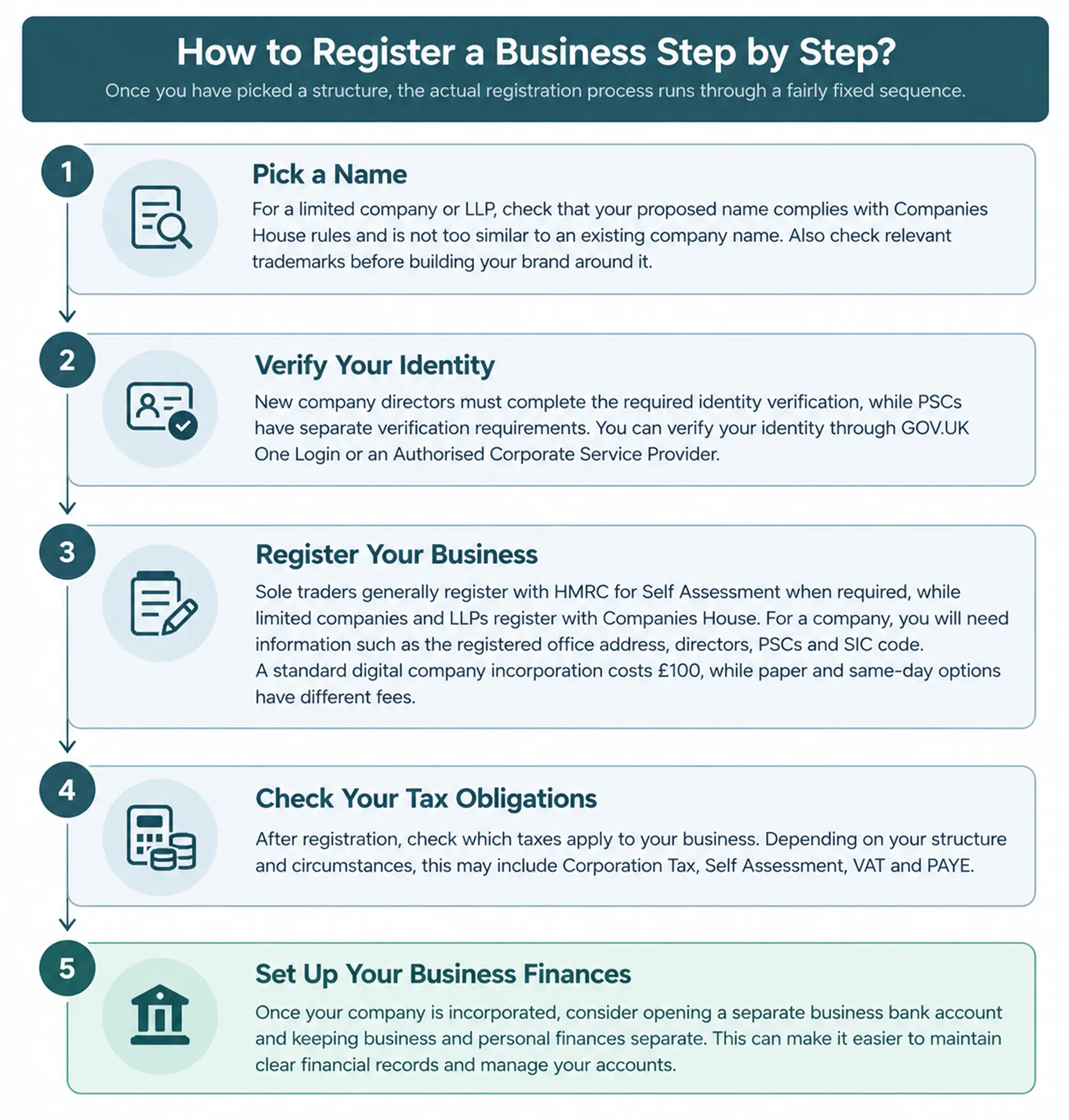
Business Registration Checklist
Before and after registering your business, check that you have:
- Chosen the appropriate business structure
- Checked the proposed company name against Companies House records
- Considered relevant trademark and brand-name conflicts
- Confirmed the registered office address
- Identified the directors and PSCs, where applicable
- Completed the required identity verification
- Selected the appropriate SIC code
- Prepared the required incorporation information and documents
- Checked the current Companies House fee
- Considered Corporation Tax, Self Assessment, VAT and PAYE requirements
- Registered for the relevant taxes within the required deadlines
- Opened a separate business bank account where appropriate
- Kept the Certificate of Incorporation and other registration records safely
Pro Tip:
Complete the required identity verification before submitting your incorporation application. This can help prevent delays caused by missing verification information.
Case Study: What Happens When You Do Not Check a Company Name Properly?
Alpha Intel Advisory Ltd was registered on 18 July 2025. Intel Corporation later applied to the Company Names Tribunal, arguing that the company name breached the Companies Act 2006. The case was undefended.
On 26 May 2026, the adjudicator ordered Alpha Intel Advisory Ltd to change its name within one month. The order also awarded Intel Corporation £800 in costs. The company did not change its name within the required period. On 13 August 2026, the adjudicator therefore changed the registered name to 16592971 LTD.
The case involved specific allegations about the use of the Intel name, so it should not be treated as an example of every company-name dispute. However, it demonstrates an important point: Companies House registration does not guarantee that a company name is protected from later challenge.
Checking the name and considering relevant existing brands before registration can reduce the risk of having to change your company name later.
Conclusion
Registering a business is not difficult, but the process has more moving parts than it did even a year ago. Start by choosing the right structure, then verify your identity, check your business name and register for the relevant taxes on time. Following these steps in the right order can help you avoid unnecessary delays and problems later. You can also benefit from a professional business advisory consultancy when making key decisions during the setup process.
Not sure which business structure or registration step applies to you?
Get in touch with Sterling Cooper Consultants for guidance on setting up your business correctly from the start.
FAQs
The process depends on your structure. Sole traders generally register with HMRC for Self Assessment when required. Limited companies and LLPs are incorporated through Companies House, with relevant tax registrations handled according to the business's circumstances.
A sole trader structure is generally simpler and has no Companies House incorporation fee, but the owner has unlimited personal liability. A limited company is a separate legal entity and generally provides limited liability, but it has additional reporting and filing responsibilities.
If your gross trading income is more than £1,000 in a tax year, you generally need to register for Self Assessment with HMRC. You may also need to register in other circumstances, such as if you want to claim certain reliefs or benefits.
Standard digital incorporation costs £100. A paper application costs £124, while the eligible same-day software service costs £156.
New directors must verify their identity as part of the Companies House incorporation or appointment process. PSCs also have identity-verification requirements, with the timing depending on their circumstances. Verification can be completed through GOV.UK One Login or an Authorised Corporate Service Provider.
Registering a name with Companies House does not guarantee that it is free from later challenge. In certain circumstances, another party can apply to the Company Names Tribunal, which can order a company to change its name. The 2026 Alpha Intel Advisory Ltd decision demonstrates how this can happen.
Recent Posts