Posted by:
Admin
Date:
February 27, 2026
Category:
blogs
VAT Notice 708: A Simple Guide to Buildings and Construction VAT Rules
Are you paying extra VAT on your construction or renovation project? This is shocking for landlords, homeowners, and developers to realise that in UK, their construction prices include VAT up to 20%. Even projects that qualify for reduced VAT rates often pay the full 20% VAT. HMRC collects over £2 billion in construction VAT in the UK each year.
However, by getting the proper information about the VAT rules, a significant amount can be reduced. HMRC has provided the official guide, which is known as VAT Notice 708.
When it comes to development, renovation, or building projects, VAT can be applied at zero Rate (0%), reduced Rate (5%), and standard Rate (20%).
In this blog, you will learn:
- Meaning of VAT Notice 708 and why it is important
- Working of HMRC VAT Notice 708 for different types of construction plans
- Who can take advantage of zero or minimum VAT rates
- Helpful tips to minimize cost and follow the rules of construction projects
What is VAT?
VAT is the short form for Value Added Tax. In the UK, most of the services and goods are subject to this tax. Its normal rate is 20%. Besides this, there are other rates such as 5% reduced VAT rate and 0% zero VAT rate.
By fulfilling certain conditions, the property and construction work can qualify for reduced VAT rates.
What is VAT Notice 708?
VAT Notice 708 is issued by HMRC to provide detailed instructions about the construction industry VAT. It clearly shows which projects are best for zero, minimum, or standard VAT charges.
It describes the exemptions, certificates, and all the established rules that are required to apply the correct VAT rate.
Importance of VAT Notice 708
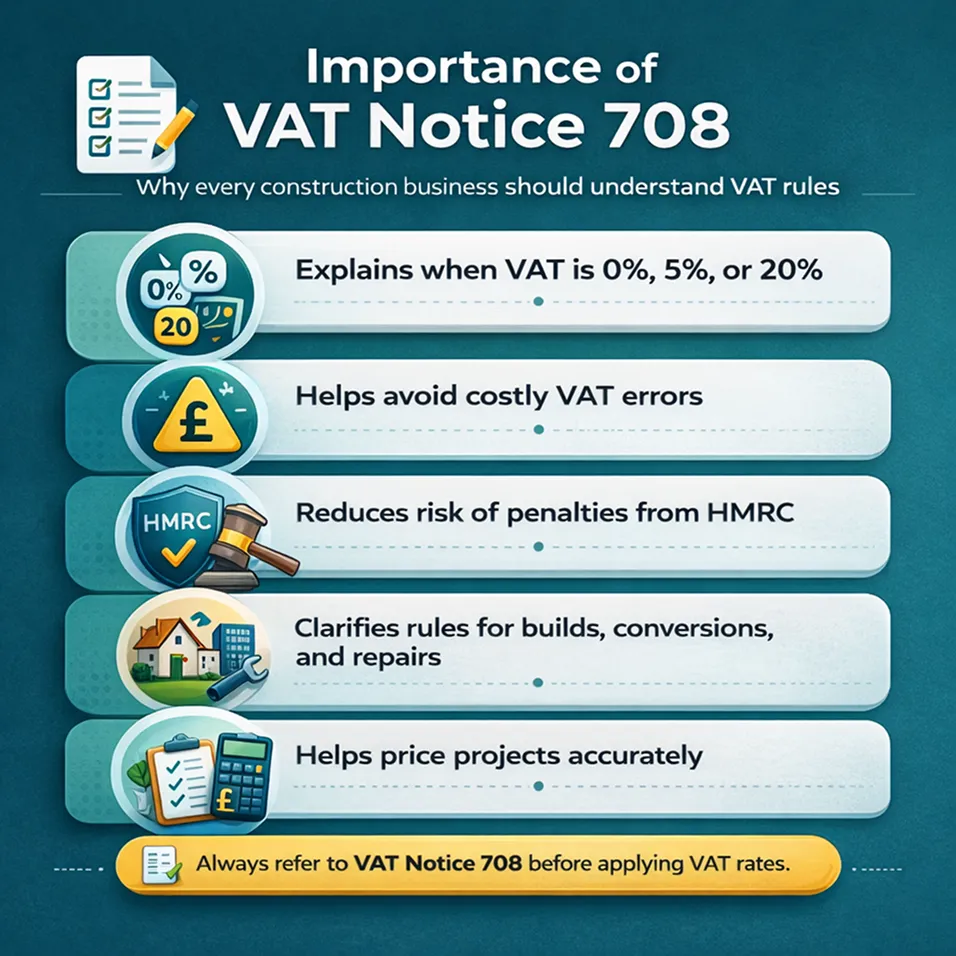
In the UK construction industry, VAT plays an important role. Its effect is directly on how much you pay the VAT and how much payment you can take back. VAT Notice 708 is essential to understand since it:
- Explains when VAT is 0%, 5%, or 20%
- Helps avoid costly VAT errors
- Reduces risk of penalties from HMRC
- Clarifies rules for builds, conversions, and repairs
- Helps price projects accurately
What are the Buildings and Construction VAT Notice 708 rules?
Everyone who is involved in construction, property development, and renovation in the UK, it’s important for them to understand the Buildings and Construction VAT Notice 708 rules.
Rules are described below, which are very important to know.
1. The Three VAT Rates in Construction
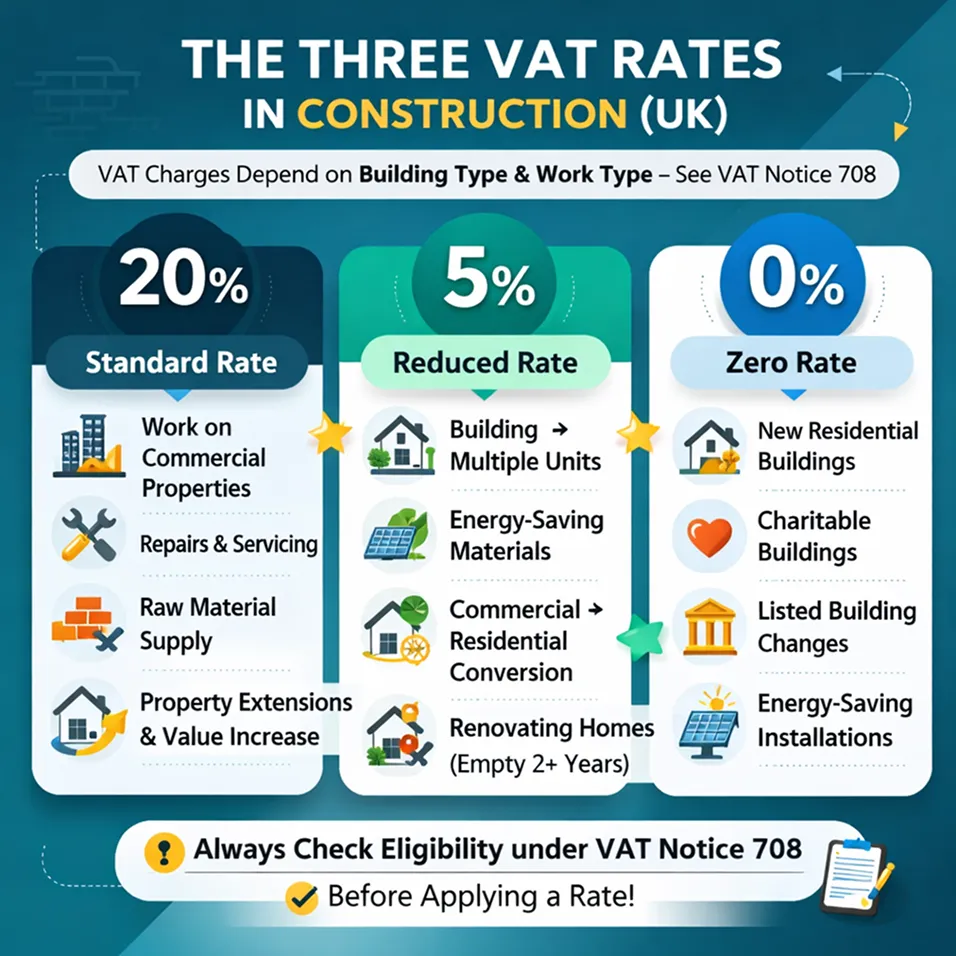
There is no fixed rate for construction work in the UK. The charges of VAT depend on the building type and work type involved, as explained in Buildings and Construction VAT Notice 708.
20% Standard Rule
Most of the construction services follow this rule, which includes these:
- Work on commercial properties
- General repairs and servicing
- Raw materials supplier
- Increase living space and property value
5% Reduced Rate
This rule applies in some special conditions, such as:
- Modifying a building to create more units
- Installing specific energy-saving materials
- Reconstructing commercial buildings and turning them into residential homes
- Renovating residential buildings empty for two years
0% Zero Rate
This rate applies to the category of the following buildings:
- Installation of certain energy-saving materials
- Construction of qualifying charitable buildings
- Approved changes to specific listed buildings
- Construction of new residential buildings
2. What are Considered to be Qualifying Buildings?
Every building does not count for zero or reduced VAT. According to HMRC Buildings and Construction VAT Notice 708, the qualifying buildings are:
- The buildings that are used only for relevant charitable purposes
- New changes built from scratch
- Self-contained residential units
These buildings should fulfil the criteria of strict design and usage requirements, such as
- Specifically, it must be for charitable or residential use.
- It should be self-contained
- It must not include non-qualifying features
3. Conversions and Renovations
The conversion renovation projects may qualify for reduced VAT; however, one should look at certain conditions.
Empty Homes
Renovation work qualifies for 5% VAT if any residential building has been empty for at least two years.
Change of Use
If a business property is changed into a residential building, this will come under the category of 5% VAT.
Number of Residential Units Changes
If the number of residential units is increased or decreased due to any project, the reduced VAT may apply.
4. Energy-Efficient Materials
Some energy-saving installations qualify for reduced or zero VAT to encourage sustainable construction. The projects must meet HMRC requirements because there are eligibility conditions and time limits.
- Groundworks directly related to the eligible installation
- Solar sheets
- Heat pumps
- Insulation
5. Materials vs Service Rule
One of the most important rules in buildings and construction is who provides the materials.
- A builder who installs and supplies materials must be VAT registered to qualify for zero or reduced VAT.
- The customers who buy materials directly pay 20% VAT.
6. Certificates are Necessary
Proper certifications are essential to qualify for reduced or zero VAT. HMRC can ask for unpaid VAT and extra charges if proper documentation is not provided.
Customer must provide:
- A valid certificate that confirms the building’s use
- A proof that the building will be charitable or residential
Constructors must:
- Keep an accurate record and invoices
- Must have copies of certificates
Learn more with: How do I get a VAT Certificate: A Complete Guide
7. DIY and Refund Scheme
In certain cases, developers and self-builders may reclaim VAT.
DIY House Builder Plan
After completion of the project, the people who are building their own houses can refund input VAT paid on materials.
Developers Refunds
The developers who have constructed zero-rated buildings can take back the input VAT on materials.
8. Compliance and HMRC Checks
HMRC observes all the construction records and VAT returns. If mistakes occur, they result in interest, fines, and assessments.
To be compliant, one must:
- File correct VAT returns
- Keep detailed invoices
- Apply accurate VAT charges
- Keep certificates safe
9. Common Errors in Construction VAT
Most people sometimes make mistakes that become so costly for them, such as:
- Failing to collect certificates
- Purchase materials separately and lose the chance of a reduced rate
- Do not verify building eligibility
- Think that all renovations come in 5%
To learn more: Common Errors on VAT Returns and How to Avoid Them?
Who Can Benefit from Reduced or Zero VAT Rates?
VAT Notice 708 clearly shows that only certain people and projects are allowed to use reduced or zero VAT rates. If you understand this rule, it will save so much money and time on a construction project. Customers who want to purchase new or renovated residential buildings cannot claim VAT relief themselves.
The people and groups below can qualify for 5% or 0% VAT if HMRC conditions are met:
- Homeowners
Such homeowners are eligible for 5% reduced VAT who want to renovate their houses that have been empty for two or more years.
- Property developers
People who want to build new residential buildings are eligible for 0% VAT.
- Self Builders
People who want to construct their own homes from scratch are eligible for 0% VAT on qualifying new builds
- Landlords
Those who want to change commercial buildings into residential ones are eligible for 5% reduced VAT on conversions.
- Charities
Construction of units for charity purposes is eligible for 0% VAT.
Project Profitability
VAT affects the profitability of a construction project. Applying the correct VAT rules under HMRC VAT Notice 708 can significantly reduce overall project costs. These rules make sure that projects are completed in accordance with all rules of VAT that are compliant with HMRC regulations.
Net Income
The effect of VAT is directly on the net income for investors and developers. If you pay unnecessary VAT, it will reduce profit margins. With the accurate HMRC VAT Notice 708, companies can reclaim eligible paid VAT and make sure that they are not overpaying. This helps them preserve their earnings and make overall returns better.
Development Budget
VAT has an important role in affecting the construction budget. Your project will become more expensive if you choose 20% VAT instead of 0% or 5%. If you study these regulations, you will know when 0 or reduced VAT applies.
It allows homeowners and developers to plan budgets correctly and do not face unexpected VAT charges.
Compliance Rate
If you follow an inaccurate VAT rate, it can take you through serious issues with HMRC. If the application of VAT is incorrect, HMRC can issue fines, interest, and backdated VAT. VAT Notice 708 is very helpful for property owners, builders, and developers to apply the accurate VAT charges.
Tips to Reduce VAT
- Seek professional VAT advice
- Collect and keep VAT certificates
- Let contractors provide materials
- Keep proper records and invoices
- Check the eligibility of building early
- Always use VAT-registered builders
Final Thoughts
The guide VAT Notice 708 has all the VAT rules for construction and buildings with simple yet powerful instructions. You can save your money on renovation and development projects if you understand them properly. The correct way to apply VAT assists you in avoiding costly charges and unexpected bills in many ways, such as building new units, developing a commercial property, or renovating a home.
Sterling Cooper provides expert construction VAT advice across the UK. If you need any help with construction VAT, contact us now and get a cost-effective and compliant project.
We have assisted developers, homeowners, and builders across the UK in applying VAT Notice 708. Our team of specialists is ready to guide you every step of the way.
Contact us if you want to ensure your construction project applies the correct VAT rate and avoid unnecessary costs.
FAQs
VAT Notice 708 is an official guide issued by HMRC that explains how VAT works for building, construction, renovation, and conversion projects in the UK. It shows when VAT is charged at 20%, reduced to 5%, or applied at 0%.
Homeowners can benefit from reduced VAT in certain cases. For example, if a residential property has been empty for at least two years or is being converted from commercial to residential use, the work may qualify for the 5% VAT rate.
Zero-rated VAT means VAT is charged at 0%, not that the project is exempt. Contractors can still reclaim input VAT on materials, but no VAT is added to the customer’s bill for qualifying work.
Certificates are essential. The customer must provide a valid certificate that confirms the building’s qualifying use. Without proper certification, HMRC may reject the reduced or zero VAT rate and charge penalties.
Self-builders can reclaim VAT on materials through the DIY Housebuilder Scheme after project completion. Developers building zero-rated properties can also reclaim input VAT if they are VAT registered.
Recent Posts
Understanding the 40% Tax Bracket in the UK
February 25, 2026
A Complete Guide to Wealth Tax in the UK
February 24, 2026