Posted by:
Admin
Date:
March 6, 2026
Category:
blogs
What Is a Leave of Absence and When Should Employees Take One?
Ever find yourself swamped with workload? Ever feel low, but work starts at 9 am? An employee might feel that he cannot carry on. If you are ill or under stress. Whether you are dealing with family troubles or facing something unexpected. There are moments when you cannot go on. That’s exactly when a leave of absence gives you time to take a break.
A leave of absence gives you approved time away from work for a serious reason. It is not the same as a holiday. It is usually longer. It may be paid or unpaid depending on the situation.
In the UK, employees are entitled to 5.6 paid weeks of holiday per year. This leave is called statutory leave entitlement or annual leave. A number of emergencies and other reasons allow for such leaves. This is done for the sake of the employee’s well being.
Understanding how a leave works can protect your job and reduce stress. In this guide, we explain your rights, when to take one and how to request it properly in the UK.
What Is a Leave of Absence?
A good place to start is by explaining what does leave of absence mean?
It is time off from work. The employee is allowed to take it for a certain period. Your job remains intact and you can be paid or not depending on the type of leave.
This leave does not mean you can just miss work. Not showing up without prior discourse can be considered as a misconduct. Therefore, it is very important to submit an absence of leave letter for work.
There are different types of leave of absence. These types depend on conditions and circumstances attached. They can be:
- Paid
- Unpaid
- Required by law
- Agreed by company policy
It is an approved time off. An absence without permission is not counted as leave.
What Does Leave of Absence Mean in the UK?
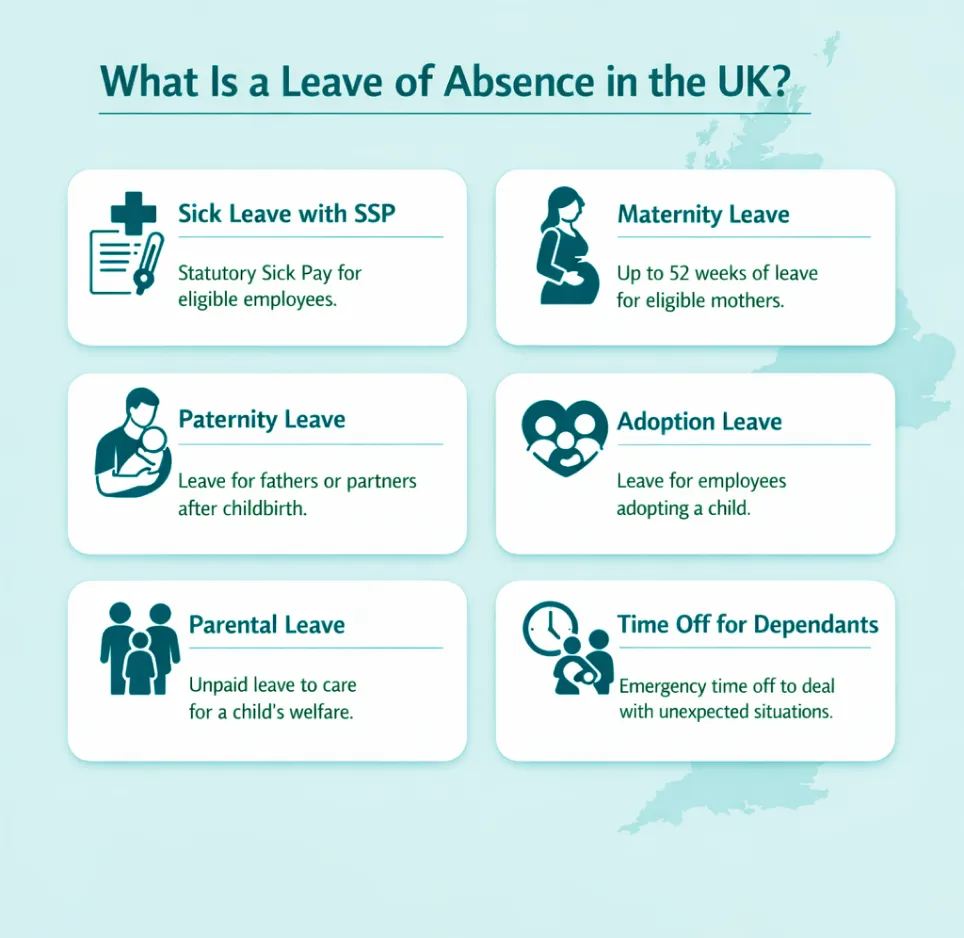
You have statutory rights to take time off for approved reasons under UK law. In the leave of absence UK system, some types of leave are protected by employment law. Statutory leaves in the UK are:
Sick Leave With Statutory Sick Pay (SSP)
In case you are too ill to work, you can get a leave of absence. You can apply for SSP if you earn £123 per week or more. Employers must pay at least £118.75 per week (2025/26). This is paid for up to 28 weeks under SSP.
Maternity Leave
You can have 52 weeks of statutory maternity leave in the UK. At least 2 weeks leave is a must. The leave starts 11 weeks before the due date. The pay is 90% of the regular earnings for at least the first 6 weeks. Next 33 weeks at 90% or £187.18 per week whichever amount is lower. The last 13 weeks are unpaid.
You can return sooner but must give at least 8-week notice.
Paternity Leave
As per law, paternity leave is a 2 week leave for husbands and spouses. This leave is to support your partner after childbirth. The leave must be taken within 52 weeks of the child’s birth.
Adoption Leave
Adoption leave is similar to maternity leave where 52 weeks are granted to the main adopter in order to bond with the child. It is given in case of adoption or surrogate birth. It involves 39 weeks of paid leave.
Parental Leave
A statutory leave of 18 weeks is granted to the working parents to care off their child before they turn 18. It is limited to 4 weeks per child per year. It is usually unpaid but certain employers do pay as well.
Time off for Dependants
You can take time off in case of emergencies that involve a family member or a dependent. Such leaves are unpaid. These are not planned leaves and usually last for a short period of time.
Employers must follow these laws. They cannot refuse certain types of protected leave of absence if the employee qualifies.
However, all leaves are not automatic. For example, unpaid personal leave or a sabbatical depends on your company’s policy. Always check your employment contract and leave policy before making plans.
When Should Employees Take a Leave of Absence?
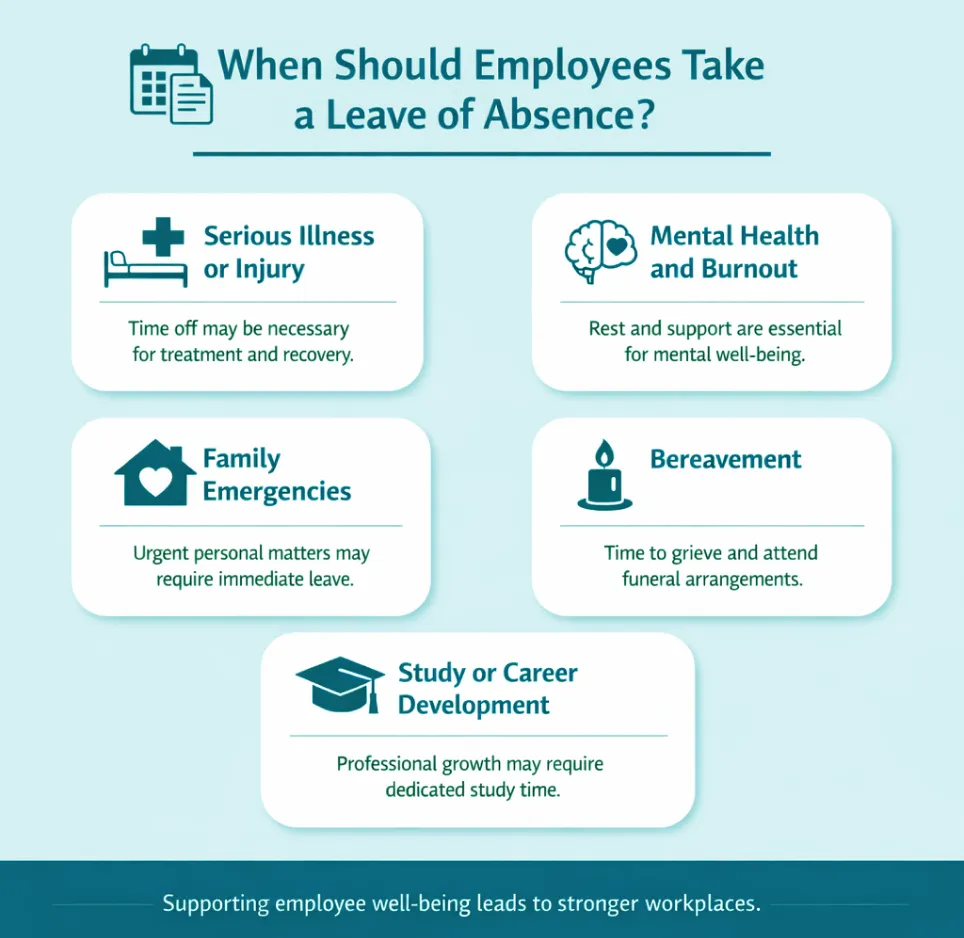
This leave should be taken when continuing to work would harm your:
- Health
- Family life
- Long term well-being
Common situations where leave may be necessary include:
1. Serious Illness or Injury
You can take a leave if:
- You are physically unwell
- Cannot safely perform your duties
For example, someone is recovering from a surgery. He may need several weeks off. Also a warehouse worker having a broken leg cannot perform labor.
As per UK system, you may need a GP fit note if you are ill for more than seven days. This supports your request for leave. This also protects your position.
2. Mental Health and Burnout
Mental health is just as important as physical health. Ongoing stress can cause
- Anxiety
- Depression
- Severe exhaustion
A leave may help you recover If you struggle to:
- Sleep
- Feel constantly overwhelmed
- Lose focus at work
In the UK, employers must take mental health seriously. A medically supported leave can prevent long term damage to your well-being.
3. Family Emergencies
Life can change suddenly. A child may fall seriously ill. A parent may need urgent care.
In all these situations, employees may request a leave to manage responsibilities at home.
The UK rules allow reasonable unpaid time off. It is for dependents in emergencies. Longer leave may require agreement with your employer.
4. Bereavement
Losing a loved one is very hard. Focusing at work may be impossible.
Many employers offer compassionate leave. In some cases, it is paid. A short leave of absence allows time to grieve and organise practical matters.
Returning too soon can affect performance and mental health.
5. Study or Career Development
Some employees request a leave to complete a qualification or training course.
For example, a teacher may take a year to complete a master’s degree. This type of leave is usually unpaid and depends on employer approval.
Although not always guaranteed under UK law, some organisations encourage development through career breaks.
What Happens If You Do Not Inform Your Employer?
Failing to communicate properly can cause serious problems. Stopping work without approval may be treated as misconduct. This is why sending an absence of leave letter for work is essential.
Even in emergencies, contact your manager as soon as possible. Follow up in writing. Clear documentation protects you and your employer.
Paid vs Unpaid Leave of Absence
Not all leaves of absence are paid. Some leaves are paid by certain employers but not statutory under UK law.
Paid Leaves
Paid leaves are statutory leaves generally under law. Such leaves make sure that pay and employment continues unaffected. Some examples are:
- Annual Leaves
- Sick Leaves
- Maternity Leaves
- Public Duties
Some companies have their own criteria for paid leaves. Such leaves are reserved at the discretion of the employer.
Unpaid Leaves
Unpaid leaves are discretionary and case dependent. They are generally reserved for personal reasons. Some examples are:
- Extended travel
- Career breaks
- Long term personal projects
- Carer’s leave
Under leave of absence UK guidelines, unpaid leave depends on agreement between employer and employee.
Unauthorised absence is unpaid and often considered a misconduct. Therefore, it is essential to write a leave of absence request before going on leaves.
How to Write Leave of Absence Request
Your request is how you convey your need for absence to the employer. Write your request clearly and directly. Explain your reasons in a professional way. You must use polite language and make your case under the light of relevant rules and guidelines.
Process:
- Start with a clear subject stating the intent and purpose
- Clearly state the end dates of your requested leave
- State the reasons in a brief manner. Avoid unnecessary personal details
- Attach any supporting documents such as medical reports etc
- Offer a handover plan for how your absence can be covered
- End with a note thanking the employer
You do not need to share private details unless legally required. Professional communication increases your chances of approval.
Case Study: Steve’s Burnout Recovery
Steve was a content creator at a marketing firm in Manchester. He worked long hours creating repetitious content day in and out. His long hours at work diminished his capacity to spend time for his hobbies. This caused him to be anxious and irritable. Soon his performance levels dropped.
Initially, he tried to ignore the signs and ‘push through’ the condition. Instead of getting better he seems to be plummeting into bad performance and lethargy. Eventually he checked in with a psychiatrist and was diagnosed with overwork and generalised anxiety disorder. The doctor advised a 4 week leave.
Steve requested a formal leave of absence supported by a medical report. His employer approved it under sick leave policy.
During this time, Steve:
- Attended therapy
- Improved his sleep routine
- Reduced stress triggers
This recovery worked. Steve returned
- Happier
- Healthier
Also, Steve was able to:
- Outperform his previous work
- Confidently face work challenges
- Avoid burnout
Employer Responsibilities in Leave of Absence UK
Employers also have legal duties. Under leave of absence UK employment law, employers must:
- Follow statutory leave rules
- Avoid discrimination
- Protect employee confidentiality
- Allow return to the same or similar job (for protected leave)
The employee may seek legal action, if an employer rejects a legally protected leave.
Can an Employer Refuse a Leave of Absence?
Yes, but only in certain situations. If the request is not legally protected, the employer may refuse based on business needs. For example, a small shop may not manage without a key staff member during peak season.
However, refusal must not be discriminatory or unfair. If you believe your leave was rejected unfairly, speak to HR or seek professional advice.
How Long Can a Leave of Absence Last?
The length depends on the type.
- Sick leave can last weeks or months
- Maternity leave can last up to 52 weeks in the UK
- Career breaks may last longer if agreed
Under UK rules, statutory leave periods are clearly defined. Always confirm with HR.
Preparing Before You Take Leave
Before your leave begins:
- Finish urgent tasks
- Inform colleagues and clients
- Set an email auto reply
- Document project details
Planning ahead makes your return smoother
Conclusion
A leave of absence is more often a need rather than desire. It is a formal way to protect your employment while dealing with life situations.
In the leave of absence UK system, employees have rights and employers have responsibilities. But communication is always essential.
In cases where a leave is linked to injury, medical recovery, or a workplace dispute, professional support can make a real difference. Sterling Cooper Consultants provides specialist employment law support, helping employees and employers handle complex absence matters with confidence and clarity. Contact us to move forward with clarity and confidence.
Need clarity around medical evidence linked to a leave of absence?
Contact our payroll and HR services today for clear, reliable expert medical reporting you can trust.
Get professional support that strengthens your case and protects your position at work.
FAQs
A leave of absence is approved time away from work for a specific reason, such as illness, family emergencies, or personal matters. It is formally agreed between the employee and employer and may be paid or unpaid.
In the leave of absence UK system, it refers to authorised time off that may be protected by employment law, such as maternity, sick, or parental leave. Other types depend on company policy.
Some types are paid, such as statutory sick pay or maternity leave. Others, like career breaks, are usually unpaid unless your employer agrees otherwise.
Keep your request clear and polite. Include your reason, dates and any supporting documents. A short, formal letter or email is usually enough.
Failing to notify your employer properly may result in disciplinary action. Always send written confirmation to protect your job.
Yes, if the leave is not legally protected. However, they cannot refuse statutory leave unfairly or discriminate against you.
Recent Posts