
Posted by:
Admin
Date:
March 5, 2026
Category:
blogs
A Complete Guide to GPSR Labelling Requirements in 2026
The General Product Safety Regulation (GPSR) is actively enforced across the European Union (EU). It replaced the older General Product Safety Directive in December 2024. The enforcement is much stricter today.
The online platforms are also checked. Did you know that a total of 15,608 recalls are recorded in 2025? It surpassed the record of 14,484 recalls in 2024.
This fact ensures that no business can sell products to the EU or Northern Ireland without GPSR. It applies for both the businesses inside or outside the EU.
The system has changed after Brexit. UK businesses face different GPSR labelling requirements today. Especially when they export to the EU and NI.
In this blog, you will learn:
- What is GPSR
- GPSR labelling requirements in 2026
- Practical steps to remain compliant to GPSR
- Where GPSR applies, and where it does not
- Which consumer products are covered under GPSR
- What must appear on a GPSR product label
- How the EU Responsible Person requirement works for UK exporters
- What risk assessment checks are expected under GPSR
- What documents must be kept for 10 years
- What must be displayed on online listings under GPSR
- What happens if GPSR rules are not followed
What Is GPSR
GPSR stands for General Product Safety Regulation. It is an EU law that is made for the safety of consumers. GPSR regulations are placed in the EU market. They apply to non food consumer products.
The GPSR labelling requirements were introduced because today’s supply chain is complex. Ecommerce has grown rapidly. Dropshipping has also increased. There are multiple websites selling dangerous products.
In addition, the earlier directive was more than 20 years old. It did not fit the digital market. The GPSR labelling requirements address this gap. GPSR regulations apply directly in all EU and EEA (European Economic Area) Member States. This holds significant value.
Now countries do not need to have their own laws. Because GPSR regulations are uniform across the EU. It helps you prevent interpretation between countries. It also helps you make the enforcement stronger.
When Did GPSR Come Into Force
The GPSR came into effect on 13 December 2024.
From this date, all new products in the EU market must comply with GPSR. The existing products must also comply with the GPSR labelling requirements.
Not following GPSR labelling requirements may result in withdrawal of your products from the market. These requirements ensure that businesses may face sanctions or fines if they don’t comply.
In 2026, market inspection officials are active. They inspect compliance. They enforce law under Safety Gate Systems.
Does GPSR Apply to the UK
GPSR does not apply to goods placed on the Great Britain (GB) market. England, Scotland and Wales continue to follow the older GPSD framework.
However, GPSR does apply to:
- Any UK business that sells products to customers in the EU
- Any UK business that sells products to Northern Ireland
- Any business outside the EU Single Market that puts products on the EU market
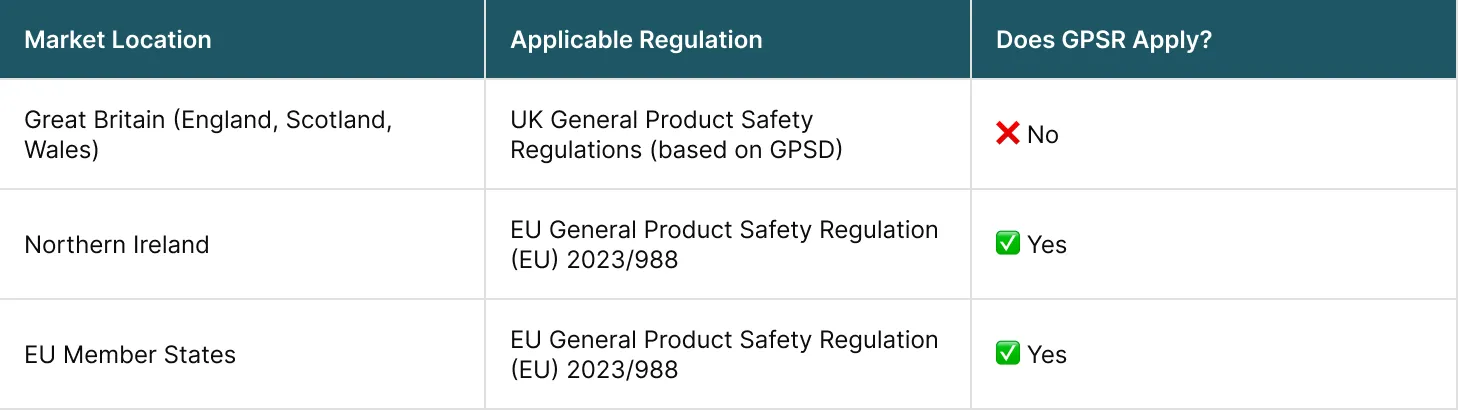
Northern Ireland follows EU product safety rules. It is because of post Brexit policy. It caused regulatory divergence. This can be observed between GB and the EU.
So, a product sold in London may follow UK rules. The same product sold in Belfast, NI must follow GPSR. Thus, cross border trade is more complex now.
Did You Know?
Products sold only in Great Britain do not need to follow GPSR, but the moment you sell into the EU or Northern Ireland, the rules apply.
What Products Are Covered Under GPSR
GPSR covers all non food consumer products including new, used and repaired goods. This also covers reconditioned goods. The digital products and CE marked goods are also included.
Even the products already CE marked may need to follow GPSR UK. There are some exemptions though. GPSR does not apply to:
- Medicines
- Medical devices
- Food and animal feed
- Live plants and animals
- GMOs used in controlled settings
- Animal by-products
- Plant protection products (like pesticides)
- Transport equipment used by service providers
- Low-risk aircraft
- Antiques
- Products clearly marked for repair before they are used
- Products made only for professional use, not for consumers
Some products are exempted from GPSR UK. But they still need to comply with other EU laws. Because product safety is still important.
Some products, like toys, are covered by specific EU harmonisation laws. For them, GPSR applies to risks that are not already covered.
However, some parts of GPSR apply to all products.
What Is EU Responsible Person Requirement
GPSR labelling requirements introduced EU based Responsible Person.
An economic operator must be there in the EU. Otherwise, a product can not be placed on the EU market. That operator becomes the Responsible Person under GPSR. This applies especially to non-EU businesses.
The Responsible Person acts as:
- A representative who makes sure the product follows the product safety rules
- A contact point for EU officials
- The person who keeps the required technical documents
- The person who checks that labels and safety information are correct
The Responsible Person must be identifiable on the product and its packaging. The accompanying documentation should also identify them. Their name and address must appear clearly.
What are GPSR Labelling Requirements in 2026
Labelling is central to GPSR compliance.
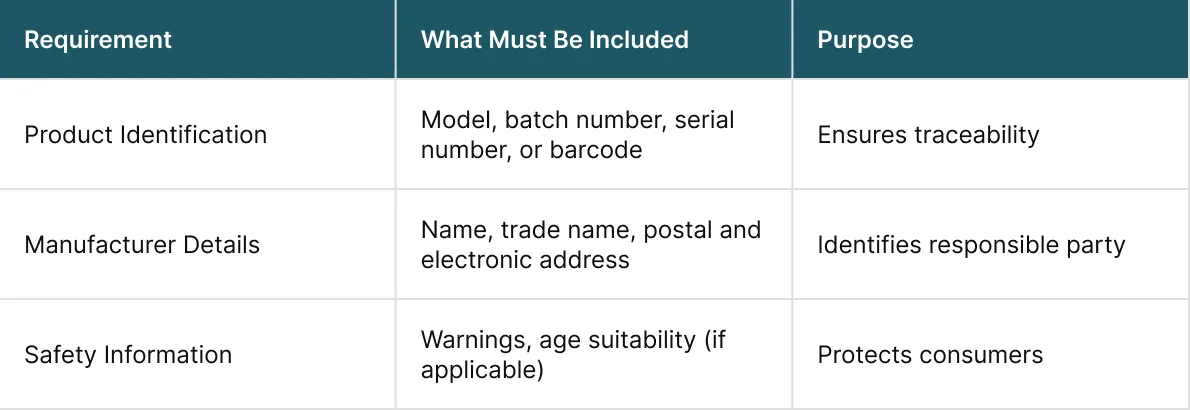
GPSR labelling requirements ensure each product must include:
- The product type or model name
- A batch number, serial number, or barcode
- The manufacturer’s name
- The manufacturer’s postal address
- The manufacturer’s email or online contact details
- Details of the Responsible Person, if needed
- Safety warnings, if required
- Age guidance, if relevant
- The registered brand name or trademark
Read more about how to register business in the UK.
Labels must be visible, legible and easy to understand. They should be in a language used in the target EU country.
Sometimes it is not possible to place information on the product. So it may be placed on the packaging. If not on the packaging, then it should be placed in the accompanying document.
Example of a Compliant GPSR Label
Below is an example of how a UK business should follow GPSR labelling requirements. This applies when they are selling in the EU or NI.
Manufacturer: Example UK Brand Ltd, Manchester, United Kingdom
support@exampleukbrand.co.uk
EU Responsible Person: Example EU Rep GmbH, Berlin, Germany
contact@exampleeurep.eu
Product: Cotton Hoodie – Size M
Model Number: HOOD-M-2026
Batch Number: 542789-C
Warning: Keep away from fire. Wash before first use.
This example shows the key elements required under GPSR. It includes manufacturer details, traceability information and safety warnings.
What are Risk Assessment Requirements under GPSR UK
Under GPSR, businesses must conduct thorough risk assessments.
Under the UK GPSR, the product’s design and the materials used are subject to checks. It also reviews the intended use. It then considers any expected misuse. Vulnerable users such as children or the elderly are also considered.
GPSR UK also checks the environmental conditions where the product will be used. The risk assessment must be written down in the technical files.
It shows that you have done your duty. It is the base of compliance.
What Are Technical Documentation Requirements of GPSR Regulations
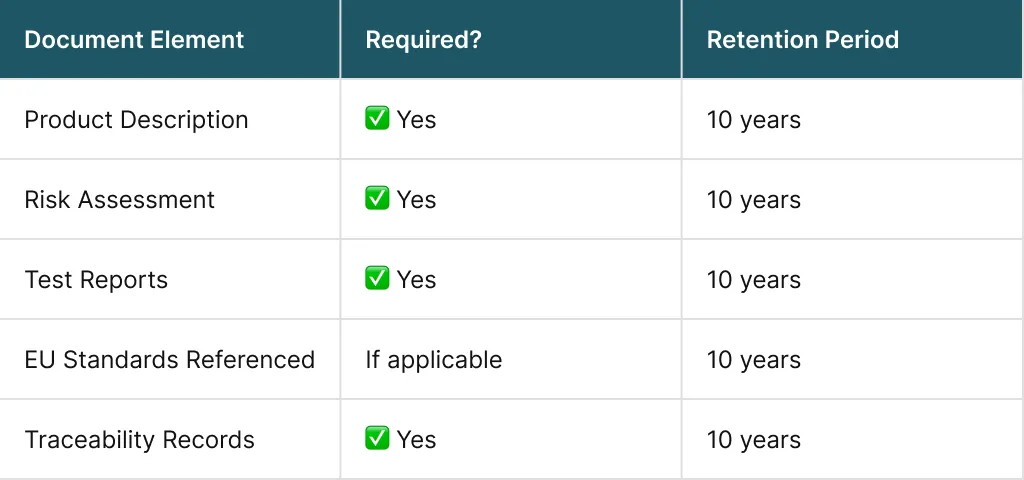
Technical documentation must include a product description. It must also have a risk analysis. It should contain test reports and a list of the European standards used. Safety instructions, labelling and traceability details are also part of it.
Documentation must be kept for at least 10 years after the product is placed on the market. EU market authorities can request these documents at any time.
What Is Traceability Under GPSR Labelling Requirements
Traceability means tracking where a product came from and where it was sold. It ensures products are quickly removed if they are not safe.
Businesses must be able to trace:
- Where the product came from
- Where the product was sent or sold
- Who handled the product along the way
Each product must have a batch number. If not, it must have a serial number or another clear identifier. Inspection officials have the authority to ask for these records.
Strong traceability systems lower the risk of recalls. They help with market checks.
What Are Online Market Obligations Under GPSR in 2026
By 2026, online marketplaces are under strict regulatory attention. GPSR UK notes that e-commerce is a major source of unsafe products being sold.
Online business must:
- Set up one clear contact point for officials and customers
- Register on the Safety Gate Portal
- Put proper product safety checks in place
- Work with market surveillance officials when needed
- Report products that are unsafe
- Remove unsafe products quickly once it is told
- Follow Regulation (EU) 2022/2065 (Digital Services Act)
- Clearly show all required product information on its website or app
Marketplaces are not always seen as ‘economic operators.’ But they still have to make sure dangerous products are not sold.
For online sales, the product listing must show:
- The manufacturer’s name
- The brand name or trademark
- The postal address and email or online contact details
- Clear product images
- The product type
- Product details such as SKU, barcode, or model number
- Safety warnings and age guidance, if required
Giving only a QR code is not enough as per GPSR labelling requirements. Digital information can help but it can not replace required visible labels.
Who Is Responsible for GPSR Labelling Compliance in 2026
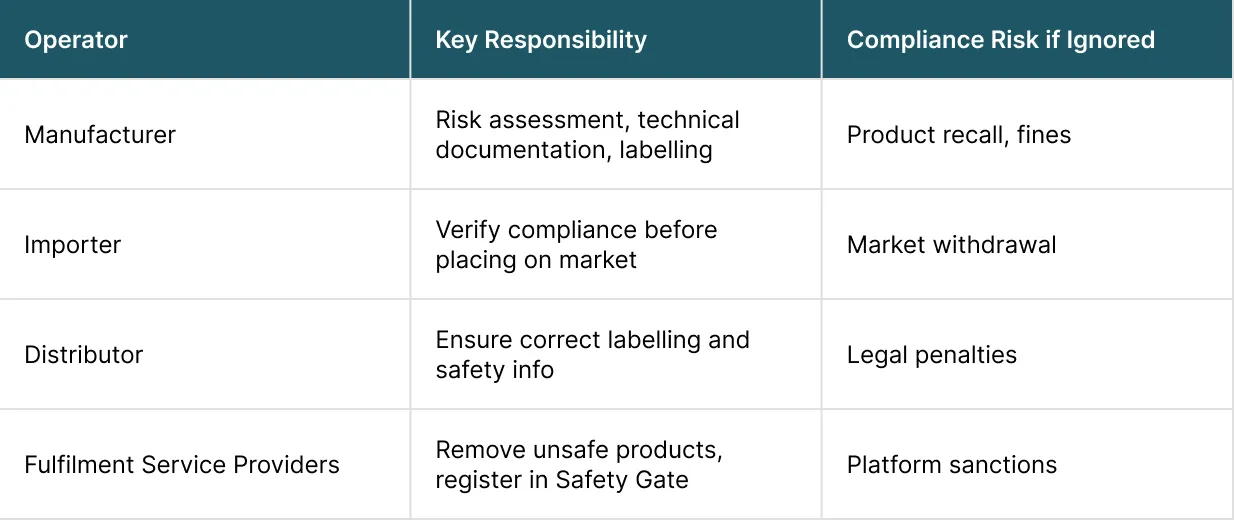
Understanding who is responsible is important. It can be learned with the help of the following:
1. Manufacturers
Manufacturers have the main responsibility. They must:
- Make sure products are safe by design
- Carry out risk checks
- Prepare and keep the required technical documents
- Make sure labels are correct and complete
- Keep documents for 10 years
- Keep checking that products remain safe
- Inform officials if there is a safety risk
- Fix problems and arrange recalls if needed
2. Importers
Importers are a second line of safety checks. They must:
- Make sure the manufacturer is following the regulations
- Confirm that a risk assessment has been done
- Check that labels and documents are correct
- Keep copies of the technical documents
- Work with officials if asked
3. Distributors
Distributors do not design products, but they still have legal duties. They must:
- Make sure products are properly labelled
- Check that safety instructions are included
- Not sell products they know are unsafe
- Help with recalls or other corrective actions
4. Fulfilment Service Providers
Sometimes there is no other EU-based operator. In that case, fulfilment providers can become the Responsible Person.
This has major implications for warehouse operators and logistics centres.
Who Becomes the EU Responsible Person Under GPSR
The GPSR provides a hierarchy:
- EU-based manufacturer: They automatically become the Responsible Person.
- EU-based importer: They become the Responsible Person if the manufacturer is outside the EU.
If goods are also being brought into the UK, import VAT may apply at the border too. See: VAT on imports in the UK.
- Authorised Representative: They are chosen through a written agreement.
- Fulfilment Service Provider: They are automatically made the Responsible Person where no EU based manufacturer, importer or authorised representative has been appointed.
This means that even warehouses or logistics centres in the EU can become Responsible Persons. This applies if no other party takes responsibility.
For UK SMEs, this often means paying for an authorised representative in the EU. Many small businesses are now thinking again about whether to export. They want to ensure if it is still worth the cost.
What Are GPSR Waste Disposal Requirements
One often overlooked area is product disposal after recall.
If a product is recalled, its disposal must:
- Protect the environment
- Support sustainability goals
- Follow the relevant EU environmental laws
This connects GPSR with broader EU law. Businesses must consider environmental impact when they remove goods that are not safe.
What Businesses Are Affected by GPSR Labelling Requirement
Many people link GPSR with electronics or toys. But it also covers clothing and textiles.
In this sector, compliance includes:
- Reducing choking risks from small parts, like buttons
- Avoiding strangulation risks from drawstrings
- Making sure chemicals are safe (such as azo dyes, formaldehyde, and heavy metals)
- Providing clear safety information where needed
- Keeping traceability records to show where the product came from and where it went
Textile products must follow EU rules on fibre labelling (Regulation (EU) No 1007/2011)).
Small fashion brands selling on sites like Etsy or their own websites must follow these rules. The regulations apply if they ship to the EU or NI.
E-commerce compliance is especially important for fashion brands.
How Does GPSR Labelling Requirement Benefits Consumer
GPSR labelling requirements help consumers know more and report their problems. They make consumer rights stronger.
Consumers now have better ways to report unsafe products. GPSR labelling requirements give more transparency and access to product information. Market inspectors can act faster. Systems like Safety Gate help share alerts across countries.
This update means product safety is not just a legal issue. It also affects a brand’s reputation. A safety alert can harm trust. In 2026’s connected digital world, it happens even faster.
Operational vs Product Safety Compliance
GPSR compliance can be viewed in two ways. They are:
1. Operational
Businesses must assign responsibilities among economic operators. They also appoint an EU Responsible Person and ensure online disclosures are complete.
In addition, maintaining traceability systems and implementing internal compliance processes is also important.
2. Product Safety
Businesses must conduct detailed risk assessments and validate product safety through testing. Mitigating identified hazards and maintaining updated technical documentation is also important. They must also ensure compliant labelling.
Both of them are necessary. One can not replace the other.
Trade Barrier Under GPSR Labelling Requirements
For British businesses, GPSR adds extra complexity.
Key points:
- GPSR does not apply to products sold only in Great Britain.
- It does apply to products sold in the EU and Northern Ireland.
- UK rules still follow the older GPSD framework.
- This means the rules are now different across markets.
Northern Ireland follows EU rules due to post-Brexit arrangements.
Many small UK businesses are rethinking selling to the EU because:
- They must appoint an EU Responsible Person
- Compliance costs are higher
- There is more paperwork to manage
SMEs represent around 60% of the UK workforce. Increased trade barriers may affect employment and growth.
Consumers may also feel the effects:
- Northern Ireland may have fewer product choices.
- As small businesses try to recover lost export income, prices in Great Britain may increase.
It shows why GPSR labelling requirements are not only legal. It is also political and commercial.
Heads Up
Online sellers must display manufacturer details, product identifiers and safety warnings directly on the product page. Hidden PDFs are not enough.
Consequences of Not Following GPSR Labelling Requirements
GPSR labelling requirements in 2026 are strict. Failure to comply them can lead to:
- Product recalls
- Products being removed from the market
- Financial penalties
- Fines and other sanctions
- Legal action
- Suspension from the market
- Damage to your reputation
- Loss of customer trust
Officials now have more powers. Inspections are more effective. It improved cooperation between EU states.
Correcting labelling later on is not always possible. Prevention is far cheaper. Non following GPSR labelling requirements is expensive. But more importantly, it damages trust.
“An ounce of prevention is worth a pound of cure.”
Benjamin Franklin
GPSR Compliance Checklist for 2026
Risk assessment requirements and technical documentation standards are updated on GPSR UK. To stay compliant with updated GPSR UK requirements, complete these steps:
- Check your product labels
- Fix any missing or wrong details
- Make sure your EU Responsible Person is set up correctly
- Update your product risk checks
- Keep your technical documents complete and up to date
- Store compliance records for 10 years
- Update online listings with the required safety and business details
- Train staff on traceability and record keeping
- Keep clear supply chain records (batch, serial, and supplier details)
- Check Safety Gate alerts regularly
- Keep a clear recall plan ready in writing
- Get expert help if needed
Compliance is ongoing, not a one-time action.
Why It Matters
Non-compliant products can be withdrawn, recalled, or fined. By 2026, EU market surveillance inspections are more active than ever.
Conclusion
GPSR has transformed product safety across the EU. Today, there are strict checks. Enforcement is active and there is more accountability.
GPSR regulations add complexity to UK businesses. You must follow when you are selling to the EU and Northern Ireland. GPSR labelling requirements are important. They ensure traceability and labelling clarity.
In addition, GPSR labelling requirements ensure that products on the EU market are safe. They also ensure that these products are supported by accountable operators.
Sterling Cooper Consultants understand that ignoring GPSR is not an option. You should prepare early and maintain proper documentation.
Making compliance a part of your operational culture is important. It helps you succeed in the EU market in 2026 and beyond. Not following GPSR labelling requirements can lead to:
- Product recalls
- Fines and financial penalties
- Removal from online marketplaces
- Damage to your reputation
GPSR UK is about consumer protection. It also maintains accountability and transparency. GPSR labelling requires consumer trust and long-term market access in the EU. Contact us today to treat labelling documentation as strategic priorities.
Worried your GPSR labels are wrong and could block EU or NI sales?
We check your labels, sort the Responsible Person setup and organise your documents. Contact us to sell into the EU or Northern Ireland with confidence.
FAQs
GPSR does not apply to some categories, such as medicinal products, food and feed, living plants and animals (including certain GMOs in contained use), animal by-products, and plant protection products. It also excludes antiques and products clearly marked to be repaired or reconditioned before use.
GPSR compliance mainly means: sell only safe products, carry out a risk assessment, keep technical documentation, ensure traceability, and provide clear labelling and safety warnings. If you sell online, required product and safety information must also be shown on the listing.
You need technical documentation that shows the product is safe, including a product description, risk analysis, and other safety proof. This documentation must be kept available for authorities for 10 years after the product is placed on the market.
A GPSR label should clearly show product identification (type/model and batch/serial or similar), and manufacturer details (name and contact info). Any warnings or safety information must be in a language consumers can understand in the country where it is sold.
GPSR is the EU General Product Safety Regulation (EU) 2023/988, a law that updates product safety rules and replaces the older directive. It has applied since 13 December 2024.
To be compliant, check if your product is covered, do a risk assessment, prepare and keep technical documents, add correct labels and warnings, and keep traceability (batch/serial or similar). If you sell into the EU from outside, you also need an EU-based economic operator responsible for compliance.
GPSR applies across EU Member States (and it is also relevant to the wider EEA context in the regulation’s scope). It also applies in Northern Ireland due to post-Brexit arrangements for product safety rules there.
GPSR is mandatory for products placed on the EU market and it also applies to Northern Ireland. It does not apply to goods placed only on the Great Britain market (England, Scotland, Wales).
In Great Britain, product safety follows UK rules (based on the older framework). In Northern Ireland, EU GPSR rules apply from 13 December 2024 for general product safety.
GPSR broadly covers non-food consumer products, including products sold online, and it can include new, used, repaired, or reconditioned items where no more specific EU product safety law fully covers the risks.
Countries affected include all EU countries (and Northern Ireland for UK trade). GPSR is the EU’s updated product safety law, applying from 13 December 2024.
It does not apply to products sold only in Great Britain, but it does apply if a UK business sells into the EU or Northern Ireland.
GPSR compliance means meeting the rules on safety checks (risk assessment), technical documentation kept for 10 years, traceability, and clear labelling and warnings, including language rules for safety information.
Recent Posts