Posted by:
Admin
Date:
August 18, 2026
Category:
Final Accounts vs Management Accounts: What’s the Difference?
What happened to your business last year? Your final accounts can tell you.
But what is happening this month? Are costs rising? Are profit margins falling? Will you have enough cash to cover the next few months?
For these questions, final accounts may not provide all the detail you need. This is where management accounts can help.
Both types of accounts use financial information from your business, but they serve different purposes. Final accounts provide a formal record of your financial performance and position over a completed accounting period. Management accounts offer more regular insights to help you monitor performance, plan ahead and make informed decisions.
Understanding the difference between final accounts and management accounts can help you decide what financial information your business needs as it operates and grows.
Key Takeaways
- Final accounts show a business’s financial performance and position for a completed accounting period.
- Management accounts provide regular financial information to support internal decision-making.
- Final accounts must follow applicable accounting rules, while management accounts can be tailored to your business needs.
- Management accounts can include budgets, forecasts, key performance indicators (KPIs) and cash flow information.
- Final accounts support compliance and external reporting.
- Growing businesses can benefit from both to understand past performance and make better-informed decisions.
What Are Final Accounts?
Final accounts are prepared at the end of an accounting period to provide a formal record of a business’s financial performance and position. For UK limited companies, these are generally referred to as statutory accounts.
According to GOV.UK guidance on preparing annual accounts, statutory accounts generally include a balance sheet, profit and loss account and notes to the accounts. Depending on the company’s circumstances, a directors’ report and an auditor’s report may also be required.
Final accounts are important for meeting relevant Companies House requirements, supporting Corporation Tax reporting and helping shareholders understand the company’s financial position.
What Do Final Accounts Include?
The exact contents depend on the company’s size, structure and applicable accounting framework. They can include:
- Profit and loss account: Shows the company’s income, expenses and profit or loss over an accounting period.
- Balance sheet: Provides a snapshot of the company’s assets, liabilities and equity at a particular date.
- Notes to the accounts: Provide additional information to help readers understand the figures.
- Directors’ report: Provides information about the company’s business and performance where required.
- Auditor’s report: Provides an independent audit opinion where an audit is required.
Final accounts are prepared using accounting records for the completed financial year. They therefore provide an important historical view of the business rather than a live picture of current performance.
What Are Management Accounts?
Management accounts are financial reports prepared for the people responsible for running a business. Unlike statutory accounts, they do not follow one fixed format for every business. Instead, they can be tailored to the information owners and management teams need.
They are often prepared monthly or quarterly and can help answer practical questions about profitability, spending, cash flow and future performance.
What Do Management Accounts Include?
Depending on your business’s needs, management accounts can cover:
- Sales and costs: Track income and expenditure over a particular period.
- Gross and net profit: Help assess profitability and identify changes in margins.
- Cash flow: Show how money moves into and out of the business.
- Budget against actual results: Highlight differences between expected and actual performance.
- Key performance indicators (KPIs): Track financial measures relevant to business objectives.
- Department or product performance: Help identify which areas contribute most to revenue or profit.
- Debtors and creditors: Provide visibility of money owed to the business and amounts it needs to pay.
- Forecast financial results: Help assess potential future performance and financial requirements.
The Department for Education’s 2026 management accounts guidance for colleges highlights the importance of comparing actual performance against budgets and forecasting the expected financial position. Although this guidance is designed for colleges, these principles also illustrate how management accounts can support financial oversight and planning in other organisations.
For a business owner, regular reporting can help identify changes before they become more difficult to address. For example, if sales increase but profit margins fall, management accounts can help you investigate rising costs or changes in pricing while there is still time to respond.
Final Accounts vs Management Accounts: What Is the Difference?
The main difference comes down to purpose, timing and audience. Although both use financial information from your business, each serves a different role.
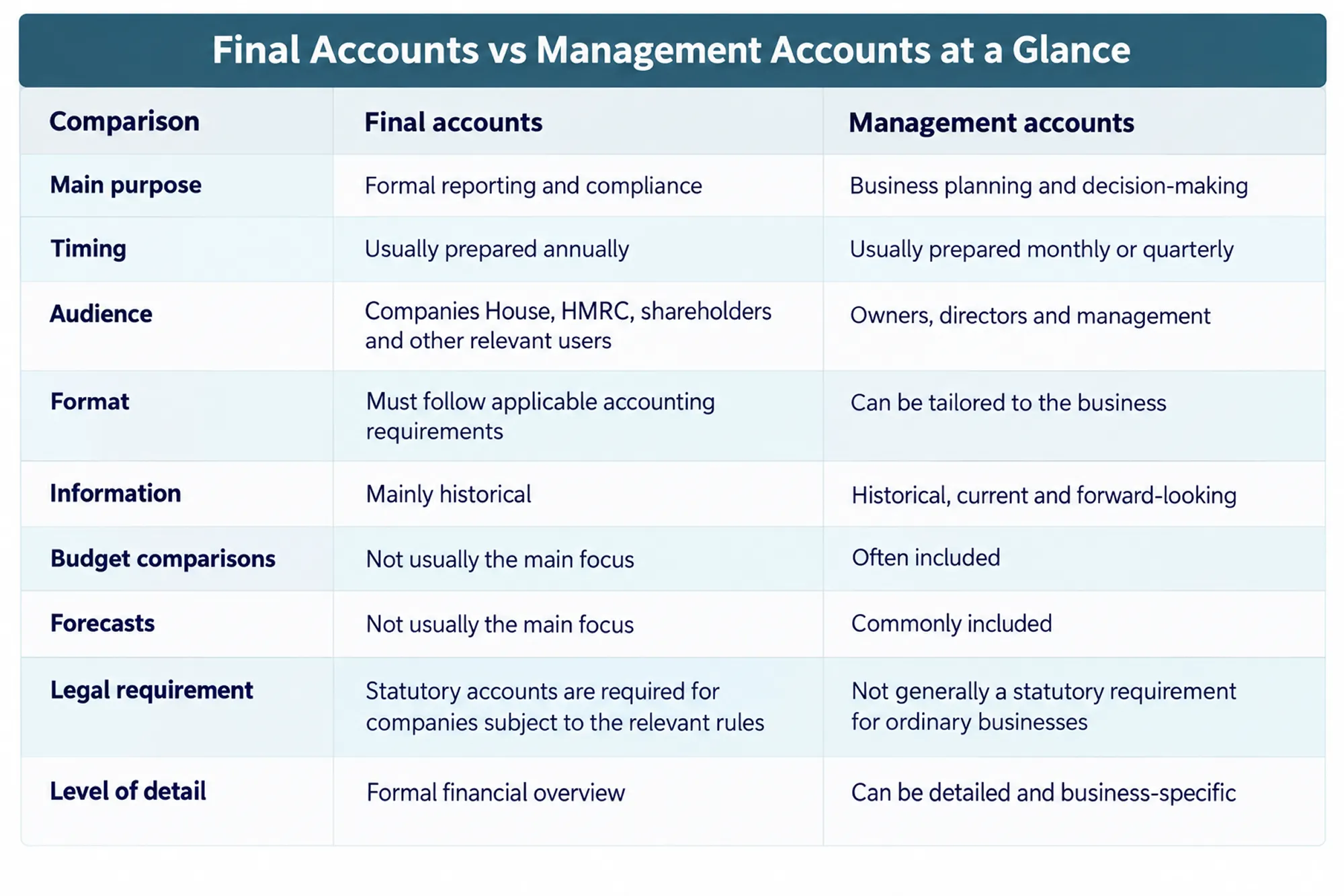
GOV.UK guidance on annual accounts for limited companies explains the requirement to prepare statutory accounts and meet relevant reporting obligations. Management accounts, by contrast, are designed around the information management needs to monitor performance and plan ahead.
Can You Use Both Final Accounts and Management Accounts?
Yes. Many businesses benefit from using both because they provide different but complementary views of the company’s finances.
Final accounts provide the formal year-end record. Management accounts offer more regular information to help owners and directors monitor performance and make decisions during the year.
The two are not competing sets of accounts. They answer different questions:
- Final accounts: How did the business perform over the completed financial year?
- Management accounts: How is the business performing now, and what might happen next?
Using both can give business owners a clearer view of past performance, current results and future financial needs.
Case Study: How Management Accounts Can Support Business Decisions
An ICAEW case study involving Six Island Bay Developments Limited illustrates how management accounts can support ongoing financial assessment.
The company’s directors reviewed the business each October using management accounts for the first nine months of the year, alongside the current-year forecast and the budget for the following year. They used this information when considering whether there were indicators of impairment in the business.
The example demonstrates how management accounts can support more than routine financial monitoring. By reviewing current results alongside forecasts and budgets, directors can use financial information to inform wider business decisions.
Which Accounts Does Your Business Need?
Final accounts and management accounts both provide valuable financial information, but they serve different purposes.
Final accounts provide a formal record of a business’s financial performance and position for a completed accounting period. Management accounts offer more regular and flexible information to help owners and directors monitor performance, control costs and plan ahead.
For a small business, annual final accounts may be enough to meet its reporting requirements. As the business grows and financial decisions become more complex, management accounts can provide the additional detail needed to make decisions with greater confidence.
Sterling Cooper Consultants supports businesses with accounting and financial reporting, including the preparation of accounts and management information. By understanding each business’s requirements, the aim is to provide financial information that supports both compliance and day-to-day decision-making.
Need Help With Your Business Accounts?
FAQs
Recent Posts