

Posted by:
Admin
Date:
June 2, 2026
Category:
blogs
Accounting vs Treasury: What’s the Difference?
Ever wondered why some companies make great profits but face issues with cash flow?
This happens because many firms struggle with accounting vs treasury handling. So, there is a need for the separation of accounting and treasury.
Research shows that 82% of SMEs faced cash flow problems in 2025. This shows that firms focus more on treasury handling.
Accounting and treasury have different jobs in the business. Accounting records the payments and makes reports. Treasury is the management of cash flow, risk assessment and a firm’s finances. Understanding accounting vs treasury helps firms manage money better.
Key Takeaways
- Accounting focuses on financial reporting, compliance, and record-keeping.
- Treasury focuses on cash flow, liquidity, and financial risk management.
- The main difference between treasury and accounting is their financial focus and time horizon.
- Treasury teams help businesses manage cash and prepare for financial uncertainty.
- Accounting teams help businesses maintain accurate financial records and compliance.
- Treasury analyst vs accountant roles differ in daily responsibilities and skill sets.
- Treasury and accounts payable teams work together to manage supplier payments and cash flow.
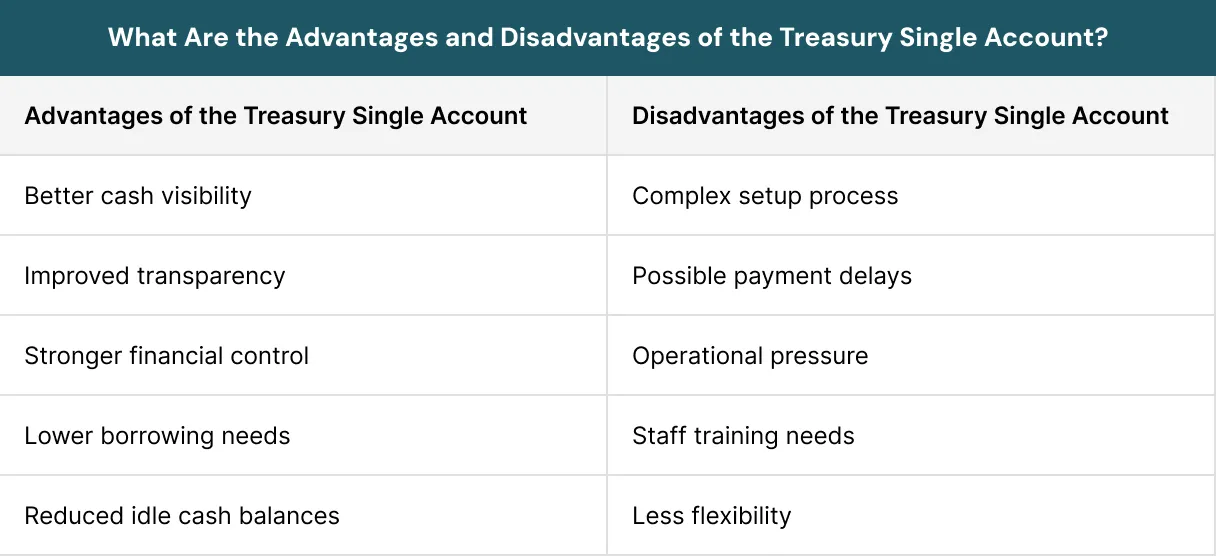
- The advantages and disadvantages of the treasury single account include stronger financial control, but possible operational challenges.
- Businesses achieve better financial stability when treasury and accounting teams communicate effectively.
- Modern technology helps accounting and treasury teams improve forecasting, reporting, and financial planning.
What Does Accounting Do in a Business?
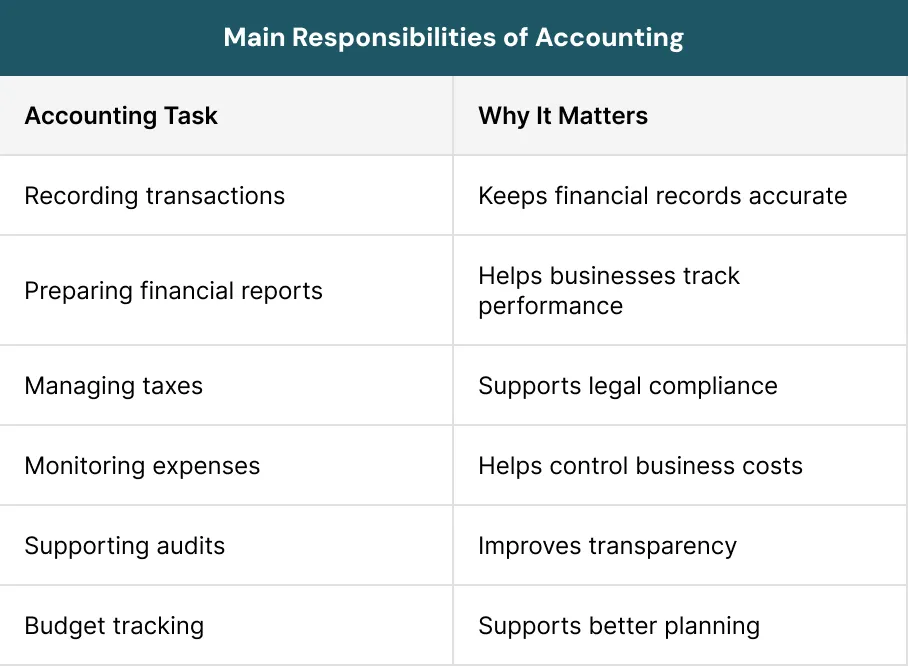
Understanding accounting vs treasury helps firms manage finance tasks. This includes the report, cost and taxes. These help to manage the profit and loss. It also shows how the firm works.
It focuses more on past and current financial issues. Poor accounting can cause many issues. It includes bad report-making and budgeting problems. This is one of the key parts of accounting vs treasury.
Key Point:
Accounting focuses on reporting, compliance, and financial accuracy. It helps businesses understand their financial position clearly.
Why Is Accounting Important for Businesses?
It helps businesses know about their finances. Many firms improve planning when they understand accounting vs treasury. Businesses use accounting information to make business decisions. The decisions are about hiring workers, spending and investing. Investors and banks use these reports to make decisions.
Further, accounting helps firms do the following:
- Keep a good budget
- Prevent mistakes
- Register profits and losses
- Prepare finance
- Follow rules
As the firm expands, it becomes more crucial.
What Does Treasury Management Do?
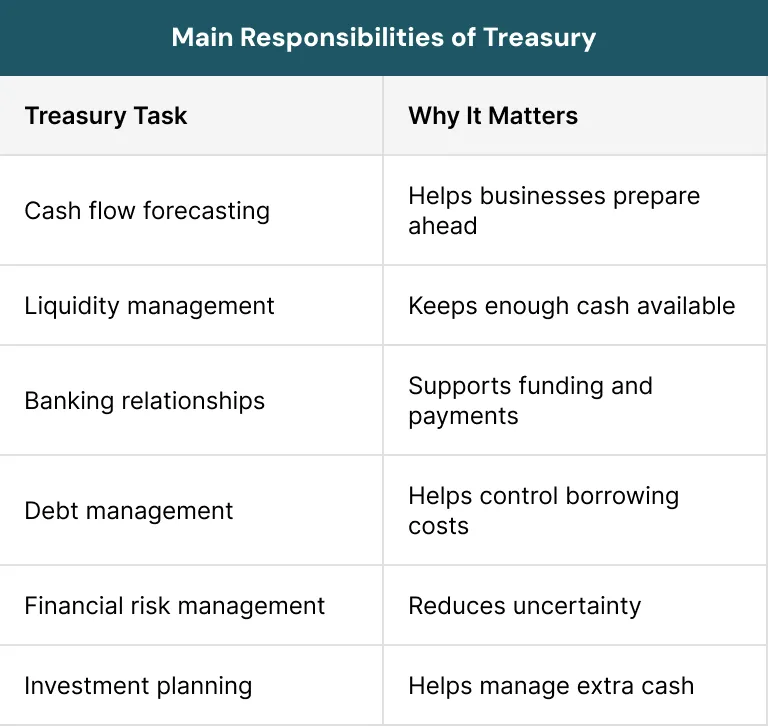
Treasury means handling a firm’s cash. It makes sure the firm can pay salaries and bills. It also handles bank payments and financial risks.
Treasury also assesses future situations. For instance, they may predict future cash flow problems or interest rate risks.
Why It Matters:
Treasury teams help businesses stay financially stable during uncertain market conditions.
Why Is Treasury Important for Businesses?
Treasury is vital for firms because sometimes a business can make a profit but still face issues. This occurs when cash flow is poorly managed. It helps businesses to avoid these mistakes. Cash planning is a major part of the accounting vs treasury comparison.
They are supported by:
- Cash managing
- Predicting cash flow
- Reducing financial risk
- Future cash needs
- Supporting financial safety
It has become more crucial as businesses face rising costs and market risk.
Accounting vs Treasury
Accounting vs treasury both deal with finances. But their roles are quite different.
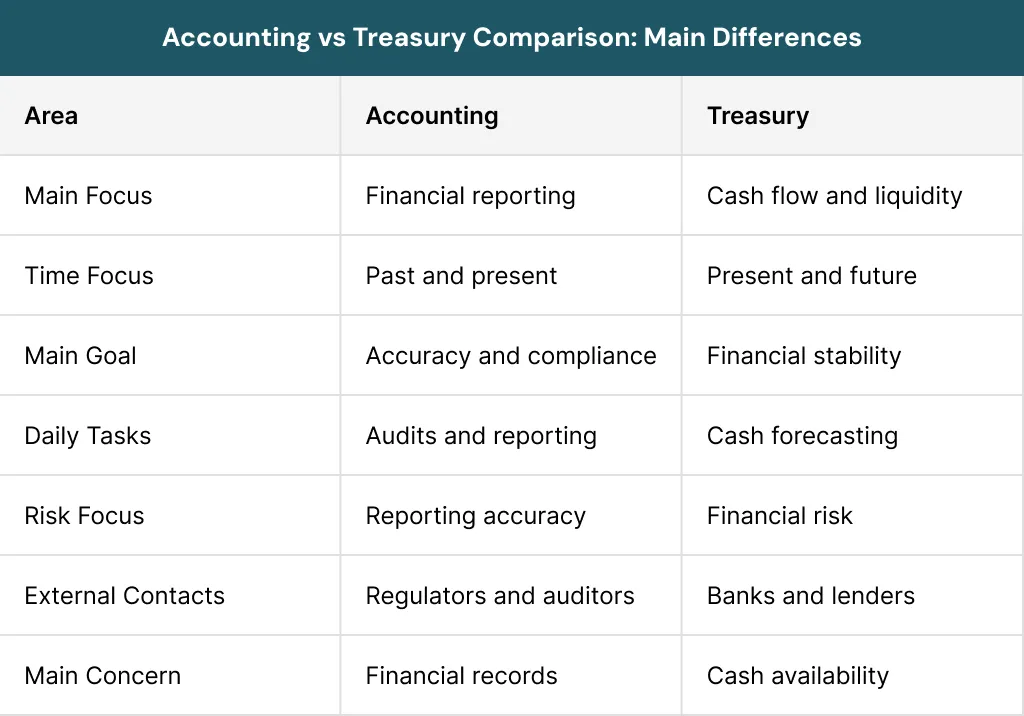
The above table explains career roles in accounting vs treasury.
How Do Accounting and Treasury Work Together?
The accounting team collects all financial data and reports. They use it for cash flow. It is also used for financial planning. Good cooperation is vital in accounting vs treasury handling.
Some examples are as follows:
- The accounting team controls business expenses.
- The treasury team considers business expenses when planning future finances.
Good teamwork between the two teams helps in better control. It also helps manage the company’s finances.
You can also check out our financial consultancy service for financial reporting and planning.
Quick Insight:
Accounting focuses on financial accuracy, while treasury focuses on liquidity and financial stability.
Treasury Analyst vs Accountant: What Is the Difference?
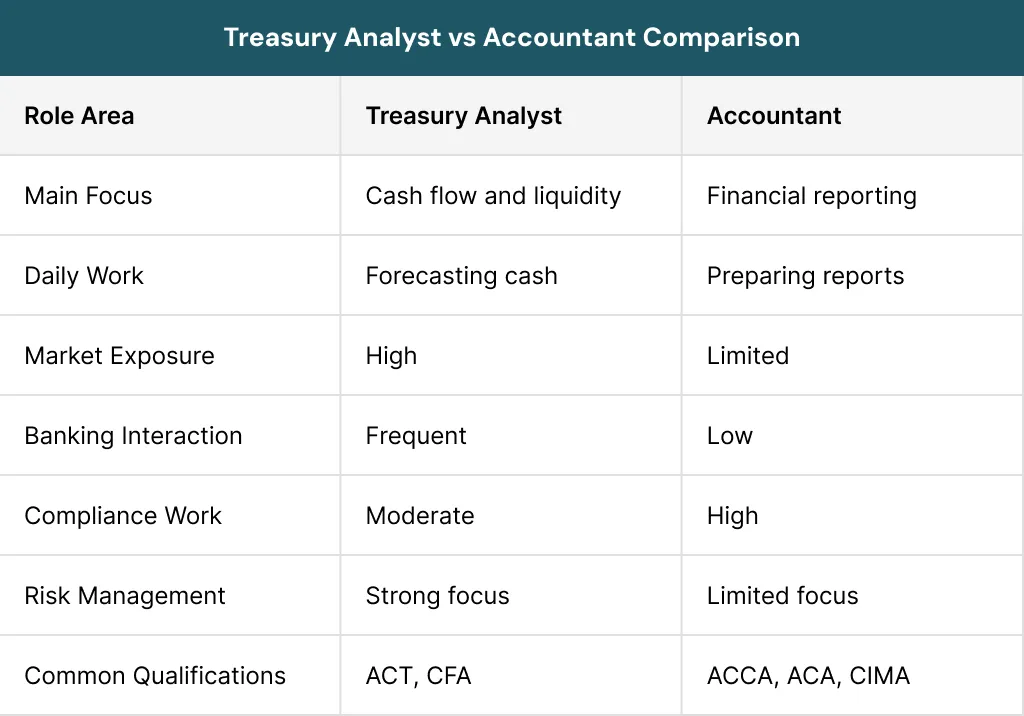
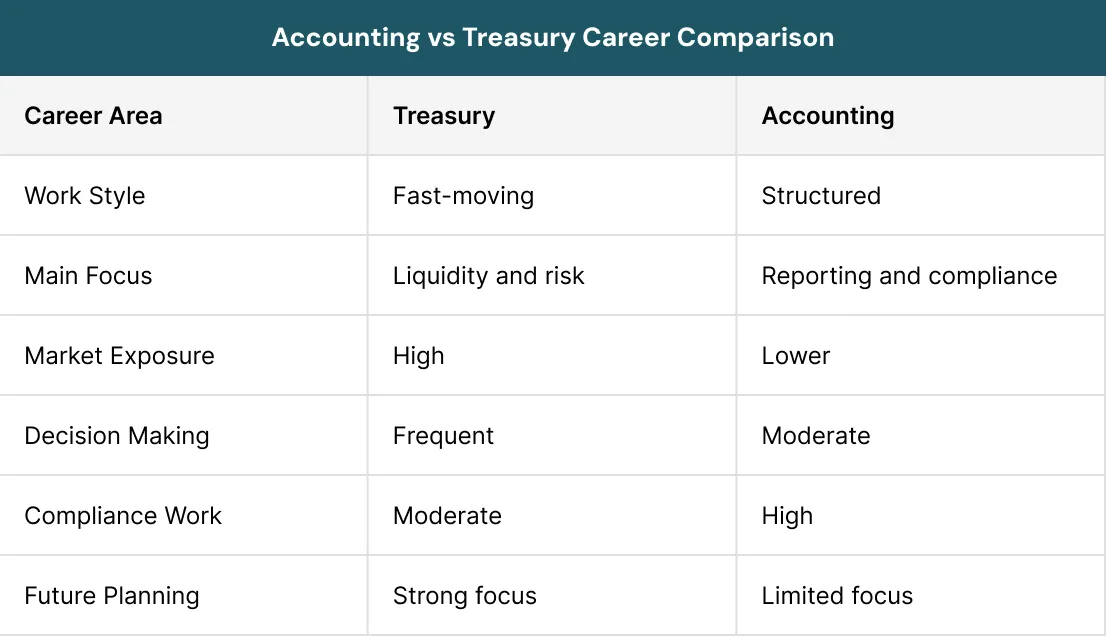
Treasury analyst vs accountant have financial handling as a common role. Still, many of their duties are different. Treasury analysts operate in fast-moving finance. Accountants work on fixed reporting work.
What Does a Treasury Analyst Do?
The treasury analyst helps manage cash flow. It also helps with financial risk for firms.
This involves:
- Cash flow planning
- Cash handling
- Banking work
- Financial investments
- Risk analysis
Treasury analysts must respond fast to market changes. Good planning skills are vital.
What Does an Accountant Do?
It involves handling firm accounts.
Some of their tasks may include:
- Preparation of accounting statements
- Recording of payments
- Tax work
- Audits
- Analysis of the budget and costs
Accountants help firms keep correct financial records and follow rules.
Treasury Analyst vs Accountant Comparison
Below is the difference between a Treasury Analyst vs Accountant:
Helpful Hint:
Treasury analysts focus more on future financial planning, while accountants focus more on reporting and compliance.
Treasury and Accounts Payable: How Do They Work Together?
The treasury and accounts payable teams must work together. They handle the payments for the firms. The accounts payable team manages supplier invoices. The Treasury team makes sure enough cash is available for payments. Payment control is another part of accounting vs treasury.
Good teamwork between treasury and accounts payable helps daily work run smoothly. It also helps to manage payments better.
What Is Accounts Payable?
Accounts payable are for money owed to suppliers.
The accounts payable team handles:
- Supplier invoices
- Payment schedules
- Purchase documentation
- Paid payments
How Treasury Supports Accounts Payable
Treasury staff help companies manage cash better.
This involves:
- Scheduling payments
- Managing cash
- Banking work
- Predicting cash flows
What Are the Advantages and Disadvantages of the Treasury Single Account?
Important Detail:
A Treasury Single Account improves visibility and control, but it still needs strong treasury management to work effectively.
Which Career Path Is Better: Treasury or Accounting?
There is no particular “better” career path between the two, treasury vs accounting. Choosing a better career path will always depend on what you like and your working style. Treasury is good for people who are interested in the flow of money. It helps businesses to improve their financial problems through a plan.
What Skills Do You Need for an Accounting Career?
One of the main skills is that you must be well-planned and work in detail. Major skills needed are:
- Accounting statements
- Focused
- Taxes
- Analysing
- Budgeting
Accounting jobs are normally planned and scheduled.
What Skills Do You Need for a Treasury Career?
The main skills needed for a treasury career include the ability to act quickly.
Treasury managers need skills like:
- Predicting cash flows
- Understanding risk handling
- Financial analysis skills
- Decision-making skills
- Banking understanding
They operate under stressful conditions. It helps during the unpredictable market conditions.
Accounting vs Treasury Career Comparison
Below is the comparison of Accounting vs Treasury Career:
“Cash is a fact. Profit is an opinion,” by Alfred Rappaport
This quote describes treasury handling well. Even when a company makes profits, cash flow keeps the business running each day.
How Do Accounting and Treasury Help Businesses?
They help firms during times of financial pressure.
They help by:
- Accounting shows the real state of a company’s finances.
- Accounting records income and costs to provide a clear view of business activities.
- The information is vital for making decisions and preparing budgets.
Treasury helps by:
- Controlling cash flow.
- It guarantees sufficient cash flows to cover wages, bills and other urgent costs.
- It predicts cash flow in the future and arranges cash when necessary.
Quick Example:
Accounting explains financial performance. Treasury helps businesses stay financially stable during uncertainty.
Case Study: How Better Treasury Planning Helped a UK Business
A small UK retail business was making good sales. But it still had cash flow problems.
Suppliers’ delayed payments. The business also struggled to pay daily costs when sales slowed.
However, the problem was not low sales but poor linking of accounting and treasury. The accounting team had an emphasis only on report generation and monthly figures. The treasury side was lacking the cash flow planning process. It resulted in difficulty in predicting future cash shortages.
This case study shows why the communication gaps must be addressed. Cash flow planning techniques must be used. If the business follows these, it can achieve the following results:
- Better supplier payment process
- Fewer issues with late payments
- Proper handling of cash flows
- Better decision-making about finances
- Financial control improvement
What Mistakes Do Businesses Make in Treasury and Accounting?
Poor financial handling leads to money issues. This happens because finance and accounting teams do not work well together.
There are many reasons why firms experience financial difficulties. Some firms focus more on profit and ignore their finances. Others delay in preparing their reports. While some are controlling their expenses. Poor planning can weaken accounting vs treasury processes.
The most common issues include:
- Not enough cash flow handling
- Delayed financial reporting
- Budgeting issues
- Failure to pay suppliers
- Lack of financial forecasts
Why Is Poor Cash Flow Planning a Problem?
Even if a business is profitable, it could still lack cash. Poor cash flow planning makes it hard to pay suppliers and staff. Treasury teams help by managing money coming in and going out. Effective cash flow handling prepares businesses for low seasons.
How Can Businesses Reduce Financial Mistakes?
Businesses can reduce mistakes by improving communication. Accounting and treasury teams should talk more often. Connected finance systems will help firms track reports, payments and cash flows. Review processes and financial planning will help make a decision.
Quick Reminder:
Strong accounting shows where the money went. Strong treasury planning helps control where money goes next.
What Challenges Do Businesses Face With Treasury and Accounting?
The common challenges businesses face include:
- Cash flow issues
- Delays in reporting
- Budget issues
- Payment issues
- Planning issues
Today, many firms use linked systems. These systems help accounting and treasury teams work better together. This ensures quick decision-making.
How Are Treasury and Accounting Changing in Modern Businesses?
Finance of business is rapidly changing. Today, firms need accounting and treasury for more than basic work. Today, modern finance teams help in planning, risk handling and business growth. New technologies have changed the finance team’s functions.
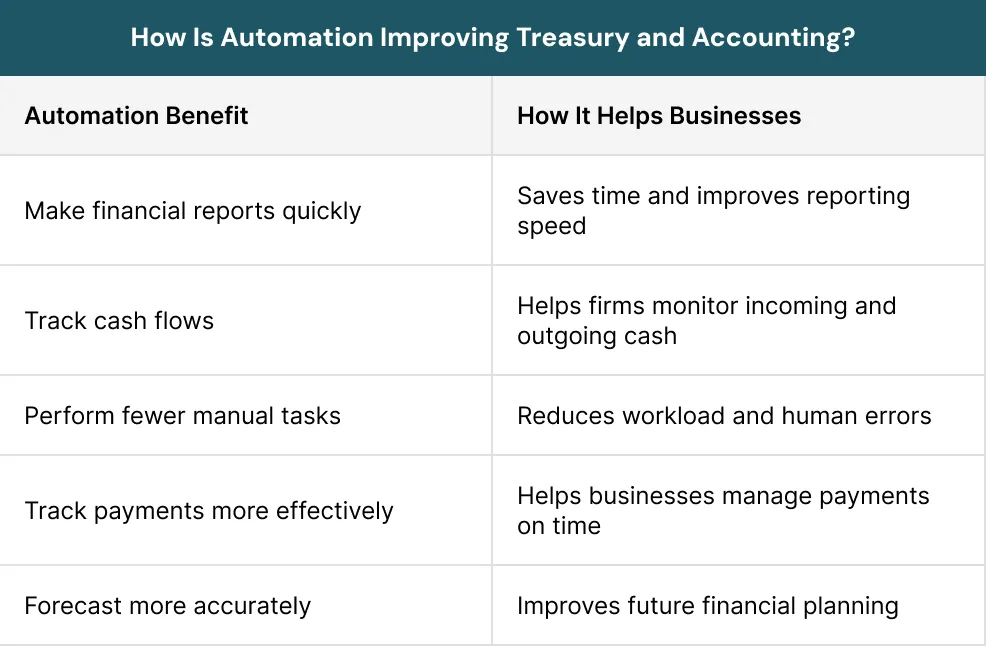
How Is Automation Improving Treasury and Accounting?
Automation tools are used by many firms to reduce time and errors. Automation gives finance teams more time to plan.
Why Are Finance Teams Becoming More Long-Term?
Accounting and treasury used to be concerned about the daily work of the firm.
Now, firms need finance teams’ help to plan their business plans and manage risks. Treasury prepares firms for any changes in the market sector. Accounting provides the financial information needed for making decisions.
How Is Technology Changing Treasury and Accounting?
Technology is constantly changing the work of the financial team. Many companies use cloud apps. They help with reports, payments, and financial work. Technology is bridging accounting vs treasury systems in many firms.
What Software Do Businesses Use for Treasury and Accounting?
Many firms now use digital tools for accounting and treasury work. These tools help businesses track cash flow, manage payments and create reports faster.
The digital tools include:
- QuickBooks Online
- Xero
- Kyriba
- CAPIX
- Expensify
- BlackLine
- Embat
The common software features included in these digital tools are:
- Cash flow tracking
- Payment management
- Budget planning
- Financial reports
- Risk tracking
Cloud-based systems also help accounting and treasury teams work better together.
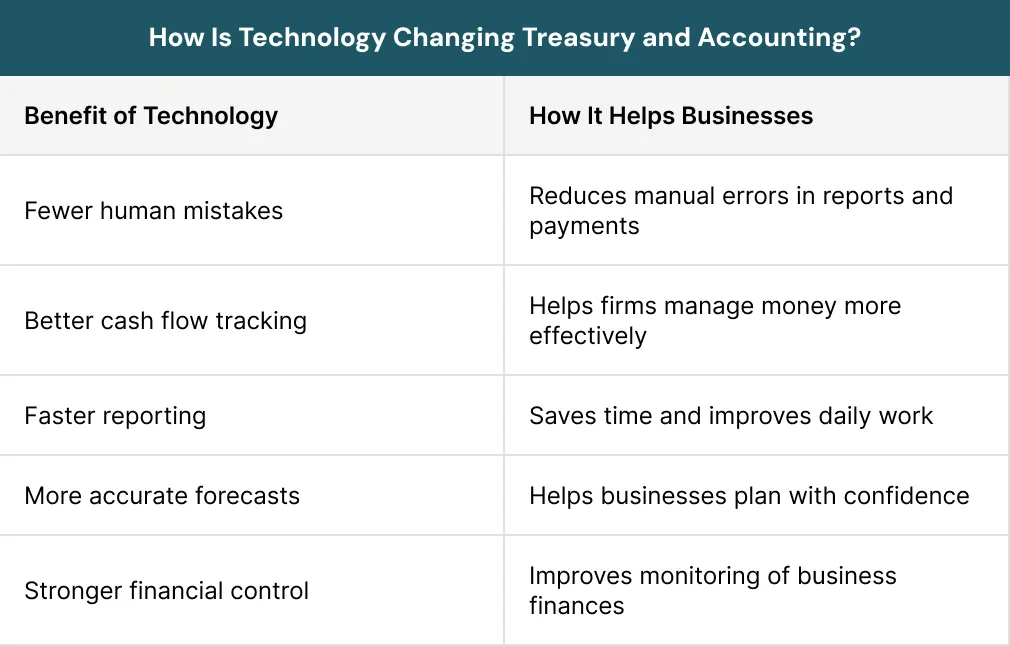
Treasury teams use technology to oversee financial risks. As systems improve, accounting and treasury teams work more closely together.
“Technology is best when it brings people together,” by Matt Mullenweg
Modern systems help accounting and treasury teams work better together.
How Can Businesses Improve Treasury and Accounting Processes?
Good teamwork between both teams improves business results. Effective communication and financial information will help firms here make better decisions.
Some ways that businesses can improve both teams include:
- Using financial software apps
- Improving cash flow
- Automating manual steps
- Regularly reviewing financial reports
- Helping internal controls
Many organisations also need external help to improve their financial handling systems. You can use our business consultancy services. They help improve your financial planning and daily work.
Best Practices:
Businesses achieve better financial stability when accounting and treasury teams work closely together.
Conclusion
Knowing the difference between accounting and treasury makes managing business finances easier. Even though both teams work together, their jobs are very different. The main task of accounting is to record payments correctly. The treasury team makes sure enough cash is available for payments. Firms that improve accounting vs treasury processes often make better financial decisions.
As financial problems grow, firms need good accounting. They also need strong treasury work. Sterling Cooper Consultants helps businesses in developing financial plans, reports and processes. If you need professional help in your finance team, feel free to contact us.
Struggling with cash flow, reporting, or financial planning?
Sterling Cooper Consultants helps businesses improve treasury management, financial reporting and work efficiency with practical support.
Ready to strengthen your financial processes? Reach out today if you want to manage your accounting reports flawlessly.
FAQs
The difference between treasury and accounting is their financial focus. Accounting manages reporting and compliance, while treasury focuses on cash flow, liquidity, and financial risk.
It depends on your interests. Treasury analysts focus more on forecasting and liquidity, while accountants focus more on reporting and compliance.
Treasury and accounts payable teams work together to manage supplier payments and maintain healthy cash flow across the business.
The advantages and disadvantages of the treasury single account include stronger financial control and better visibility, but also possible operational delays and implementation challenges.
Treasury helps businesses manage liquidity, improve cash flow, and reduce financial risk during uncertain market conditions.
Recent Posts

How to Build a Cash Reserve for Business Stability
August 11, 2026

How to Forecast Cash Flow During Economic Uncertainty
August 6, 2026