

Posted by:
Admin
Date:
January 20, 2026
Category:
blogs
Accounting Terms Made Easy: A Simple Guide for Non-Financial People
Have you heard about ‘assets’ and ‘liabilities’? We often hear such terms in the world of finance. On a surface level they sound simple. They take deeper meaning, when it comes to finance. It is important to understand basic accounting terms, even if you are not an accountant. Knowing these terms gives you a clearer view of your company’s finances. It also helps you make better and more informed decisions. This blog explains the key accounting and finance terms you should know.
If you want to learn more about bookkeeping and managing your money, read our guide for bookkeeping.
What Are Accounting Terms?
Accounting means keeping track of the money your business makes. It involves keeping track of and recording all cash transactions. It also means telling people about them. Accounting help companies stay on the legal side of the law. It also shows how much money they have. You need to know some simple accounting terms if you want to learn about it. If you are a small business owner or an individual worker, this is very helpful. You’ll understand how to make budgets and decisions about money a lot better.
“The role of accounting education in mastering technical terms has gained attention in the global arena. According to Bochkay et al. (2023), Kermis & Kermis (2010), accounting education plays a crucial role in preparing individuals for careers in the Þ nancial sector. It involves a comprehensive understanding of technical terms that are essential for effective financial reporting and analysis.”
Djuwari et al.
Here is some basic terminology of accounting that you need to know:
1. General terms:
These are the general accounting terms that you might need to know about.
Accounting Period
It is the length of time that a financial statement for operations covers. For instance, fiscal years, quarters, calendar years, etc. are all accounting periods. Each period covers one accounting cycle (8-step process that accountants do).
Double-Entry Bookkeeping
Every financial transaction is recorded two times. One entry is a debit, and the other is a credit. The books are “balanced” when total debits equal total credits.
Single-Entry Bookkeeping
In this system, each transaction is recorded only once. Income and costs are written as single entries in the accounts.
Debit
This accounting term refers to an item that raises assets or lowers liabilities. In accounting paperwork, debits are located on the left-hand side.
Credit
This accounting term refers to an item that raises obligations or lowers assets. In accounting papers, credits are located on the right-hand side. They serve as the functional opposite of debits.
Closing the Books
The closing of the books means the end of an accounting cycle. This finance term refers to the approval of financial data for specific timings.
General Ledger
A ledger is a system that keeps track of transactions. Businesses and organisations use ledgers, which are a system of accounting. General ledger (GL or G/L) is the accounting term for the master account that houses all ledger accounts.
Trial Balance
This accounting term means a list of all account balances at one time. After each reporting period, accountants make a trial balance. They use it to check if all numbers are correct.
Overhead (O/H)
This term means the costs needed for daily work. These costs help keep the business running. They are not added to the company’s services and products. However, they are crucial for running the company.
Return on Investment (ROI)
This accounting term is the profit or loss on an investment. It is usually expressed in the form of a percentage. It is calculated by dividing net profit by cost.
Payroll
Payroll accounting refers to records of payments made to employees. It also consists of an analysis of these payments. Fringe benefits and income checks are included in the payroll.
Diversification
Diversification is a way to lower risk. It helps you avoid putting too much money in one asset or business. For this, you may spread your capital across options.
Net Margin / Gross Margin
The phrase “net margin” describes net profit as a ratio of total revenues for a business. Gross margin indicates the net sales value less the cost of products sold.

2. Terms from Balance Sheet
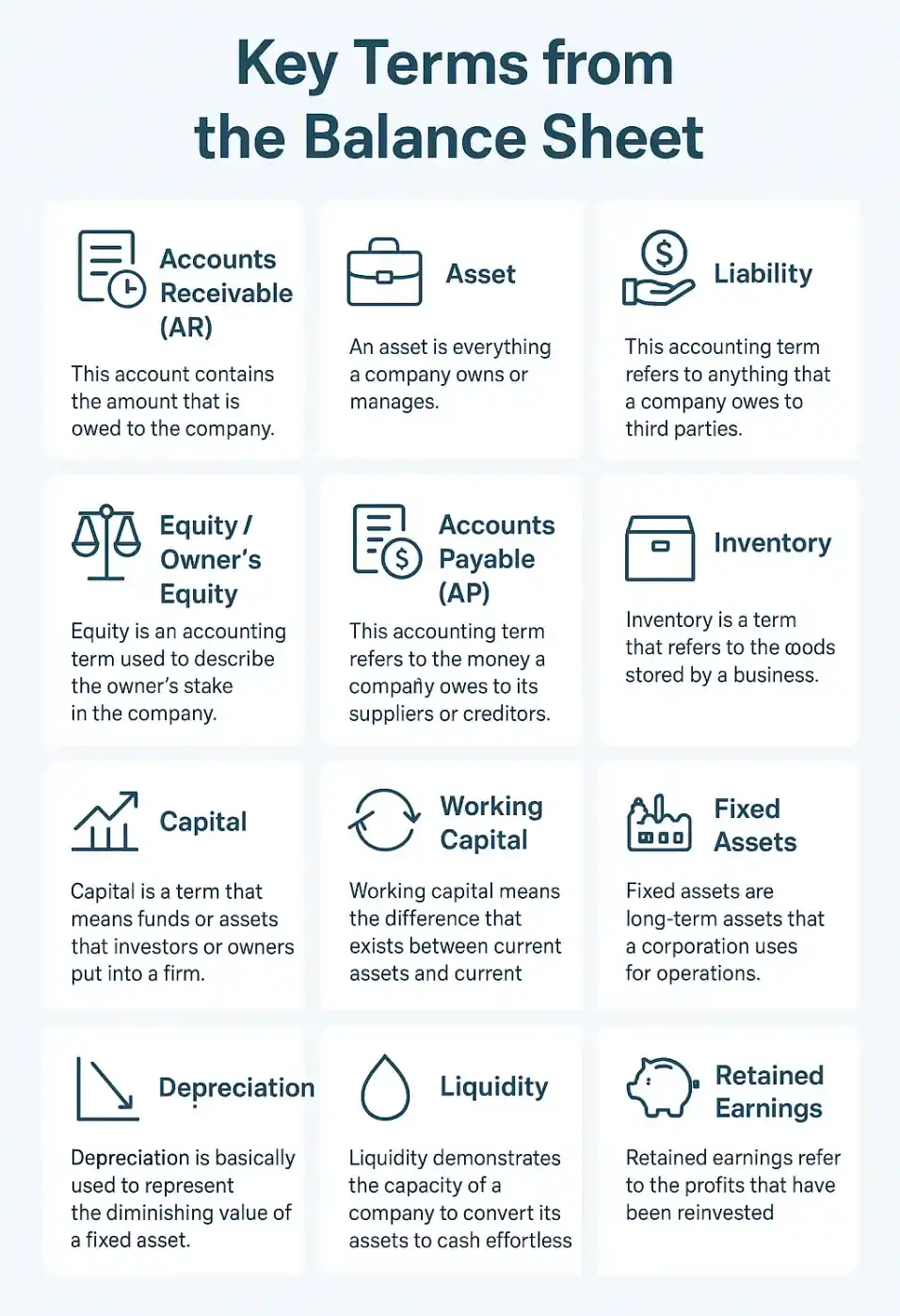
A balance sheet is the most commonly used financial report. It shows what a business owns, what it owes, and what the remainder is. The following are the terms that commonly appear in a balance sheet.Accounts Receivable (AR)
Asset
Liability
Equity / Owner’s Equity / Shareholders’ Equity
Accounts Payable (AP)
Inventory
Capital
Working Capital
Fixed Assets
Depreciation
Liquidity
Retained Earnings
Chart of Accounts
3. Terms from the Income Statement
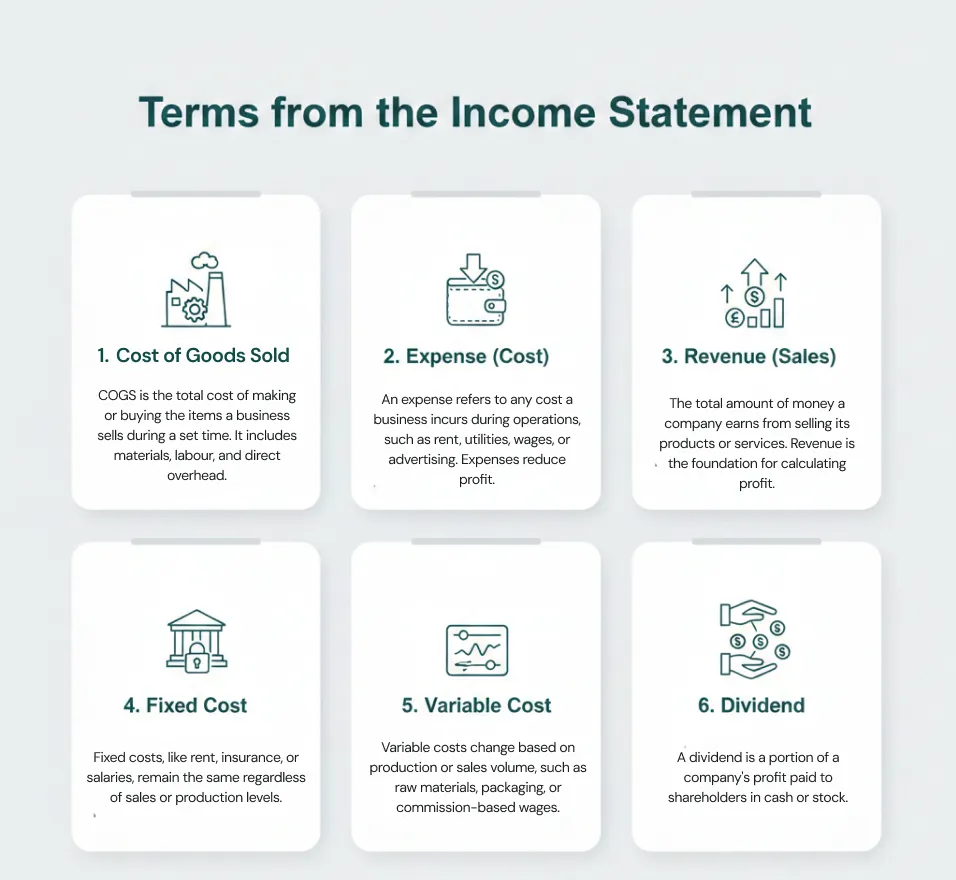
It is also known as a profit and loss statement. It reflects revenues, expenses and profits within a particular period of time. Revenue is shown at the top of the report. Then different costs are subtracted from it. After all costs are removed, the amount left is Net Income.Cost of Goods Sold (COGS)
Expense (Cost)
Revenue (Sales)
Fixed Cost
Variable Cost
Dividend
4. Terms from the Cash Flow Statement
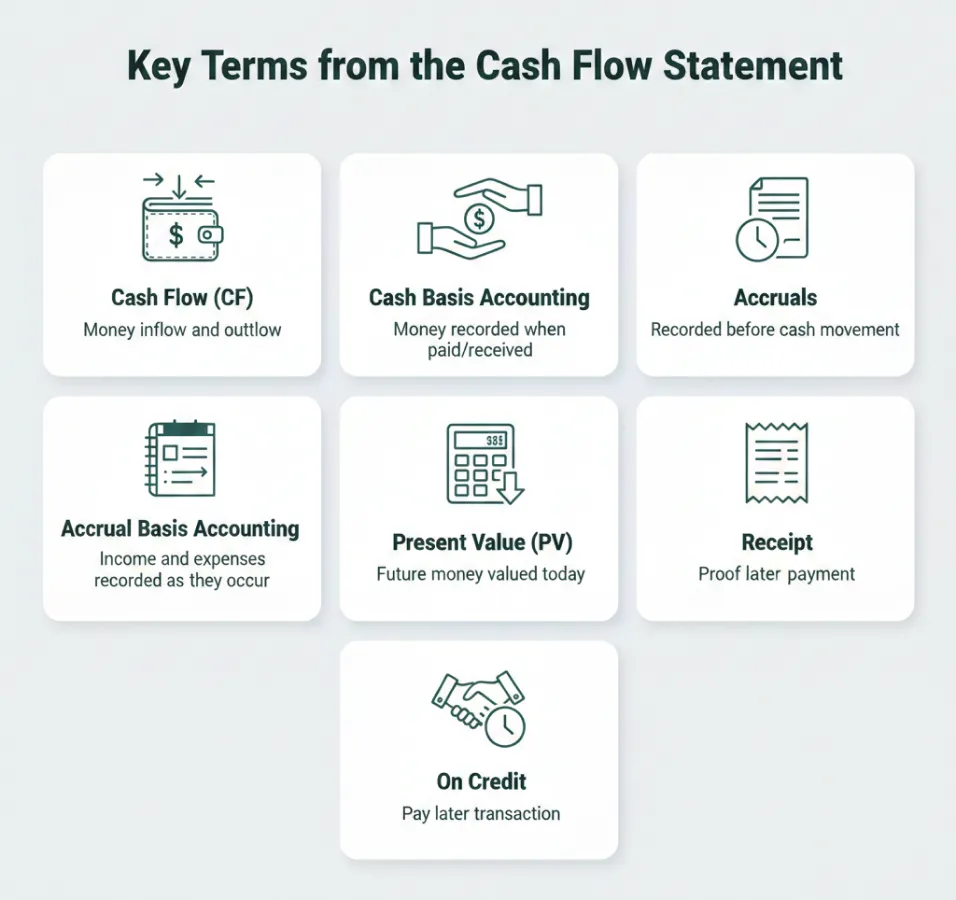
This is another very important accounting term. A cash flow statement constitutes a statement of finance that indicates the extent to which cash flows in and out of a business within a given period of time. Here are some of the important terms of the cash flow statement.Cash Flow (CF)
Cash Basis Accounting
Accruals
Accrual Basis Accounting
Present Value (PV)
Receipt
On Credit
5. Most Common Finance Terms You Should Know
Finance terms are words we use to talk about money. They help us understand things like saving, spending, investing, and how a business is doing. These terms make it easier to talk clearly about money in daily life or at work. Here is the finance terminology that you should pay attention to:Profit (Net Income)
Budget vs Forecast
Working Capital
Break-even Point

Conclusion
Knowing these accounting terms helps you manage money. You will understand your money health better. You will know your tax needs clearly. You will see your business direction easily.Therefore, learning a few basic accounting concepts is the way to go. Here at Sterling Cooper Consultants, we understand this. We take care of your accounts and cash flow. We also deal with filing your taxes and avoiding penalties. We ensure that you can focus on your business by taking care of all the monetary aspects.
Sterling Cooper Consultants offer expert Accounting and Bookkeeping Services.
So why wait? Contact us now!
FAQs
In the UK, a certified public accountant is a distinguished and recognised professional who provides expert accounting services to people, companies, and organisations. They are frequently members of the Certified Public Accountants Association.
At the conclusion of each month or year, books that are records of financial transactions are closed. An accountant reconciles and double-checks them so that the company can go into the following month. This is not a physical activity, but a procedural one.
Fixed expenses are the costs which do not change no matter of how the business is doing. It includes fixed costs like office space rent, weekly wages, and asset and equipment depreciation. Power consumption bills, travel, transportation, and company credit card fees are examples of variable expenses that can vary depending on factors like hourly earnings, travel, and transportation.
It means the knowledge that the credit customer (debtor) won’t be able to pay the amount that is due.
It refers to something existing independently. For instance, a business that exists independently of its owner.