Posted by:
Admin
Date:
October 5, 2026
Category:
Final Accounts: A Complete Guide for UK Businesses
Every business needs a clear picture of its financial position. You need to know how much money your business has earned, what it owns, what it owes and how much profit it has made. But how do you bring all this information together and make sure your business meets its legal reporting duties? This is where final accounts play an important role.
Final accounts bring together your financial records for a particular period. They help you understand your business’s performance, prepare financial statements and meet relevant reporting requirements.
This guide explains what final accounts include, how UK accounting periods work, which businesses need to prepare accounts and how to prepare and file them correctly. You will also learn about filing deadlines, late filing penalties, common accounting mistakes and how professional support can help.
Key Takeaways
- Final accounts summarise a business’s financial performance and position at the end of an accounting period.
- A company’s financial year is usually 12 months, although its first accounts can cover a longer period.
- The accounting period for Corporation Tax cannot exceed 12 months and may differ from the period covered by annual accounts.
- Company accounts usually include a profit and loss account, a balance sheet and notes to the accounts.
- Most UK private limited companies must file annual accounts with Companies House within nine months of their financial year-end. Public limited companies generally have six months.
- A Company Tax Return has a separate deadline, usually 12 months after the end of the Corporation Tax accounting period.
- Keeping accurate records and understanding your deadlines can help you avoid errors and late filing penalties.
What Are Final Accounts?
Final accounts are financial statements prepared at the end of an accounting period. They bring together the transactions recorded during that period to show how your business has performed and what it owns and owes. Final accounts serve two important purposes. First, they help you understand your business’s financial performance and make informed decisions. Second, they provide financial information for shareholders, Companies House, HM Revenue and Customs (HMRC) and other relevant parties. For many UK limited companies, the main financial statements include a profit and loss account, a balance sheet and notes to the accounts. A directors’ report and an auditor’s report may also be required, depending on the company’s size and circumstances.What Is an Accounting Period in the UK?
An accounting period is the period covered by a set of financial records or accounts. However, the exact meaning depends on the type of accounts being prepared. For a UK limited company, the financial year used to prepare annual accounts is usually a 12-month period. It is determined by the company’s accounting reference date, which sets the date on which its financial year ends. For an existing company, the next financial year normally begins the day after the previous one ends. A new company starts its first financial year on the date it is incorporated. For example, if a company’s financial year ends on 31 December, its next financial year will normally run from 1 January to 31 December. A company’s first annual accounts may cover more than 12 months. This is because the period starts on the date the company is incorporated and ends on its first accounting reference date. In the usual statutory framework, the first accounting reference period can be longer than 12 months, up to a maximum of 18 months. The Corporation Tax accounting period is different. It is the period covered by a Company’s Tax Return and cannot be longer than 12 months. It will usually match the company’s financial year, but this is not always the case. If the first annual accounts cover more than 12 months, the company may need to submit two Company Tax Returns to cover the same overall period. Understanding this difference is important because the deadlines for filing annual accounts, submitting a Company Tax Return and paying Corporation Tax are not necessarily the same.5 Final Accounts UK Businesses Should Know
Final accounts typically include several key financial statements and reports, depending on the size and type of business. These are the five main components to understand.1. Profit and Loss Account
The profit and loss account, often called the P&L, shows your company’s financial performance over an accounting period. It records income and relevant expenses to show whether your business has made a profit or a loss. For example, a company may have £500,000 in sales but £420,000 in allowable business costs and other expenses. Its accounts help show the resulting profit after the relevant accounting adjustments. Reviewing your P&L can help you understand your income, monitor spending and identify areas where you may need to make changes.2. Balance Sheet
The balance sheet provides a snapshot of your company’s financial position on a specific date, usually at the end of its financial year. It shows the business’s assets, liabilities and shareholders’ funds. Assets may include cash, stock, equipment, property and amounts customers owe your company. Liabilities can include loans, unpaid bills and other amounts your business owes. The balance sheet is particularly useful when assessing your business’s financial position. A company can report a profit but still experience cash flow problems, so looking at the P&L alone does not give you the full picture.3. Notes to the Accounts
Notes to the accounts explain important details behind the figures in your financial statements. For example, your balance sheet may show the total value of the equipment your business owns. The notes may explain how that equipment has been valued and how depreciation has been calculated. Depending on the applicable reporting requirements, the notes may also cover accounting policies, fixed assets, loans, share capital, creditors and other relevant information. These details help readers understand how the figures have been calculated and what they represent.4. Directors’ Report
A directors’ report provides information about the company and its directors where required. The reporting requirements depend on the company’s size and circumstances. Some smaller companies can benefit from exemptions. For example, certain companies may not need to deliver a directors’ report to Companies House, even where other reporting requirements apply. Companies House has also announced changes to corporate reporting requirements planned to take effect from April 2028. These include requiring small companies and micro-entities to file profit and loss accounts, with an option to opt out of publishing this information on the public register. The reforms will also require companies to use commercial software to file their accounts. If you run a small company, keep up to date with these changes so you can prepare for the new requirements.5. Auditor’s Report
An auditor’s report gives an independent auditor’s opinion on a company’s financial statements where an audit is required. However, not every UK company needs an audit. Many companies that qualify as small can claim audit exemption, subject to the relevant rules and exclusions. You should check whether your company qualifies for an exemption rather than assuming an audit is unnecessary because your business is small.Which Businesses Need to Prepare Final Accounts?
The need to prepare and file accounts depends on your business structure and the rules that apply to it. Different requirements apply to limited companies, partnerships and sole traders. Here are the main business types and what you need to know.Private Limited Companies
UK private limited companies generally need to prepare annual statutory accounts and deliver them to Companies House, even if they have made a loss or had little trading activity. Your accounts must meet the legal requirements that apply to your company. Depending on its size, your company may qualify for certain reporting exemptions or be able to use simpler accounts. Directors remain responsible for ensuring that the company’s accounts are properly prepared and filed on time. They can appoint an accountant to help with this work, but they retain their legal responsibilities.Limited Liability Partnerships (LLPs)
Limited Liability Partnerships also have annual accounting responsibilities. LLPs generally need to prepare and file annual accounts with Companies House, including when they are dormant. The accounts usually include a profit and loss account, a balance sheet and notes, with other reports required where applicable. LLP members have legal responsibilities for ensuring that the accounts are properly prepared and filed.Sole Traders and Ordinary Partnerships
Sole traders and ordinary partnerships also need to keep accurate financial records and work out their business income and expenses. Their year-end accounts can help them calculate taxable profits and complete the relevant tax returns. However, sole traders and ordinary partnerships do not generally file annual accounts with Companies House in the same way as limited companies and LLPs. The exact records and tax reporting requirements depend on the business structure and the rules that apply to it.Dormant Companies
Being dormant does not automatically mean there is nothing to file. A company that is dormant for Companies House purposes generally still needs to file annual accounts and a confirmation statement. Dormant companies may qualify to file simpler accounts if they meet the relevant conditions. If your company has stopped trading, check which filing requirements still apply. You should not assume that you can stop submitting accounts simply because the business is inactive.Community Interest Companies (CICs)
Community Interest Companies have additional reporting responsibilities. A CIC must prepare and deliver accounts to Companies House. It must also file a CIC report, known as CIC34, which explains how the company has used its assets to benefit the community. If you operate a CIC, make sure you understand these additional requirements alongside your usual accounting and filing responsibilities.How to Prepare Final Accounts in the UK
Preparing your accounts becomes easier when you follow a clear process. The aim is to make sure your financial records are complete, your figures are accurate and your business meets its reporting duties. Here are four practical steps to follow.Step 1: Gather Your Financial Records
Start by collecting the records for the full accounting period. These will normally include:- Bank statements
- Sales invoices
- Purchase invoices and receipts
- Payroll information
- Loan statements
- Asset records
- VAT records
- Details of money owed to or by the business
Step 2: Review and Adjust the Accounts
Once your records are complete, your accounts can be prepared. At this stage, an accountant will usually review the trial balance and make appropriate year-end adjustments. These may include:- Accruals: Expenses that relate to the accounting period but have not yet been paid or invoiced.
- Prepayments: Payments made in advance for goods or services that relate to a future accounting period.
- Depreciation: The allocation of the cost of a fixed asset over its useful life.
- Stock adjustments: Changes needed to reflect the value of stock held at the end of the period, where relevant.
Step 3: Prepare and File Your Annual Accounts
Once the accounts have been prepared and approved, the relevant accounts are delivered to Companies House if your business is required to file them. For most private companies, subsequent annual accounts are due nine months after the end of the accounting reference period. Public companies generally have six months. The deadline for first accounts can be different, particularly if they cover more than 12 months. For example, a private company’s first accounts covering more than 12 months are generally due within 21 months of incorporation or three months after the accounting reference date, whichever is later. Check your company’s specific deadline and allow enough time to review the accounts before filing. Companies House must receive acceptable accounts by the deadline. Simply sending them before the deadline does not guarantee they will be accepted on time.Step 4: Submit Your Company Tax Return
Companies normally also need to submit a Company Tax Return to HMRC when required to do so. The CT600 is the form used to report your company’s Corporation Tax position. The return is supported by the relevant accounts and tax computations. The normal deadline for filing a Company Tax Return is 12 months after the end of the Corporation Tax accounting period.Remember:
A company can have one deadline for paying Corporation Tax and a later deadline for filing its CT600. Missing one deadline does not automatically mean the other deadline has also passed.
For many companies that are not required to pay Corporation Tax by instalments, payment is due nine months and one day after the end of the accounting period. Different payment rules can apply, including to some larger companies.
Make sure you track these obligations separately so you do not overlook a payment or filing deadline.
Final Accounts Filing Deadlines in the UK
Meeting your filing deadlines helps you avoid penalties and keeps your business compliant with UK rules.
However, the deadline for filing annual accounts with Companies House is different from the deadlines for submitting your Company Tax Return and paying Corporation Tax to HMRC. Understanding these differences helps you plan ahead and avoid unnecessary problems.
Companies House Filing Deadlines
The deadline depends on your business structure and whether you are filing your first accounts or subsequent accounts.
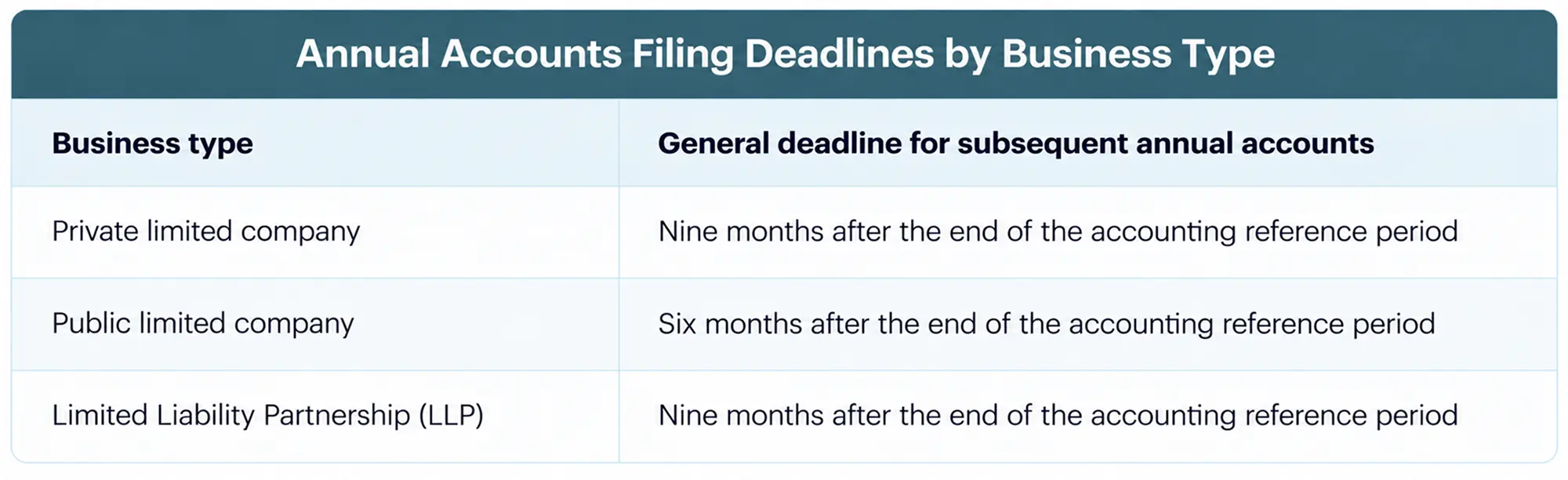
First accounts may have different deadlines, particularly when they cover more than 12 months. Changes to a company’s accounting reference date can also affect its filing deadline.
For example, if a private company’s financial year ends on 31 December, its annual accounts would normally be due by 30 September of the following year.
Check your company’s specific deadline rather than relying only on the general rule.
Company Tax Return and Corporation Tax Deadlines
Companies also need to keep track of their Corporation Tax obligations.
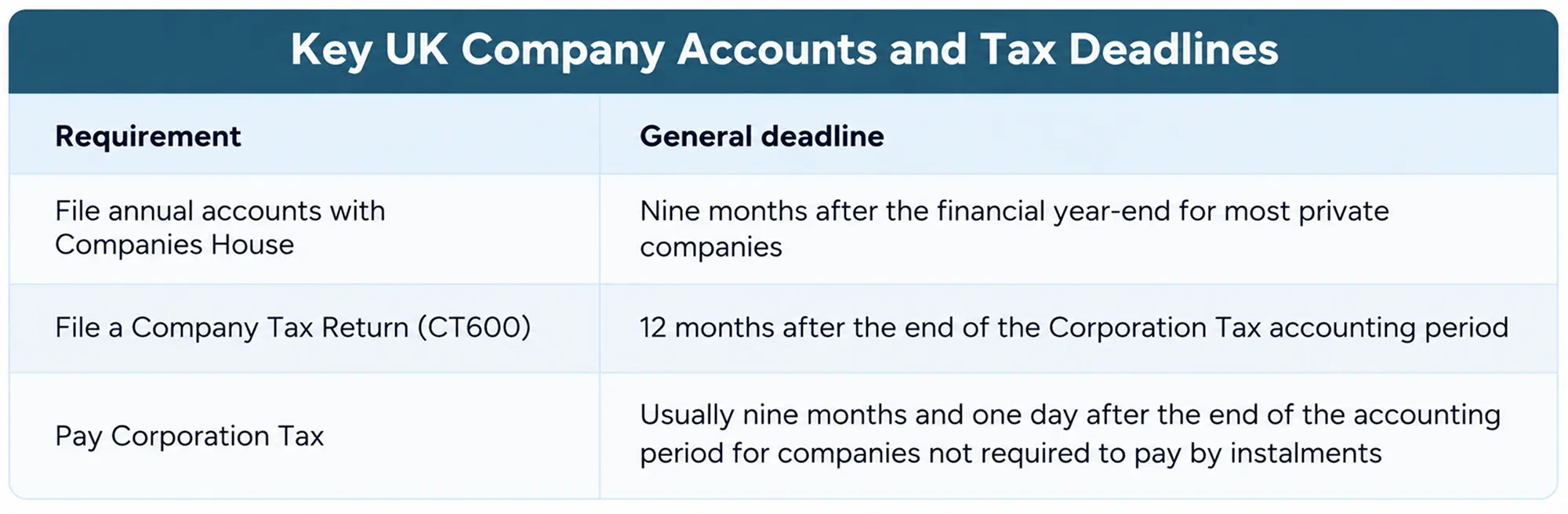
These deadlines are general rules. The exact dates can vary, particularly in a company’s first year or when its financial year and Corporation Tax accounting period do not match.
Late Filing Penalties
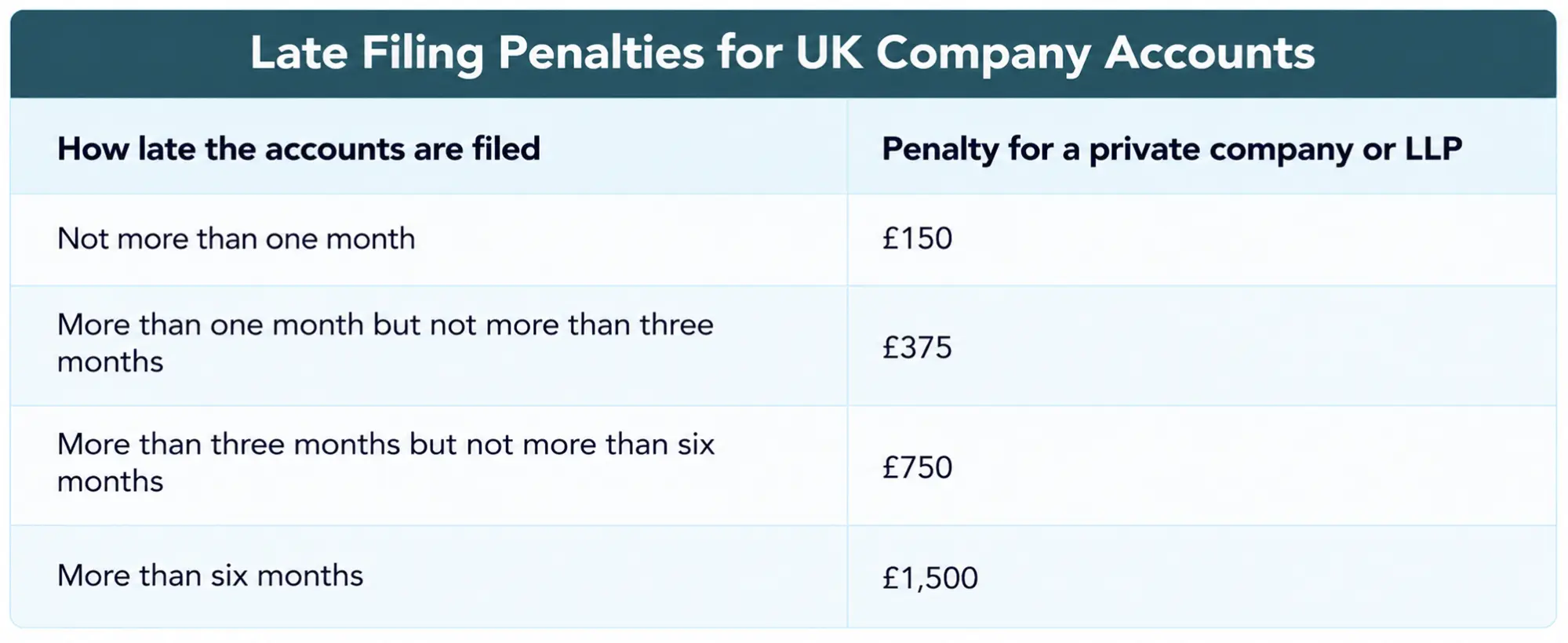
Missing the filing deadline can result in an automatic late-filing penalty. The following table shows the penalties for private companies and LLPs under current Companies House guidance.
Common Mistakes to Avoid When Preparing Final Accounts
Small accounting errors can create bigger problems at year-end. A careful review can prevent many of them. Here are three common mistakes to avoid.1. Failing to Reconcile Accounts
One common mistake is failing to reconcile balance sheet accounts. You should check bank balances, loans, VAT accounts, payroll balances, customer debts and supplier balances against the supporting records. Reconciliation helps you identify missing transactions, incorrect balances and other discrepancies before the accounts are finalised.2. Missing Accruals and Prepayments
Missing unpaid expenses, known as accruals, or costs paid in advance, known as prepayments, can make your year-end profit and liabilities inaccurate. Check that expenses such as wages, pensions, bonuses and holiday pay are recorded in the correct accounting period. Getting these adjustments right helps ensure that your accounts give a more accurate picture of your company’s financial performance.3. Misclassifying Transactions
Another common issue is recording transactions in the wrong account. For example, an asset purchase should not automatically be treated as an ordinary business expense. Similarly, personal spending should not be mixed with company transactions. Good bookkeeping throughout the year makes the year-end process much easier. Keeping your records up to date also helps you identify errors before they become more difficult to resolve.Can Accounting Software Help You Prepare Final Accounts?
Accounting software can make it easier to organise financial records, track transactions and prepare information for year-end accounts. Common software used by UK businesses includes Sage, Xero and QuickBooks. The right option depends on the size and needs of your business. Some software also supports year-end accounts preparation and tax reporting. These tools can help you organise trial balances, journals and other accounting data. However, accounting software does not remove the need for professional judgement. Your records still need to be accurate, adjustments must be appropriate and the accounts must meet the reporting requirements that apply to your business. If you are unsure whether your accounts are complete or correctly prepared, professional support can help you identify potential issues before filing.How Sterling Cooper Can Help With Your Final Accounts
Preparing final accounts can be challenging when bookkeeping is incomplete, deadlines are approaching and tax calculations need careful review. Professional support can make the process more straightforward and help you avoid common accounting errors. At Sterling Cooper, we support you throughout the final accounts process, from reviewing your financial records and preparing accurate accounts to helping you manage the relevant filing requirements. Our aim is to provide a clear picture of your business’s financial position while helping you stay on top of your UK reporting obligations. With well-prepared accounts and the right support, you can manage your year-end responsibilities with greater confidence and spend more time focusing on running your business.Protect your business from costly accounting errors and missed deadlines with expertly prepared final accounts. Contact us today for accurate, compliant accounts and complete peace of mind.
FAQs
Final accounts are financial statements prepared at the end of an accounting period. They show a business's financial performance and position, helping owners understand their finances and meet relevant reporting requirements.
A company's financial year is usually 12 months. Its first annual accounts can cover more than 12 months, up to 18 months in the usual statutory framework. However, a Corporation Tax accounting period cannot exceed 12 months. This means the period covered by annual accounts may differ from the period covered by a Company Tax Return.
For most private companies, subsequent annual accounts are due nine months after the end of the financial year. First accounts can have a different deadline, so you should check your company's specific filing date.
Yes. A dormant company generally still needs to file annual accounts and a confirmation statement with Companies House. It may qualify to file simpler accounts if it meets the relevant conditions.
A CT600 is the form a company uses to submit its Company Tax Return to HMRC. It reports the company's Corporation Tax position and is supported by the relevant accounts and tax computations.
For many companies that are not required to pay Corporation Tax by instalments, payment is due nine months and one day after the end of the Corporation Tax accounting period. Different rules apply to some larger companies, so check the deadline that applies to your business.
Yes. An accountant can prepare and submit accounts on behalf of a company where the appropriate arrangements and filing methods are in place. However, the directors remain legally responsible for ensuring that the company's accounts are properly prepared and filed on time.