Posted by:
Admin
Date:
September 11, 2026
Category:
blogs
Small Accounting Firm vs Big Four: Which Suits an SME Best?
Choosing an accounting firm is an important decision for any small or medium-sized enterprise (SME). The right firm should provide the expertise, services and financial guidance your business needs without adding unnecessary costs or complexity.
A small accounting firm may be a practical choice if you need ongoing support with bookkeeping, tax compliance, payroll and financial planning. The Big Four, Deloitte, EY, KPMG and PwC, may be more suitable if your business has complex transactions, international operations or highly specialised reporting requirements.
So, which option is right for your SME? This guide compares small accounting firms and the Big Four, explains when each makes sense and highlights what to consider before making your decision.
Key Takeaways
- Small accounting firms can offer accessible, personalised support and services suited to an SME’s requirements.
- The Big Four provide extensive specialist expertise, international networks and resources for complex financial matters.
- Compare fees against the services, expertise and level of support included rather than choosing on price or reputation alone.
- SMEs with international operations, major transactions or complex reporting requirements may benefit from a larger firm or specialist adviser.
- The right accountant should meet your current needs while having the expertise or professional network to support your future growth.
Small Accounting Firm vs Big Four: What Is the Difference?
The main difference between a small accounting firm and the Big Four lies in their scale, service structure, specialist resources and typical client requirements.
Small accounting firms often work with owner-managed businesses, start-ups and growing SMEs. Depending on their expertise, they can provide services such as bookkeeping, annual accounts, tax compliance, payroll, management reporting and business advice.
The Big Four are Deloitte, EY (Ernst & Young), KPMG and PwC (PricewaterhouseCoopers). These global professional services networks offer extensive accounting, audit, tax, consulting and transaction-related expertise, often serving large organisations and businesses with complex requirements.
However, firm size alone does not determine the quality of service an SME receives. A smaller firm with the right expertise may be better suited to a particular business than a larger organisation.
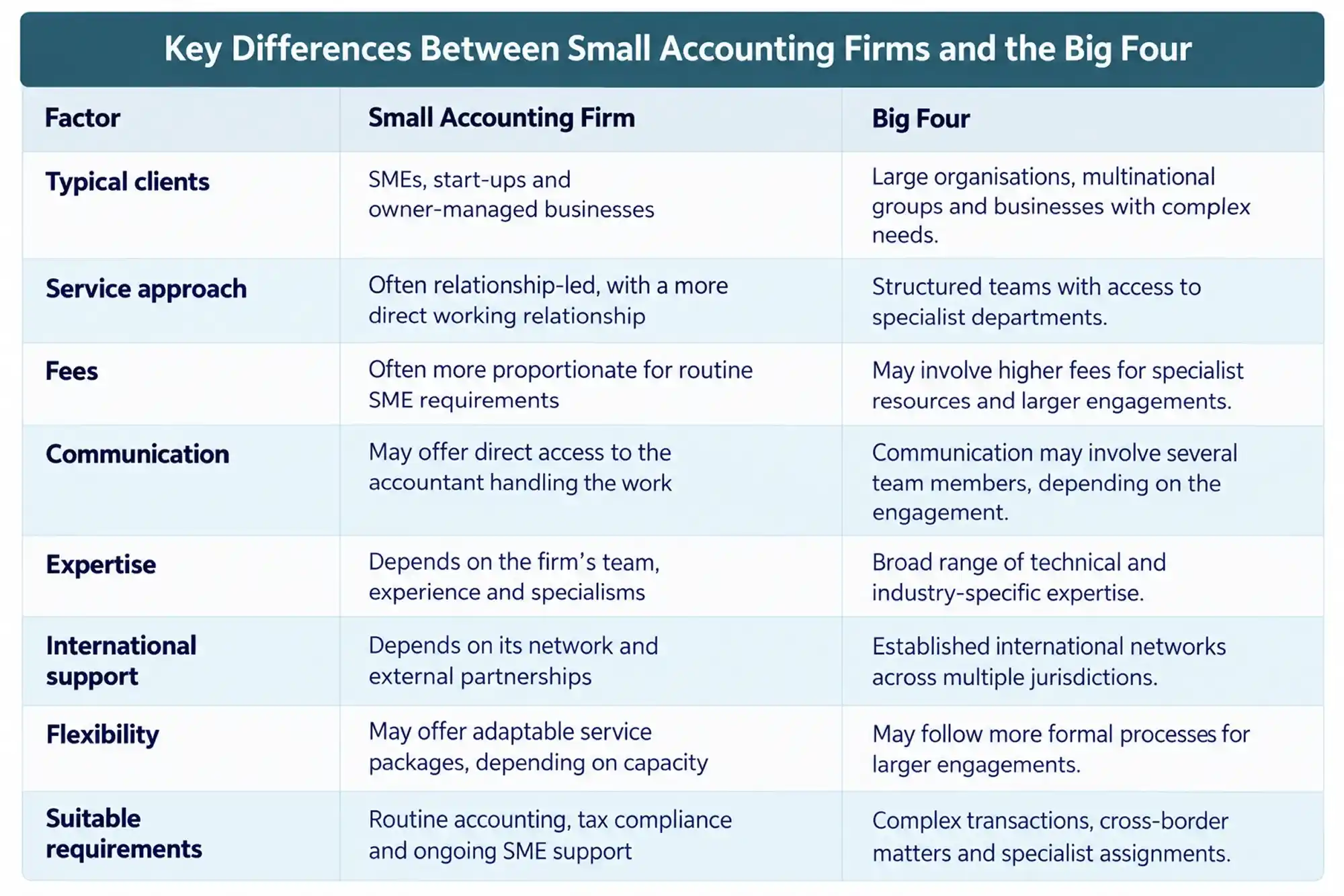
The most suitable option depends on what your business needs from its accountant. For routine financial management, a smaller firm may provide all the necessary services. If your business requires several specialist disciplines or coordinated support across countries, a larger firm may be worth considering.
Which Is Better for an SME: A Small Firm or the Big Four?
For many SMEs, a small or specialist accounting firm is a sensible starting point. It may provide the services needed to maintain accurate financial records, meet tax obligations and make informed business decisions without requiring the resources of a large professional services network.
However, a smaller firm is not automatically the right choice for every SME. Businesses with complicated ownership structures, international subsidiaries, significant transactions or demanding reporting requirements may need expertise that a larger firm can provide.
Use the following guide to identify which option is more likely to suit your circumstances.
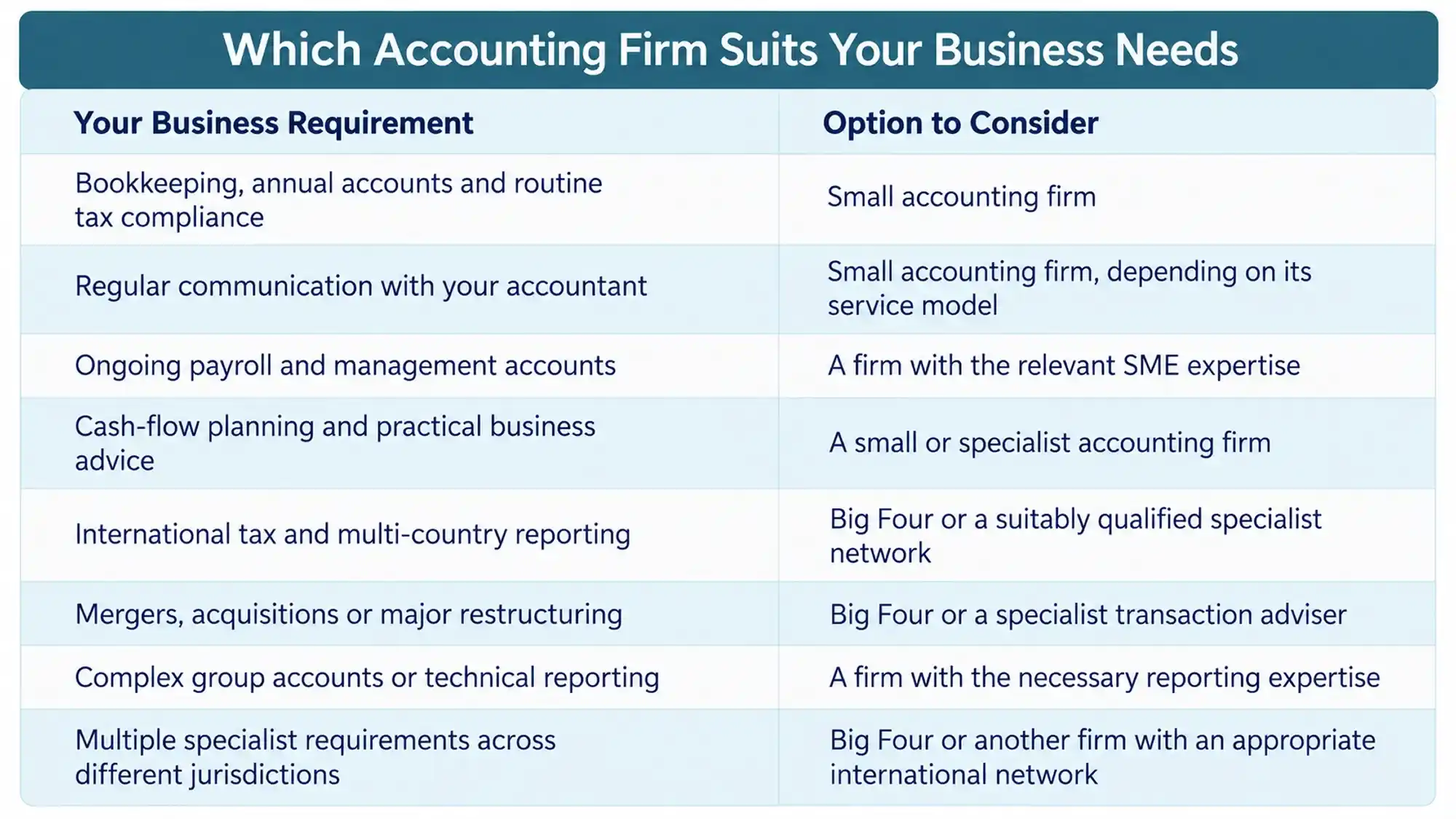
These are starting points rather than fixed rules. Some smaller firms handle sophisticated work, while larger firms may have dedicated teams serving smaller businesses. Before deciding, establish whether the firm can meet your specific requirements and who will be responsible for the work.
Cost vs Value
Accounting fees matter to an SME because they affect operating costs and the budget available for other business priorities. However, choosing the cheapest accountant may prove costly if the service does not meet your needs.
When comparing proposals, look at what each firm includes. One quote might cover bookkeeping, year-end accounts and tax returns, while another may include management reporting, regular meetings and ongoing financial advice.
A smaller firm may offer better value if you primarily need routine accounting and compliance support. Paying for access to a larger team may be justified if you need specialist advice for a major transaction, a complex tax position or international expansion.
Ask each firm to clarify its fees, scope of work, additional charges and arrangements for out-of-scope advice. This makes it easier to compare the actual service you will receive rather than the headline price.
Service and Accessibility
Your relationship with your accountant can influence how effectively you manage your business finances. Regular access to someone who understands your operations can help you discuss cash flow, upcoming tax obligations, financial performance and growth plans.
Smaller firms may offer a more direct working relationship, particularly when the same accountant manages your account over time. However, this depends on the firm’s structure, workload and approach to client communication.
The Big Four can provide access to specialist teams, but the person responsible for routine communication may differ from the partner or specialist overseeing an engagement. This is not necessarily a disadvantage, especially when several areas of expertise are required.
Before appointing a firm, ask who will handle your account, how quickly you can expect responses, whether regular meetings are included and how you can access specialist advice when needed.
Complexity and Specialist Requirements
An SME’s accounting needs can change as its operations grow. A business might initially require bookkeeping and annual accounts, then need more detailed management reporting, tax planning, payroll support or assistance with funding and expansion.
A capable small accounting firm may be able to support this development, provided it has the relevant expertise and capacity. It may also work with external specialists when a particular assignment falls outside its core services.
The Big Four become worth considering when your requirements involve several technical disciplines, multiple jurisdictions or substantial transactions. Their broader resources can help coordinate work across areas such as international taxation, transaction advisory, corporate finance and complex reporting.
The important consideration is not simply how large your business is, but how complicated its financial arrangements have become. A business with substantial UK operations but a straightforward structure may have different needs from a smaller company with overseas subsidiaries, multiple investors and cross-border tax obligations.
When Should an SME Consider a Big Four Accounting Firm?
A Big Four firm may be appropriate when your business needs specialist expertise, international coordination or resources beyond its routine accounting requirements.
Before making that decision, identify the specific problem you need the firm to solve. The following situations may justify considering a larger firm or another specialist adviser.
Complex Transactions or Restructuring
Mergers, acquisitions, business disposals and major restructurings can involve financial due diligence, transaction structuring, tax considerations and detailed financial analysis.
In these situations, you may need several specialists to assess financial risks and support the transaction. A Big Four firm can be worth considering when the scale or complexity of the work requires a coordinated team.
However, the Big Four are not the only option. Boutique transaction advisers and specialist accounting firms may also have the expertise to handle your assignment. Compare relevant experience, fees and the proposed scope of work before deciding.
International Operations
Expanding into other countries can introduce additional accounting, tax, reporting and regulatory requirements. These may include overseas subsidiaries, cross-border transactions and obligations in multiple tax jurisdictions.
A Big Four firm’s international network can help coordinate advice across countries, particularly when several local teams need to work together.
For businesses with more limited international requirements, a UK accounting firm with established overseas partners may provide sufficient support. The right choice depends on the countries involved, the complexity of your operations and the level of coordination required.
Highly Specialised Reporting Requirements
Some businesses face reporting requirements that call for detailed technical knowledge or industry-specific expertise. These needs may arise from complex group structures, particular accounting treatments, regulatory obligations or substantial changes to financial reporting.
A larger firm may offer access to dedicated technical specialists who can help address these requirements.
Nevertheless, specialist capability matters more than the firm’s name. Before appointing an accountant, confirm that the proposed team has relevant experience and can meet your reporting obligations.
Institutional or Investor Requirements
External investors, lenders and other stakeholders may request financial information, independent assurance or reporting to support their decisions. The precise requirements depend on the investment arrangement, financing terms and applicable regulations.
A Big Four firm may be suitable when the assignment requires extensive specialist resources, a particular level of assurance or experience with complex transactions.
However, an SME does not automatically need a Big Four accountant simply because it plans to attract investment or secure funding. A smaller audit firm or specialist adviser may meet the relevant requirements. Establish what the investor, lender or regulator actually requires before choosing a provider.
Why Consider Sterling Cooper for Your SME?
Choosing an accountant should start with your business requirements rather than the size or reputation of the firm. You need a provider that can manage your accounting responsibilities, help you understand your financial position and offer relevant support as your business develops.
Sterling Cooper Consultants provides accounting and bookkeeping services, taxation support, payroll, management reporting and business advisory services. Depending on your requirements, these services can help bring routine financial management and wider business support together through one provider.
For an SME seeking ongoing accounting support, the practical next step is to discuss your current responsibilities, reporting needs and future plans with the firm. You can then establish which services are appropriate, who will handle the work and whether additional specialist support may be needed as your business grows.
This approach helps you assess the suitability of an accounting firm based on its actual services and capabilities rather than assuming that a larger firm will always provide greater value.
Conclusion
For many SMEs, a small or specialist accounting firm can provide the right balance of accounting support, accessibility and cost. It may be particularly suitable if your business needs routine compliance services, ongoing financial management and practical advice.
The Big Four may be a better fit when you need extensive international resources, specialist technical expertise or support with complex transactions. Other specialist firms may also be able to meet these requirements.
Before making your decision, compare the scope of services, relevant experience, fees, communication arrangements and capacity to support your business as it grows. The best choice is the firm that meets your actual requirements and provides value for the work involved.
Get the Right Accounting Support for Your Business
Take the next step towards better financial management. Contact us to discuss your accounting needs and find the right support for your business.
FAQs
A small accounting firm may be a better fit for SMEs that need routine accounting, tax compliance and ongoing financial advice. The Big Four may be more suitable when a business requires extensive specialist expertise or international support. The right choice depends on your circumstances.
They often charge higher fees for engagements requiring extensive specialist resources, although costs vary by service and scope. Compare the work included, additional charges and level of support offered before making a decision.
Yes. A small accounting firm can support a growing business if it has the necessary expertise and capacity. Ask how it handles more complex accounting, tax and advisory requirements as a business expands.
No. Most SMEs can assess their options based on their accounting needs rather than choosing a firm because of its size. A Big Four firm may be worth considering for complex transactions, international operations or specialist reporting requirements.
Consider relevant experience, service range, professional credentials, fees, communication, technology and the firm's ability to support future requirements. Clarify who will manage your account and what is included in the proposed service.
Yes. Depending on its expertise, a small accounting firm may offer management accounts, cash-flow planning, tax planning and business advisory services. Confirm which services are available and whether they are included in your engagement.
Price is important, but it should not be the only consideration. Compare the services included, the expertise available, communication arrangements and any additional fees to determine which firm offers the best value for your business.
Recent Posts