Posted by:
Content Editor
Date:
September 28, 2026
Category:
blogs
How to Choose the Right Accounting Firm for Your Business
As a business owner, you might be overseeing every aspect of your business operations, including your finances. However, when it comes to managing your books and taxes, professional support can make a significant difference.
Choosing an accountant is an important decision for any business. The right firm can help you manage your accounts, meet tax deadlines and understand what your numbers are telling you. The wrong choice can lead to poor communication, unexpected fees or advice that does not fit your business.
This matters because most small businesses already rely on professional support for their tax affairs. HMRC’s 2025 Agents, Small and Mid-Sized Businesses Customer Survey found that 73% of small businesses had used a tax agent or external accountant in the previous 12 months. Of those businesses, 92% were satisfied with the support and advice they received.
So, how do you choose an accounting firm that is right for your business rather than simply choosing the first one you find?
This guide explains what to look for when comparing accounting firms, from professional qualifications and industry experience to accountancy services, fees, technology and the level of business advice you can expect.
Key Takeaways
Before comparing firms, it helps to know which factors matter most. Keep these points in mind as you assess your options:
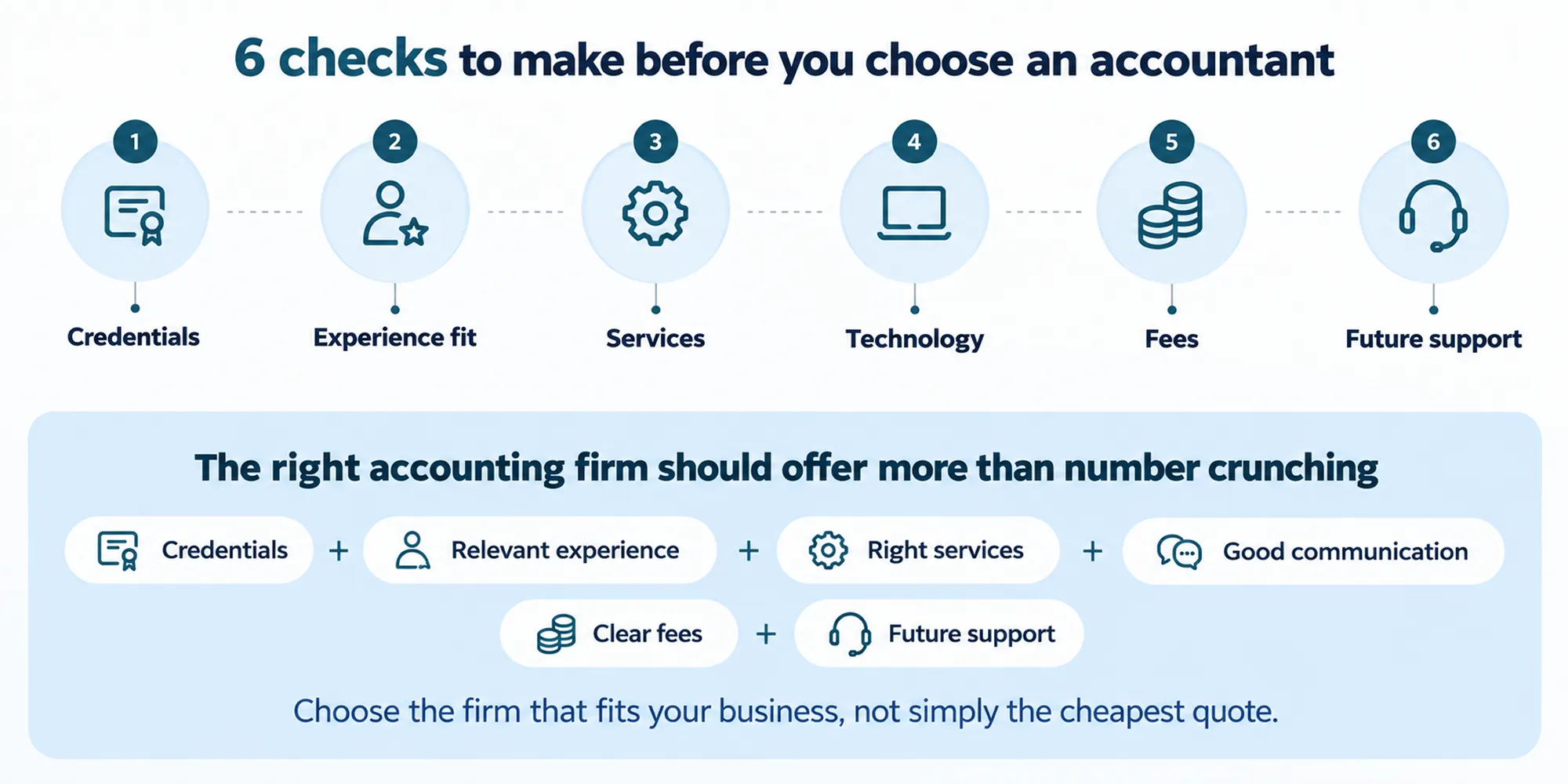
- Check the firm’s qualifications, experience and professional membership.
- Choose an accounting firm that understands your industry and business structure.
- Compare the full range of accountancy services rather than looking at price alone.
- Ask how the firm uses accounting software and supports Making Tax Digital.
- Find out who will manage your account and how you will communicate.
- Check what is included in the fees and what will cost extra.
- Choose an accountant who can provide useful financial advice as your business grows.
Why Choosing the Right Accounting Firm Matters
An accountant can become an important part of your business support network, rather than simply the person who prepares your accounts once a year.
ICAEW advises small businesses to consider more than basic charges when choosing an accountant. It recommends discussing the scope of your needs, communication frequency and turnaround times during the initial consultation.
This matters because accounting firms can offer very different levels of service.
One firm may only prepare annual accounts and tax returns. Another may provide bookkeeping, payroll, VAT, management accounts, forecasting and business planning.
The cheapest option may therefore not be the best fit. The better question is whether the firm provides the services, expertise and support your business actually needs.
10 Things to Consider When Choosing an Accounting Firm
Choosing an accounting firm involves more than comparing prices. The firm’s qualifications, experience, services and approach to client support can all affect the value you receive. Use these 10 factors to compare your options and identify a firm that fits both your current needs and future plans.
1. Check Their Qualifications and Professional Membership
A good starting point is to establish whether the firm has the professional credentials and experience you would expect from an accounting provider.
Look at its qualifications, experience and professional body membership. Professional organisations such as ICAEW and ACCA provide directories that allow businesses to check firms and members.
ICAEW recommends looking for an accountant with a professional qualification and explains that appointing an ICAEW Chartered Accountant or regulated firm provides qualified and accountable professional support.
You can also search the official ICAEW directory for a chartered accountant or firm by location and specialist area.
ACCA also provides a directory of accountancy firms. Its guidance explains that businesses should check a firm’s certificates to understand whether it is regulated by ACCA for specific activities.
This does not mean you have to choose a firm from one particular professional body. It means you should verify the firm’s credentials and understand what those credentials cover.
2. Look for Experience in Your Industry
Professional qualifications are important, but an accountant also needs to understand the commercial realities of your business.
Different businesses face different financial and tax issues. A construction company may have different VAT and subcontractor requirements from a consultancy. An online retailer may need help with stock, payment platforms and international sales.
Ask whether the accounting firm already works with businesses similar to yours.
You can ask:
- Do you work with businesses in my industry?
- Do you understand my business structure?
- Have you supported businesses at a similar stage?
- Can you help if the business expands?
- What financial or tax issues do businesses like mine usually face?
Industry experience can help an accountant understand your problems faster and provide advice that is more relevant to your business.
3. Compare the Accountancy Services You Need
Before comparing fees, make sure you understand what support your business actually needs.
Common accountancy services include:
- Bookkeeping
- Annual accounts
- Self Assessment
- Corporation Tax
- VAT returns
- Payroll
- Management accounts
- Cash flow forecasting
- Budgeting
- Tax planning
- Financial forecasting
- Business planning
However, not every accounting firm provides all of these services.
Ask each firm for a clear list of what is included in its package and what would cost extra.
This can also prevent you from having to change accountants later because the firm cannot provide a service your growing business needs.
4. Ask How They Handle Digital Accounting
Technology should also be part of your decision when comparing accounting firms.
Cloud accounting software can make it easier for you and your accountant to access financial records, keep information up to date and work together.
This is becoming more important as Making Tax Digital expands.
From 6 April 2026, sole traders and landlords with qualifying income above £50,000 have had to use Making Tax Digital for Income Tax. The threshold falls to more than £30,000 from April 2027 and more than £20,000 from April 2028.
Businesses within the rules need compatible software to keep digital records and send quarterly updates to HMRC.
Therefore, ask a potential accounting firm:
- Which accounting software do you use?
- Is the software compatible with Making Tax Digital?
- Can you help me move from spreadsheets to accounting software?
- Will you manage my digital records or will I?
- Can I access my accounts and reports?
A good firm should be able to explain the process clearly rather than simply telling you which software to buy.
5. Find Out Who Will Manage Your Account
This is easy to overlook, but it can have a significant impact on your experience with the firm.
You may meet a partner or senior accountant during the sales process but later deal mainly with another member of the team.
Ask who your main contact will be and how the relationship will work.
You should know:
- Who prepares your accounts?
- Who reviews the work?
- Who answers tax questions?
- Can you speak directly to a qualified accountant?
- How quickly does the firm usually respond?
ICAEW highlights communication frequency and turnaround time as matters worth discussing during your initial consultation.
A firm can have excellent technical skills but still be frustrating to work with if you cannot get a response when you need one.
6. Compare Fees and What Is Included
Once you understand the level of support you need, you can compare fees more fairly.
Price matters, but it should not be the only thing you compare.
Two accounting firms may quote very different fees because they offer different levels of service.
For example, one quote may cover annual accounts and Corporation Tax only. Another may include bookkeeping, VAT returns, payroll and regular management reports.
Ask each firm to explain:
- The total fee
- What accountancy services are included
- What is charged separately
- Whether fees are fixed or based on time
- Whether there are setup costs
- How often you will be billed
- What happens if your business needs change
A clear fee structure makes it easier to compare firms fairly.
7. Ask What Business Advice They Provide
Your accountant should be able to help you understand your numbers, not simply record them.
Ask whether the firm provides advice on cash flow, margins, budgeting, tax planning and business growth.
This can become more valuable as your business develops.
A growing business may need an accountant who can help assess whether it can afford to hire staff, invest in equipment, take on finance or expand into a new market.
That is why it is worth asking what happens after the accounts have been prepared.
Will the firm explain what the numbers mean and highlight issues that need your attention?
For a growing business, this kind of financial insight can be just as valuable as getting the compliance work completed.
8. Check Their Approach to HMRC and Tax Matters
Tax support is another area where it is useful to understand exactly what an accounting firm will handle for you.
If your accountant acts as your tax agent, you may authorise them to deal with HMRC on your behalf.
HMRC’s current guidance explains that authorised agents can perform different tasks depending on the tax service involved, including dealing with Self Assessment and VAT matters.
Before giving authority, make sure you understand what the accounting firm will handle for you.
You should also ask how the firm deals with tax enquiries, late filings and changes to your circumstances.
A professional accountant should be able to explain your responsibilities as well as their own.
9. Check Their Reputation and Client Reviews
Once you have narrowed down your options, it is worth looking at what existing or previous clients say about the firm.
Reviews can give you useful information about how a firm communicates and works with clients.
However, do not rely on reviews alone.
Look for client testimonials, professional memberships, years of experience and evidence of the firm’s work. You can also ask for references or speak to another business owner who uses the firm.
ICAEW recommends asking colleagues and friends for recommendations when looking for an accountant.
Pay attention to recurring comments about communication, accuracy, responsiveness and the quality of advice.
10. Think About Your Future Needs
Finally, consider whether the firm can continue to support you as your business changes.
The accounting firm you choose today may still be working with you several years from now.
Your business could move from sole trader to limited company. You may take on employees, register for VAT, need management accounts or start planning for expansion.
Therefore, ask the firm how it supports growing businesses.
A useful question is:
‘If my business doubles in size over the next few years, how could your services change with it?’
The answer can tell you whether the firm is thinking about a long-term relationship or simply the immediate compliance work.
Case Study: Why the Right Accountant Can Offer More Than Tax Support
The difference between basic compliance and wider financial support becomes clearer when you look at a real business example.
Bhangra Blends, a UK ready-to-drink cocktail and mocktail business, provides a useful example of what a growing business may need from an accountant.
The founders realised they needed more than basic bookkeeping and tax filing. They wanted help understanding cash flow, margins and financial decisions as they built the business.
Founder Arshia Bhatnagar explained:
‘What we really needed was someone who could help us build the financial side of the business like cash flow, understanding our margins properly.’
The business also needed industry-specific support. When the company experienced a VAT fraud incident involving the misuse of its VAT number, its accountant helped chase the issue with HMRC and provided guidance while it was being resolved.
The founders also used their accountant for unit economics, cash flow management and investment planning.
The case demonstrates why choosing an accounting firm should not be based solely on whether it can prepare your annual accounts. For a growing business, the right accountant can become a source of financial insight and practical support.
10 Questions to Ask Before Hiring an Accounting Firm
Once you have shortlisted two or three firms, an initial consultation gives you an opportunity to compare what each one actually offers. Rather than focusing only on price, use these questions to understand the firm’s experience, communication, services and ability to support your business as it grows.
- What accountancy services are included in your fees?
- Do you work with businesses in my industry?
- Who will manage my account?
- How often will we communicate?
- Which accounting software do you use?
- Can you support my Making Tax Digital requirements?
- Do you provide tax planning and business advice?
- How quickly do you normally respond to queries?
- What happens if my business grows or changes?
- Are there any additional fees I should know about?
The answers will make it easier to compare accounting firms based on the support you will actually receive, rather than simply comparing headline prices.
Conclusion
Choosing the right accounting firm is about finding the right balance between technical expertise, reliable service and useful business advice.
Start by checking qualifications and experience. Then look at the accountancy services you need, the firm’s approach to technology, communication, fees and future business support.
The best accountancy firm for your business should understand where you are now and have the skills to support where you want to go.
Need Help With Your Business Accounts?
If you are looking for reliable accountancy services covering your business accounts, tax and wider financial needs, the team at Sterling Cooper Consultants can help you find an approach that fits your business.
FAQs
No, accounting firms also work with sole traders, start-ups and small businesses. The level of support can be tailored to the size and needs of the business.
Yes, many accounting firms provide tax advice alongside their wider accountancy services. However, the services offered vary between firms, so check what is included before hiring one.
Yes, industry experience can be valuable because different sectors can have different tax, accounting and commercial issues. Ask potential firms which businesses and industries they regularly support.
No, a higher fee does not automatically mean better service. Compare the firm's qualifications, experience, services, communication and advice alongside the total cost.
Yes, an accounting firm can help you prepare for Making Tax Digital and may act as your authorised agent. Businesses that need to use Making Tax Digital for Income Tax must use compatible software to keep digital records and send quarterly updates to HMRC.
Yes, comparing two or three firms can help you assess their services, fees, experience and communication before making a decision.
A small business may need bookkeeping, annual accounts, tax returns, VAT, payroll and tax planning. As the business grows, management accounts, cash flow forecasting and wider business advice may also become useful.