Posted by:
Admin
Date:
February 11, 2026
Category:
blogs
What Is Workforce Analytics and Why Is It Essential for Modern HR?
Most HR teams already have a lot of data. Numbers for payroll. Numbers of people hired. Records of absences. Logs of training. Scores from the survey. But data by itself doesn’t fix problems. You still need to know what it means and what to do next.
Use only the data you need. Keep it fair, and share results at group level to protect the trust. You can see patterns early on. You can back up your choices with proof. You can also choose actions that are more likely to work.
At a Glance
What Is It?
Using workforce data to understand what is happening in your organisation, why it is happening, and what actions are most likely to work.
What Does It Help With?
Hiring, retention, absence, skills planning, labour costs, and fair people decisions.
Who Is It For?
HR teams, people managers, and business leaders who want to make evidence-based decisions using existing data.
What Is Workforce Analytics?
Workforce analytics means using employee data to see what is really happening at work. It helps HR understand why things happen and what actions are likely to help. It looks at the whole employee journey, from hiring and training to staying or leaving.
You may also hear it called people analytics or HR analytics. They are often used to mean the same thing. In practice, workforce analytics focuses on HR areas such as hiring, training, performance, absence, and retention. While people analytics sometimes goes a step further by linking workforce data to wider business results.
People analytics can sometimes connect people data to other business data.
People often use workforce analytics to look at the health of their workers, make plans for them, and see how well they are doing (in terms of capacity, turnover, absence, and skills).
- The goal is the same in practice: HR based on evidence. The CIPD’s advice talks about people analytics and evidence-based practice as ways to use critical thinking and different types of evidence to make better decisions.
What Is Not Termed as Workforce Analytics?
Reporting is only one part of HR workforce analytics. Reporting tells you ‘what happened.’ Analytics goes deeper and asks ‘why,’ ‘what next,’ and ‘what should we do?’
It is not ‘secret monitoring’ either. You need to stay within the law and keep trust if you use any kind of monitoring data, like system log-ins or activity data. The ICO’s draft guidance and other materials make it clear that monitoring should be legal and that employers should think about what is necessary, what is fair, and what workers’ rights are.
What Are the Types of Workforce Analytics?
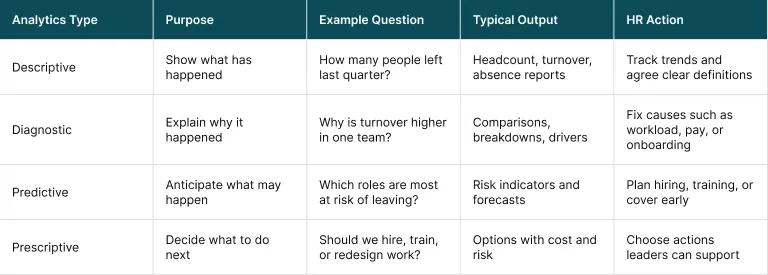
HR workforce analytics is commonly grouped into a few layers. Each layer focuses on a different type of question.
1. Descriptive Analytics
It uses clear reporting to show facts like these:
- Number of people in each department.
- People who join and leave.
- Days off and hours worked over time.
- Time to fill by role.
The base layer is descriptive work. People stop trusting the data if the definitions change every month. Begin by agreeing on basic terms, such as what ‘turnover’ means and what date range you use.
2. Diagnostic Analytics
This breaks down the data to test possible reasons behind changes in results. For example, one site has a higher turnover rate. Is it pay, shift pattern, manager changes, or commute time?
- The time it took to hire someone for one job went up. Is the problem with sourcing, interviews, or approvals?
- One good habit is to write your ‘why’ as a sentence that can be tested.
For example, ‘Early exits are higher because new hires don’t get enough training in their first week.’ Then you look at the data. You learn and change if the data doesn’t agree.
3. Predictive Analytics
This part of HR workforce analytics looks for patterns that can help you predict risks and demand, like:
- Likely to leave (risk signals, not labels).
- Future hiring based on plans for growth.
- Pressure to retire in a certain skill area.
- There are peaks in future absence based on the season.
Work that makes predictions doesn’t have to be ‘AI.’ A simple trend line can help. The most important thing is to look over your predictions often and learn from what happens.
4. Prescriptive Analytics
It helps you look at your choices, like:
- Hire, cross-train, or outsource?
- Change the design of the rota or add more people.
- Make onboarding better or change the steps for choosing.
When you look at costs, time, and risk all at once, prescriptive workforce analytics works best. That’s what leaders need to make choices they can support.
What Key Data Sources Are Used in Workforce Analytics?
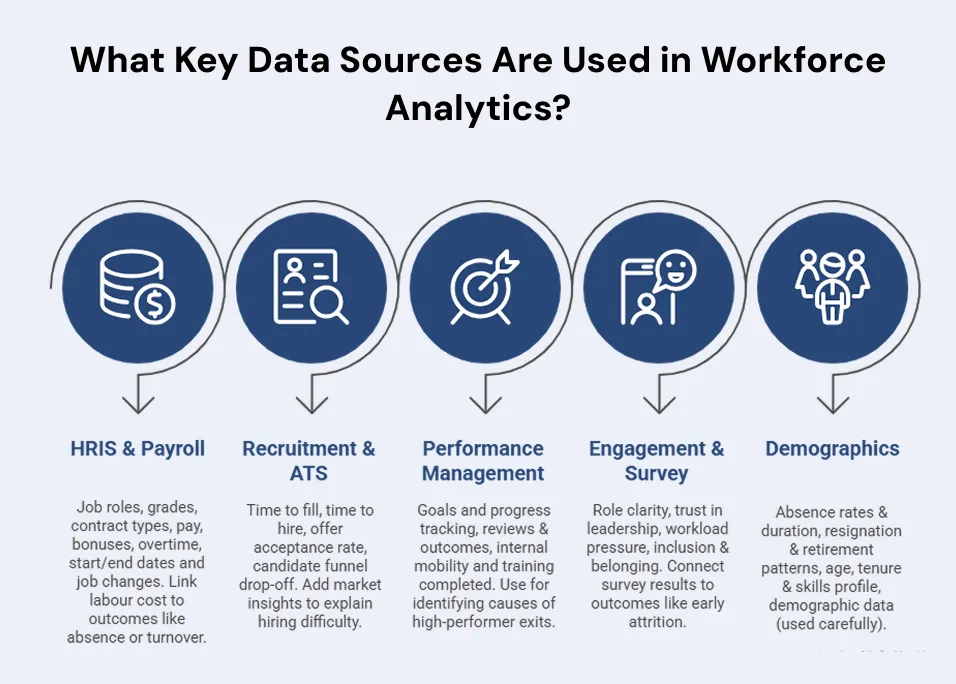
Good workforce analytics starts with clean data. Most businesses already have it. The job is to bring them together and keep them the same.
1. HRIS & Payroll Systems
HRIS and payroll data usually includes:
- Job and grade.
- Type of contract and hours.
- Pay, bonuses, and overtime.
- Dates when you start and end a job, as well as when you change jobs.
Payroll is often the cleanest dataset because it is regulated and needs to be done quickly. This is also where leaders start to wonder about the cost. Your analytics will be much more useful if you can link labour costs to outcomes like turnover or absence.
2. Recruitment & Applicant Tracking Systems
ATS and hiring data can show:
- Time to fill, time to hire.
- Where to hire.
- Rate of acceptance of offers.
- Funnel drop-off points.
A lot of teams also add information about the outside market, like the demand for skills in the local job market. Job market data is not a replacement for your own records, but it can explain why hiring is getting harder in one skill set.
3. Performance Management Data
Data about performance can include:
- Goals and progress.
- Look over the results (if you used them).
- Moving up and around within the company.
- Getting trained and certified.
When you add context to this data, it becomes much more useful. For instance, do high achievers quit because they don’t see a way to grow? Or maybe it’s because the workload is too much? You can connect the dots without making assumptions with workforce analytics.
4. Employee Engagement & Survey Data
Survey data helps you find out things that admin systems can’t see, like:
- Clear roles.
- Trust in leadership.
- Pressure from work.
- Being included and feeling like you belong.
One useful thing to do is to connect engagement signals to results. You have a clear goal for improvement if one area has low role clarity and a lot of early exits: better onboarding and manager support.
5. Absence, Turnover & Workforce Demographics
Core workforce datasets consist of:
- How often and how long people are absent.
- Patterns of resignations and retirements.
- Age, length of service, and skills profile.
- Demographics of the workforce (collected and used carefully).
You can use benchmarking to double-check your work. For instance, ONS estimates how many UK workers are sick and unable to work. HSE tracks how many workdays are lost annually due to injuries and illnesses.
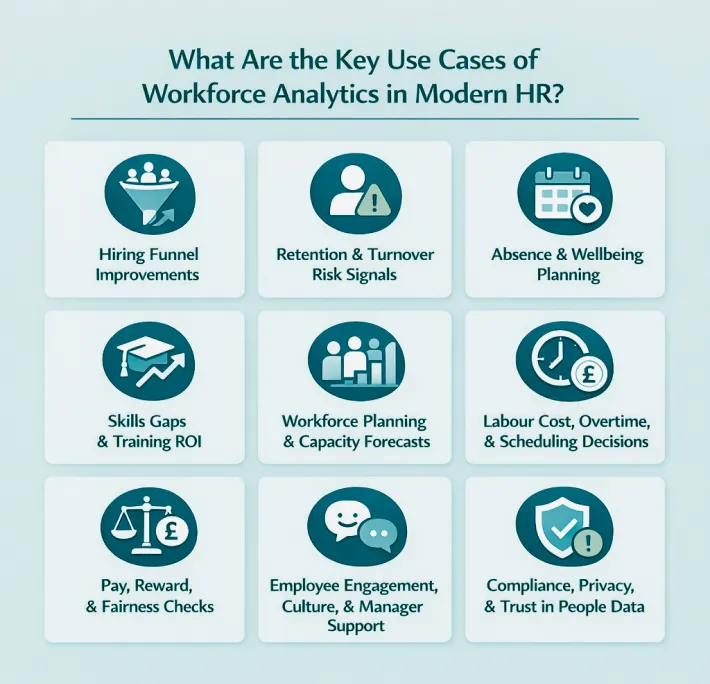
What Are the Key Use Cases of Workforce Analytics in Modern HR?
Here are some ways HR teams use HR workforce analytics to improve decisions. Starting with one clear question and agreeing on each use case will yield the best results.
1. Hiring Funnel Improvements and Quality of Hire
Analytics can reveal hiring slowdowns and quality declines.
These should be monitored:
- Filling and hiring time.
- Interview-to-offer and offer-to-accept ratios.
- New hire turnover (0–90 days).
- How to use the results:
- Fix approval delays.
- Strengthen screening questions.
- Facilitate candidate conversations.
- Comparison of referrals, job boards, and agencies.
A lot of people talk about using workforce data analytics in hiring to make it more efficient and based on data.
2. Retention and Turnover Risk Signals
There isn’t just one problem with turnover. There can be early exits, exits by high performers, or exits in one place.
Helpful cuts of the data:
- Turnover by manager, role, shift, and tenure band.
- Voluntary vs involuntary exits.
- Exit reasons (if collected consistently).
When turnover is a problem, the CIPD offers tips on measuring and retaining employees. Linking turnover to changeable factors like onboarding, workload, scheduling, development, and pay structure is most valuable.
3. Absence Management and Wellbeing Planning
In the UK, HR teams often notice simple patterns that point to pressure. For example, short sick days may rise after a run of heavy overtime. Absence can also go up in teams where pay depends a lot on shifts and extra hours.
Here’s what you need to keep track of:
- Rate, frequency, and length of absence.
- Patterns of short-term and long-term absence.
- Absence by shift pattern and overtime exposure.
One useful thing to do is to look for ‘hot spots’ where overtime and absence happen at the same time. That usually means there aren’t enough staff, the schedule is bad, or the rest time is bad.
4. Skills Gaps and Training ROI
It’s easier to fix skill gaps when you can see them.
Here’s what you should do:
- List critical skills by team.
- Map who has the skill today.
- Track training completion and application.
- Track internal moves into critical roles.
You can start with a simple spreadsheet and add to it over time, even if you don’t have a skills platform. Some HR advice also stresses the importance of linking performance and learning outcomes so that development plans are based on facts, not just opinions.
5. Workforce Planning and Capacity Forecasts
Workforce planning analytics is where HR gets a lot of respect because leaders need answers about staffing.
A basic model can have:
- FTE by team right now.
- Demand drivers (projects, clients, sales).
- Known joiners and known leavers.
- Time-to-fill for critical roles.
- Productivity assumptions.
6. Labour Cost, Overtime, and Scheduling Decisions
‘Why is the cost of labour going up?’ leaders ask. Analytics helps you give clear answers.
Here is what you need to separate:
- Pay for regular hours vs. overtime.
- Temporary work vs. permanent work.
- Planned hours versus actual hours.
7. Pay, Reward, and Fairness Checks
When you can explain your decisions about rewards, they seem more fair.
Here are a few easy things to look for:
- Pay range based on level and job.
- Pay compression (between new hires and long-term employees).
- The speed of progression (time in grade).
You can also compare results between groups to be fair. But be careful and make sure the goal is to get better, not to blame.
8. Employee Engagement, Culture, and Manager Support
Engagement scores may seem ‘soft,’ but they are often behind hard results like customer quality, retention, and absence.
One easy way to use analytics here is to ask small questions and ask them often. For instance:
- ‘I know what my boss wants me to do.’
- ‘I have everything I need to do my job.’
- ‘My boss helps me when I have problems.’
Then link those answers to results you already keep track of. You know what to do next if one team has low role clarity and a lot of turnover in the first few weeks. Make onboarding better. Make job briefs better. Help managers set goals.
Correlation does not always mean causation. Data points to where to look, not what to assume. Use it as a signpost, then speak to people and test small changes before scaling.
Keep trust at the centre. Report engagement results in groups, not for each person. Tell others what you learnt and what you will do differently. People are more likely to respond and be honest when they see action. That is when HR workforce analytics becomes a tool employees benefit from, not a tool they fear.
9. Compliance, Privacy, and Trust in People Data
The more you use data, the more you need to keep it safe.
The ICO guidance is a good place to look if you use monitoring-style data. It stresses the need for legal monitoring and talks about necessity, proportionality, and how it affects workers’ rights and trust.
Good governance for analytics usually means:
- Each dataset has a clear purpose.
- The least amount of data needed.
- Limited access and trails for audits.
- Clear messages to employees.
- When needed, impact assessments.
Trust is not something you can live without. People won’t use data if they don’t trust you, and your workforce analytics program will stop working.
Conclusion
Workforce analytics helps HR move from reports to action. It helps you answer the questions that leaders keep asking: ‘What’s going on, why is it happening, and what should we do now?’ Begin with small things. Choose one problem with your business. Use clear definitions. Make one easy-to-use dashboard and one easy-to-understand insight. Then agree on one thing to do. When you trust and share your data, small wins add up quickly. You can start making predictions and better plans as trust grows.
Need clearer answers from your HR and payroll data?
At Sterling Cooper Consultants, we help organisations build practical reporting, payroll support, and people processes that leaders can rely on. Explore our Payroll and HR Services for support options.
FAQs
In HR, workforce analytics means using workforce data to make better decisions about hiring, development, wellbeing, and retention. It turns HR data into insight you can act on.
Workplaces change quickly. HR analytics helps teams respond with evidence, not guesswork. It also helps HR explain decisions in business terms. The CIPD explains evidence-based practice as a way to improve decision-making by using the best available evidence and critical thinking.
Workforce analysis is important because it shows problems early. For example, you might spot that absence is rising in one shift, or that new starters are leaving fast. Early signals help you act before service, cost, and morale are hit.
It means looking at your people's data so you can understand what is going on, and decide what to do next.
HR analytics can transform the workplace by helping you:
1. Hire faster and improve hiring quality.
2. Reduce avoidable turnover.
3. Plan staffing and skills for the future.
4. Improve wellbeing through workload and absence insight.
5. Make reward decisions fairer and clearer.
When it is done with privacy and transparency, it also strengthens trust.
Recent Posts

How to Build a Cash Reserve for Business Stability
August 11, 2026

How to Forecast Cash Flow During Economic Uncertainty
August 6, 2026