Posted by:
Admin
Date:
January 8, 2026
Category:
blogs
Cash vs. Accrual Accounting: Which Method Is Right for You?
The accounting method you use affects when your business records income and expenses. In the UK, businesses may use cash or accrual accounting, depending on their structure, tax rules and reporting requirements. Cash accounting records income and expenses when money is received or paid. Accrual accounting records income when it is earned and expenses when they are incurred, even if payment happens later.
The difference can affect how your business reports profits, tracks outstanding invoices and bills, and assesses its financial performance. This guide explains how each method works and helps you determine which approach may be suitable for your business.
Key Takeaways
- Cash accounting records income and expenses when money is received or paid.
- Accrual accounting records income when it is earned and expenses when they are incurred.
- The UK cash basis can simplify tax calculations for eligible sole traders and partnerships.
- Accrual accounting can provide a clearer picture of performance when invoices, bills, stock or other timing differences are involved.
- The accounting method available to you depends on your business structure, tax rules and reporting requirements.
Cash vs. Accrual Accounting: What Is the Difference?
The main difference between cash and accrual accounting is when income and expenses are recognised. Under cash accounting, income is generally recorded when payment is received and expenses when they are paid. Under accrual accounting, income is recognised when it is earned and expenses when they are incurred, regardless of when the money changes hands:
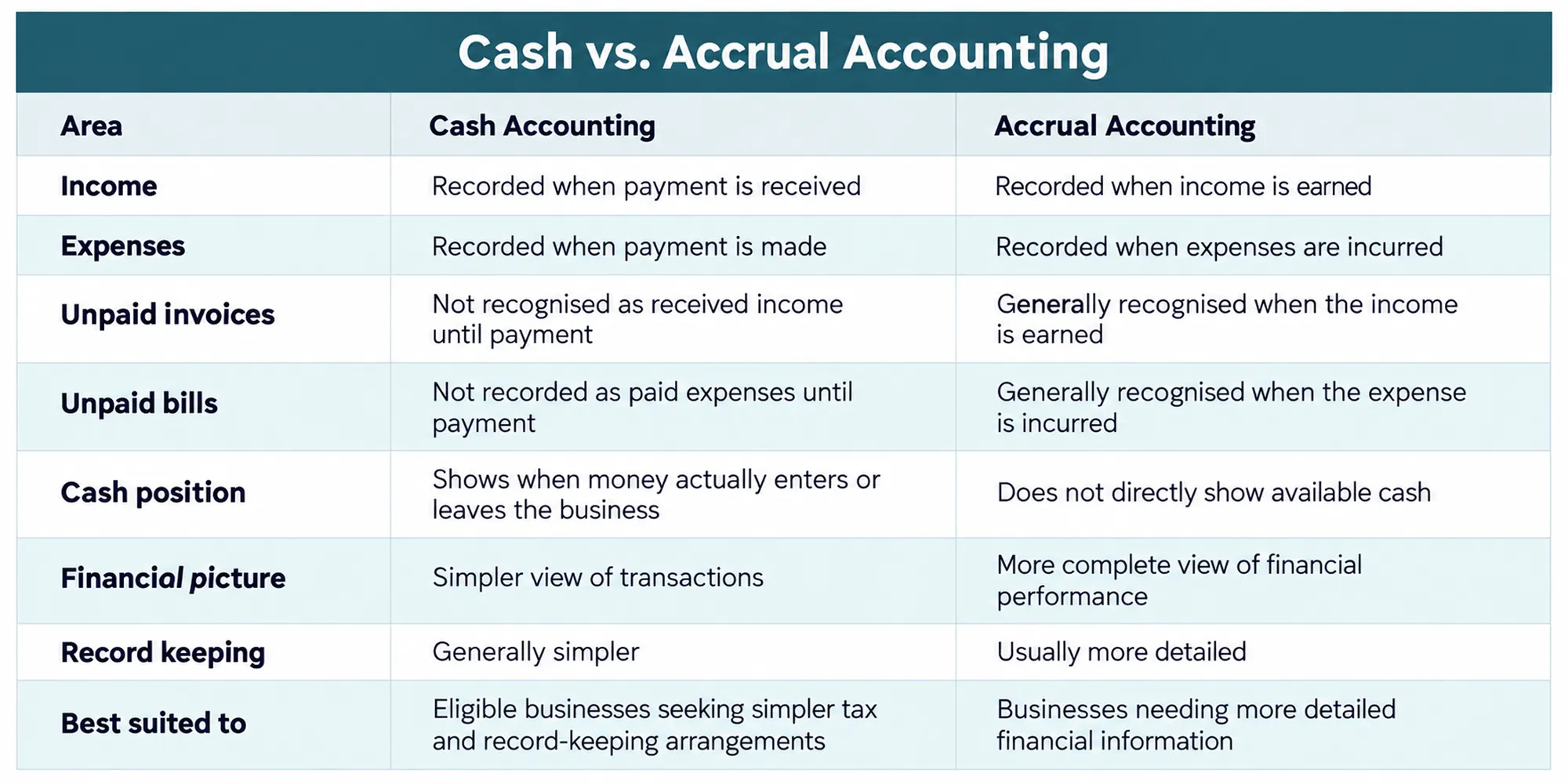
For example, suppose you invoice a customer £1,000 in March, but they pay you in April. Under cash accounting, the £1,000 is recorded when you receive the payment in April. Under accrual accounting, the income is generally recognised when it is earned in March. The same principle applies to expenses. Cash accounting records an expense when you pay it, while accrual accounting records it when you incur the expense.
This timing difference can affect reported profits and the way your business’s financial position is understood.
What Are the Advantages and Disadvantages of Cash Accounting?
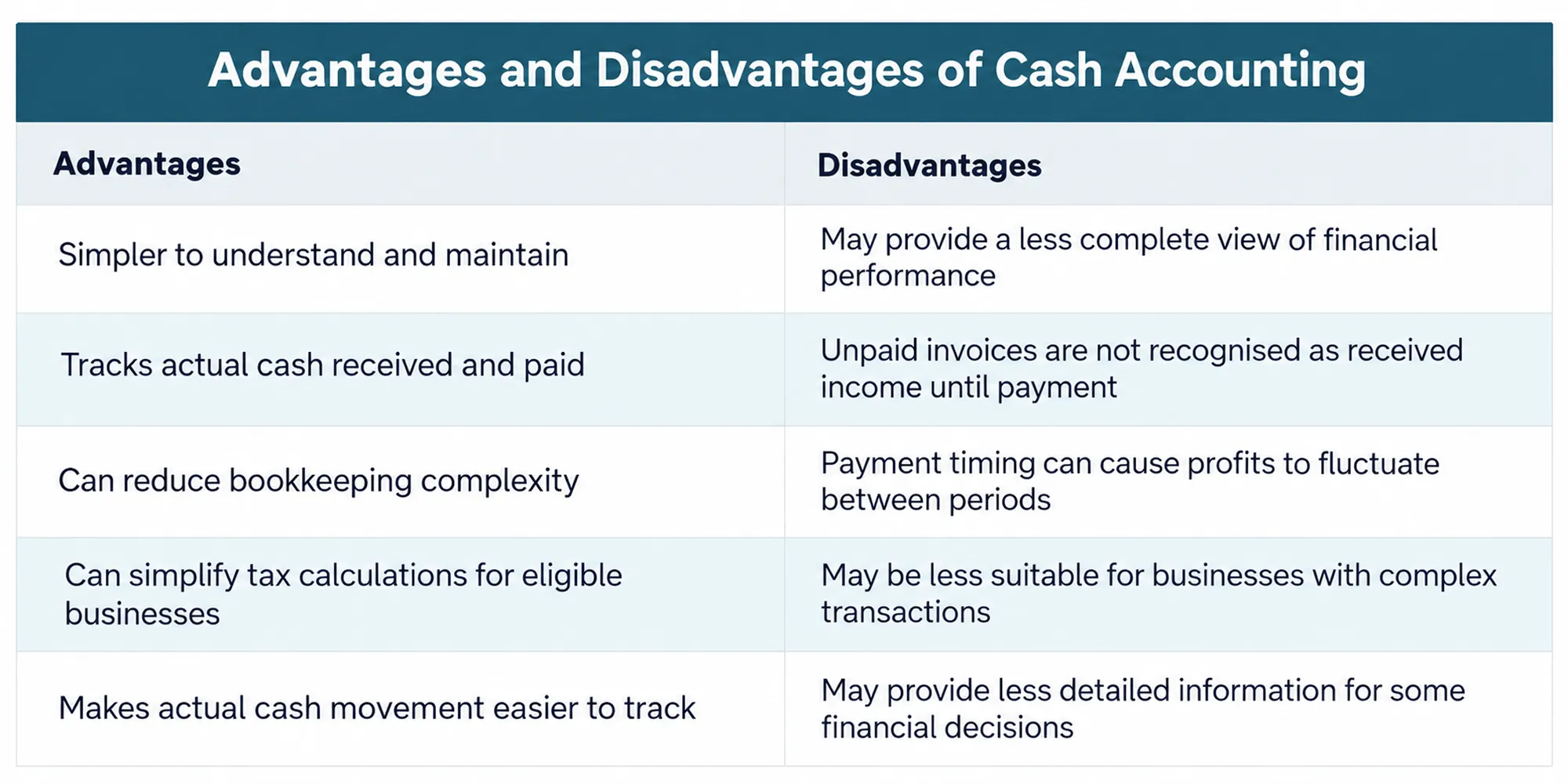
Cash accounting can simplify bookkeeping because transactions are recorded when money is received or paid. For eligible UK businesses using the cash basis, it can also simplify the calculation of taxable trading profits. However, cash accounting does not always provide a complete picture of business performance.
For example, an invoice may remain unpaid at the end of an accounting period, meaning the business has earned income that is not yet reflected in its cash records. The table below describes the advantages and disadvantages of cash accounting for a business:
What Are the Advantages and Disadvantages of Accrual Accounting?
Accrual accounting gives a broader view of business performance by recognising income and expenses in the period they relate to. This can be particularly useful when a business has unpaid invoices, outstanding bills, stock or other transactions that span different periods.
It can help you understand what your business has earned and incurred during a reporting period, rather than focusing only on when payments are made.
However, accrual accounting generally requires more detailed bookkeeping and accounting adjustments. It also does not show how much cash is currently available, so businesses still need to monitor cash flow separately.
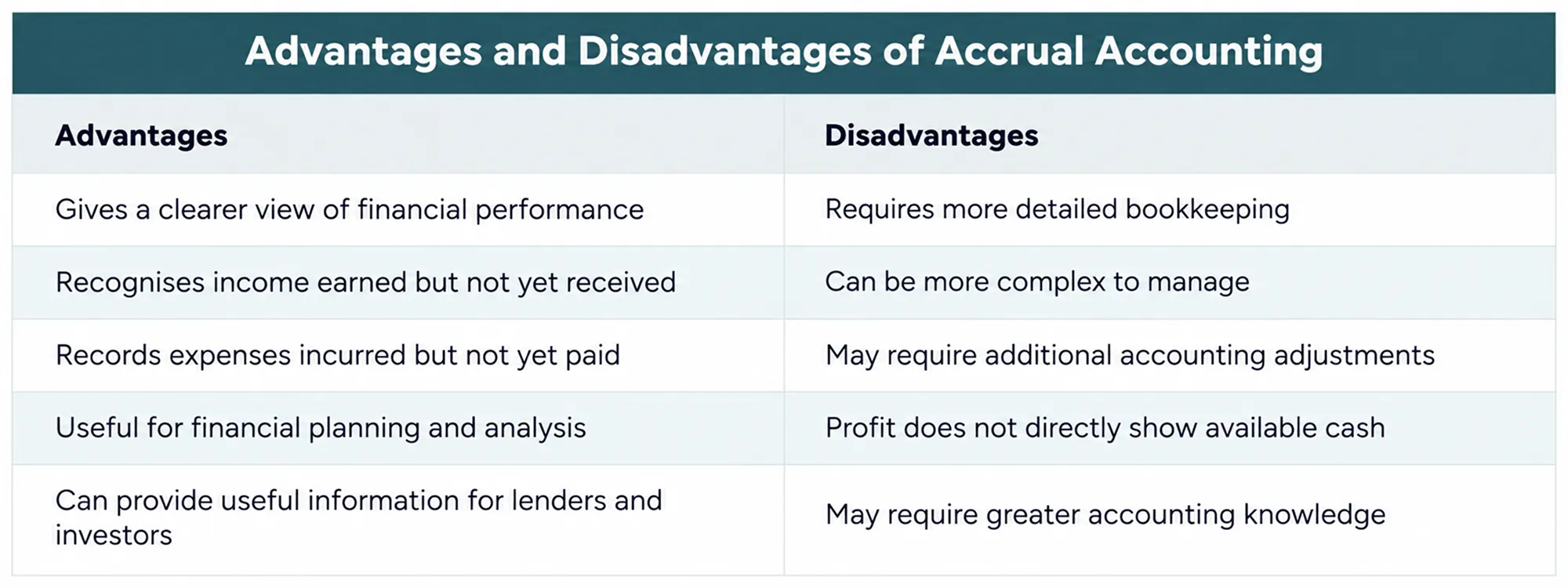
Accrual accounting is often more suitable for businesses with complex transactions or those that need detailed financial information for planning and reporting.
Cash vs. Accrual Accounting: Which Method Applies to Your Business?
In the UK, the accounting method available to you depends partly on your business structure. It also depends on whether you are calculating tax or preparing financial statements.
For eligible sole traders and partnerships without corporate partners, the cash basis is generally the default method for calculating trading profits from the 2024/25 tax year. However, they can choose traditional accounting instead. The cash basis is subject to eligibility requirements and specific rules.
Limited companies cannot use the HMRC cash basis to calculate their Corporation Tax profits. They generally calculate taxable profits using accounts prepared under the relevant accounting rules. Tax adjustments may then be required.
Limited liability partnerships (LLPs) and partnerships with corporate partners are also outside the HMRC trading cash basis.
It is also important to distinguish tax calculations from statutory financial reporting. Businesses that prepare accounts under an applicable accounting framework, such as FRS 102, may need to use accrual-based accounting for their financial statements.
The method used for statutory accounts does not necessarily match the method used to calculate taxable profits.
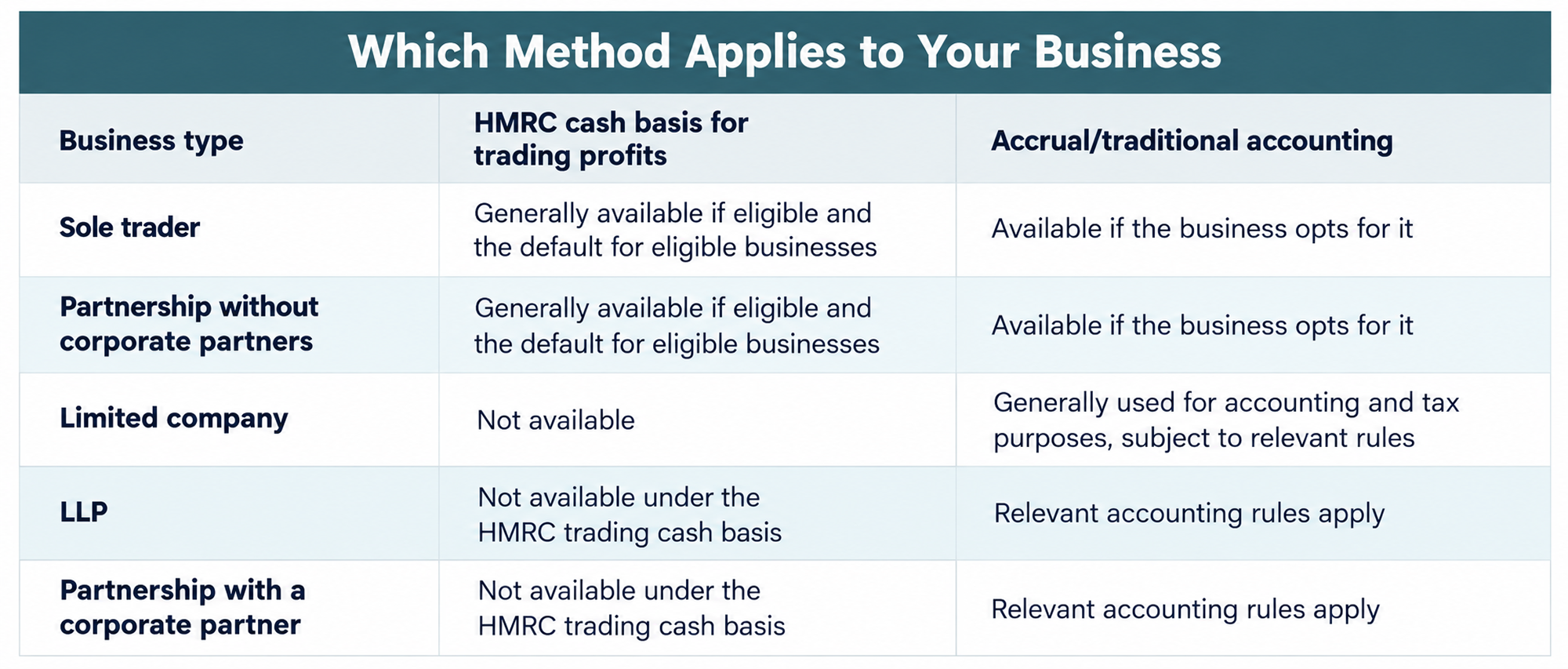
Because the rules differ according to business structure and purpose, businesses should check the current HMRC requirements and applicable accounting framework before changing their accounting method.
Which Accounting Method Is Right for You?
The right accounting method depends on your business structure, transaction patterns, reporting requirements and the rules that apply to your business. There is no single method that is suitable for every business. Cash accounting may suit you if:
- You are eligible to use the HMRC cash basis.
- Your transactions are relatively straightforward.
- Most customers pay soon after receiving an invoice.
- You want simpler bookkeeping.
- Tracking actual cash received and paid is a priority.
- You do not need detailed accrual-based financial information.
On the other hand, accrual accounting may suit you if:
- Customers regularly pay invoices after they are issued.
- Your business has significant receivables or unpaid bills.
- You hold stock or have more complex transactions.
- You need a clearer view of profitability for each accounting period.
- You need detailed financial information for planning or finance applications.
- Your business structure or reporting requirements mean that an accrual-based approach applies.
If you are eligible for the cash basis but unsure whether it suits your business, consider how each method affects your tax calculations and financial reporting. Also consider which method gives you a clearer view of your business performance.
Conclusion
Cash and accrual accounting mainly differ in when income and expenses are recognised. Cash accounting records them when money is received or paid, while accrual accounting recognises them when income is earned and expenses are incurred.
For eligible UK businesses, the cash basis can simplify trading profit calculations and record-keeping. Accrual accounting can provide a clearer view of financial performance and may be required for certain businesses or financial reporting.
The right approach depends on your business structure, tax position and reporting requirements. If you are unsure which method applies, professional accounting advice can help you choose an appropriate approach.
Need Help Choosing The Right Accounting Method?
Sterling Cooper Consultants provides accounting and bookkeeping support tailored to your business needs. Speak to our consultants to understand your options and choose an appropriate approach.
FAQs
No. The HMRC cash basis for calculating trading profits is separate from VAT accounting. VAT-registered businesses must follow the VAT rules and use the VAT accounting scheme that applies to them.
Under the cash basis, stock and work in progress are generally treated differently from traditional accounting, which can simplify the calculation of taxable trading profits. However, businesses with significant stock may still benefit from more detailed accounting records to understand their financial position and performance.
Yes. Eligible sole traders and partnerships can use simplified expenses for certain costs, such as qualifying vehicle expenses and working from home. Simplified expenses are separate from the choice between the cash basis and traditional accounting.
Yes, but the rules apply to each trade. If you have more than one business, you can choose cash basis or traditional accounting for each business, subject to the relevant eligibility rules.
Yes. An eligible business can choose to move from the cash basis to traditional accounting. However, changing methods can require adjustments to prevent income or expenses from being counted twice or omitted.
Yes. The cash basis has specific rules for claiming relief on capital expenditure. In many cases, qualifying capital expenditure can be deducted directly under the cash basis, subject to exclusions and restrictions. The treatment of cars and other assets can differ, so check the current HMRC rules before making a claim.
Yes. The rules for calculating and using trading losses can differ depending on whether you use the cash basis or traditional accounting. If your business has made a loss, check the current HMRC rules or seek professional advice before deciding how to use it.
No. Cash accounting determines when income and expenses are recognised for accounting or tax purposes. Cash flow refers to the movement of money into and out of a business. A business using cash accounting still needs to monitor its cash flow to understand how much money is available.
Recent Posts